


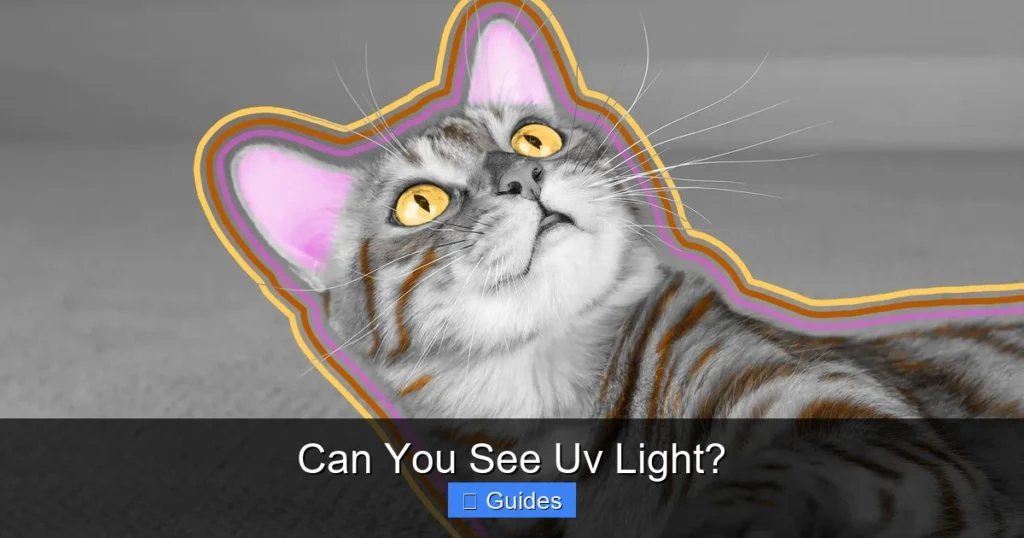
Most humans generally cannot see UV light because our eyes’ natural lenses effectively filter out these shorter, higher-energy wavelengths before they can reach the retina. While our vision is limited to the visible spectrum, a small number of people, particularly those who have had cataract surgery without a modern UV-filtering intraocular lens, may gain a limited ability to perceive ultraviolet light as a bluish-white haze. The fascinating animal kingdom, however, is full of creatures that possess dedicated UV vision, allowing them to see a much richer world.
Imagine a world that exists just beyond the edges of your perception. A world painted with colors and patterns that your eyes simply can’t register. When we talk about light, most of us think of the rainbow – the vibrant reds, oranges, yellows, greens, blues, and violets that make up the visible spectrum. This is the narrow band of electromagnetic radiation that our human eyes are specifically evolved to detect.
But what about the light that falls outside this spectrum? Specifically, what about ultraviolet (UV) light? It’s all around us, invisible yet powerful, shaping everything from suntans to the intricate patterns on a flower that only a bee can truly appreciate. The question, “Can you see UV light?” is a fascinating one, leading us down a rabbit hole into the biology of our eyes, the wonders of the animal kingdom, and the very nature of light itself. Let’s peel back the layers of perception and explore the hidden side of our visual world.
Key Takeaways
- Human Vision Limits: Our eyes are primarily designed to perceive the visible light spectrum (from red to violet), a very small portion of the entire electromagnetic spectrum.
- The Lens’s Crucial Role: The natural lens within the human eye acts as a protective filter, absorbing and blocking almost all ultraviolet (UV) light from reaching the light-sensitive retina.
- Aphakia Exception: Individuals who have had their natural lens removed (a condition called aphakia, often after cataract surgery) and not replaced with a modern UV-filtering intraocular lens might gain a limited, non-color-specific perception of UV light.
- Not “UV Color”: Even in cases of aphakia, what’s perceived isn’t a distinct “UV color” but rather UV radiation stimulating the eye’s blue-sensitive cones and rods, resulting in a sensation of a bluish-white or violet haze.
- Animal UV Vision: Many species in the animal kingdom, including birds, insects, fish, and some reptiles, possess specialized photoreceptors that allow them to see and utilize UV light for navigation, foraging, mating, and communication.
- UV’s Dual Nature: UV light has beneficial practical applications, such as sterilization and forensics, but it also poses significant health risks, including severe damage to the skin and eyes, without proper protection.
- Protecting Your Eyes: It is crucial to wear UV-protective sunglasses (labeled UV400 or 100% UV protection) and other protective gear, especially outdoors, to shield your eyes from the invisible yet harmful effects of ultraviolet radiation.
Quick Answers to Common Questions
Can average humans see UV light?
No, the average human eye cannot directly perceive UV light because the natural lens blocks these wavelengths from reaching the retina.
What part of the eye typically blocks UV light?
The natural lens inside the eye acts as a primary filter, absorbing most UV radiation before it can reach the light-sensitive retina.
Do any animals see UV light?
Yes, many animals, including various species of birds, insects (like bees), fish, and some reptiles, possess the ability to see UV light.
Is UV light harmful to human eyes?
Yes, prolonged or intense exposure to UV light can be very harmful, leading to conditions like cataracts, photokeratitis (cornea sunburn), and increasing the risk of macular degeneration.
What is aphakia in relation to UV vision?
Aphakia is the absence of the natural lens in the eye; individuals with this condition, particularly if they don’t have a modern UV-filtering intraocular lens, may perceive some UV light as a bluish-white haze.
📑 Table of Contents
1. The Electromagnetic Spectrum: Where UV Resides and Why It Matters
To understand if you can see UV light, we first need to understand what light actually is. Light isn’t just what we see; it’s a form of electromagnetic radiation, which travels in waves and carries energy. Think of it like ripples in a pond, but these ripples can vary wildly in length and energy. The entire range of these ripples is called the electromagnetic spectrum.
Understanding Light: Waves and Energy
The electromagnetic spectrum is vast, encompassing everything from long radio waves, which carry signals for your phone and radio, to extremely short and high-energy gamma rays, which come from cosmic events. In between these extremes are microwaves, infrared light (which we feel as heat), visible light, ultraviolet light, and X-rays.
The Full Spectrum: Our Place in It
Our eyes are incredibly sophisticated instruments, but they are also remarkably limited. They’ve evolved to detect only a tiny sliver of this immense spectrum – the part we call “visible light.” This visible spectrum runs from approximately 400 nanometers (nm) for violet light to about 700 nm for red light. When you see a rainbow, you’re witnessing this visible spectrum separated into its constituent colors.
Ultraviolet Light Defined
Ultraviolet (UV) light sits just beyond the violet end of the visible spectrum, hence its name (“ultra” meaning beyond). UV light has shorter wavelengths (typically from 10 nm to 400 nm) and higher energy than visible light. This higher energy is key to understanding both its power and its potential dangers. UV light is further categorized into three main types:
- UVA (315-400 nm): Has the longest wavelength and is less energetic. It penetrates deeply into the skin, contributing to aging and wrinkles, and can initiate skin cancer. It also passes easily through window glass.
- UVB (280-315 nm): More energetic than UVA. It’s the primary cause of sunburn and directly damages DNA, significantly increasing the risk of skin cancer. Most UVB is absorbed by the ozone layer, but enough gets through to be harmful.
- UVC (100-280 nm): The most energetic and dangerous type of UV light. Fortunately, the Earth’s ozone layer completely blocks UVC from reaching the surface. Artificial UVC sources are used for sterilization.
Given its position next to visible violet light, it’s a natural question to ask: “Can you see UV light?”
2. The Human Eye: A Filtered View of the World
So, why can’t we, as humans, typically see this high-energy light that’s just a stone’s throw away from the violet hues we perceive? The answer lies in the incredible, yet imperfect, design of our own eyes.
Visual guide about Can You See Uv Light?
Image source: camerasunleashed.com
Anatomy of Vision: A Quick Overview
Our eyes are complex optical systems. Light enters through the cornea, passes through the pupil, and then goes through the lens. The lens focuses this light onto the retina, a layer of tissue at the back of the eye containing millions of light-sensitive cells called photoreceptors. These photoreceptors, rods (for low light and peripheral vision) and cones (for color vision), convert light into electrical signals that are sent to the brain, which then interprets them as images.
The Lens as a UV Blocker: Our Natural Shield
The primary reason you cannot generally see UV light is your eye’s natural lens. This remarkable structure, located just behind your iris, serves two crucial functions: focusing light and acting as a protective filter. Over time, the human lens develops a yellowish pigment that becomes increasingly effective at absorbing UV radiation. This absorption prevents UV light from reaching the delicate retina, which is highly susceptible to damage from high-energy radiation.
Think of your lens as a built-in pair of sunglasses. It does an excellent job of blocking wavelengths below about 400 nm. While this filtering protects the retina from potential harm, it also prevents any UV light from ever reaching the photoreceptors that would otherwise detect it.
Retinal Sensitivity: Tuned for Visible Light
Even if UV light somehow bypassed the lens, our retinal photoreceptors aren’t ideally tuned to detect it. The cones, responsible for color vision, are primarily sensitive to red, green, and blue wavelengths within the visible spectrum. While the blue-sensitive cones (S-cones) have some sensitivity extending into the near-UV range, they are far more responsive to blue light. Rods, which handle vision in dim light, also have a peak sensitivity in the blue-green part of the spectrum.
So, even if UV light were to reach the retina, it wouldn’t stimulate our photoreceptors in a way that creates a distinct “UV color” perception. Instead, it might weakly stimulate the blue cones or rods, leading to a vague sensation of a bluish or whitish light, rather than a unique hue.
Evolutionary Reasons: A Trade-off for Protection
Why did humans evolve this way? It’s likely a trade-off for protection. UV radiation, especially UVB and UVC, carries enough energy to damage biological molecules like DNA and proteins. Prolonged exposure can lead to cataracts (clouding of the lens itself), photokeratitis (a painful sunburn of the cornea), and macular degeneration (damage to the central part of the retina). By having a lens that blocks UV, our eyes are naturally shielded from these harmful effects, allowing us to maintain vision longer into old age. The ability to see UV light might be an interesting trick, but the long-term damage it could cause our delicate retinas would far outweigh the benefits.
3. Rare Glimpses: When Humans Might Perceive UV Light
While the general answer to “Can you see UV light?” is a resounding “no” for most of us, there are some fascinating exceptions and unique circumstances where humans might get a glimpse into the UV world.
Aphakia: The Missing Lens
The most well-documented exception involves a condition called aphakia, which means “without a lens.” This usually occurs in individuals who have had their natural lens removed, most commonly due to cataract surgery, and have not had a modern intraocular lens (IOL) implanted that filters UV light. Before the widespread use of UV-filtering IOLs, surgeons would simply remove the clouded lens, leaving the eye aphakic.
In such cases, with the UV-blocking lens gone, UV light can reach the retina. What do these individuals report seeing? It’s not a distinct new color like “ultraviolet purple.” Instead, they often describe a bluish-white or violet haze, especially when exposed to strong UV sources like bright sunlight or a blacklight. This happens because the UV light, now reaching the retina, stimulates the blue-sensitive cones and rods, which are weakly responsive to wavelengths just below the visible spectrum.
A famous anecdotal example is the French Impressionist painter Claude Monet. After cataract surgery in the 1920s, he reportedly gained the ability to perceive wavelengths closer to UV. He even complained that his later paintings were “too blue” because he could now see more of the blue-violet end of the spectrum that was previously filtered out by his cataract-clouded lens. However, modern IOLs are designed to block UV light, protecting the retina while still allowing visible light through, so this phenomenon is less common today.
Younger Eyes and Extreme Sensitivity
There’s also some discussion about whether very young children might have a slightly increased sensitivity to near-UV wavelengths. The natural lens begins to yellow and absorb more UV as we age. A very young, pristine lens might allow a tiny bit more near-UV to pass. However, any such perception would still be extremely limited and likely register as an extension of violet, rather than a distinct UV color. Scientific evidence for this direct perception in healthy young eyes is largely anecdotal and not conclusive.
Artificial Enhancement: Seeing What We Can’t
While humans can’t naturally see UV light, we’ve developed technology that can! UV cameras and specialized filters can capture UV images. For example, a UV camera can reveal patterns on flowers that are invisible to the human eye, showing how insects might perceive them. This isn’t seeing UV light directly, but rather using technology to translate UV into the visible spectrum for our interpretation.
4. The Animal Kingdom: Masters of Ultraviolet Vision
While we humans are largely blind to UV light, many other creatures in the animal kingdom not only see it but rely on it for their very survival. Their world is painted with an entirely different palette, one that includes the vibrant blues, purples, and even “UV colors” that we can only imagine. This ability to see UV light offers incredible advantages for navigation, foraging, mating, and avoiding predators.
Beyond Human Limits: A Different Set of Eyes
Many animals have evolved specialized photoreceptors in their retinas that are sensitive to UV wavelengths. Unlike humans, whose lenses filter out UV, many animals have lenses that are transparent to UV, or they simply lack a lens structure that would block it. This opens up a whole new visual dimension for them.
Birds: A World of Hidden Plumage
Birds are perhaps one of the most well-known groups with UV vision. To a human eye, two male birds of the same species might look identical. But to a female bird, one might glow with vibrant UV patterns that signal health, fitness, or mate quality. Their feathers often reflect UV light in ways that create intricate, species-specific displays invisible to us. UV vision also helps birds find food, as many fruits and berries reflect UV, and even track migratory paths, possibly by detecting polarized UV light in the sky.
Insects: Navigating by UV Maps
Insects like bees and butterflies are classic examples of UV visionaries. Flowers that appear uniformly yellow or white to us often reveal intricate “nectar guides” or bulls-eye patterns when viewed under UV light. These patterns lead insects directly to the pollen and nectar, making pollination a highly efficient process. Mating rituals also involve UV, with many insects displaying UV-reflective patterns on their wings or bodies to attract mates. Mosquitoes are even drawn to the UV signature of humans!
Fish and Reptiles: Camouflage and Communication
Many fish species, especially those living in clear shallow waters, use UV vision. This can help them detect zooplankton, which are often UV-reflective, or even communicate with each other through UV patterns on their scales that act as mating signals or camouflage against UV-rich backgrounds. Some reptiles, like certain lizards, also possess UV vision, which they might use to detect predators or differentiate between species during social interactions.
Why It’s Advantageous: A Richer, More Complex World
For these animals, seeing UV light isn’t just a novelty; it’s a fundamental aspect of their ecological niche. It allows them to perceive hidden signals, locate resources more efficiently, and navigate their environments with greater precision than a human ever could. It’s a stark reminder that our human visual experience is just one narrow interpretation of a much grander, more colorful universe.
5. UV Light in Our Lives: Uses, Dangers, and Protection
Even though most of us can’t directly see UV light, it profoundly impacts our lives. It has both incredibly useful applications and significant potential dangers that we must be aware of.
Beneficial Applications of UV: The Invisible Helper
UV light might be invisible, but it’s far from useless. In fact, we harness its unique properties for a wide array of practical purposes:
- Blacklights (UV-A): Often seen at concerts or parties, blacklights make certain fluorescent materials glow. This is because these materials absorb the invisible UV light and re-emit it as visible light. This property is also used in forensics to detect bodily fluids or in examining works of art for forgeries or repairs.
- Sterilization (UV-C): Short-wave UVC radiation is highly effective at killing bacteria, viruses, and other microorganisms. It’s widely used to sterilize medical equipment, purify water and air in HVAC systems, and sanitize surfaces in labs and hospitals.
- Currency and Document Verification: Many banknotes, passports, and credit cards incorporate hidden security features that only become visible under UV light, helping to prevent counterfeiting.
- Forensics: As mentioned, UV light is invaluable in crime scene investigation to reveal evidence such as fingerprints, blood, and other bodily fluids that fluoresce.
- Curing Resins: In dentistry and 3D printing, UV light is used to rapidly cure certain light-sensitive resins and adhesives.
The Dangers of UV Exposure: A Silent Threat
Despite its utility, the high energy of UV light means it can be incredibly damaging to living tissues. Our inability to see it makes it an even more insidious threat, as we often don’t realize we’re being exposed to harmful levels until it’s too late.
- Skin Damage: Prolonged exposure to UVA and especially UVB light is the primary cause of sunburn, premature skin aging (wrinkles, age spots), and, most dangerously, skin cancer (melanoma, basal cell carcinoma, squamous cell carcinoma).
- Eye Damage: Your eyes are particularly vulnerable. Short-term, intense exposure can cause photokeratitis, a painful “sunburn of the eye” that affects the cornea and conjunctiva, leading to symptoms like redness, irritation, and sensitivity to light. Long-term, cumulative exposure significantly increases the risk of cataracts (clouding of the lens), pterygium (a growth on the conjunctiva), and even macular degeneration, a leading cause of vision loss.
Protecting Your Vision from UV: Essential Steps
Given the dangers, protecting your eyes from UV light is non-negotiable. Here’s how:
- Wear UV-Protective Sunglasses: This is the single most important step. Look for sunglasses that block “UV400” or “100% UV protection.” This means they block 99-100% of UVA and UVB radiation. Don’t be fooled by dark lenses; darkness doesn’t guarantee UV protection, and can even be worse if they lack UV filtering, as your pupils will dilate, allowing more UV in.
- Wear a Wide-Brimmed Hat: A hat with a brim at least three inches wide can block approximately 50% of UV radiation from reaching your eyes and eyelids.
- Seek Shade: Especially during peak UV hours (typically 10 a.m. to 4 p.m.), try to stay in the shade.
- Be Aware of Reflective Surfaces: Sand, water, snow, and concrete can reflect UV rays, increasing your exposure even when in the shade. Snow, for instance, can reflect up to 80% of UV radiation.
- Consider Wraparound Styles: Sunglasses with a wraparound design offer more comprehensive protection by blocking UV rays that might come in from the sides.
- Don’t Forget Cloudy Days: UV rays can penetrate clouds. Always wear protection, even on overcast days.
Even though most of us cannot naturally see UV light, understanding its presence and its impact is crucial for our health and safety.
Conclusion
So, “Can you see UV light?” For the vast majority of humans with healthy eyes, the answer is a fascinating no. Our eyes are marvels of evolution, designed to navigate a world bathed in visible light, and our natural lens serves as a vital shield, protecting our delicate retinas from the harmful, high-energy ultraviolet rays. This evolutionary trade-off ensures our long-term vision, even if it means missing out on a hidden spectrum.
However, the rare exceptions, like individuals with aphakia, offer a tantalizing glimpse into what lies just beyond our ordinary perception. And stepping into the animal kingdom reveals a vibrant, UV-rich world that most of us can only imagine. Birds, insects, and fish navigate, communicate, and find food using this invisible light, showcasing the incredible diversity of vision on our planet.
Ultimately, while we might not directly see UV light, its presence is undeniable, shaping our environment, enabling critical technologies, and posing significant health risks. Understanding that we cannot see UV light reinforces the critical importance of protecting our eyes from its silent, yet potent, dangers. So next time you step outside, remember the invisible light around you and give your eyes the protection they deserve. The world might not be quite as you see it, but it’s endlessly fascinating nonetheless.
🎥 Related Video: The Science of UV Light 🔦 Explained in 20 Seconds ✅
📺 hcraft
Ultraviolet (UV) light is a type of electromagnetic radiation just beyond the violet part of visible light. 👁️✨ Though invisible to us, …
Frequently Asked Questions
What is UV light?
UV light, or ultraviolet light, is a form of electromagnetic radiation with wavelengths shorter than visible light but longer than X-rays. It’s invisible to most humans and carries higher energy than the light we can see, existing in UVA, UVB, and UVC categories.
Why can’t our eyes see UV light?
Our eyes cannot see UV light primarily because the natural lens in the eye acts as a protective filter, absorbing and blocking these shorter, high-energy wavelengths. This prevents the UV light from reaching and potentially damaging the delicate photoreceptor cells on the retina, which are also not optimally tuned for UV detection.
Can cataract surgery make you see UV light?
Yes, in some cases. If a person undergoes cataract surgery and their natural, UV-blocking lens is removed and replaced with an older type of intraocular lens (IOL) that doesn’t filter UV, or if no IOL is implanted (aphakia), they might gain a limited ability to perceive UV light as a bluish-white or violet tint.
Do sunglasses block UV light?
Good quality sunglasses do block UV light. When purchasing sunglasses, look for labels that state “UV400” or “100% UV protection,” which indicates they block nearly all UVA and UVB rays. Darker lenses do not automatically mean better UV protection, so always check the label.
How is UV light used?
Despite being invisible to us, UV light has many practical applications. It’s used in sterilization (killing germs), forensics (detecting bodily fluids), currency verification (revealing hidden security features), curing resins in dentistry, and in “blacklights” to make fluorescent materials glow.
Is there a way to safely experience UV light?
You can’t safely “see” UV light directly with your natural eyes, as it’s harmful. However, you can experience its effects indirectly and safely by observing objects under a blacklight (which emits mostly harmless UVA) to see them fluoresce, or by using special UV cameras that capture UV images and translate them into the visible spectrum for our viewing.
