


Yes, you absolutely need a UV light for gel polish, or an LED equivalent, to cure it properly. Gel polish doesn’t air dry; it undergoes a chemical reaction called polymerization when exposed to specific wavelengths of light. Without a curing light, your gel polish will remain a sticky liquid, never hardening into that durable, chip-free finish you desire.
Have you ever found yourself gazing at those beautiful, glossy, and impossibly durable gel manicures, wondering if you could achieve that salon-perfect look at home? The allure of chip-free nails for weeks on end is undeniable, and it’s no surprise that at-home gel kits have skyrocketed in popularity. But as you dive into the world of DIY gel polish, one question inevitably pops up: “Do you need a UV light for gel polish?”
It’s a common query, often stemming from the familiarity of traditional nail polish that simply air-dries. However, gel polish operates on an entirely different principle, and understanding this fundamental difference is key to mastering your at-home manicure. Spoiler alert: the short answer is a resounding “yes!” But let’s dive deeper into the science, the options, and the best practices so you can achieve flawless, long-lasting results every single time.
Key Takeaways
- Curing is Essential: Gel polish does not air dry like traditional nail polish. It requires exposure to specific wavelengths of light (UV or LED) to undergo a chemical process called polymerization, which hardens it.
- UV or LED: Both UV and LED lamps can cure gel polish. UV lamps use a broader spectrum of UV light, while LED lamps use a narrower, more targeted spectrum, often resulting in faster cure times for compatible gels.
- Compatibility Matters: Not all gel polishes are compatible with all lamps. Most modern “LED” gels are also UV-compatible, but older “UV only” gels may not cure under an LED lamp. Always check your polish instructions.
- Safety First: While exposure from home use is minimal, it’s wise to use broad-spectrum sunscreen on your hands or wear fingerless UV protective gloves during curing sessions to protect your skin from potential UV exposure.
- No Curing, No Hardening: Without a proper curing light, gel polish will remain a liquid or sticky, tacky mess and will never fully harden or adhere correctly to your nails.
- Consider a Hybrid Lamp: Hybrid lamps offer the best of both worlds, emitting both UV and LED wavelengths, making them compatible with the widest range of gel polishes on the market.
Quick Answers to Common Questions
Do you need a UV light for gel polish to harden?
Yes, gel polish requires either a UV light or an LED light to harden. It undergoes a chemical reaction called polymerization, triggered by light, which transforms it from a liquid to a solid.
Can I use regular nail polish with a UV light?
No, regular nail polish does not contain the photoinitiators needed to cure under a UV or LED light. It air-dries and will not be affected by a curing lamp.
Are LED lights better than UV lights for gel polish?
LED lights often offer faster curing times and have longer-lasting bulbs. Many modern gel polishes are formulated to be “UV/LED compatible,” meaning they can cure under both types of lamps, but LED is generally preferred for efficiency and bulb longevity.
What happens if gel polish isn’t cured properly?
If gel polish isn’t cured properly, it will remain sticky and gooey, chip easily, lift from the nail, and can even increase the risk of developing an allergic reaction to uncured gel components.
Can I cure gel polish with sunlight?
While sunlight contains UV rays, it’s not recommended for curing gel polish. The intensity and wavelength are inconsistent and uncontrolled, leading to unpredictable and often incomplete curing, which can compromise the durability and safety of your manicure.
📑 Table of Contents
Understanding Gel Polish: More Than Just Nail Polish
First things first, let’s clarify what gel polish actually is and how it differs from its traditional counterpart. When you think of “drying” nail polish, you’re usually thinking about solvents evaporating, leaving behind a hard film. Gel polish, however, is a whole different beast.
What Makes Gel Polish Different?
Traditional nail polish is made up of a polymer dissolved in a solvent. As the solvent evaporates, the polymer hardens. Gel polish, on the other hand, is primarily composed of acrylate oligomers and monomers, along with photoinitiators. These special ingredients are the secret to its incredible durability and shine. The crucial distinction is that these components don’t “dry” by air; they undergo a chemical reaction.
The Concept of “Curing”
Instead of drying, gel polish “cures.” Curing is a polymerization process where the liquid monomers and oligomers link together to form long, strong polymer chains. This process is initiated by light, specifically UV (ultraviolet) light or LED (light-emitting diode) light, which activates the photoinitiators within the gel formula. Once activated, these photoinitiators trigger the hardening of the gel, transforming it from a sticky liquid into a solid, durable coating. This is why you absolutely need a UV light for gel polish or an LED light.
The Indispensable Role of Curing Lights
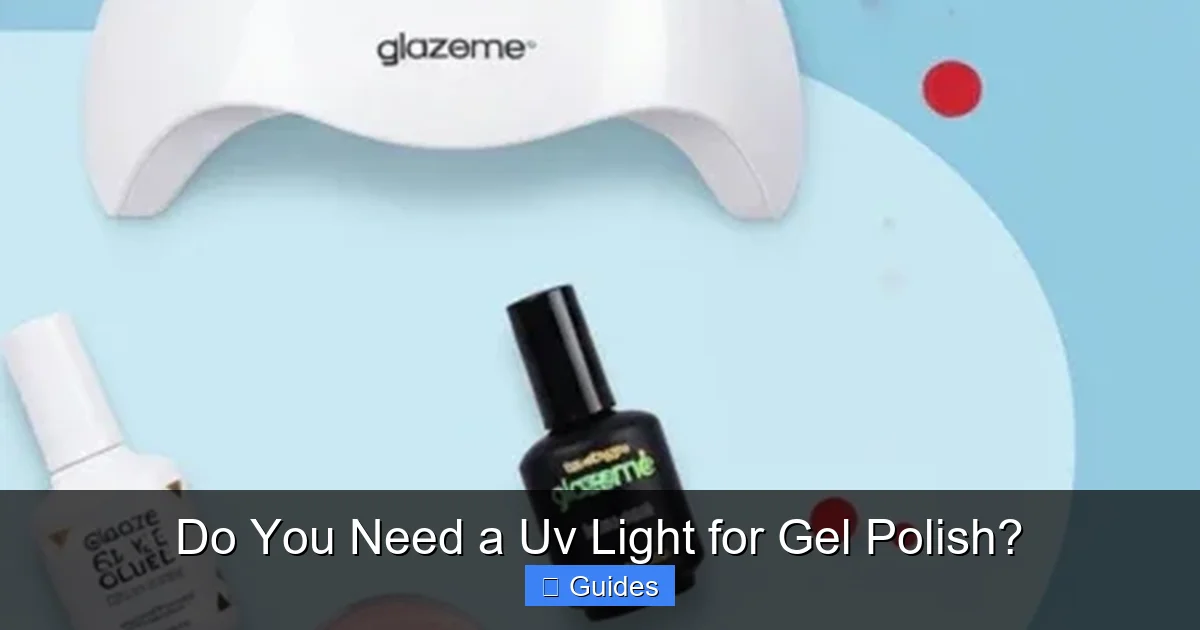
Visual guide about Do You Need a Uv Light for Gel Polish?
Image source: glazeme.com.au
Without a curing light, gel polish simply won’t work. It’s not an optional step; it’s a fundamental part of the process. Trying to air-dry gel polish would be like trying to bake a cake without an oven – it just won’t happen!
How Photoinitiators Work
Imagine tiny, dormant chemical agents within your gel polish. These are the photoinitiators. When exposed to the specific wavelengths of light emitted by a UV or LED lamp, they “wake up” and become active. They then start a chain reaction, causing the liquid gel components to bond together and solidify. Each layer of gel polish, from the base coat to the top coat, needs this exposure to light to cure properly.
Why Air Drying Isn’t an Option
If you apply gel polish and simply wait for it to air dry, you’ll be waiting forever. It will remain a sticky, gooey mess. It won’t harden, it won’t be durable, and it certainly won’t give you that beautiful, long-lasting finish. The solvents that make traditional polish evaporate are absent or present in very small amounts in gel polish, meaning air drying is completely ineffective. So, when asking “do you need a UV light for gel polish?”, the answer is always yes, or an LED equivalent.
The “Tacky Layer” Explained
After each layer of gel polish has cured under the light, you might notice a sticky, wet-looking film on the surface. This is known as the “inhibition layer” or “tacky layer.” It’s a normal byproduct of the curing process and doesn’t mean your polish isn’t fully cured. This layer occurs because oxygen in the air inhibits the polymerization of the very top layer of the gel. Don’t worry, it’s easily removed at the end of your manicure with a lint-free wipe saturated with isopropyl alcohol (rubbing alcohol) or a specialized gel cleanser, revealing the super glossy finish underneath.
UV Light vs. LED Light: Demystifying the Choice
When discussing “do you need a UV light for gel polish?”, it’s important to understand that there are actually two main types of curing lights available: traditional UV lamps and newer LED lamps. Both do the job, but they have key differences.
UV Lamps: The Traditional Workhorse
UV lamps utilize fluorescent bulbs that emit a broad spectrum of UV (ultraviolet) light, typically covering UVA and sometimes UVB wavelengths. These were the original lights used for curing gel polish.
- Pros: Generally less expensive upfront, compatible with almost all gel polishes (as most gels are formulated to cure under UV light), bulbs are replaceable.
- Cons: Slower cure times (often 2-3 minutes per layer), bulbs need to be replaced every 6-12 months as their light output diminishes, UV exposure concerns (though minimal for home use, see safety section).
LED Lamps: The Modern Contender
LED lamps use light-emitting diodes to produce a more concentrated, narrower spectrum of light, usually around 395-405 nanometers.
- Pros: Much faster cure times (often 30-60 seconds per layer), LED bulbs last significantly longer (up to 50,000 hours, often the lifetime of the lamp) and don’t need replacing, generally considered safer due to specific wavelength and shorter exposure times.
- Cons: Can be more expensive initially, not all older gel polishes are formulated to cure under LED light (though most newer gels are “UV/LED compatible”).
Hybrid Lamps: The Best of Both Worlds?
Many modern curing lamps on the market are “hybrid” lamps. These lamps combine both UV fluorescent bulbs and LED diodes, or sometimes feature special LED diodes that emit a broader spectrum closer to traditional UV. This design aims to offer the best of both worlds: the fast curing of LED with the broad compatibility of UV. If you’re unsure which lamp to choose, a hybrid lamp is often a safe bet as it will cure the widest range of gel polishes.
Compatibility Matters
This is a crucial point when considering your curing light. Not all gel polishes will cure under all lamps.
- UV Gels: Will cure under UV lamps and typically under hybrid lamps. May or may not cure under LED-only lamps (check label).
- LED Gels: Will cure under LED lamps, hybrid lamps, and usually UV lamps (as LED-compatible gels often contain photoinitiators responsive to both).
- “UV/LED” or “Universal” Gels: These are formulated to cure under both UV and LED lights and are the most common type found today.
Always check the specific gel polish bottle or manufacturer’s instructions to ensure it’s compatible with your chosen lamp. Using the wrong lamp or an underpowered lamp can result in improperly cured, sticky gel that lifts easily or causes allergic reactions.
Safety First: Addressing Concerns About Curing Lights
The phrase “UV light” often conjures images of sun damage and skin cancer, leading many to ask about the safety of using a UV light for gel polish. It’s a valid concern, and one worth addressing with facts.
UV Radiation Exposure: Is It Harmful?
The UV exposure from gel nail lamps is significantly lower than direct sun exposure. Most studies suggest that the amount of UV radiation emitted by a nail lamp, even over many manicures, is comparable to a few minutes in the sun or less. The risk of skin cancer from occasional home use is considered very low. However, sensitive individuals or those with certain skin conditions might still wish to take precautions.
Proper Usage for Minimal Risk
If you’re concerned about UV exposure, here are some practical tips:
- Sunscreen: Apply a broad-spectrum SPF 30+ sunscreen to your hands about 20 minutes before your manicure.
- UV Protective Gloves: You can purchase fingerless gloves specifically designed to block UV rays while still allowing your nails to be exposed for curing.
- Limit Exposure: Follow the recommended curing times strictly. Over-curing doesn’t make the gel harder and only increases exposure.
- Check for Malfunctions: Ensure your lamp’s bulbs are working correctly and replace them in a UV lamp as recommended by the manufacturer.
Dispelling Myths
Don’t be tempted to use alternatives like regular household lamps, sunlamps, or even direct sunlight to cure your gel polish. These will not work. Household lamps lack the specific UV or LED wavelengths needed, and while sunlight does contain UV, the intensity is inconsistent and uncontrolled, leading to poor curing and potential overexposure. You truly need a dedicated UV light for gel polish, or an LED equivalent.
Choosing Your Curing Lamp: A Practical Guide
Now that you know you need a curing light, how do you choose the right one? Here’s what to consider.
Power (Wattage) and Efficiency
Don’t get too caught up in wattage numbers alone. While higher wattage often implies more power, the *efficiency* of the lamp’s design (how well it distributes light and targets the right wavelengths) is just as important. A well-designed 48W LED lamp might cure faster and more thoroughly than a poorly designed 72W lamp. Focus on reputable brands and reviews rather than just the highest number.
Lamp Type (UV, LED, Hybrid) and Gel Compatibility
As discussed, this is perhaps the most critical factor.
- If you already have a collection of older “UV only” gels, a UV or hybrid lamp is best.
- If you’re starting fresh or primarily using modern gels, an LED or hybrid lamp is a great choice for speed and longevity.
- If in doubt, a good quality hybrid lamp offers the most versatility.
Features to Look For
Practical features can greatly enhance your at-home gel manicure experience:
- Timer Settings: Most lamps come with preset timers (e.g., 30s, 60s, 90s, 120s). This is essential for proper curing.
- Automatic Sensor: Many lamps turn on automatically when you insert your hand and turn off when you remove it, which is incredibly convenient.
- Removable Bottom: A removable base makes it easier to do pedicures and also simplifies cleaning the lamp.
- Plenty of LEDs/Bulbs: Ensure there are enough light sources to cover all five fingers (and thumb) evenly, without needing to reposition your hand.
Budget vs. Quality
While you can find very inexpensive curing lamps online, investing in a good quality lamp from a reputable brand is often worth it. A cheap, underpowered lamp can lead to frustratingly sticky, poorly cured nails, which can chip easily and even increase the risk of allergies due to uncured gel. A reliable lamp ensures consistent, salon-quality results.
Mastering Your At-Home Gel Manicure (Beyond the Lamp)
Having the right UV light for gel polish is just one piece of the puzzle. Proper application technique is equally important for a beautiful, long-lasting gel manicure.
Nail Prep is Key
A good gel manicure starts with meticulous nail preparation.
- Clean: Ensure your nails are completely free of old polish, oils, and dirt.
- Shape and Buff: File your nails to your desired shape and gently buff the nail plate to remove shine and create a slightly rough surface for the gel to adhere to.
- Dehydrate: Wipe your nails with isopropyl alcohol or a dedicated nail dehydrator to remove any lingering oils or moisture. Don’t touch your nails after this step!
- Push Back Cuticles: Gently push back your cuticles to ensure the gel doesn’t get on the skin.
Thin Coats for Optimal Curing
This is a golden rule for gel polish! Apply gel in very thin, even coats. Thick coats can lead to:
- Incomplete Curing: The light might not penetrate all the way through a thick layer, leaving the bottom layer uncured and gooey.
- Wrinkling or Shrinking: Thick gel can wrinkle or shrink during curing.
- Bubbles: Trapped air can create unsightly bubbles.
It’s always better to apply two or three thin coats than one thick one.
Full Coverage and Proper Positioning
When placing your hand in the UV light for gel polish, ensure all nails, especially your thumbs, are fully exposed to the light. Some lamps require you to cure your thumbs separately to ensure full coverage. Make sure the light sources hit the entire nail surface evenly. Avoid getting gel polish on your skin or cuticles, as this can lead to lifting and potential allergic reactions. If you do get some on your skin, clean it off with an orange wood stick or a brush dipped in alcohol before curing.
Post-Cure Care
Once your final top coat is cured, your nails will likely still have that tacky inhibition layer.
- Wipe the Sticky Layer: Use a lint-free wipe saturated with isopropyl alcohol (rubbing alcohol) or a gel cleanser to gently wipe away the sticky layer. This will reveal the brilliant, hard shine.
- Hydrate: Finish by applying cuticle oil to nourish your cuticles and the surrounding skin.
So, do you need a UV light for gel polish? Absolutely. It’s not just a recommendation; it’s a requirement for the chemical process that transforms liquid gel into a durable, glossy manicure. By understanding the role of curing lights, choosing the right lamp, and following proper application techniques, you’ll be well on your way to enjoying salon-quality gel nails right from the comfort of your home. Happy polishing!
🎥 Related Video: Gel Nails without the UV Lamp?! #nails
📺 Parabell Beauty
Frequently Asked Questions
Do I need a UV light for gel polish or can I just air dry it?
No, you cannot air dry gel polish. Gel polish requires a specific type of light, either UV or LED, to cure. This light initiates a chemical reaction that hardens the gel, unlike traditional polish which simply dries by solvent evaporation.
What is the difference between a UV lamp and an LED lamp for gel nails?
UV lamps use broad-spectrum fluorescent bulbs and generally have longer cure times and replaceable bulbs. LED lamps use specific diodes, offer much faster cure times, and have very long-lasting bulbs, often for the life of the lamp itself.
Is using a UV light for gel polish safe for my skin?
The UV exposure from nail lamps is considered low, especially for occasional home use. To minimize any potential risk, you can apply sunscreen to your hands or wear fingerless UV protective gloves during the curing process.
How long does gel polish need to cure under a UV or LED light?
Curing times vary depending on the type of lamp (UV or LED) and the specific gel polish brand. UV lamps typically require 2-3 minutes per layer, while LED lamps can cure in as little as 30-60 seconds. Always follow the manufacturer’s instructions for your specific products.
Can I use any gel polish with any UV or LED lamp?
Not always. It’s crucial to check the compatibility of your gel polish with your curing lamp. While most modern gels are “UV/LED compatible,” some older gels might only cure under UV, and some LED-only lamps might not cure all UV-specific gels.
My gel polish is still sticky after curing. What went wrong?
A sticky or “tacky” layer after curing is normal; it’s called the inhibition layer. This layer needs to be wiped off with isopropyl alcohol or a gel cleanser at the very end of your manicure to reveal the hard, glossy finish. If the gel underneath is soft or gooey, it means it was under-cured, possibly due to thick coats or insufficient lamp time/power.
