


As an Amazon Associate, We earn from qualifying purchases.
Thomas Edison didn’t invent the light bulb from scratch, but he revolutionized it by creating the first practical, long-lasting, and affordable incandescent light bulb. His methodical approach at Menlo Park, exhaustive material testing (including the famous carbonized cotton filament), and the development of a complete electrical distribution system were crucial. Edison’s genius lay in making electric light accessible and usable for everyone, transforming the world.
How Did Thomas Edison Make the Light Bulb
Have you ever wondered about the glowing orb above your head? The one that banishes darkness with a flick of a switch? For many, the name Thomas Edison immediately springs to mind when thinking about the light bulb. But here’s a fascinating twist: Edison didn’t *invent* the light bulb. That’s right! There were many brilliant minds experimenting with electric light long before him. So, if he didn’t invent it, then how did Thomas Edison make the light bulb truly practical and revolutionize the world?
Edison’s genius wasn’t just in creating something entirely new, but in taking an existing, flawed idea and perfecting it. He transformed a laboratory curiosity into an everyday essential. Imagine a world before reliable electric light – homes lit by candles or gas lamps, cities plunged into darkness after sunset. Edison’s work didn’t just give us a bulb; it gave us the ability to turn night into day, shaping modern life as we know it. Let’s embark on a journey to understand the monumental effort and ingenious problem-solving that went into Edison’s version of the light bulb.
The World Before Edison: A Glimmer of Electric Light
Before we delve into how Thomas Edison make the light bulb a reality for the masses, it’s important to understand the landscape of electric lighting at the time. The idea of using electricity to create light wasn’t new. Scientists and inventors across the globe had been toying with it for decades. These early attempts, while innovative, had significant drawbacks that prevented them from being widely adopted.
Early Pioneers and Arc Lamps
One of the earliest forms of electric light was the arc lamp. Sir Humphry Davy demonstrated the first electric arc lamp in 1802. This involved passing electricity through two carbon rods, creating a brilliant, intense arc of light. While incredibly bright, arc lamps were impractical for everyday use. They were extremely hot, consumed a lot of power, produced harsh, flickering light, and their carbon rods quickly burned away, requiring constant adjustment and replacement. You certainly wouldn’t want one in your living room!
The Quest for Incandescence
Parallel to arc lamps, inventors were also exploring incandescent lighting – light produced by heating a filament until it glows. Many individuals experimented with this concept:
- Joseph Swan in England made significant progress, using carbonized paper filaments in evacuated glass bulbs in the 1860s and 1870s.
- Heinrich Goebel in Germany reportedly created light bulbs with carbonized bamboo filaments in the 1850s, though his claims were later contested.
- Others, like William Sawyer and Albon Man in the United States, were also working on their own incandescent designs.
The problem with all these early incandescent bulbs was their short lifespan and inefficiency. The filaments would burn out quickly, often within minutes or hours, and they required substantial power. No one had yet figured out how to create a bulb that was durable, affordable, and practical enough for widespread use. This was the challenge that Thomas Edison set out to conquer.
Edison’s Approach: The Menlo Park “Invention Factory”
The brilliance of Thomas Edison wasn’t just his personal inventive spark, but his unique method. When considering how did Thomas Edison make the light bulb work so effectively, it’s crucial to look at his legendary laboratory in Menlo Park, New Jersey. This wasn’t just a workshop; it was an “invention factory.”
A Systematic Method to Innovation
Edison’s genius lay in his systematic and relentless approach to invention. He believed in tireless experimentation and meticulous record-keeping. His motto, “Genius is one percent inspiration and ninety-nine percent perspiration,” perfectly encapsulates his philosophy. When tackling the light bulb, he didn’t just tinker; he organized a full-scale research project. He understood that a successful invention wasn’t just about a single “aha!” moment, but about iterating through countless failures to find the one path that worked. This methodical discipline was key to how Thomas Edison make the light bulb a reality.
Assembling a Team of Innovators
Edison wasn’t a lone wolf inventor. He surrounded himself with a team of brilliant machinists, scientists, and assistants. Men like Francis Upton (a mathematician and physicist), Charles Batchelor (a skilled mechanic), and John Kruesi (a master machinist) were integral to the daily grind of experimentation and prototype building. This collaborative environment allowed for specialized knowledge to be pooled, challenges to be discussed from multiple angles, and experiments to be conducted simultaneously, significantly accelerating the pace of discovery. It was a true testament to teamwork and shared vision.
The Focus on Commercial Viability
Unlike many of his contemporaries, Edison wasn’t just interested in demonstrating a scientific principle. He was deeply focused on creating inventions that were commercially viable, affordable, and useful to the public. For the light bulb, this meant not only making a bulb that glowed but one that lasted for hundreds of hours, consumed reasonable amounts of electricity, and could be manufactured at scale. He also knew that the bulb itself was only part of the equation; a complete system was needed, from power generation to switches and wiring, to make electric light truly practical.
The Quest for the Perfect Filament: Trial and Error
The heart of the incandescent light bulb is its filament – the tiny wire that glows when electricity passes through it. Finding the right material for this filament was arguably the biggest hurdle, and it’s where Edison’s team conducted thousands of experiments. This search is a core part of understanding how did Thomas Edison make the light bulb effective.
Initial Experiments: Platinum and Carbonized Paper
Edison’s team initially experimented with high-resistance metal filaments, primarily platinum. Platinum had a high melting point and could withstand intense heat, but it was incredibly expensive and still had a limited lifespan. While these early platinum filaments showed promise, they were far from ideal for a mass-market product.
They then shifted their focus to carbon-based materials. Carbon had a higher resistance than platinum, meaning it would glow more brightly with less current, and it was far cheaper. Early carbon filaments were made from carbonized paper or cardboard, which again, provided light but burnt out relatively quickly. Edison famously stated, “I have not failed 10,000 times. I have successfully found 10,000 ways that will not work.” This persistence was evident in their filament research.
The Breakthrough: Carbonized Cotton Thread
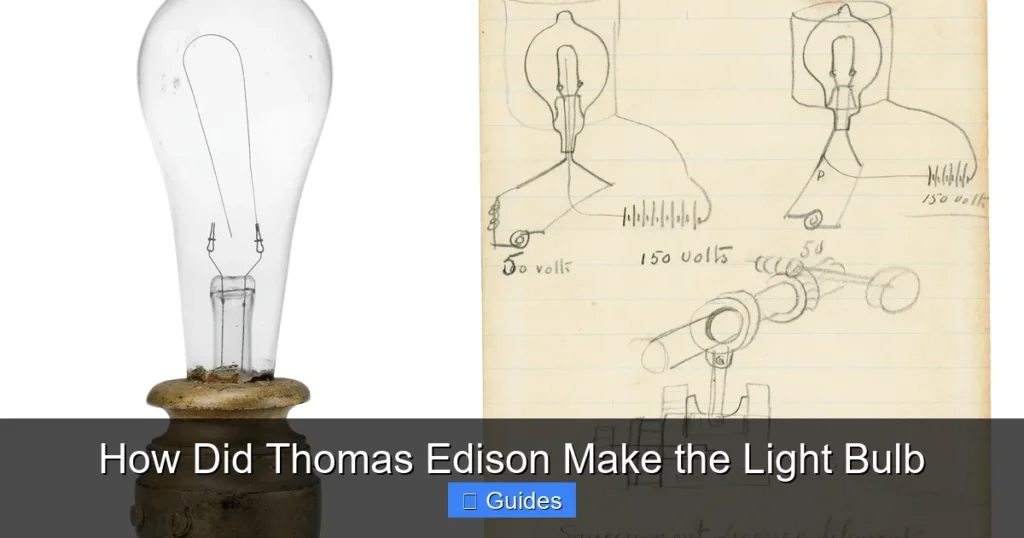
In October 1879, after countless attempts, a significant breakthrough occurred. Edison and his team tried carbonizing a simple cotton sewing thread. They carefully bent a piece of cotton thread into a horseshoe shape, baked it in a high-temperature oven in a vacuum (to prevent it from burning to ash), and then sealed it inside an evacuated glass bulb.
When they ran electricity through this delicate carbonized cotton filament, it glowed! And it didn’t just glow for a few minutes; it glowed for hours, then days. On October 22, 1879, the team observed a carbonized cotton filament bulb glow for an astounding 13.5 hours. Further refinements led to bulbs lasting over 1,200 hours. This was a monumental leap forward in longevity and efficiency, a critical step in how did Thomas Edison make the light bulb commercially viable.
Endurance and Practicality: Longer Lifespan
The extended lifespan of the carbonized cotton filament bulb was the game-changer. Suddenly, electric light wasn’t just a fleeting novelty; it was a practical alternative to gas lighting. This achievement meant that replacing bulbs would not be a constant chore, making electric light far more appealing for homes and businesses. Edison’s team continued to refine the filament, eventually settling on carbonized bamboo fibers from Japan in 1880, which provided an even longer lifespan and better performance. This dedication to finding the absolute best material highlights Edison’s relentless pursuit of perfection.
Beyond the Filament: Vacuum and Power Systems
Even with the perfect filament, a light bulb won’t work effectively without a few other crucial components and a robust electrical system. Edison understood this holistically, developing not just the bulb itself, but the entire infrastructure needed to support it. This systematic thinking is vital to grasp how Thomas Edison make the light bulb a global phenomenon.
The Importance of a Near-Perfect Vacuum
One of the most critical elements in extending the life of the carbon filament was creating a near-perfect vacuum inside the glass bulb. If oxygen were present, the hot carbon filament would quickly oxidize and burn up, much like charcoal in a barbecue. Early bulbs struggled with this. Edison’s team utilized improved vacuum pumps, which could draw almost all the air out of the bulb, creating an environment where the filament could glow brightly without combusting. This significantly increased the bulb’s lifespan from minutes to hundreds or even thousands of hours. The meticulous sealing of the bulb to maintain this vacuum was also a challenging engineering feat.
Designing a Robust Electric Generator
A light bulb, no matter how good, needs electricity. Early dynamos (generators) were inefficient and unreliable. Edison’s team didn’t just stop at the bulb; they designed and built a highly efficient dynamo, nicknamed the “Long-Waisted Mary-Ann.” This generator was capable of producing a consistent and sufficient supply of direct current (DC) electricity to power hundreds of bulbs simultaneously. The efficiency of his generators meant that electricity could be produced at a lower cost, further contributing to the commercial viability of his lighting system.
Wiring and Distribution: A Complete System
Perhaps one of Edison’s most significant, yet often overlooked, contributions was developing the complete electrical distribution system. What good is a light bulb if you can’t get power to it? Edison envisioned a centralized power station that would distribute electricity to homes and businesses. This required:
- Safe and Insulated Wiring: To carry electricity without hazards.
- Switches: To turn lights on and off.
- Fuses: To prevent overloads and fires.
- Meters: To measure electricity consumption and allow for billing.
- Screw-In Sockets: Making it easy to replace bulbs (the Edison screw base is still in use today!).
Edison’s holistic approach ensured that his light bulb wasn’t just a standalone invention but a fully integrated part of a safe, reliable, and user-friendly electrical infrastructure. This foresight truly shows how Thomas Edison make the light bulb a practical reality for millions.
Public Demonstration and Commercialization
Having developed a practical bulb and a robust system, Edison knew the next step was to convince the world. Public demonstrations were crucial in swaying public opinion and attracting investors, illustrating the tangible benefits of his inventions.
Menlo Park’s Grand Illumination (1879-1880)
To prove the viability of his invention, Edison staged spectacular public demonstrations. On New Year’s Eve 1879, he opened his Menlo Park laboratory to the public, illuminating the entire complex with hundreds of his incandescent bulbs. Thousands flocked to witness this marvel. People walked through paths lined with glowing lights, marveled at buildings bathed in a soft, steady glow, and were convinced that this was the future. This demonstration, alongside subsequent ones, effectively marketed his invention and silenced skeptics who claimed electric light was too expensive or impractical. It showcased exactly how Thomas Edison make the light bulb a public sensation.
The Edison Electric Light Company
Edison wasn’t just an inventor; he was an entrepreneur. He founded the Edison Electric Light Company in 1878 (later to become General Electric). This company was instrumental in manufacturing his bulbs and installing his electrical systems. He tirelessly worked to secure patents, raise capital, and build the necessary infrastructure for a burgeoning electrical industry.
Bringing Light to Homes and Cities
The ultimate test came with actual implementation. In 1882, Edison launched the Pearl Street Station in New York City, the world’s first central power plant. This station began supplying electricity to a small section of Manhattan, powering offices and homes. The success of Pearl Street proved that Edison’s vision of a widespread electrical grid was not only feasible but transformative. It marked the beginning of the end for gaslight and the dawn of the electric age, fundamentally changing how people lived, worked, and experienced the world after dark. The impact of how Thomas Edison make the light bulb a reality for urban life cannot be overstated.
Conclusion
So, how did Thomas Edison make the light bulb? It wasn’t by creating the very first electric light, but by taking a nascent technology and making it practical, enduring, and commercially viable. His contribution was a meticulous combination of scientific inquiry, persistent experimentation, and brilliant engineering, all fueled by a visionary entrepreneurial spirit.
Edison’s legacy is a testament to the power of systematic innovation. He didn’t just invent a bulb; he invented a system – from the durable filament and efficient vacuum to the reliable generator and comprehensive distribution network. This holistic approach is what truly transformed incandescent lighting from a laboratory curiosity into an essential component of modern life. The next time you flip a switch and your room fills with light, take a moment to appreciate the incredible journey, the thousands of failures, and the relentless dedication that went into perfecting that simple, yet revolutionary, invention by Thomas Edison and his team.
Key Takeaways
- Edison Perfected, Not Solely Invented: While many had experimented with electric lights before him, Thomas Edison’s key contribution was developing a practical, long-lasting, and commercially viable incandescent light bulb, along with the entire system to power it.
- The Menlo Park “Invention Factory”: Edison’s systematic approach, bringing together a team of skilled researchers and technicians, allowed for rapid experimentation and problem-solving, making his laboratory a hub of innovation.
- Filament was Key: The core challenge was finding a filament material that would glow brightly without burning out quickly. Edison and his team tested thousands of materials, with carbonized cotton thread proving to be the breakthrough that offered a sustained glow for hundreds of hours.
- Beyond the Bulb Itself: Edison understood that a light bulb was useless without a reliable power source and distribution network. He concurrently developed improved dynamos, wiring, fuses, and meters to create a complete electrical lighting system.
- Importance of Vacuum: Creating a near-perfect vacuum inside the bulb was critical. This prevented the filament from oxidizing and burning out almost instantly, significantly extending the bulb’s lifespan.
- Commercialization and Public Adoption: Edison wasn’t just an inventor; he was a shrewd businessman. His public demonstrations, such as the illumination of Menlo Park, showcased the practicality and safety of his system, paving the way for widespread adoption.
Quick Answers to Common Questions
Who invented the first electric light?
While many experimented, Sir Humphry Davy demonstrated the first electric arc lamp in 1802. However, it was not a practical light bulb for general use.
What was the main problem with early light bulbs before Edison?
Early light bulbs suffered from extremely short lifespans, often burning out within minutes or hours, and were inefficient, making them impractical and expensive for widespread adoption.
What material did Edison first use for his successful light bulb filament?
Edison’s breakthrough filament was a carbonized cotton sewing thread, which significantly extended the bulb’s lifespan compared to previous attempts.
Why was a vacuum important in Edison’s light bulb?
A near-perfect vacuum inside the bulb prevented the filament from oxidizing and burning out quickly, allowing it to glow for hundreds of hours without combusting.
What was the Pearl Street Station?
The Pearl Street Station, opened in 1882 in New York City, was the world’s first central power plant, designed by Edison to supply electricity to a local grid, marking the beginning of commercial electric power distribution.
Frequently Asked Questions
Did Thomas Edison invent electricity?
No, Thomas Edison did not invent electricity. Electricity is a natural phenomenon that scientists and inventors had been studying and harnessing long before Edison’s time. His work focused on inventing practical applications for electricity, such as the light bulb and a system for its distribution.
How many attempts did it take Edison to perfect the light bulb?
Edison and his team conducted thousands of experiments, testing numerous materials for the filament alone. While it’s difficult to put an exact number on “attempts,” it’s often said he famously tried over a thousand different materials and variations before finding a successful, long-lasting filament.
What was unique about Edison’s light bulb compared to others?
Edison’s bulb was unique because it combined a long-lasting, high-resistance filament (carbonized cotton or bamboo), a nearly perfect vacuum, and a practical, screw-in base. Crucially, he also developed the entire system needed to power it, from generators to wiring and switches, making it a viable commercial product.
Where was Edison’s famous “invention factory”?
Thomas Edison’s famous laboratory, often referred to as his “invention factory,” was located in Menlo Park, New Jersey. This is where he and his team conducted the extensive research and experimentation that led to the practical light bulb and many other inventions.
Did Edison face competition in developing the light bulb?
Yes, Edison faced significant competition. Many other inventors, like Joseph Swan in England and William Sawyer and Albon Man in the US, were simultaneously working on their own versions of incandescent light bulbs. Edison’s ultimate success lay in his ability to create a superior product and a comprehensive commercial system.
How did the light bulb change daily life?
The practical light bulb profoundly changed daily life by extending working and social hours beyond daylight, improving safety by replacing fire-prone gas lamps, and facilitating the development of modern cities. It also led to the widespread adoption of electricity, impacting everything from industry to home appliances.
