


As an Amazon Associate, We earn from qualifying purchases.
Curious how much electricity does a light bulb use? Understanding your light bulbs’ energy consumption is a simple yet powerful way to save money and reduce your environmental footprint. Modern LED bulbs are incredibly efficient, consuming significantly less power than older incandescent or even CFL bulbs. By making informed choices about your lighting, you can enjoy substantial long-term savings on your electricity bill and contribute to a greener planet.
Have you ever stopped to wonder, really wonder, how much electricity does a light bulb use? It might seem like a small detail, but when you consider all the light bulbs in your home, workplace, and city, the answer can have a huge impact. Understanding your lighting’s energy consumption isn’t just for tech enthusiasts; it’s a practical step anyone can take to save money, reduce their environmental footprint, and make smarter choices for their home.
For many years, we didn’t give much thought to light bulbs beyond whether they turned on. But the world of lighting has changed dramatically. Gone are the days when a “60-watt bulb” was the only choice. Today, we have a dazzling array of options, each with different energy profiles, brightness levels, and costs. Let’s shine a light on this topic and uncover everything you need to know about how much electricity a light bulb uses.
Key Takeaways
- Bulb Types Matter: The amount of electricity a light bulb uses varies drastically by type. LEDs are the most efficient, followed by CFLs, with incandescent bulbs being the least efficient.
- Watts vs. Lumens: Watts measure energy consumption, while lumens measure brightness. For maximum efficiency, look for bulbs with higher lumens per watt.
- Cost Savings are Significant: Switching from traditional incandescent bulbs to LEDs can save you hundreds of dollars over the bulb’s lifespan, even if the upfront cost is higher.
- Kilowatt-Hours (kWh) Determine Your Bill: Your electricity bill is based on kWh. A 60-watt incandescent bulb uses far more kWh over its lifetime than a 9-watt LED that produces similar light.
- Environmental Impact: Reducing how much electricity a light bulb uses contributes to lower carbon emissions and a smaller environmental footprint.
- Practical Tips for Savings: Dimmer switches, smart lighting, maximizing natural light, and simply turning off lights in empty rooms can further reduce your energy consumption.
- Lifespan Adds Value: LEDs not only use less electricity but also last much longer than other bulb types, meaning fewer replacements and less waste.
Quick Answers to Common Questions
How many watts does an LED light bulb typically use?
An LED light bulb typically uses between 4 to 15 watts, depending on its brightness (lumens). For example, an LED equivalent to a 60-watt incandescent often uses just 8-9 watts.
Do LED lights use more electricity than CFLs?
No, LED lights use significantly less electricity than CFLs. LEDs are generally about 50% more energy-efficient than CFLs for the same light output.
Does turning lights on and off frequently use more electricity?
For modern LED bulbs, turning them on and off frequently has a negligible impact on energy use or lifespan. For older incandescent bulbs, it also doesn’t significantly affect electricity use, but it can shorten the bulb’s lifespan.
What is the most energy-efficient type of light bulb?
LED (Light-Emitting Diode) bulbs are by far the most energy-efficient type of light bulb currently available for residential and commercial use.
How much can I save by switching to LED light bulbs?
You can save a substantial amount, often hundreds of dollars over the lifespan of the bulbs. Replacing a single 60-watt incandescent with an 8-watt LED can save you around $8-$10 per bulb per year in electricity costs, plus the cost of fewer replacements.
📑 Table of Contents
The Basics: Understanding Watts, Lumens, and Kilowatt-Hours
Before we dive into specific bulb types, it’s essential to understand the language of electricity and light. These terms will help you make sense of any light bulb packaging and truly grasp how much electricity a light bulb uses.
What is a Watt (W)?
In simple terms, a watt is a unit of power. When you see “60W” on an old incandescent bulb, it tells you how much electricity that bulb consumes when it’s on. The higher the wattage, the more electricity the bulb draws. Think of it like this: a higher wattage light bulb is like a car with a bigger engine; it uses more fuel (electricity) to run.
What are Lumens (lm)?
Here’s where things get interesting. Watts measure energy consumption, but lumens measure brightness. In the past, we often associated higher watts with brighter light. However, with modern energy-efficient bulbs, that’s no longer the case. An LED bulb can produce the same amount of light (lumens) as an old incandescent bulb while using significantly fewer watts. So, when you’re buying a new light bulb, focus on the lumens if you want to know how bright it will be, and the watts if you want to know how much electricity it will use.
What is a Kilowatt-Hour (kWh)?
This is the unit your electricity company uses to calculate your bill. A kilowatt-hour represents the use of 1,000 watts for one hour. So, if you have a 100-watt light bulb on for 10 hours, it uses 1,000 watt-hours, or 1 kWh. Your monthly electricity bill is a tally of all the kWh your household consumes. Understanding kWh is crucial because it directly translates to the cost of how much electricity a light bulb uses over time.
The Evolution of Light Bulbs: From Power Hogs to Energy Savers
The journey of the light bulb has been one of constant innovation, primarily driven by the need for greater efficiency. Let’s look at how different bulb types compare in terms of how much electricity they use.
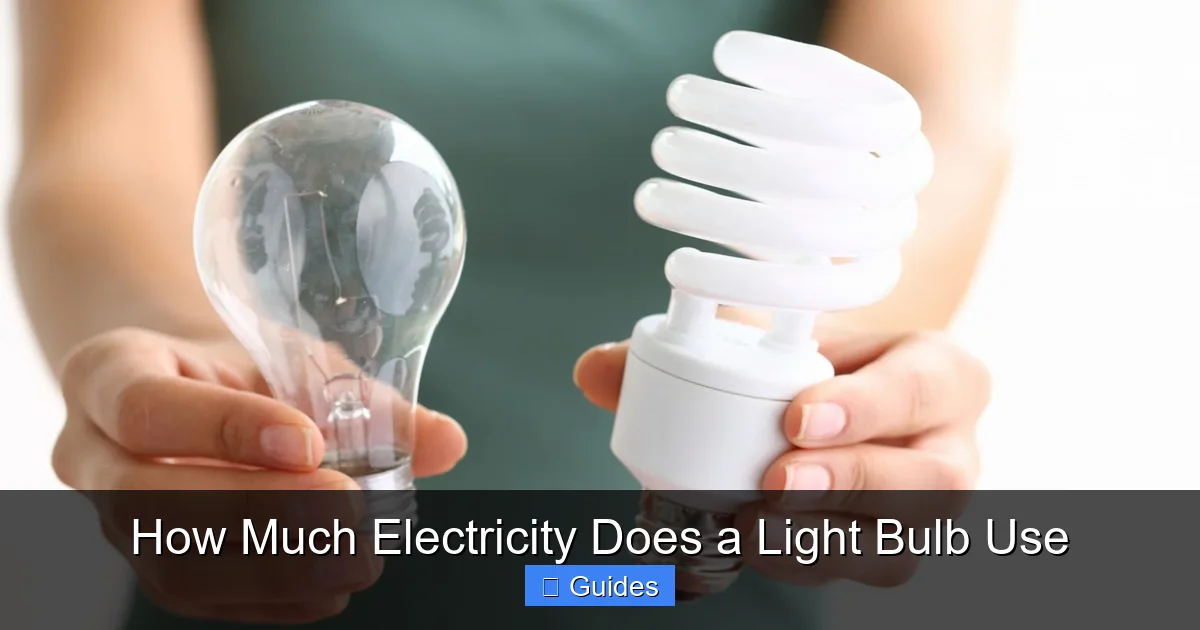
Visual guide about How Much Electricity Does a Light Bulb Use
Image source: storables.com
Incandescent Bulbs: The Power Hogs of the Past
These are the traditional light bulbs that have been around for over a century. They work by heating a small wire filament until it glows, producing light. Unfortunately, they are incredibly inefficient. A significant portion of the electricity they consume is converted into heat, not light. For example, a typical 60-watt incandescent bulb only converts about 5% of its energy into visible light, with the rest lost as heat. This means a 60-watt incandescent bulb uses a lot of electricity for the amount of light it provides.
Halogen Bulbs: A Slight Improvement
Halogen bulbs are a type of incandescent bulb that uses halogen gas to improve efficiency and lifespan slightly. They produce a brighter, whiter light than standard incandescents. While better than their predecessors, they still operate on the same principle of heating a filament, making them far less efficient than newer technologies. They still use a considerable amount of electricity compared to modern options.
CFLs (Compact Fluorescent Lamps): The First Energy-Saving Wave
CFLs became popular in the early 2000s as the first widely available energy-efficient alternative to incandescents. They work by passing an electric current through a tube containing argon and a small amount of mercury vapor. This produces ultraviolet (UV) light, which then excites a fluorescent coating on the inside of the tube, causing it to emit visible light. CFLs use about 70-75% less electricity than incandescent bulbs for the same amount of light and last much longer. However, they contain a small amount of mercury, which requires special disposal, and they often take a moment to reach full brightness.
LEDs (Light-Emitting Diodes): The Current Champions
LEDs are the undisputed champions of energy efficiency in lighting today. They produce light by passing an electric current through a semiconductor material. This process is incredibly efficient, converting almost all the electricity directly into light, with very little wasted as heat. This is why an LED bulb is cool to the touch, unlike a scorching incandescent. An LED bulb can use up to 90% less electricity than an equivalent incandescent and 50% less than a CFL. They also have an exceptionally long lifespan, often lasting 15-25 times longer than incandescents. When considering how much electricity a light bulb uses, LEDs offer the most significant savings and environmental benefits.
How Much Electricity Does a Light Bulb Actually Use? (Real Numbers)
Let’s get down to the brass tacks and look at some real-world comparisons to understand the actual electricity consumption and cost implications.
Incandescent vs. LED: A Direct Comparison
Imagine you want a light bulb that produces about 800 lumens – which is roughly equivalent to an old 60-watt incandescent bulb.
- Incandescent Bulb: To get 800 lumens, you’d typically need a 60-watt bulb.
- LED Bulb: To get 800 lumens, you’d typically need an 8-9 watt LED bulb.
That’s a massive difference in how much electricity a light bulb uses! The LED bulb uses almost 85% less electricity for the same amount of light.
Calculating Your Bulb’s Energy Cost
Let’s put this into perspective with an average electricity rate. The national average electricity price in the U.S. is around 15 cents per kWh (this can vary greatly by region). Let’s assume you leave one bulb on for 3 hours a day, every day, for a year (about 1,095 hours annually).
- 60-watt Incandescent Bulb:
- Energy consumption per hour: 60 watts = 0.06 kWh
- Annual consumption: 0.06 kWh/hour * 1,095 hours/year = 65.7 kWh
- Annual cost: 65.7 kWh * $0.15/kWh = $9.86
- 9-watt LED Bulb (800 lumens equivalent):
- Energy consumption per hour: 9 watts = 0.009 kWh
- Annual consumption: 0.009 kWh/hour * 1,095 hours/year = 9.855 kWh
- Annual cost: 9.855 kWh * $0.15/kWh = $1.48
For just one bulb, over one year, switching from incandescent to LED saves you about $8.38. Now, multiply that by all the light bulbs in your home (typically 20-40) and you can see how quickly the savings add up. Over the lifespan of an LED bulb (which can be 25,000 hours or more), the savings are truly substantial.
Factors Influencing Actual Usage
The calculations above are a good starting point, but a few things can influence the actual amount of electricity a light bulb uses:
- Usage Time: The longer a bulb is on, the more electricity it consumes. It’s simple math!
- Dimmer Switches: Using a dimmer switch with compatible bulbs can reduce energy consumption, as the bulb is operating at a lower power level.
- “Always On” Devices: Some smart bulbs might draw a tiny amount of power even when “off” to maintain connectivity (though this is typically negligible).
Beyond the Bulb: The Hidden Costs and Environmental Impact
Understanding how much electricity a light bulb uses extends beyond just the immediate financial savings. There are broader implications for your electricity bill and the planet.
Your Electricity Bill: How Bulbs Contribute
Lighting typically accounts for about 10-15% of an average household’s electricity bill. While not the largest share (heating and cooling often take the top spot), it’s a significant chunk that can be easily reduced. Every incandescent bulb you replace with an LED directly translates to fewer kilowatt-hours used, which means a lower bill. It’s a consistent, ongoing saving that compounds over time.
Carbon Footprint and Sustainability
The electricity supplied to your home often comes from power plants that burn fossil fuels, which release greenhouse gases like carbon dioxide into the atmosphere. These gases contribute to climate change. By reducing how much electricity a light bulb uses, you’re directly decreasing the demand for electricity generation, which in turn reduces carbon emissions. It’s a small but meaningful contribution to environmental sustainability. Choosing energy-efficient lighting is one of the easiest ways for individuals to reduce their carbon footprint.
Reduced Heat Output
As we mentioned, incandescent bulbs produce a lot of heat. In warmer climates or during summer months, this heat can actually make your air conditioning work harder, consuming even more electricity to cool your home. LEDs, by contrast, produce very little heat, which can subtly reduce the load on your cooling system, leading to additional energy savings.
Smart Lighting and Further Savings
The world of lighting continues to evolve, offering even more ways to optimize how much electricity a light bulb uses.
Smart Bulbs and Home Automation
Smart LED bulbs take efficiency a step further. These bulbs can connect to your home Wi-Fi and be controlled via an app on your smartphone or through voice assistants. This allows for:
- Scheduling: Turn lights on and off automatically at specific times.
- Remote Control: Turn off lights you accidentally left on while away from home.
- Dimming: Easily adjust brightness, saving energy when full light isn’t needed.
- Motion Sensors: Integrate with motion sensors so lights only turn on when a room is occupied.
These features can significantly reduce the amount of time lights are unnecessarily on, thereby minimizing how much electricity a light bulb uses.
Maximizing Natural Light
The cheapest form of light is natural light! Whenever possible, open blinds, pull back curtains, and let the sunshine in. Arranging furniture to avoid blocking windows and using lighter paint colors on walls can also help bounce natural light further into a room, reducing the need for artificial lighting during the day.
Regular Maintenance and Lifespan
While LEDs have incredibly long lifespans, regular dusting of fixtures and bulbs can ensure maximum light output and efficiency. A dusty bulb might appear dimmer, tempting you to add more lighting or turn up the brightness, thus using more electricity. Also, remember that even efficient bulbs need to be turned off when not in use. It sounds obvious, but it’s often overlooked!
Conclusion
So, how much electricity does a light bulb use? The answer, as we’ve seen, isn’t a single number. It’s a spectrum, ranging from the relatively high consumption of older incandescent bulbs to the remarkably low draw of modern LEDs. Making the switch to energy-efficient lighting, especially LEDs, is one of the smartest and easiest home upgrades you can make.
By understanding watts, lumens, and kilowatt-hours, you’re empowered to make informed decisions that benefit your wallet and the planet. Every time you choose an LED, turn off a light in an empty room, or embrace natural light, you’re contributing to a more sustainable future and enjoying lower electricity bills. It’s a simple change with profound, lasting impacts.
Frequently Asked Questions
How do I calculate the electricity cost of a light bulb?
To calculate the electricity cost, first find the bulb’s wattage, then convert it to kilowatts (divide by 1000). Multiply this by the number of hours the bulb is used and then by your electricity rate per kWh (found on your utility bill). This will give you the total cost for that bulb over a specific period.
Why do older incandescent bulbs use so much electricity?
Incandescent bulbs use a lot of electricity because they generate light by heating a filament until it glows. A large portion of the energy consumed is wasted as heat rather than converted into visible light, making them very inefficient compared to modern alternatives.
Are smart light bulbs more energy-efficient?
Smart light bulbs themselves are typically LED, so they are inherently energy-efficient. Their “smart” features, like scheduling, remote control, and dimming, can further enhance energy savings by ensuring lights are only on when needed and at the optimal brightness, thus reducing how much electricity a light bulb uses overall.
How does dimming a light bulb affect its electricity usage?
When you dim a compatible light bulb (like an LED or incandescent with a dimmer switch), it reduces the amount of power flowing to the bulb, which in turn reduces the amount of electricity it uses. So, dimming your lights is an effective way to save energy and extend bulb life.
What is the typical lifespan difference between incandescent and LED bulbs?
The lifespan difference is enormous. A typical incandescent bulb lasts about 1,000-2,000 hours, while an LED bulb can last anywhere from 15,000 to 50,000 hours or even more. This means LEDs require far fewer replacements over their operational life.
Does leaving a light on use more electricity than turning it off and on?
For almost all modern light bulb types, especially LEDs, it is more energy-efficient to turn them off when you leave a room, even if you plan to return shortly. The minimal surge of electricity when turning on a bulb is far less than the continuous draw of leaving it on, especially if you’re gone for more than a few minutes.
