


As an Amazon Associate, We earn from qualifying purchases.
The common belief that Thomas Edison solely invented the light bulb is a widespread myth. While Edison played a crucial role in developing a practical, long-lasting, and commercially viable bulb and an entire electrical distribution system, many brilliant inventors contributed foundational discoveries and improved designs over decades. It was an evolutionary process, built upon the work of pioneers like Humphry Davy, Joseph Swan, and Heinrich Goebel, among others, that truly illuminated the world.
Picture this: a dark room, suddenly bathed in a soft, warm glow. For most of us, the image that instantly comes to mind is Thomas Edison, perhaps in a workshop, holding up a glowing filament. It’s a powerful and enduring image, one that has been etched into our collective memory by history books, popular culture, and savvy marketing. But what if I told you that this iconic image, while partially true, doesn’t tell the whole story of who really invented the light bulb?
The truth is, the invention of the light bulb is far more complex, fascinating, and collaborative than any single-person narrative suggests. It’s a testament to incremental progress, fierce competition, and the power of building upon the work of those who came before. So, let’s turn on the lights and illuminate the incredible journey behind one of humanity’s most transformative inventions.
Key Takeaways
- No Single Inventor: The light bulb, as we know it, was not invented by one person but evolved through the contributions of many scientists and inventors over several decades.
- Edison’s Pivotal Role: Thomas Edison is credited for developing the first *practical, long-lasting, and commercially viable* incandescent light bulb, alongside a complete electrical generation and distribution system.
- Pre-Edison Pioneers: Humphry Davy (arc lamp), Warren de la Rue (platinum filament), Joseph Swan (carbonized paper filament), and Heinrich Goebel (bamboo filament) made significant, foundational advancements before Edison.
- The “System” Was Key: Edison’s genius lay not just in his improved bulb, but in creating an entire, integrated system of power generation, distribution, and reliable lamps that made electric light accessible and affordable.
- Evolution, Not Revelation: The invention of the light bulb was a process of continuous improvement, problem-solving, and building upon prior knowledge, highlighting the collaborative nature of scientific and technological progress.
- Patent Disputes Were Common: Due to concurrent research and similar discoveries, patent disputes (like those between Edison and Swan) were frequent during this era of rapid innovation.
- Tungsten Revolution: While carbon filaments were a breakthrough, the development of tungsten filaments much later (early 20th century) dramatically improved bulb efficiency and longevity, further advancing the technology.
Quick Answers to Common Questions
Who is commonly believed to have invented the light bulb?
Thomas Edison is the individual most commonly credited with inventing the light bulb.
Did Edison invent the very first device to produce electric light?
No, Edison did not invent the very first electric light. Humphry Davy created the electric arc lamp in 1802, decades before Edison.
What was Edison’s most significant contribution to the light bulb?
Edison’s most significant contribution was developing the first practical, long-lasting, and commercially viable incandescent light bulb, along with the complete system (generators, wiring, meters) needed to power it.
Name one other prominent inventor who contributed to the early light bulb.
Joseph Swan is a prominent inventor who made significant contributions, including developing carbon fiber filaments and improved vacuum techniques, publicly demonstrating his bulb before Edison’s.
What material did Edison’s team eventually settle on for his long-lasting filament?
Edison’s team eventually settled on a carbonized bamboo fiber as the filament for his long-lasting bulbs.
📑 Table of Contents
The Myth of the Lone Genius: Edison’s Role and Legacy
When you ask most people, “Who really invented the light bulb?” the answer will almost invariably be Thomas Edison. And while Edison absolutely deserves immense credit, his contribution was more about perfecting, commercializing, and systematizing an existing idea rather than inventing it from scratch. Think of it less as a sudden bolt of inspiration and more as an intricate puzzle, where Edison expertly fitted the final, crucial pieces together.
Edison’s Breakthrough: The Practical Filament
Edison’s team, working diligently in his Menlo Park laboratory, focused on two critical problems that plagued earlier bulb designs: a short-lived filament and an inadequate vacuum within the bulb. After thousands of experiments with different materials, they famously discovered that a carbonized cotton thread, placed in a near-perfect vacuum, could glow for over 13 hours. This was a significant leap from earlier attempts, which often lasted minutes or a few hours at best.
This wasn’t a one-off experiment. Edison and his researchers continued to refine the filament, eventually settling on a carbonized bamboo fiber that could last an astonishing 1,200 hours. This was the game-changer. A bulb that lasted for weeks or months, rather than days, was suddenly practical for widespread use.
Why Edison Gets the Credit: The “System” Approach
But Edison’s genius extended far beyond the bulb itself. He understood that a light bulb, no matter how good, was useless without a complete electrical system to power it. He didn’t just invent a better bulb; he invented the *entire infrastructure* needed to bring electric light to homes and businesses. This included:
- Generators: To produce electricity on a large scale.
- Distribution Lines: To carry electricity safely and efficiently.
- Meters: To measure consumption and bill customers.
- Switches and Sockets: To make the light easily controllable.
His creation of the Pearl Street Station in New York City in 1882, the world’s first central power plant, was perhaps as revolutionary as the bulb itself. It demonstrated the feasibility of a complete, integrated electrical grid. This holistic approach, combined with aggressive patenting and brilliant marketing, solidified Edison’s place in history as *the* inventor of the light bulb, even though the story truly began much earlier.
Illuminating History: Pioneers Before Edison
To truly understand who really invented the light bulb, we need to travel back in time, long before Edison ever stepped into his lab. The journey to electric light began with simple observations about electricity and glowing materials.
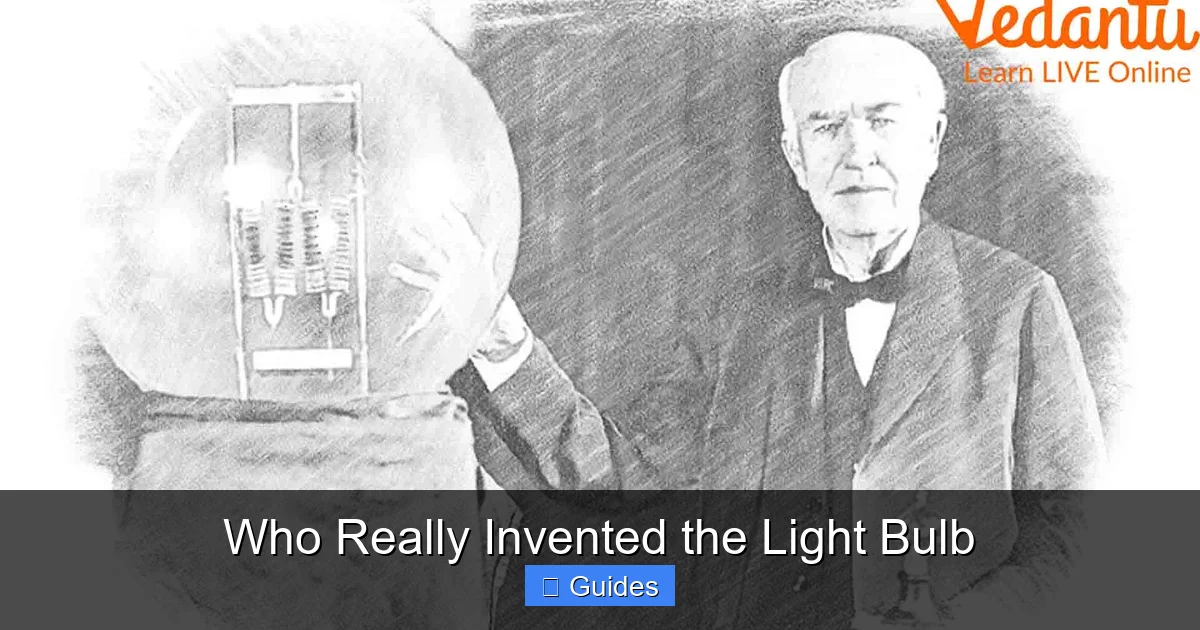
Visual guide about Who Really Invented the Light Bulb
Image source: vedantu.com
Humphry Davy and the Arc Lamp (Early 1800s)
Our story starts in 1802 with the English chemist Humphry Davy. Using a large electric battery, he demonstrated that when two charcoal rods were connected to the battery and brought close together, an intense, brilliant arc of light was created. This was the first electric lamp, known as the “electric arc lamp.” While incredibly bright, it was impractical for general lighting: it consumed enormous amounts of power, was dangerously hot, and quickly burned out. But it proved that electric light was possible.
Warren de la Rue and the Platinum Filament (1820)
Fast forward to 1820, another Englishman, Warren de la Rue, made an important step forward. He enclosed a coiled platinum filament in a vacuum tube and passed an electric current through it. Platinum was an excellent choice because it has a very high melting point, allowing it to glow brightly without melting. The vacuum helped to reduce the chemical reaction of the filament with air, making it last longer. However, platinum was incredibly expensive, making de la Rue’s bulb utterly impractical for widespread use.
Joseph Swan: A Direct Rival (1850s-1870s)
Perhaps Edison’s most direct competitor and a significant contributor was another British physicist, Joseph Swan. As early as 1850, Swan began experimenting with carbonized paper filaments in evacuated glass bulbs. He patented a “light-emitting device” in 1860, which featured a treated carbon paper filament. His early bulbs, however, suffered from a poor vacuum, which quickly burned out the filament.
By the late 1870s, Swan had significantly improved his vacuum technology and developed a long-lasting carbon fiber filament derived from cotton. He publicly demonstrated a working light bulb in Newcastle, England, in 1878, just a year before Edison’s famous carbonized thread demonstration. Swan even began installing his lights in homes and public buildings in Britain, including a theater in 1881 and the Savoy Theatre in London, which became the first public building in the world to be lit entirely by electricity.
Heinrich Goebel’s Often Overlooked Contributions (1850s)
An interesting and often debated figure is German immigrant Heinrich Goebel. In the 1850s, Goebel, a skilled clockmaker, is said to have created durable incandescent light bulbs using carbonized bamboo filaments. He reportedly used these bulbs to illuminate his shop and even for public demonstrations. While his work was not widely recognized or commercialized at the time, some historians argue that his bulbs had a longer lifespan than many later designs, hinting at the potential of bamboo as a filament material – a material Edison would later also experiment with.
The Race for a Practical Bulb: Challenges and Collaborations
The path to a practical, affordable light bulb was fraught with scientific and engineering challenges. It wasn’t just about finding something that glowed; it was about finding something that glowed *efficiently, durably, and affordably*.
Key Challenges in Early Bulb Development
- Filament Material: The material needed to conduct electricity, glow brightly when heated, and withstand high temperatures without melting or disintegrating. Early materials ranged from platinum to various forms of carbon.
- Vacuum Technology: Air inside the bulb caused the filament to quickly oxidize and burn out. Creating a near-perfect vacuum was crucial but difficult with the technology of the time. Improvements in vacuum pumps were essential.
- Longevity and Efficiency: Early bulbs were inefficient, converting most of their energy into heat rather than light, and had very short lifespans. The goal was a bulb that could last hundreds, if not thousands, of hours and convert more electricity into visible light.
- Cost and Scalability: For electric light to replace gaslight, it needed to be cost-effective to manufacture on a large scale and operate affordably.
Patent Wars and Collaborative Progress
Given the simultaneous advancements by multiple inventors, it’s no surprise that patent disputes were rampant. The most famous was between Edison and Swan. Swan had a strong claim in Britain, having demonstrated a functional bulb earlier. Edison held strong patents in the US. Rather than engage in endless legal battles, they eventually merged their companies in Britain to form “Edison & Swan United Electric Light Company,” a smart move that pooled their resources and intellectual property.
This period highlights a critical aspect of innovation: it’s rarely a solo endeavor. Scientists and engineers around the world were tackling similar problems, often unaware of each other’s precise progress. Information shared (or leaked), patents filed, and public demonstrations all contributed to a rapid acceleration of development, with each success building upon previous failures and insights.
Beyond the Filament: The Importance of a System
While discussing who really invented the light bulb, it’s vital to appreciate that the bulb itself was only one component of a much larger, revolutionary vision. Edison’s genius lay in seeing the bigger picture: not just a single light source, but an entire infrastructure to bring electricity to the masses.
Edison’s Integrated Approach
Imagine having a perfectly functioning light bulb but no reliable way to power it. That was the challenge many early inventors faced. Edison understood that to truly make electric light a practical reality, he needed to create a complete, reliable, and affordable system. This involved:
- Centralized Power Generation: Designing large-scale dynamos (generators) capable of producing enough electricity for entire neighborhoods.
- Efficient Distribution Networks: Developing safe and efficient wiring systems to carry electricity from the power plant to individual homes and businesses.
- Standardized Components: Creating consistent sockets, switches, fuses, and wiring standards so that bulbs could be easily installed and replaced.
- Economic Model: Devising a way to measure and bill for electricity usage, making it a viable commercial enterprise.
The opening of the Pearl Street Station in lower Manhattan in 1882 marked the dawn of the electrical age. It began providing direct current (DC) electricity to 85 customers, powering 400 lamps. This wasn’t just a demonstration; it was a functioning model for how an entire city could be illuminated. This holistic approach is what truly distinguishes Edison’s contribution and explains why his name is so closely associated with the invention of practical electric light.
The Evolution Continues: From Carbon to LEDs
The story of the light bulb didn’t end with Edison and Swan. The quest for more efficient, brighter, and longer-lasting illumination continued, leading to further revolutionary advancements.
The Tungsten Revolution
While carbon filaments were a monumental step, they weren’t perfect. They still had limitations in terms of efficiency and brightness. The next major leap came in the early 20th century with the introduction of tungsten filaments. William Coolidge, working at General Electric, developed a process to make ductile (malleable) tungsten in 1908. Tungsten has an even higher melting point than carbon, allowing it to glow hotter and brighter, producing more light per watt of electricity. Tungsten filaments dramatically increased the efficiency and lifespan of incandescent bulbs, becoming the standard for nearly a century.
Beyond Incandescent: Fluorescent and LED Lighting
The innovation didn’t stop there. The mid-20th century saw the rise of fluorescent lighting, which uses gas discharge to create UV light that then excites a phosphor coating to produce visible light. These were significantly more efficient than incandescent bulbs and became a staple in commercial and industrial settings.
And today, we are in the era of LED (Light Emitting Diode) lighting. LEDs are solid-state devices that produce light through the movement of electrons in a semiconductor material. They are incredibly energy-efficient, long-lasting, and versatile, representing the latest chapter in the ongoing story of artificial illumination. Each of these advancements builds upon the fundamental principles and challenges overcome by the early pioneers.
Conclusion: A Symphony of Innovation
So, who really invented the light bulb? The most accurate answer is: humanity. It was not a singular eureka moment from one individual but a complex, multi-faceted process involving hundreds of dedicated minds across different continents and decades. From Humphry Davy’s initial arc lamp to Joseph Swan’s carbon filaments and Heinrich Goebel’s early experiments, the stage was set.
Thomas Edison certainly stands out for his pivotal role in bringing all the disparate pieces together, creating a commercially viable, long-lasting incandescent bulb, and, critically, developing the entire electrical generation and distribution system that made electric light a practical reality for the world. His contributions transformed the invention from a scientific curiosity into a widespread utility.
The story of the light bulb is a powerful reminder that true innovation often comes from incremental improvements, collaborative efforts, and the relentless pursuit of solutions to complex problems. It’s a testament to the idea that no great invention truly belongs to one person, but rather to the collective human spirit of ingenuity and discovery. The next time you flip a switch, take a moment to appreciate the countless brilliant minds that contributed to that simple, yet profound, act of illumination.
Frequently Asked Questions
Was the light bulb invented in a single moment?
No, the light bulb was not invented in a single moment or by one person. It was the result of continuous scientific advancements and engineering improvements made by numerous inventors over many decades, each building upon previous discoveries.
What made Edison’s light bulb different from earlier attempts?
Edison’s light bulb stood out because it combined a long-lasting, high-resistance carbon filament with an improved vacuum, making it practical, durable, and commercially viable for widespread use. He also developed the entire electrical distribution system to power it.
Were there any patent disputes over the light bulb?
Yes, there were significant patent disputes, most notably between Thomas Edison and British inventor Joseph Swan. Both had independently developed similar incandescent light bulb designs around the same time, leading to legal battles that eventually resulted in them merging their companies in Britain.
What role did Joseph Swan play in the invention of the light bulb?
Joseph Swan was a crucial pioneer who developed an early, functional incandescent light bulb using carbonized paper and later carbon fiber filaments in an improved vacuum. He demonstrated his bulbs and began installing them in public buildings in Britain before Edison’s major breakthroughs.
Why do we often only hear about Thomas Edison’s involvement?
Thomas Edison’s name is most often associated with the light bulb due to his successful development of a practical, long-lasting bulb, his aggressive patenting, and critically, his creation of an entire commercial electrical system (like the Pearl Street Station) that made electric light accessible to the public. His robust marketing and historical narrative also played a significant role.
How did light bulb technology evolve after Edison?
After Edison, light bulb technology continued to evolve with the development of more efficient tungsten filaments in the early 20th century, greatly increasing brightness and lifespan. Later innovations included fluorescent lighting and, more recently, highly energy-efficient LED (Light Emitting Diode) technology, constantly improving efficiency and longevity.
