


As an Amazon Associate, We earn from qualifying purchases.
When asking what base is a standard light bulb, you’re usually thinking of the Edison Screw base, specifically the E26 in North America and the E27 in Europe and most other regions. These threaded bases twist into fixtures and are by far the most common for general household lighting. Understanding these standard types will help you confidently choose the correct bulb every time.
What Base Is a Standard Light Bulb?
Have you ever stood in the light bulb aisle, staring at a dizzying array of shapes, sizes, and numbers, feeling utterly lost? You just need a simple light bulb, but suddenly you’re confronted with terms like E26, E12, GU10, and B22. It can feel like trying to decipher a secret code! The truth is, selecting the right light bulb isn’t just about brightness or color; it’s crucially about making sure the base, the part that connects to your lamp or fixture, matches perfectly.
Understanding “what base is a standard light bulb” is probably one of the most common questions people have when replacing a bulb. And for good reason! Using the wrong base can range from a minor inconvenience (the bulb just won’t fit) to a significant safety risk. Don’t worry, though. By the time you finish reading this guide, you’ll be armed with all the knowledge you need to confidently pick the perfect bulb every single time. We’re going to break down the mystery of light bulb bases, focusing on the ones you’ll most often encounter in your home.
So, let’s pull back the curtain on these seemingly complex codes and demystify the world of light bulb bases. We’ll explore the true “standard” in different regions, look at other common types you might run into, and give you practical tips for ensuring a perfect fit. Get ready to illuminate your understanding!
Key Takeaways
- E26 is the Standard in North America: For most general-purpose household light fixtures in the United States and Canada, the E26 (Edison 26mm) screw-in base is the universally recognized standard light bulb base.
- E27 is the Standard Globally: In Europe, Australia, and many other parts of the world, the E27 (Edison 27mm) screw-in base holds the title of the standard light bulb base for everyday use.
- E26 and E27 are Functionally Interchangeable (with caveats): While E26 and E27 bases have slightly different diameters (26mm vs. 27mm), they are often functionally interchangeable in terms of threading. However, ensure voltage compatibility, as E26 is typically 120V and E27 is 220-240V.
- Other Common Bases Exist for Specific Uses: Beyond the E26/E27, you’ll encounter other bases like E12 Candelabra (for decorative lights), E17 Intermediate (for appliances), B22 Bayonet (common in the UK), and GU10/MR16 (for spotlights and recessed lighting).
- Always Check Your Fixture or Old Bulb: The best way to determine the correct light bulb base is to physically check the existing bulb or the label inside your light fixture. Manufacturers print base codes on packaging and sometimes on the bulb itself.
- Never Force a Bulb: If a bulb doesn’t screw in or twist easily, it’s likely the wrong base type. Forcing it can damage both the bulb and the fixture, creating a safety hazard.
Quick Answers to Common Questions
What does E26 mean for a light bulb?
E26 means it’s an Edison screw-in base with a diameter of 26 millimeters. It’s the standard for general-purpose light bulbs in North America.
Is an E27 bulb the same as an E26?
While physically similar (Edison screw type, 27mm vs 26mm diameter), E27 bulbs are designed for 220-240V systems, whereas E26 bulbs are for 120V systems. They can often fit into each other’s sockets but should not be used interchangeably due to voltage differences.
What is a Candelabra base?
A Candelabra base typically refers to an E12 Edison screw-in base, which is 12 millimeters in diameter. It’s a smaller base often used in decorative fixtures like chandeliers, nightlights, and some accent lamps.
What’s the difference between a screw-in and a bayonet base?
A screw-in base (like E26 or E27) has threads that you twist to secure the bulb into the socket. A bayonet base (like B22) has two pins on the side that push into slots and then twist to lock the bulb in place, without threads.
Can I put an LED bulb in any standard light fixture?
Most LED bulbs are designed as “retrofit” replacements, meaning they come with standard bases (like E26, E27, B22, GU10) that fit existing fixtures. As long as the base type matches, and the fixture is not enclosed in a way that traps excessive heat (unless the LED is rated for enclosed fixtures), you can typically use an LED bulb.
📑 Table of Contents
- Decoding Light Bulb Bases: The Essentials
- The North American Standard: The E26 Edison Screw
- The Global Standard: The E27 Edison Screw
- Beyond the “E”: Other Common Bases You Might See
- How to Identify Your Light Bulb Base and Choose a Replacement
- The Future of “Standard” Bases: LEDs and Smart Bulbs
- Conclusion: Illuminating Your Choices
Decoding Light Bulb Bases: The Essentials
Before we dive into specifics, let’s understand what a “base” actually is and why it’s so important. The light bulb base is the part of the bulb that makes electrical contact with the light fixture. It also holds the bulb securely in place. Bases are designed to be standardized so that you can easily replace a bulb without needing a new fixture.
The naming conventions for light bulb bases might seem random, but they actually follow a logical pattern. Most commonly, you’ll see a letter followed by a number. The letter usually indicates the type of base, and the number tells you its diameter in millimeters. For example, an “E” often stands for Edison screw, and the number after it is the width of the base.
Why Do Different Bases Exist?
You might wonder why there isn’t just one universal base for everything. The variety of bases stems from several factors:
- Historical Development: As lighting technology evolved, different inventors and companies developed their own base designs.
- Application Specifics: Some fixtures require smaller bases (like chandeliers), while others need robust ones for high wattage (like industrial lights).
- Regional Standards: Different countries and regions adopted different standards based on historical precedents and electrical systems.
- Safety and Functionality: Certain base types are better suited for specific environments or types of light (e.g., locking mechanisms for vibration).
Understanding these differences is the first step in answering what base is a standard light bulb for *your* needs.
The North American Standard: The E26 Edison Screw
When most people in the United States and Canada ask “what base is a standard light bulb,” the answer they’re looking for is almost always the E26. This is the undisputed champion of household light bulbs across North America.
What Does E26 Mean?
The “E” in E26 stands for *Edison*, referring to the threaded screw-in design originally developed by Thomas Edison. The “26” denotes the diameter of the base in millimeters. So, an E26 base is an Edison screw-in base that is 26 millimeters (about 1 inch) wide.
You’ll find E26 bases on a vast majority of your household lamps, ceiling fixtures, and general-purpose lighting. From your living room table lamp to the overhead light in your kitchen, if it’s a typical screw-in bulb, it’s almost certainly an E26. This standardization makes life much simpler for consumers, as it means most fixtures accept this common type.
Why E26 is So Common
The E26 base became standard for several key reasons:
- Early Adoption: It was an early and effective design for connecting incandescent bulbs to power.
- Reliability: The screw-in design provides a secure electrical connection and physical hold.
- Versatility: It can accommodate a wide range of bulb shapes and wattages (now lumens for LEDs).
Even with the advent of LED and smart bulb technology, the E26 base has remained the dominant choice. Manufacturers continue to produce LED bulbs with E26 bases, ensuring compatibility with existing fixtures and making the transition to energy-efficient lighting seamless for homeowners.
The Global Standard: The E27 Edison Screw
While E26 reigns supreme in North America, its slightly larger sibling, the E27, is the standard for much of the rest of the world. If you live in Europe, Australia, or many parts of Asia, when you ask “what base is a standard light bulb,” you’re likely referring to the E27.
What Does E27 Mean?
Similar to the E26, the “E” in E27 stands for *Edison*, and the “27” signifies that the base has a diameter of 27 millimeters. So, an E27 base is an Edison screw-in base that is 27 millimeters wide.
E26 vs. E27: Are They Interchangeable?
This is a very common and important question! The difference between 26mm and 27mm is just one millimeter. In many cases, an E26 bulb will physically screw into an E27 socket, and an E27 bulb will screw into an E26 socket. The threading is quite similar.
However, there’s a crucial caveat: voltage.
- E26 bulbs are designed for 120V systems (North America).
- E27 bulbs are designed for 220-240V systems (Europe, etc.).
While the physical fit might be okay, installing a 120V E26 bulb into a 240V E27 fixture (or vice-versa) can be dangerous. The bulb could burn out instantly, perform poorly, or even pose a fire hazard. Always ensure that the voltage rating of the bulb matches the voltage of your electrical system, regardless of whether the base physically fits. If you’re traveling or buying bulbs internationally, this distinction is vital.
Beyond the “E”: Other Common Bases You Might See
While E26 and E27 cover the majority of general household lighting, there are several other light bulb base types that are quite common for specific applications. Knowing these will broaden your understanding of what base is a standard light bulb for particular fixtures.
The E12 Candelabra Base
The E12 base, also an Edison screw type, is significantly smaller than the E26/E27. The “12” indicates a diameter of 12 millimeters. You’ll typically find E12 bulbs in:
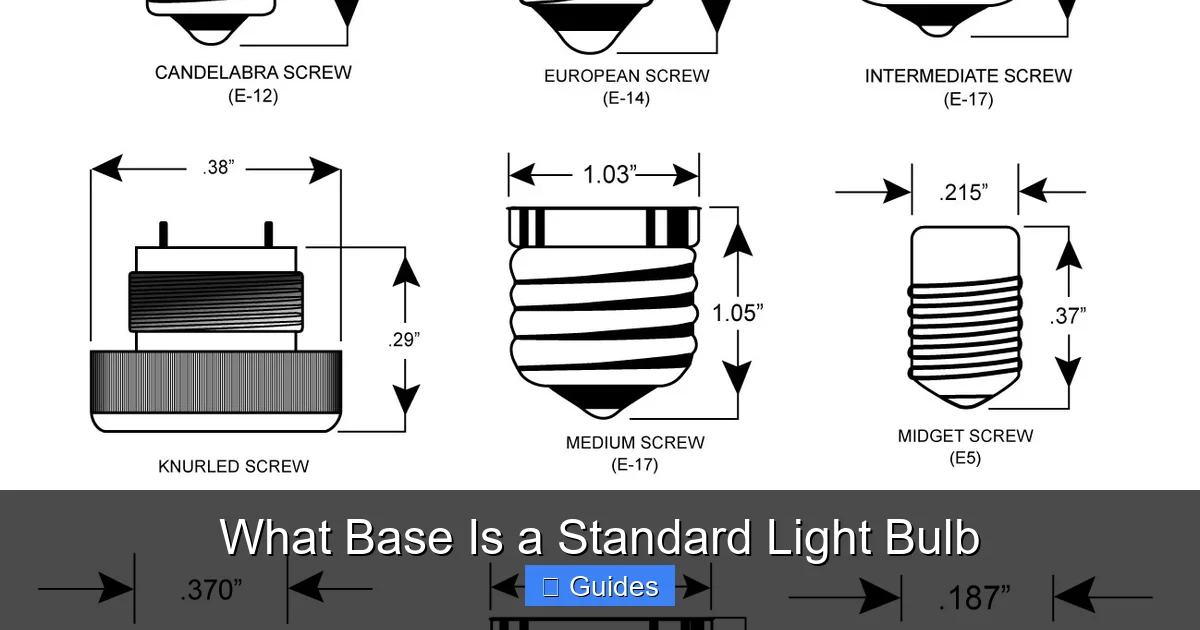
Visual guide about What Base Is a Standard Light Bulb
Image source: resources.made-in-china.com
- Chandeliers
- Decorative light fixtures
- Nightlights
- Scent warmers
- Some appliance lights (like range hoods)
These bulbs are often petite and designed for aesthetic appeal or low-light situations.
The E17 Intermediate Base
Falling between the E12 and E26 in size, the E17 base (17mm diameter) is less common for general lighting but frequently appears in:
- Appliances (e.g., microwave ovens, refrigerators)
- Some specialty lamps
- Outdoor string lights
It’s a niche player but good to be aware of, especially when an appliance bulb burns out.
The B22 Bayonet Base (UK/Australia Standard)
Stepping away from the Edison screw, the B22 is a *bayonet* base. Instead of screwing in, it has two pins on the side that push into the socket and twist to lock in place. The “B” stands for bayonet, and “22” refers to its 22mm diameter.
The B22 is the standard light bulb base for general household use in the United Kingdom, Ireland, Australia, India, and other Commonwealth countries. If you’re in one of these regions, this is the “standard” you’ll encounter most often for everyday lamps and fixtures.
GU10 and MR16 (Bi-Pin Bases)
These are common for spotlighting and recessed lighting. They don’t screw in but rather push and twist (GU10) or simply push in (MR16).
- GU10: Features two short, thick pins that twist and lock into the socket. Common for track lighting, recessed lights, and display lighting. The “G” indicates a bi-pin base, and “U” refers to its U-shaped ceramic body, “10” is the distance between the centers of the pins in millimeters.
- MR16: Has two slender pins that push straight into the socket. These are typically low-voltage bulbs often found in landscape lighting or indoor accent lighting, frequently paired with a transformer. The “MR” stands for multifaceted reflector, referring to the bulb shape.
These are examples of specialized bases for specific lighting needs, demonstrating that “what base is a standard light bulb” isn’t always a one-size-fits-all answer.
How to Identify Your Light Bulb Base and Choose a Replacement
Finding the right replacement bulb doesn’t have to be a guessing game. Here’s a foolproof method to make sure you get the correct base every time:
1. Check the Old Bulb
This is usually the easiest way. Take the old bulb out and look at its base. Many manufacturers print the base type (e.g., E26, E12) directly on the metal or plastic base of the bulb. If not, visually compare it to common types. Is it screw-in or push-and-twist? What’s its approximate diameter?
2. Inspect the Fixture Itself
Sometimes the old bulb is missing, or the markings are worn off. In this case, examine the socket in the light fixture. Look for any labels or stamps. The base type might be printed there. Observe the socket’s design:
- Does it have threads for screwing in (Edison)?
- Does it have two slots for pins to push and twist (Bayonet or GU10)?
- Does it have two small holes for slender pins (MR16)?
3. Read the Product Packaging/Manual
If you’re buying a new fixture or lamp, the product packaging or instruction manual will clearly state what light bulb base type it requires. This is the most reliable source of information for new purchases.
4. When in Doubt, Measure!
If all else fails, you can carefully measure the diameter of the base (or the socket opening) in millimeters. This will directly tell you whether it’s an E12, E17, E26, or E27. Remember, an E26 is ~1 inch wide.
A Crucial Tip: Never Force It!
If a bulb doesn’t screw in or twist into the socket easily, *do not force it*. Forcing the wrong size or type of base can damage the bulb, strip the threads of the socket, or even break the glass, potentially leading to electrical shorts or fire hazards. Always double-check and ensure a smooth fit.
The Future of “Standard” Bases: LEDs and Smart Bulbs
You might think that with the rise of new lighting technologies like LEDs and smart bulbs, the traditional base types would become obsolete. Surprisingly, this isn’t the case! Most modern LED bulbs and smart bulbs are designed to be “retrofit,” meaning they fit into existing fixtures.
This is fantastic news for consumers. It means you can upgrade your lighting to be more energy-efficient or smart without having to replace all your lamps and light fixtures. The E26 remains the standard light bulb base for screw-in LED bulbs in North America, and the E27 for screw-in LED bulbs in other regions. Similarly, GU10 and MR16 LED replacements are widely available for their respective specialized fixtures.
This continued standardization ensures that as lighting technology advances, our transition remains as easy as twisting in a new bulb. Knowing “what base is a standard light bulb” will continue to be a valuable piece of information for years to come, regardless of the light source inside the bulb.
Conclusion: Illuminating Your Choices
We’ve journeyed through the world of light bulb bases, uncovering the identity of “what base is a standard light bulb” in different parts of the world. For most homes in North America, it’s the reliable E26 Edison screw. For many other countries, particularly in Europe, it’s the E27. We’ve also touched on the smaller E12 and E17, the twist-and-lock B22 bayonet, and specialized bi-pin bases like GU10 and MR16.
Armed with this knowledge, you no longer have to feel overwhelmed in the light bulb aisle. You can confidently identify the base you need, ensure voltage compatibility, and make smart, safe choices for all your lighting needs. Remember to check your old bulb or fixture, and never, ever force a bulb into a socket. Happy lighting!
🎥 Related Video: Standard Light Bulb – Size & Codes | Spec. Sense
📺 AMRE Supply
What does the A19 code describe? What is an E26 base? In this episode of Spec. Sense, Vance shows how to measure and how …
Frequently Asked Questions
How do I know what base my existing light bulb has?
The easiest way is to look at the metal or plastic base of the old bulb itself, as the base type (e.g., E26, E12) is often printed or molded onto it. If not, you can measure its diameter in millimeters or visually compare it to known base types like the common screw-in (Edison) or push-and-twist (bayonet/GU10) designs.
What if my light bulb base isn’t E26 or E27?
If your bulb isn’t an E26 or E27, it likely has a specialized base. Common alternatives include E12 (candelabra), E17 (intermediate), B22 (bayonet, standard in UK/Australia), GU10 (twist-and-lock bi-pin for spotlights), or MR16 (push-in bi-pin for low-voltage applications). Always match the base type to your fixture.
Are there adapters available for different light bulb bases?
Yes, adapters are available that allow you to convert one base type to another, for example, an E26 to an E12, or vice versa. While they can be convenient, it’s generally best to use the correct bulb base designed for your fixture. If using an adapter, ensure it’s rated for the bulb’s wattage and that the combined bulb and adapter don’t interfere with the fixture’s shade or enclosure.
What happens if I try to use the wrong light bulb base?
If you try to use the wrong light bulb base, it simply won’t fit into the socket. Attempting to force it can damage the bulb, strip the threads or internal components of the fixture, or even break the glass, creating a potential safety hazard. Always ensure a smooth and easy fit.
Does the light bulb base affect the brightness or color of the light?
No, the light bulb base itself does not affect the brightness (lumens) or color temperature (Kelvin) of the light. These characteristics are determined by the light source inside the bulb (e.g., LED, filament type) and are independent of the physical connector. The base only ensures proper electrical connection and physical stability.
Is a standard light bulb base different for smart bulbs or LED bulbs?
No, the physical base for smart bulbs and LED bulbs typically remains the same as traditional incandescent bulbs. Most modern LED and smart bulbs are designed as “retrofit” replacements, meaning they use common standard bases like E26, E27, or B22 to fit into existing light fixtures without needing special adapters or new lamps.
