


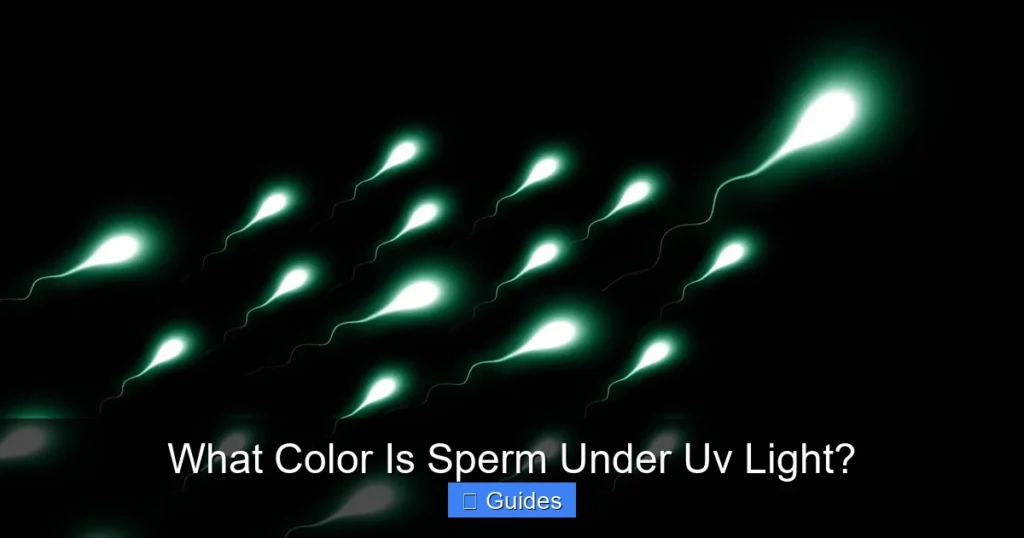
Have you ever questioned, “What color is sperm under UV light?” The simple answer is that sperm, or more accurately, components within seminal fluid, typically glow with a distinctive greenish-blue fluorescence when exposed to ultraviolet (UV) light. This unique luminescent property is due to certain organic molecules present in the fluid, making UV light a fascinating tool for forensic investigation, cleaning, and sometimes just sheer curiosity.
Have you ever found yourself pondering some of life’s more unusual questions? Perhaps you’ve watched a crime show and seen investigators sweep a room with a black light, revealing all sorts of hidden secrets. Or maybe, out of pure curiosity, you’ve wondered about the unseen world around us. One such fascinating question that often piques people’s interest is, “What color is sperm under UV light?” It might sound like a niche inquiry, but the answer delves into some pretty cool science, with practical applications from forensic investigations to simply keeping your home clean.
The world seen through ultraviolet light is surprisingly vibrant, revealing things invisible to the naked eye. This special light energy, which we can’t see, interacts with certain substances in a way that makes them “glow” or fluoresce. It’s like magic, but it’s pure physics and chemistry at play. So, let’s turn on our metaphorical black light and explore the intriguing answer to what color is sperm under UV light, and why it happens. Get ready to uncover a glowing secret!
Key Takeaways
- Distinctive Glow: When exposed to UV light, sperm (or rather, seminal fluid components) typically fluoresces with a greenish-blue color, a property shared by many organic substances.
- Scientific Basis: The fluorescence is primarily attributed to naturally occurring organic molecules like flavins (riboflavin) and choline, which absorb UV energy and re-emit it as visible light.
- Forensic Applications: UV light is a crucial tool in forensic science for detecting potential seminal stains at crime scenes, though further laboratory tests are always needed for definitive identification.
- Cleaning Challenges: The glow helps identify invisible seminal fluid stains on fabrics or surfaces, making targeted cleaning easier, but many other common substances also fluoresce.
- Not Unique to Sperm: While characteristic, the greenish-blue glow is not exclusive to sperm. Many other bodily fluids (like urine, saliva) and household items (detergents, toners) can also fluoresce, requiring careful interpretation.
- Safety First: When using UV lights, always prioritize safety by wearing appropriate eye protection to prevent eye damage and limiting skin exposure.
Quick Answers to Common Questions
What causes seminal fluid to glow under UV light?
Seminal fluid glows under UV light primarily due to the presence of naturally occurring fluorescent organic compounds, especially flavins like riboflavin, which absorb UV energy and re-emit it as visible light.
Is the greenish-blue glow unique to sperm?
No, the greenish-blue glow is not unique to sperm. Many other substances, including urine, saliva, some detergents, and certain fabrics, can also fluoresce with similar colors under UV light.
Can UV light identify specific individuals from a sperm stain?
No, UV light can only indicate the potential presence of a seminal stain. To identify a specific individual, forensic scientists would need to collect the sample and perform DNA analysis in a laboratory.
Is it safe to look at sperm under UV light?
While brief, indirect exposure to a common UV-A black light is generally considered safe, you should never stare directly into the light. Prolonged exposure to any UV light can be harmful to your eyes, so using UV-blocking glasses is recommended.
Does seminal fluid glow forever under UV light?
The fluorescent properties of seminal fluid can persist for a long time, even when dried, often for years. However, the intensity of the glow might diminish over time due to environmental factors like light exposure and degradation of the fluorescent compounds.
📑 Table of Contents
- The Luminous Truth: What Color Is Sperm Under UV Light?
- Why Does Seminal Fluid Fluoresce? The Science Behind the Glow
- Beyond Sperm: Other Substances That Glow Under UV Light
- Practical Applications and Misconceptions of UV Light
- Safety and Ethics of UV Light Use
- Distinguishing Seminal Fluid from Other Stains Under UV Light
- Conclusion
The Luminous Truth: What Color Is Sperm Under UV Light?
If you’ve ever shined a UV light (often called a black light) on a seminal stain, you’d likely observe a distinct and often vibrant glow. So, what color is sperm under UV light? The most common answer is a **greenish-blue or whitish-blue fluorescence**. This isn’t just a faint shimmer; it can be quite pronounced, making stains that are otherwise invisible in normal light stand out clearly.
Identifying the Specific Hue
The exact shade of this glow can vary a little. Sometimes it appears as a bright, almost electric blue. Other times, it might lean more towards a yellow-green. Factors like the age of the stain, the material it’s on, and the specific composition of the seminal fluid can all influence the precise hue and intensity of the fluorescence. However, the overarching characteristic remains that brilliant greenish-blue or whitish-blue luminescence. This unique visual signature is what makes UV light a powerful preliminary tool in various scenarios, from forensic investigations to revealing hidden messes.
Why Does Seminal Fluid Fluoresce? The Science Behind the Glow
Visual guide about What Color Is Sperm Under Uv Light?
Image source: geology.com
The fascinating phenomenon of seminal fluid glowing under UV light isn’t magic; it’s biochemistry. This property, known as fluorescence, occurs when certain molecules absorb high-energy ultraviolet radiation and then re-emit that energy as lower-energy visible light, which is what we see as the glow.
Key Fluorescent Compounds
Seminal fluid is a complex mix of many substances, and several of these contribute to its distinctive glow. The primary culprits responsible for the greenish-blue fluorescence are:
- Flavins: These are a group of organic compounds, with riboflavin (Vitamin B2) being a common example. Flavins are naturally present in seminal fluid and are known for their strong fluorescent properties. They absorb UV light and emit light in the blue-green spectrum.
- Choline: While choline itself doesn’t fluoresce strongly, one of its derivatives, choline-conjugated proteins, can contribute to the overall luminescence. Choline is a vital nutrient and a component of many biological membranes.
- Spermine and Spermidine: These are polyamines found in high concentrations in seminal fluid. While they primarily help in DNA stability, they can also exhibit some fluorescent properties under UV light, though perhaps less intensely than flavins.
It’s the combined effect of these and other trace organic molecules that gives seminal fluid its characteristic response to UV light. Without these fluorescent compounds, you wouldn’t be asking, “What color is sperm under UV light?” because there would be no glow to see!
The Role of UV Wavelengths
Not all UV lights are created equal. The type of UV light used, specifically its wavelength, can affect how strongly and in what exact hue a substance fluoresces. Most common “black lights” operate in the long-wave UV-A spectrum (around 365-400 nanometers), which is generally safe for short-term exposure and highly effective at exciting these fluorescent compounds. Using the right kind of UV light is crucial for getting the best results when trying to observe what color is sperm under UV light.
Beyond Sperm: Other Substances That Glow Under UV Light
While knowing what color is sperm under UV light is useful, it’s incredibly important to understand that many, many other things also glow under UV light. This fact is critical, especially when considering forensic applications or even just cleaning. You can’t simply assume a glowing stain is seminal fluid.
Common Fluorescent Materials
Here’s a list of just some common substances you might encounter that also fluoresce, often in similar blue-white or yellow-green hues:
- Other Bodily Fluids:
- **Urine:** Often fluoresces bright yellow or greenish-yellow, especially if it’s dried.
- **Saliva:** Can glow with a whitish-blue light.
- **Blood:** While blood itself doesn’t strongly fluoresce, some components or cleaning agents used on bloodstains might.
- **Vaginal secretions:** Can also show a blue-white fluorescence, adding to the complexity in forensic contexts.
- Household Items:
- **Laundry Detergents and Optical Brighteners:** These are specifically designed to make clothes look “whiter and brighter” by fluorescing blue. They are notorious for glowing intensely under UV light.
- **Tonic Water:** The quinine in tonic water fluoresces a striking blue.
- **Certain Fabrics:** Some synthetic fabrics, especially those treated with optical brighteners, will glow.
- **Adhesives and Glues:** Many glues, especially super glue, can fluoresce.
- **Pet Urine Stains:** These are very common sources of bright yellow-green fluorescence on carpets and upholstery.
- Natural & Environmental Substances:
- **Mold:** Some types of mold can fluoresce.
- **Some Fungi:** Certain mushrooms glow.
- **Pollen:** Can show varying fluorescent colors.
This extensive list highlights why forensic experts never rely solely on UV light for identification. The answer to what color is sperm under UV light is a crucial piece of the puzzle, but it’s far from the only piece.
Practical Applications and Misconceptions of UV Light
Understanding what color is sperm under UV light has real-world implications, but it also comes with its share of myths. Let’s look at where this knowledge is genuinely useful and where it can lead to misunderstandings.
Forensic Investigations: A Preliminary Tool
In crime scene analysis, UV light, or forensic light sources tuned to specific wavelengths, is an indispensable initial tool. Investigators use it to locate potential biological fluids that might be invisible to the naked eye. If a greenish-blue glow appears, it flags a spot for further investigation.
- **Finding Evidence:** A UV scan can quickly identify areas that might contain seminal fluid, blood, saliva, or other bodily fluids. This helps narrow down areas to collect samples from.
- **Not Definitive Proof:** Crucially, the presence of a glow is *not* definitive proof of seminal fluid. As we discussed, many substances fluoresce. Forensic scientists must then collect samples from the glowing areas and conduct specific laboratory tests (like acid phosphatase tests, P30 protein tests, or DNA analysis) to confirm the presence of sperm and identify the donor. So, while what color is sperm under UV light gives a good clue, it’s just the first step.
Cleaning and Stain Detection
For homeowners, a small handheld UV flashlight can be a game-changer for cleaning.
- **Pet Stains:** It’s incredibly effective at finding dried urine stains from pets on carpets, furniture, and floors, which often glow a distinct yellow-green.
- **Hidden Grime:** It can reveal hidden dust, lint, and even some bacteria that have settled in hard-to-reach places.
- **Identifying Unknown Stains:** If you’re wondering what a mysterious stain on your bedsheets might be, a quick pass with a UV light could reveal a greenish-blue glow, indicating potential seminal fluid. This then prompts you to clean that specific area more thoroughly.
Common Misconceptions
There are a few myths surrounding UV light and biological fluids:
- **Myth 1: “If it glows blue, it’s definitely sperm.”** Absolutely false. As covered, many things glow blue or greenish-blue. It’s a strong indicator but requires confirmation.
- **Myth 2: “UV light sterilizes surfaces.”** While some specialized, high-intensity UV-C light (germicidal UV) can kill germs, the common UV-A black lights you buy are generally not powerful enough to effectively sterilize surfaces. They are for detection, not disinfection.
- **Myth 3: “Only fresh bodily fluids glow.”** Not true. Dried stains of seminal fluid, urine, and saliva can glow for a very long time, sometimes years, depending on the environment. The intensity might diminish over time, but the fluorescence can still be visible.
Safety and Ethics of UV Light Use
While UV light is fascinating and useful, it’s essential to use it safely and consider the ethical implications, especially when dealing with personal spaces or sensitive information.
Prioritizing Personal Safety
Most common black lights emit UV-A radiation, which is generally considered less harmful than UV-B or UV-C. However, prolonged or direct exposure can still pose risks:
- **Eye Protection:** Your eyes are the most vulnerable. Never stare directly into a UV light. Wearing UV-blocking safety glasses is highly recommended, especially if you’re using a powerful light or for extended periods. UV exposure can contribute to cataracts and other eye damage over time.
- **Skin Exposure:** While casual use of a low-power UV-A light is usually fine, prolonged exposure to any UV radiation can accelerate skin aging and increase the risk of skin cancer. Limit direct skin exposure.
- **Proper Ventilation:** If using UV lights in confined spaces for long periods, ensure good ventilation, as some older or very powerful units can produce ozone.
Ethical Considerations
Using UV light in shared or personal spaces can raise privacy concerns.
- **Respecting Privacy:** When using a UV light in a hotel room, a friend’s house, or any space that isn’t solely your own, be mindful of privacy. Shining a UV light around could reveal things the occupants might not want exposed.
- **Informed Consent:** In a forensic context, the use of UV light is governed by strict protocols and legal frameworks, respecting the rights and privacy of individuals involved.
Knowing what color is sperm under UV light is one thing, but knowing *when* and *how* to look for it is just as important.
Distinguishing Seminal Fluid from Other Stains Under UV Light
As we’ve firmly established, many substances glow under UV light. This makes definitive identification challenging based on fluorescence alone. However, there are some subtle differences that can provide clues, even if they aren’t conclusive.
Subtle Visual Cues
While not foolproof, here are some observations that experienced users and forensic scientists might consider when evaluating what color is sperm under UV light versus other glowing stains:
- **Color Intensity and Hue:** Seminal fluid often exhibits a distinct, vibrant greenish-blue or whitish-blue glow. Pet urine, especially dried, tends to be more yellow-green and sometimes has a characteristic “halo” effect on carpets. Detergents are usually a very bright, almost electric blue.
- **Pattern and Location:** The pattern of the stain can offer clues. A spray pattern might suggest a different origin than a large, diffused patch. The location also matters – a stain on bedding might suggest seminal fluid more than one on a kitchen counter (though not exclusively).
- **Odor:** While not related to the glow, an accompanying odor (e.g., ammonia from urine) can help differentiate.
- **Texture and Consistency:** Some stains, when viewed up close in normal light, might have a different texture or residue (e.g., crusty urine, sticky residue from certain foods) that can further inform your suspicion.
Ultimately, if definitive identification is needed (as in forensic cases), visual inspection under UV light only serves as a presumptive test. It guides further, more specific chemical tests. For personal use, it helps you identify areas that need thorough cleaning. Knowing what color is sperm under UV light is the starting point, not the end.
Conclusion
So, there you have it! The answer to “What color is sperm under UV light?” is a clear and often striking greenish-blue or whitish-blue glow. This fascinating property is due to the presence of natural fluorescent compounds like flavins within seminal fluid, causing it to absorb UV energy and re-emit it as visible light.
From assisting crime scene investigators in preliminary evidence detection to helping homeowners spot hidden pet stains and other grime, UV light is a surprisingly versatile tool. However, remember its limitations: many other substances also fluoresce, often with similar hues. Always use UV light safely, protecting your eyes and skin, and interpret your findings with a healthy dose of skepticism. The world under a black light is certainly full of surprises, and now you’re equipped with the knowledge to understand one of its more intriguing secrets!
🎥 Related Video: Weird $800 Vegas Suite vs UV Light
📺 Freakin’ Reviews Shorts
I brought a UV light to this strange $800 Vegas Suite. Full video: https://youtu.be/8XKPYEt2ckc.
Frequently Asked Questions
What is the primary color of sperm under a black light?
The primary color that sperm, or more accurately the seminal fluid components, exhibit under a black light (UV light) is a distinct greenish-blue or whitish-blue fluorescence. This glow can be quite vibrant and easily visible.
Are all bodily fluids fluorescent under UV light?
No, not all bodily fluids are equally fluorescent under UV light. While seminal fluid, urine, and saliva often show a strong glow, blood itself does not strongly fluoresce, though some components or cleaning agents might.
Can a UV light be used to detect semen on clothing after washing?
It can be challenging. While the fluorescent compounds might persist after washing, the washing process can dilute the substances, spread them, or introduce fluorescent detergents, making definitive identification under UV light much harder. Lab tests would be necessary for confirmation.
Does dried sperm glow more intensely than fresh sperm under UV light?
Dried seminal fluid often appears to glow more intensely than fresh, wet fluid. This is partly because the water content in fresh fluid can reduce the perceived intensity, and as the fluid dries, the fluorescent compounds become more concentrated on the surface.
What is the difference between fluorescence and phosphorescence?
Fluorescence is when a substance immediately re-emits light after absorbing UV energy and stops glowing almost instantly when the UV source is removed. Phosphorescence, on the other hand, involves a delayed emission of light, meaning the substance continues to glow for a period after the UV source is turned off.
Is the “black light” I buy at a store the same as a forensic UV light?
A “black light” from a store is typically a long-wave UV-A light, which is similar to what’s used in forensics for initial screening. However, forensic light sources are often more powerful, emit specific wavelengths (including UV-B and UV-C), and come with filters to enhance the visibility of different types of evidence, making them more specialized and effective.
