


As an Amazon Associate, We earn from qualifying purchases.
An E26 light bulb is the most common screw-in light bulb type in North America, characterized by its 26-millimeter diameter Edison screw base. This standard ensures compatibility across a vast range of fixtures, making it incredibly versatile for homes and businesses alike. Understanding the E26 bulb helps you navigate choices from traditional incandescents to modern, energy-efficient LED options, ensuring you always pick the right light for your space.
Have you ever found yourself standing in the lighting aisle, staring at a dizzying array of light bulbs, and wondering what all those letters and numbers mean? Don’t worry, you’re definitely not alone! One of the most common terms you’ll encounter, especially if you live in North America, is “E26.” It might sound a bit technical, but understanding what an E26 light bulb is is actually quite simple and incredibly helpful for anyone looking to light up their home or office.
In essence, an E26 light bulb is the undisputed king of standard light bulbs in the United States, Canada, and Mexico. It’s the go-to choice for almost every lamp, ceiling fixture, and sconce you’ll find. But what exactly does “E26” mean, and why is it so prevalent? Let’s dive in and demystify this essential piece of household technology, making you a more informed and confident light bulb shopper.
This guide will walk you through everything you need to know about an E26 light bulb, from its origins and why it’s so common, to the various types of bulbs that use this base, and how to choose the perfect one for your specific needs. We’ll also touch on practical tips for installation and safety, and even glimpse into the future of E26 lighting. Get ready to illuminate your understanding!
Key Takeaways
- E26 is the North American Standard: The E26 light bulb is the most prevalent screw-in bulb base in the United States, Canada, and Mexico, designed for 120V electrical systems.
- “E” Stands for Edison Screw: The “E” in E26 refers to the Edison screw thread, invented by Thomas Edison, while “26” denotes the base’s diameter in millimeters.
- Versatility Across Bulb Types: E26 bases are compatible with various bulb technologies, including incandescent, CFL, halogen, and LED, offering flexibility in lighting choices.
- Crucial for Home Lighting: From ceiling fixtures and lamps to outdoor lights, understanding the E26 standard is essential for selecting appropriate and safe lighting.
- Consider More Than Just the Base: When choosing an E26 light bulb, also think about lumens (brightness), color temperature (warmth/coolness), wattage equivalent, dimmability, and smart features.
- Easy Installation and Broad Availability: Its widespread use means E26 bulbs are easy to find, install, and replace, making them a convenient choice for most lighting needs.
Quick Answers to Common Questions
What does E26 stand for?
E26 stands for “Edison screw” (E) and a base diameter of 26 millimeters (26). It’s a standard screw-in base for light bulbs.
Is an E26 bulb the same as a standard bulb?
Yes, in North America (USA, Canada, Mexico), an E26 light bulb is considered the standard or medium base light bulb for most household fixtures.
Can I use an E26 bulb in an E27 socket?
Physically, an E26 bulb can often fit into an E27 socket because the diameter difference is only 1mm. However, E27 sockets are typically found in regions with 220-240V electricity, while E26 bulbs are for 120V. Using a 120V E26 bulb in a 220V E27 socket can cause the bulb to burn out quickly or safely. It’s best to match the bulb’s voltage to the socket’s voltage.
Are all E26 bulbs LED?
No, not all E26 bulbs are LED. While LED E26 bulbs are the most common and energy-efficient choice today, you can still find incandescent, halogen, and CFL E26 bulbs.
What voltage is an E26 light bulb?
An E26 light bulb is primarily designed for 120-volt (V) electrical systems, which is the standard household voltage in North America.
📑 Table of Contents
- What Exactly Is an E26 Light Bulb? Unpacking the Standard
- Why Is the E26 Light Bulb So Common? A Story of Standardization
- Understanding E26 Bulb Types and Technologies
- Choosing the Right E26 Light Bulb for Your Needs
- Installation and Safety Tips for E26 Bulbs
- The Future of E26: Smart Lighting and Beyond
- Conclusion: Illuminating Your World with Confidence
What Exactly Is an E26 Light Bulb? Unpacking the Standard
Let’s start with the basics. When we talk about an E26 light bulb, we’re primarily referring to the base of the bulb – the part that screws into the light fixture. The letters and numbers are a code that tells us about this base. So, what do they mean?
Decoding the “E” and the “26”
- “E” for Edison Screw: The “E” in E26 stands for “Edison screw.” This refers to the thread-based fitting system invented by none other than Thomas Edison himself. It’s a simple, reliable design that allows you to screw the bulb into a corresponding socket, establishing an electrical connection. The Edison screw is known for its ease of use and secure fit, which is why it has remained a standard for so long.
- “26” for Diameter: The “26” in E26 refers to the diameter of the screw base in millimeters. So, an E26 light bulb has a screw base that is exactly 26 millimeters (or approximately 1 inch) wide. This precise measurement is crucial for ensuring that the bulb fits snugly and safely into an E26 socket.
Together, E26 specifies a screw-in base that is 26mm in diameter, making it compatible with sockets designed for this particular standard. This base is also sometimes referred to as “medium Edison screw” (MES) or simply “standard base” in North America. Its commonality is primarily due to historical factors and the standardization efforts that followed Edison’s invention.
Voltage Considerations for E26 Bulbs
While the E26 designation describes the physical base, it’s also implicitly linked to the electrical system it’s designed for. In North America (U.S., Canada, Mexico), the standard household voltage is 120 volts (V). Therefore, an E26 light bulb is almost always designed to operate safely and effectively on a 120V electrical supply. It’s important to remember this, as E27 bulbs (which are physically very similar, being 27mm in diameter) are typically used in regions with 220-240V electrical systems. While an E27 bulb might physically fit into an E26 socket, using a 220V E27 bulb in a 120V E26 fixture would result in very dim light, and conversely, putting a 120V E26 bulb into a 220V E27 fixture could cause the bulb to burn out quickly or even pose a safety hazard.
Why Is the E26 Light Bulb So Common? A Story of Standardization
The ubiquity of the E26 light bulb isn’t just a happy accident; it’s the result of decades of standardization and practical design. Its widespread adoption makes life much easier for consumers and manufacturers alike.
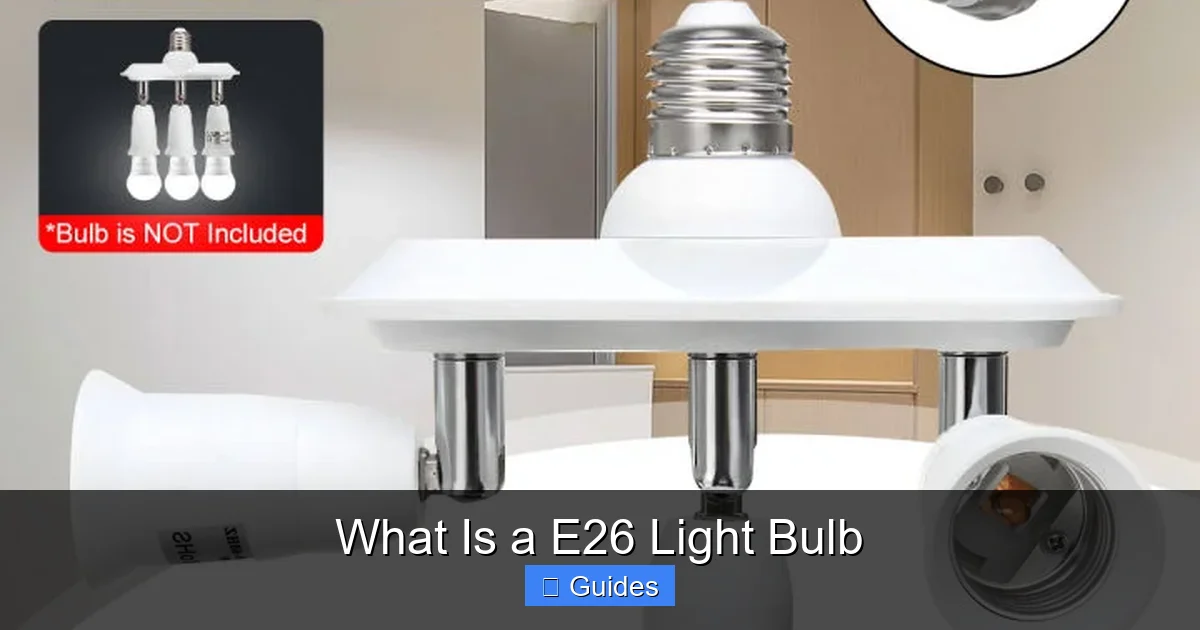
Visual guide about What Is a E26 Light Bulb
Image source: img.lazcdn.com
The Power of Consistency
Imagine a world where every lamp and every light bulb had a different base. Replacing a bulb would be a nightmare! The E26 standard eliminates this chaos. Because the majority of lighting fixtures and lamps sold in North America are designed with an E26 socket, you can be confident that most light bulbs you buy will fit. This consistency simplifies everything, from manufacturing processes to how you shop for replacements.
Historical Dominance
The Edison screw design gained traction very early in the history of electric lighting. As electricity became more widespread and residential lighting became a staple, manufacturers converged on a few key base types, with the medium Edison screw (E26) emerging as the dominant standard for general-purpose lighting in North America. This historical momentum has carried through to today, even as bulb technologies have evolved dramatically.
Consumer Convenience
For you, the consumer, the prevalence of the E26 light bulb means unparalleled convenience. You don’t need to measure your socket or worry about intricate compatibility charts for most indoor and many outdoor applications. If you have a lamp or a fixture, chances are an E26 light bulb will work. This ease of use is a major reason why it continues to be the most popular choice.
Understanding E26 Bulb Types and Technologies
The E26 base is incredibly versatile. It doesn’t dictate what kind of light the bulb produces, only how it connects to power. This means you can find E26 light bulbs in virtually every lighting technology available on the market. Let’s explore the main types:
Incandescent E26 Bulbs
These are the classic, traditional light bulbs most people grew up with. They produce light by heating a filament inside a glass bulb. While known for their warm, inviting glow, incandescent E26 bulbs are also very inefficient, converting most of their energy into heat rather than light. Due to energy efficiency regulations, they are becoming increasingly rare and are often being phased out in many regions.
Halogen E26 Bulbs
Halogen bulbs are a type of incandescent bulb, but they contain a halogen gas that helps extend the filament’s life and makes them slightly more efficient than traditional incandescents. They typically produce a brighter, whiter light. You can find E26 halogen bulbs, but like incandescents, they are also less energy-efficient compared to newer technologies.
CFL (Compact Fluorescent Lamp) E26 Bulbs
CFLs became popular as a more energy-efficient alternative to incandescents. They work by passing an electric current through a tube containing argon and a small amount of mercury vapor, producing ultraviolet light that then excites a fluorescent coating on the inside of the bulb, making it glow. E26 CFL bulbs consume significantly less energy and last much longer than incandescents. However, they contain mercury and can take a moment to reach full brightness, and their light quality can sometimes be inconsistent.
LED (Light Emitting Diode) E26 Bulbs
LED E26 bulbs represent the pinnacle of modern lighting technology. They produce light by using semiconductors that emit light when an electric current passes through them. LED E26 bulbs are incredibly energy-efficient, using a fraction of the power of incandescents and CFLs. They also have an extremely long lifespan, often lasting for tens of thousands of hours, and they turn on instantly to full brightness. Plus, they offer excellent light quality, with a wide range of color temperatures and brightness levels. For these reasons, LED E26 bulbs are now the dominant choice for new installations and replacements.
Choosing the Right E26 Light Bulb for Your Needs
With so many E26 options available, how do you pick the perfect one? It’s about more than just ensuring the base fits. Here are the key factors to consider:
Brightness (Lumens, Not Watts!)
For a long time, we associated brightness with wattage. “I need a 60-watt bulb!” we’d say. However, wattage measures energy consumption, not light output. With efficient LEDs, a “60-watt equivalent” LED bulb might only consume 8-10 watts. The true measure of brightness is lumens (lm). A typical 60-watt incandescent bulb produces around 800 lumens. When choosing an E26 light bulb, look for the lumen rating to understand how bright it will be.
- For ambient lighting: 400-800 lumens per bulb.
- For task lighting: 800-1600+ lumens, depending on the task.
Color Temperature (Kelvin Scale)
Color temperature, measured in Kelvins (K), describes the “warmth” or “coolness” of the light.
- Warm White (2700K – 3000K): Similar to traditional incandescent bulbs, these cast a yellowish, cozy light. Perfect for living rooms, bedrooms, and dining areas.
- Cool White / Bright White (3500K – 4500K): A more neutral, whiter light, good for kitchens, bathrooms, and offices where you need clarity.
- Daylight (5000K – 6500K): Mimics natural daylight, very bright and slightly blue. Ideal for workspaces, garages, or areas where true color rendering is important.
Choose the color temperature of your E26 light bulb based on the mood and function of the room.
Dimmability
Not all E26 bulbs are dimmable, especially older CFLs or some cheaper LEDs. If you plan to use your E26 bulb with a dimmer switch, make sure the packaging explicitly states “dimmable.” Also, be aware that some LED dimmable bulbs may require an LED-compatible dimmer switch for optimal performance and to avoid flickering.
Smart Features
The world of E26 lighting has embraced smart technology. You can now find E26 LED bulbs that connect to your Wi-Fi, allowing you to control them with your smartphone, voice assistant (like Alexa or Google Assistant), or even integrate them into a smart home system. These bulbs offer features like remote control, scheduling, color changing, and mood settings. They are often slightly more expensive but add a new level of convenience and customization to your lighting.
Energy Efficiency and Lifespan
This is where LED E26 bulbs truly shine. They use significantly less energy than incandescent or halogen bulbs, saving you money on your electricity bill. Furthermore, their extended lifespan means you won’t be replacing them nearly as often, reducing waste and the hassle of frequent bulb changes. Always check the estimated lifespan (in hours) on the packaging.
Installation and Safety Tips for E26 Bulbs
Installing an E26 light bulb is straightforward, but a few safety precautions are always a good idea to keep you and your home safe.
Before You Begin
- Turn Off the Power: This is the most crucial step. Before touching any light fixture or bulb, always turn off the power at the wall switch. For extra safety, you can also flip the corresponding circuit breaker in your electrical panel.
- Let It Cool Down: If you’re replacing an incandescent or halogen E26 bulb, allow it to cool completely before touching it. These bulbs can get extremely hot and cause burns.
The Installation Process
Once the power is off and the old bulb (if any) is cool and removed, gently screw the new E26 light bulb into the socket. Turn it clockwise until it’s snug, but don’t overtighten it. Overtightening can damage the bulb’s base or the socket itself. Once installed, restore power and test your new light!
Matching Wattage (or Wattage Equivalent)
Always check the maximum wattage rating of your light fixture. This rating is usually printed on the fixture itself or inside the socket.
- For Incandescent/Halogen E26 Bulbs: Do not install a bulb with a higher wattage than the fixture’s maximum rating. This can lead to overheating, electrical fires, or damage to the fixture.
- For LED E26 Bulbs: Since LEDs consume very little power, you typically don’t have to worry about exceeding the fixture’s wattage limit. For example, if your fixture says “Max 60W,” you can safely use an “8-watt LED 60-watt equivalent” E26 bulb. The fixture’s maximum rating still applies to the heat it can dissipate, but LEDs produce significantly less heat.
Disposal
Most E26 LED bulbs can be safely disposed of in regular household trash, though checking local recycling guidelines is always a good idea, especially for electronic waste. CFL E26 bulbs, however, contain a small amount of mercury and should be recycled properly at designated collection points to prevent environmental contamination. Many hardware stores offer CFL recycling programs.
The Future of E26: Smart Lighting and Beyond
Even with the rapid advancements in lighting technology, the humble E26 base remains incredibly relevant. Its standardization is a huge advantage, allowing new innovations to slot seamlessly into existing infrastructure.
Smart Home Integration
The E26 form factor is perfectly suited for the smart home revolution. Smart E26 LED bulbs are at the forefront of this trend, offering unparalleled control and customization. Imagine waking up to a gentle, warm light that gradually brightens, or setting your lights to dim automatically when you start a movie. The E26 base ensures that these intelligent bulbs can fit into the same lamps and fixtures you already own, making the transition to a smart home easier than ever.
Continued Evolution
As LED technology continues to evolve, we can expect E26 bulbs to become even more efficient, offer even better light quality, and perhaps integrate new features like advanced occupancy sensors, circadian rhythm lighting, or even visible light communication (Li-Fi). The physical E26 base itself is unlikely to change drastically, precisely because its consistency is its strength.
The E26 light bulb is a testament to enduring design and standardization. From its simple Edison screw origins to its role in powering cutting-edge smart lighting, it continues to be the workhorse of North American illumination. Understanding what an E26 light bulb is empowers you to make smarter, more efficient, and more enjoyable lighting choices for your home and lifestyle.
Conclusion: Illuminating Your World with Confidence
By now, you should feel much more confident about what an E26 light bulb is and why it’s such a fundamental part of lighting in North America. It’s not just a technical specification; it’s a key that unlocks a world of lighting possibilities, from warm ambient glows to bright, functional task lighting.
Remember, the E26 refers to the 26mm diameter Edison screw base, a standard that makes compatibility a breeze. While the base stays consistent, the technology inside an E26 light bulb has transformed dramatically, with energy-efficient, long-lasting, and often smart LED options now dominating the market. When choosing your next E26 bulb, think about lumens for brightness, Kelvin for color temperature, and consider dimmability or smart features to truly tailor your lighting experience.
So, the next time you’re in the lighting aisle or simply changing a bulb at home, you’ll know exactly what an E26 light bulb signifies. You’re not just screwing in a bulb; you’re connecting to a century of innovation and a standard that continues to light up our lives, efficiently and beautifully. Happy lighting!
🎥 Related Video: Standard Light Bulb – Size & Codes | Spec. Sense
📺 AMRE Supply
What does the A19 code describe? What is an E26 base? In this episode of Spec. Sense, Vance shows how to measure and how …
Frequently Asked Questions
What is the difference between an E26 and an E27 bulb?
The primary physical difference is the base diameter: E26 is 26mm, and E27 is 27mm. While they are very similar in size and can sometimes fit interchangeably, the crucial difference lies in their intended voltage. E26 is for 120V systems (North America), while E27 is for 220-240V systems (Europe, Asia, etc.).
How do I know if my fixture needs an E26 light bulb?
In North America, most standard lamps, ceiling lights, and wall sconces use an E26 light bulb. You can usually tell by looking at the existing bulb’s base, which will have a screw-in design around 1 inch in diameter. If there’s an old bulb, check for markings on its base or the fixture itself, which might specify E26 or “medium base.”
Can I put an LED E26 bulb into any fixture that used an incandescent E26 bulb?
In most cases, yes! LED E26 bulbs are designed to be direct replacements for incandescent E26 bulbs. Just ensure the fixture’s maximum wattage rating is not exceeded if you’re replacing with an incandescent, but with LEDs, this is rarely an issue due to their low power draw.
What does “60-watt equivalent” mean for an E26 LED bulb?
“60-watt equivalent” indicates that the LED E26 bulb produces a similar amount of light (lumens) as a traditional 60-watt incandescent bulb. However, the LED version will consume significantly less actual wattage (e.g., 8-10 watts) to achieve that brightness, making it much more energy-efficient.
Are E26 smart bulbs worth the investment?
E26 smart bulbs offer significant convenience and customization, allowing you to control lights remotely, change colors, set schedules, and integrate with smart home systems. While they have a higher upfront cost, their energy efficiency and enhanced functionality often make them a worthwhile investment for those seeking modern, flexible lighting solutions.
How long do E26 LED light bulbs typically last?
E26 LED light bulbs are known for their exceptional longevity. A typical E26 LED bulb can last anywhere from 15,000 to 50,000 hours, depending on the manufacturer and model. This translates to many years of use, significantly longer than incandescent (750-1,000 hours) or CFL (8,000-10,000 hours) E26 bulbs.
