


As an Amazon Associate, We earn from qualifying purchases.
Choosing the right light bulb can seem tricky, but understanding the base is key. The regular light bulb base, most commonly known as E26 in North America and E27 in Europe, is the standard screw-in type you’ll find in most household lamps and fixtures. This guide simplifies identifying your bulb’s base, ensuring you pick the perfect fit every time and avoid frustrating mismatches. Always match the base type for safety and proper function, as even a slightly wrong fit can lead to issues.
What Is a Regular Light Bulb Base
Ever found yourself standing in the light bulb aisle, staring at a dizzying array of shapes, sizes, and numbers, and wondering, “Which one do I need?” It’s a common scenario! One of the biggest culprits for this confusion isn’t just about brightness or color, but something far more fundamental: the light bulb base.
The base of a light bulb is its unsung hero. It’s the part that physically connects the bulb to your lamp or fixture and, crucially, allows electricity to flow, bringing light into your home. While there are many types of light bulb bases out there, most people are looking for what we affectionately call the “regular light bulb base.” But what exactly is that, and why is it so important to get it right?
This guide is here to demystify the world of light bulb bases, focusing on what constitutes a regular light bulb base, how to identify it, and why choosing the correct one is absolutely essential for both functionality and safety. Let’s shed some light on this often-overlooked but vital component!
Key Takeaways
- E26/E27 is the “Regular” Base: The E26 (North America) and E27 (Europe/globally) are the most common screw-in type, widely considered the “regular light bulb base” for household use.
- Functionality is Key: A light bulb base serves two critical roles: providing a secure physical connection to the fixture and establishing electrical contact for power.
- Size Matters: The “E” stands for Edison screw, and the number (26 or 27) denotes the diameter of the base in millimeters. This measurement is crucial for compatibility.
- Beyond the Regular: While E26/E27 dominate, other common bases exist, such as candelabra (E12), intermediate (E17), and various bi-pin bases (GU10, G9, G13), each designed for specific fixtures and purposes.
- Easy Identification: You can identify a light bulb base by checking markings on the bulb, measuring its diameter, or consulting your fixture’s manual. A quick photo can also help at the store.
- Safety First: Always match the bulb’s base type exactly to the fixture’s socket. Using an incompatible base can lead to poor connection, electrical hazards, or damage to the bulb or fixture.
- LED Compatibility: Modern LED bulbs are designed to fit traditional base types, meaning you can often upgrade your old incandescent bulbs to energy-efficient LEDs without changing fixtures, as long as the base matches.
Quick Answers to Common Questions
What does “E” stand for in light bulb bases?
The “E” in light bulb bases like E26 or E27 stands for “Edison screw,” named after Thomas Edison who developed the threaded screw base design.
Can I use an E26 bulb in an E27 socket?
Physically, an E26 bulb can often screw into an E27 socket (and vice versa) due to the minimal 1mm diameter difference. However, it’s crucial to match the voltage; E26 systems are 110-120V, while E27 systems are 220-240V. Using a bulb with the wrong voltage can cause damage or be dangerous.
What is the most common light bulb base in the U.S.?
In the United States, the most common and “regular light bulb base” is the E26, often referred to as the medium or standard Edison screw base.
How do I identify the base type of my old light bulb?
You can identify the base type by checking for markings printed on the bulb’s base or glass, measuring the base’s diameter with a ruler, or referring to your light fixture’s manual or label.
Are all LED bulbs compatible with old fixtures?
Most modern LED bulbs are designed with standard base types (like E26 or E27) to be backward compatible with old incandescent fixtures. As long as the base type matches and the fixture can accommodate the physical size and any heat dissipation requirements, you can usually upgrade to LEDs.
📑 Table of Contents
Understanding the Basics: What is a Light Bulb Base?
Before we dive into what makes a “regular” light bulb base, let’s understand the role of any light bulb base. Simply put, the base is the part of the light bulb that screws or plugs into the light fixture’s socket. It’s much more than just a physical connector; it’s the bridge that completes the electrical circuit, allowing power to flow from your home’s wiring into the bulb itself.
The Dual Function of a Bulb Base
Every light bulb base serves two primary functions:
- Physical Support: It holds the bulb securely in place within the fixture. Without a snug fit, the bulb could wobble, fall out, or fail to make proper contact.
- Electrical Connection: It provides the necessary electrical contacts to power the bulb. For screw-in bases, this involves the threaded metal casing (which connects to the neutral wire) and a small metal contact at the very bottom (which connects to the live wire). Plug-in bases have pins that align with corresponding slots in the fixture.
Getting the base right is non-negotiable. An incorrectly sized or shaped base won’t fit into the socket, or if it does, it won’t make the correct electrical connection. This could lead to a bulb that doesn’t light up, flickers, or, in worst-case scenarios, poses a safety hazard like short circuits or overheating. This is why understanding what a regular light bulb base is, and how it differs from others, is so crucial.
The “Regular” Light Bulb Base: Unpacking E26/E27
When most people think of a “regular light bulb base,” they’re almost certainly picturing an Edison screw base. This type of base is ubiquitous in homes around the world, found in everything from ceiling fixtures and table lamps to outdoor floodlights. The “E” in Edison screw refers to Thomas Edison, who pioneered the design. The number that follows the “E” indicates the diameter of the screw base in millimeters (mm).
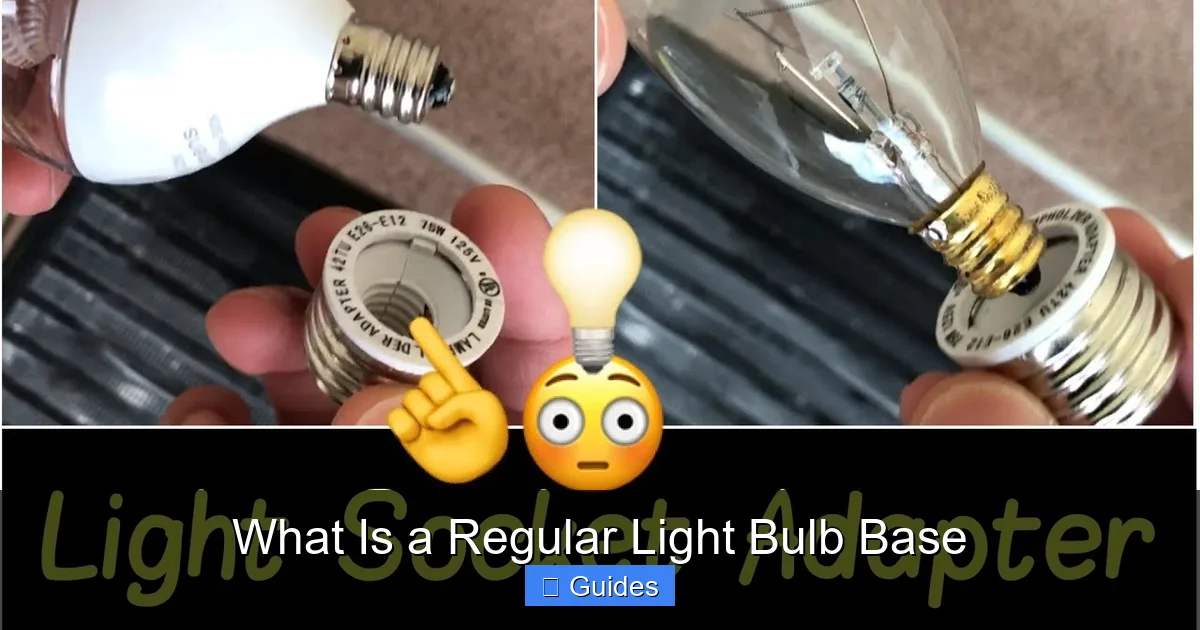
Visual guide about What Is a Regular Light Bulb Base
Image source: i.ytimg.com
The two most common sizes for a regular light bulb base are E26 and E27. These are often used interchangeably in casual conversation, but there’s a subtle yet important distinction.
E26: The North American Standard
The E26 base is the standard screw-in base found throughout North America, including the United States, Canada, and Mexico. It’s also sometimes referred to as the “medium” or “standard” Edison screw. The “26” in E26 means the base has a diameter of 26 millimeters. If you live in North America, chances are that almost all your household lamps, ceiling fans, and general-purpose light fixtures use an E26 base. This is truly the quintessential regular light bulb base in this region.
When you go to buy a new bulb for your desk lamp or the overhead light in your kitchen, if you’re in North America, you’re almost certainly looking for an E26 base. Manufacturers have designed countless bulb shapes and technologies – incandescent, CFL, and especially LED – to fit this widely adopted regular light bulb base, making it easy to find replacements and upgrades.
E27: The European Equivalent and Global Standard
Across the Atlantic, in Europe and many other parts of the world, the E27 base reigns supreme. Like the E26, the “E” stands for Edison screw, and “27” indicates a diameter of 27 millimeters. While it’s a hair larger than the E26, the difference is often visually imperceptible to the untrained eye.
The E27 is the standard “regular light bulb base” in countries that use 220-240V electricity, contrasting with North America’s 110-120V. This base is incredibly common in Australia, New Zealand, and parts of Asia and Africa, solidifying its status as a global standard for household lighting.
Why the Small Difference Matters (and When It Doesn’t)
So, an E26 is 26mm, and an E27 is 27mm. That’s a mere 1-millimeter difference! Can you use an E26 bulb in an E27 socket, or vice versa? Generally, yes, with a caveat.
Due to the small difference in diameter and similar threading, an E26 bulb will often screw into an E27 socket, and an E27 bulb will often fit into an E26 socket. However, while they might physically fit, it’s crucial to understand the electrical context:
- Voltage Differences: The primary distinction between E26 and E27 applications is the voltage. E26 systems run on 110-120V, while E27 systems operate on 220-240V. While a bulb might physically fit, using a 120V E26 bulb in a 240V E27 system (or vice-versa with a 240V bulb in a 120V system) can be dangerous. A 120V bulb in a 240V system will likely burn out instantly or violently, potentially causing a fire. A 240V bulb in a 120V system will probably just glow very dimly, if at all.
- Safety and Performance: For optimal safety and performance, it’s always best to match the bulb’s base type and its intended voltage to your fixture and local electrical grid. Most modern LED bulbs are designed to be “multi-voltage” or have specific voltage ranges, which reduces the electrical risk, but the physical fit is still paramount.
For the purpose of identifying your regular light bulb base, if you’re in North America, think E26. If you’re in Europe or a 220-240V region, think E27. Both are the widely recognized “regular” screw-in types.
Beyond the Regular: Other Common Light Bulb Base Types
While E26 and E27 are the kings of the “regular light bulb base” world, it’s helpful to know that they’re not the only players. Many specialized fixtures and decorative lamps use different base types. Here’s a quick overview of some other common ones you might encounter:
Candelabra (E12)
This is a smaller version of the Edison screw base, often found in chandeliers, decorative wall sconces, and night lights. The “12” indicates a 12mm diameter. These bulbs often have a slender, flame-tip, or torpedo shape, fitting their elegant applications. So, while it’s a screw-in, it’s clearly not the regular light bulb base you’d use for a standard lamp.
Intermediate (E17)
Sitting between the candelabra (E12) and the regular (E26/E27) sizes, the E17 base has a 17mm diameter. It’s less common than E12 or E26 but can be found in some older decorative fixtures, certain appliance bulbs, and sometimes in ceiling fan lights.
Bi-Pin Bases (GU10, G9, G4, Gx.x)
Instead of a screw-in mechanism, bi-pin bases feature two pins that either push into a socket or twist and lock into place. The “G” indicates a bi-pin base, and the number usually refers to the distance between the two pins in millimeters. They are popular for track lighting, spot lighting, and under-cabinet lighting, and often used with halogen or LED MR16/MR11 lamps.
- GU10: Features two thick pins with “feet” that twist and lock into the socket. Common in track lighting and recessed lighting.
- G9: Has two loop-shaped pins that push into the socket. Often found in modern decorative fixtures and smaller lamps.
- G4, GU4, G5.3, G6.35: Smaller bi-pin bases used for low-voltage applications like accent lighting, landscape lighting, or under-cabinet lights.
Medium Bi-Post (G13 for T8/T12 tubes)
Fluorescent tube lights (and their LED replacements) often use bi-pin bases at each end. The G13 base is the most common for standard T8 and T12 fluorescent tubes, with pins 13mm apart. This is a very specific type of base for linear lighting.
Understanding these other types helps highlight why the E26/E27 is considered the “regular light bulb base” – its sheer versatility and prevalence in everyday household fixtures set it apart.
How to Identify Your Light Bulb Base
So, you need a new bulb, but you’re not sure if you need a regular light bulb base or something else. Don’t worry, identifying your bulb’s base is usually quite straightforward. Here are a few reliable methods:
1. Check the Bulb Itself
Most light bulbs, especially newer ones, have markings printed on the base or the glass near the base. Look for codes like “E26,” “E12,” “GU10,” or “G9.” This is the easiest and most reliable way to identify the base type. If it says E26, you’ve found your regular light bulb base!
2. Measure the Diameter (for Screw-in Bases)
If there are no markings, you can measure the diameter of the screw-in base. Simply use a ruler or tape measure to find the width across the threads of the metal base.
- If it’s approximately 26mm (about 1 inch), it’s likely an E26 (your regular light bulb base in North America).
- If it’s approximately 27mm, it’s an E27 (the regular light bulb base in Europe/other regions).
- If it’s around 12mm (about 0.5 inches), it’s an E12 (candelabra).
- If it’s around 17mm (about 0.67 inches), it’s an E17 (intermediate).
For bi-pin bases, measure the distance between the center of the two pins. This will give you the “G” number (e.g., 9mm for G9, 10mm for GU10).
3. Consult Your Fixture’s Manual or Label
Many lamps and light fixtures come with a manual that specifies the recommended bulb type and base. Some fixtures also have a sticker or label inside the socket area that provides this information, often along with maximum wattage recommendations. This can be especially helpful if the existing bulb is missing or damaged.
4. When in Doubt: Take a Picture
If you’re still unsure, unscrew the old bulb and take it with you to the store. Better yet, snap a clear picture of the base from several angles. Most hardware store employees or lighting specialists can quickly identify the base type from a photo, helping you find the right regular light bulb base or specialized alternative.
Choosing the Right Bulb: Tips and Common Mistakes
Now that you know how to identify what is a regular light bulb base and other types, here are some practical tips for buying replacement bulbs and avoiding common pitfalls:
Always Match the Base Type
This is the golden rule. Never try to force a bulb with an incorrect base into a socket. Even if it seems to almost fit, it could damage the socket, break the bulb, or create a dangerous electrical connection. If your fixture takes a regular light bulb base (E26/E27), stick with that. If it needs an E12, don’t try to use an E26.
Consider Wattage and Lumens
While the base ensures physical and electrical compatibility, you also need to think about how much light you want and how much power your fixture can handle. Most fixtures have a maximum wattage rating (e.g., “Max 60W”).
- For Incandescent/Halogen: Never exceed the maximum wattage.
- For LED: LEDs use far less wattage to produce the same light (lumens) as old incandescent bulbs. For example, a “60W equivalent” LED might only draw 9-10W. This means you can often put a much brighter LED bulb (in terms of lumens) into an old fixture without exceeding its wattage limit. Always ensure the physical size of the LED fits the fixture, especially if it’s an enclosed one.
LED vs. Incandescent vs. CFL: Base Compatibility
The good news is that bulb manufacturers have ensured that modern LED and CFL bulbs are designed to fit the same bases as their incandescent predecessors. So, if your lamp uses a regular light bulb base (E26), you can almost certainly find an E26 LED bulb to replace your old E26 incandescent bulb. This makes upgrading to energy-efficient lighting incredibly easy without needing to replace your fixtures.
Smart Bulbs and Base Types
Smart bulbs, which can be controlled via apps or voice commands, also come in a variety of base types. The most popular smart bulbs typically feature a regular light bulb base (E26 or E27) because they are designed to replace standard bulbs in common fixtures. So, if you’re looking to upgrade to smart lighting, check the base type of your current bulb first.
Adapters: Use with Caution
You might see base adapters (e.g., E26 to E12, or E12 to E26). While these can seem like a convenient solution for using a bulb with a different base type, they should be used with extreme caution. Adapters can add length to the bulb assembly, potentially causing it to protrude or not fit inside a fixture’s housing. They can also introduce additional points of failure or heat buildup. It’s almost always better and safer to use a bulb with the correct, native base type for your fixture.
Conclusion
Understanding “what is a regular light bulb base” is a fundamental step in making informed decisions about your home’s lighting. The E26 in North America and the E27 in Europe are the undisputed champions of the household bulb world, forming the backbone of countless lamps and fixtures. Knowing this distinction, along with how to identify different base types, empowers you to choose the right bulb every single time.
Remember, the light bulb base isn’t just about fitting; it’s about making a safe and reliable electrical connection. By paying a little attention to this often-overlooked detail, you’ll ensure your lights shine brightly, safely, and efficiently for years to come. So next time you’re at the store, you’ll walk into that light bulb aisle with confidence, knowing exactly what to look for!
Frequently Asked Questions
What is the primary function of a light bulb base?
The primary function of a light bulb base is twofold: to provide a secure physical connection that holds the bulb in the fixture, and to establish the necessary electrical contact that allows power to flow from the fixture into the bulb, making it light up.
Why is it important to choose the correct light bulb base size?
Choosing the correct light bulb base size is vital for safety and functionality. An incorrect base might not fit, could get stuck, or, more importantly, may not make proper electrical contact, leading to a bulb that doesn’t work, flickers, or even poses a risk of overheating or electrical short circuits.
Are there adapters available for different light bulb bases?
Yes, base adapters are available to convert one base type to another (e.g., E26 to E12). However, they should be used with caution as they can add length to the bulb, potentially cause fitting issues, and may introduce additional points of electrical resistance or failure. It’s generally safer to use a bulb with the native base type.
What are some common light bulb bases besides E26/E27?
Beyond the regular E26/E27 bases, other common types include the E12 (candelabra) for decorative fixtures, E17 (intermediate), and various bi-pin bases like GU10 or G9, often used for spot lighting, track lighting, or smaller accent lights.
Does the “regular light bulb base” (E26/E27) work with all types of bulbs (LED, CFL, Incandescent)?
Yes, the regular light bulb base (E26/E27) is compatible with virtually all bulb technologies, including traditional incandescent, compact fluorescent (CFL), and modern LED bulbs. This design choice ensures that consumers can easily upgrade their lighting to more energy-efficient options without needing to change their existing light fixtures.
What does the number in E26 or E27 signify?
In the E26 or E27 light bulb bases, the number (26 or 27) signifies the approximate diameter of the screw-in base in millimeters (mm). For example, an E26 base has a diameter of 26 millimeters, while an E27 base has a diameter of 27 millimeters.
