


As an Amazon Associate, We earn from qualifying purchases.
Standard light bulb bases define how bulbs connect to fixtures, ensuring compatibility and safety across countless lighting applications. The most common types include screw-in Edison bases like the prevalent E26 (North America) and E27 (Europe), alongside bayonet and bi-pin connectors, each with specific design and size specifications. Understanding these standardized fittings is crucial for selecting the right bulb and maintaining safe, functional illumination.
What Is a Standard Light Bulb Base
Have you ever stood in the lighting aisle of a hardware store, absolutely bewildered by the sheer number of light bulbs, each with a slightly different connection point? You’re not alone! It’s a common scenario: your trusty lamp bulb finally gives up the ghost, and you confidently head out to replace it, only to be met with an array of choices that seem to speak a secret language of letters and numbers. E26? B22? GU10? It can feel like trying to decipher an ancient code just to get some light back into your living room.
But what if I told you that understanding light bulb bases isn’t nearly as complicated as it seems? In fact, once you get a handle on a few key types and how they’re categorized, you’ll be able to confidently pick out the right bulb every single time. It’s all about knowing what a standard light bulb base truly means for your specific fixture and region. Let’s demystify this essential component of every light bulb, transforming confusion into clarity and making your next bulb-buying experience a breeze.
We’re going to dive deep into the world of light bulb bases, exploring the most common types you’ll encounter, how to identify them, and why they’re designed the way they are. By the end of this guide, you’ll not only know what a standard light bulb base refers to in various contexts but also feel like a seasoned pro when it comes to lighting your home efficiently and safely.
Key Takeaways
- Match Base to Fixture: Always ensure your bulb base matches the lamp socket.
- Identify Standard Sizes: E26 is US standard; E27 is common globally. Know these.
- Understand Base Codes: “E” means Edison screw, “B” is Bayonet, “GU” means bi-pin.
- Measure Diameter: Numbers after “E” or “B” indicate the base diameter in millimeters.
- Check Your Old Bulb: The simplest way to determine the correct replacement base.
- Avoid Damage: Forcing a wrong base can harm the bulb or your light fixture.
- Consider Adapters Cautiously: Use adapters carefully; they might affect performance or safety.
Quick Answers to Common Questions
What’s the most common “standard light bulb base” I’ll find in homes?
In North America, the E26 is your go-to standard light bulb base. This “medium” screw base is practically universal for general household lighting, so chances are it’s what you have!
Why are there so many different types of light bulb bases out there?
Different bases exist to ensure the correct bulb fits the right fixture, preventing issues with voltage, wattage, and physical fit. This variety helps maintain safety and proper function across various lighting applications, not just one standard light bulb base.
How can I figure out what standard light bulb base my lamp needs?
The easiest way is to check your old bulb – the base type is often printed on it or clearly visible. If not, look inside the fixture or consult the lamp’s manual to identify the required standard light bulb base.
Can I use an adapter if my new bulb’s base doesn’t quite match my fixture?
While adapters are available to convert between different base types, it’s generally best to use the exact standard light bulb base recommended for your fixture. Adapters should be used cautiously, ensuring they meet safety standards and don’t exceed the fixture’s wattage limits.
What do those letters and numbers on a light bulb base like “E26” or “GU10” actually mean?
The letter usually indicates the base type (like ‘E’ for Edison screw or ‘GU’ for bi-pin), while the numbers typically refer to the diameter of the base in millimeters or the pin spacing. So, E26 means an Edison screw base that’s 26mm in diameter – the classic standard light bulb base!
📑 Table of Contents
Understanding the Basics: Why Bases Matter
At its core, a light bulb base is the crucial link between the bulb itself and your light fixture. It’s not just a decorative cap; it’s an engineered component with several vital jobs. Think of it as the handshake between the power source and the light-emitting part of the bulb. Get this connection wrong, and you’re either left in the dark or, worse, facing a safety hazard.
More Than Just a Connection
The primary role of any standard light bulb base is twofold: to provide a secure physical fit within the fixture and to establish a safe electrical connection. Without a proper fit, the bulb won’t stay in place, and without a reliable electrical connection, it simply won’t light up. Beyond these basics, the base also plays a role in heat dissipation and ensuring proper alignment for optimal light output, especially in directional lighting. It’s a small component doing a lot of heavy lifting.
A World of Shapes and Sizes
When we talk about a “standard light bulb base,” it’s important to remember that “standard” isn’t a universal, one-size-fits-all concept. Standards often vary by region and application. What’s common in North America might be rare in Europe or vice versa. These variations typically stem from historical electrical standards and safety regulations that evolved differently across the globe. Some bases are measured in millimeters (metric), while others might follow older imperial measurements, although most modern designations convert to metric for clarity.
The Dominant Player: Edison Screw Bases
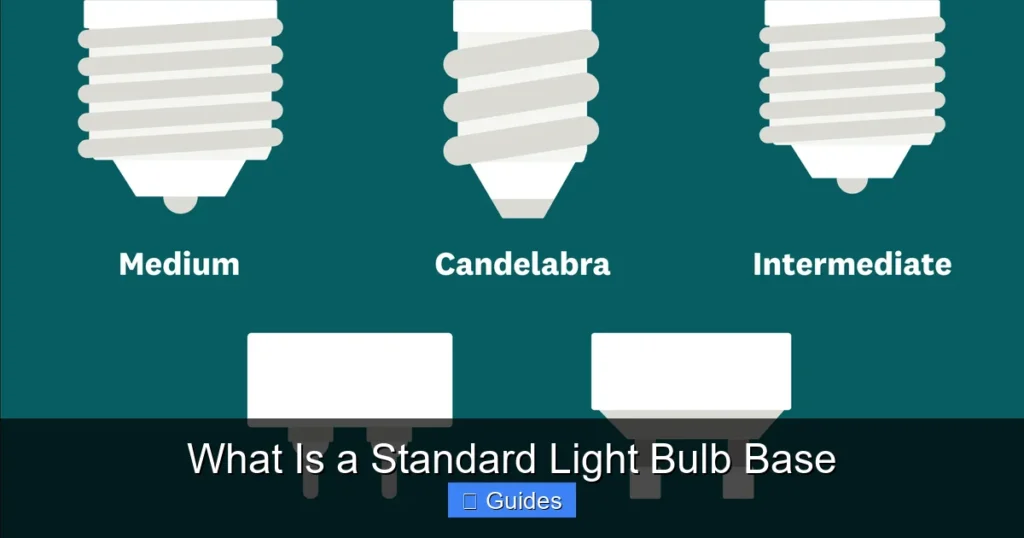
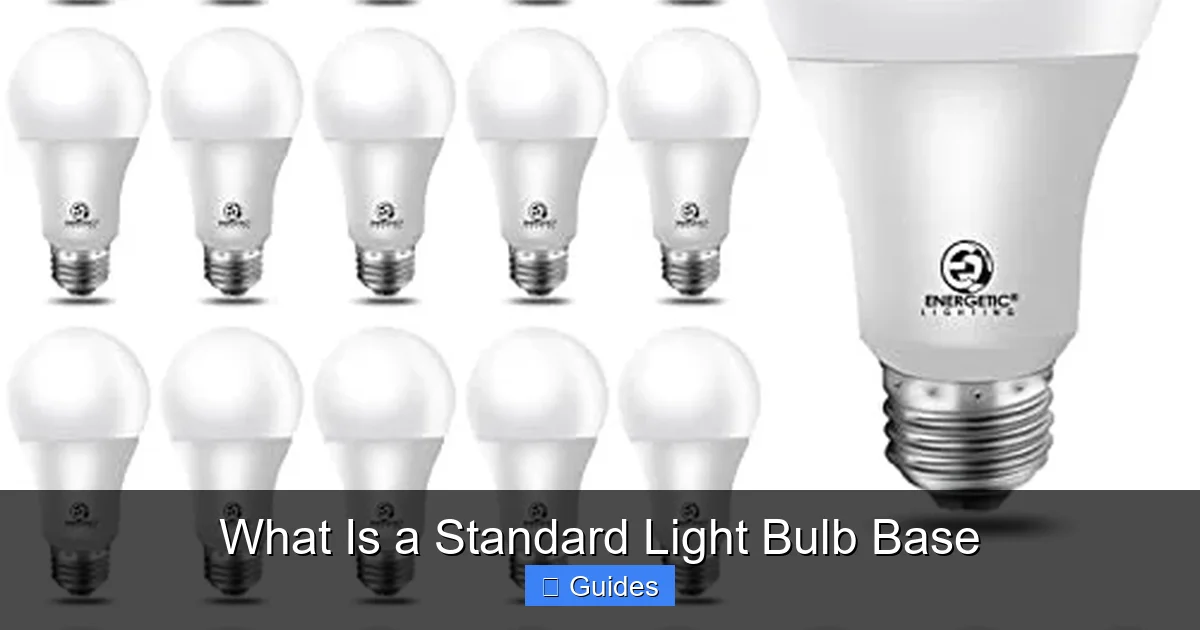
If there’s one type of standard light bulb base that immediately comes to mind for many, it’s likely the Edison screw base. Named after Thomas Edison, who famously patented it, this design has been around for over a century and remains incredibly popular due to its simplicity and effectiveness. It’s a screw-in mechanism, easily identifiable by its threaded metal casing.
Visual guide about What Is a Standard Light Bulb Base
Image source: m.media-amazon.com
E26: The North American Workhorse
In North America, the E26 is undeniably the most common and truly standard light bulb base. The “E” stands for Edison Screw, and the “26” denotes its diameter in millimeters – 26mm. If you’re changing a bulb in a typical table lamp, ceiling fixture, or most household lights in the US or Canada, chances are you’re dealing with an E26. It’s the go-to base for everything from traditional incandescent bulbs to modern CFLs and LED replacements, making it incredibly versatile.
E27: Europe’s Everyday Standard Light Bulb Base
Across the Atlantic, in much of Europe and many other parts of the world, the E27 takes center stage as the standard light bulb base. Functionally, it’s very similar to the E26, featuring the same Edison screw design, but with a diameter of 27mm. While a 1mm difference might seem negligible, and E26 bulbs can sometimes fit into E27 sockets (and vice-versa), it’s crucial to use the correct base for safety and optimal performance, especially considering voltage differences between regions. Always check the bulb’s specified voltage to ensure it matches your fixture’s power supply.
Smaller and Larger Edison Bases (E12, E14, E39, E40)
While E26 and E27 dominate, the Edison screw family has siblings of varying sizes for different applications:
- E12 Candelabra: This smaller base, often just called “candelabra,” is common in decorative fixtures, chandeliers, night lights, and certain appliance bulbs. Its slender profile is perfect for elegant, smaller-scale lighting.
- E14 Small Edison Screw (SES): Similar to the E12 in application but with a slightly larger 14mm diameter, the E14 is prevalent in Europe for smaller lamps, appliance bulbs, and decorative lighting where a compact base is needed.
- E39/E40 Mogul: On the opposite end of the spectrum, the E39 (North America) and E40 (Europe) are robust, large-diameter bases designed for industrial lighting, streetlights, and high-wattage applications. These are the giants of the Edison family, built to handle powerful light sources.
Beyond the Screw: Bayonet Bases
Stepping away from the threaded design, we encounter another widely adopted standard light bulb base: the bayonet cap. Instead of screwing in, these bulbs are inserted and twisted to lock into place using pins that engage with slots in the fixture. This push-and-twist mechanism offers a quick, secure connection, often favored in areas prone to vibrations, like vehicles, or for specific safety reasons.
B22d: The UK and Commonwealth Favorite Standard Light Bulb Base
If you’ve ever visited the UK, Australia, or many other Commonwealth countries, you’ve almost certainly encountered the B22d. This is their equivalent of the E26/E27, serving as the primary standard light bulb base for general household lighting. The “B” stands for bayonet, “22” for its 22mm diameter, and the “d” indicates a double contact point at the bottom for electrical connection. It’s a robust and reliable system, giving a satisfying “click” when properly installed.
Smaller Bayonet Bases (B15d)
Just like the Edison screw, the bayonet family also has smaller versions. The B15d is a miniature bayonet base, often found in appliance lights (like in ovens or refrigerators), older decorative fixtures, or specialized applications where space is limited. It works on the same push-and-twist principle but on a smaller scale, with a 15mm diameter.
Pin Bases and Specialty Connectors
While screw-in and bayonet bases cover a vast majority of general lighting, there’s a whole category of pin bases designed for more specialized applications, particularly in recessed lighting, spotlights, and low-voltage systems. These bases offer precise directional control and are often associated with halogen and more recently, LED technology.
GU10: The Twist-and-Lock Spotlight
The GU10 is a very common standard light bulb base for recessed lighting and track lighting, especially in kitchens and bathrooms. It features two short, stubby pins with enlarged ends that are pushed into the fixture and then twisted to lock securely. The “G” indicates a multi-pin base, the “U” signifies a specific shape (often a reflector bulb), and “10” refers to the 10mm distance between the centers of the two pins. It’s primarily used for mains voltage (120V or 230V) bulbs and is a favorite for directional spot and flood lighting.
Bi-Pin Bases (G4, G9, GU5.3/MR16)
Many specialized light sources use a bi-pin configuration, where two thin pins simply push into a socket. The naming convention typically uses “G” followed by the distance between the pins in millimeters:
- G4 and G9: These are tiny bases for compact capsule-style bulbs. G4 bulbs have pins 4mm apart and are often low voltage (12V), used in decorative lighting, under-cabinet lighting, or small desk lamps. G9 bulbs have pins 9mm apart and are typically mains voltage, found in smaller decorative fixtures or some pendant lights.
- GU5.3 (MR16): This is another prevalent bi-pin base, particularly for low-voltage (12V) MR16 halogen or LED spotlight bulbs. The pins are 5.3mm apart. It’s often seen in track lighting, landscape lighting, and some recessed fixtures where a transformer is used to reduce voltage. It’s crucial not to confuse MR16s (GU5.3) with GU10s, as they are electrically incompatible and require different fixture types.
Fluorescent Tube Bases (G13/T8, G5/T5)
While perhaps not what comes to mind when you hear “standard light bulb base” for a typical home bulb, fluorescent tubes also have their own standardized bases. The G13 base is common for T8 fluorescent tubes, featuring two pins 13mm apart at each end of the tube. T5 tubes, which are thinner and often used in more compact fixtures, typically use a G5 base with pins 5mm apart. These bases are designed to provide stable support and electrical contact along the length of the tube.
Navigating the Numbers and Letters: Decoding Base Codes
By now, you’ve probably noticed a pattern in the naming conventions for light bulb bases. Understanding this simple code is your key to quickly identifying the right bulb. It’s like learning the alphabet of lighting!
The Anatomy of a Light Bulb Base Code
Most standard light bulb base codes follow a logical structure:
- The Letter: This usually indicates the family or type of base.
- ‘E’ for Edison Screw
- ‘B’ for Bayonet Cap
- ‘G’ for bi-pin or multi-pin bases
- The Number: This almost always refers to a measurement in millimeters (mm).
- For Edison and Bayonet bases, it’s the diameter of the base. For example, E26 means an Edison screw base with a 26mm diameter.
- For bi-pin bases, it’s the distance between the centers of the pins. For example, GU10 means a bi-pin base with pins 10mm apart.
- Additional Letters (Optional): Sometimes you’ll see extra letters that provide more detail:
- ‘d’ for double contact (e.g., B22d)
- ‘s’ for single contact
- ‘c’ for candelabra (though often implied with E12)
- ‘U’ in GU signifies a specific type of reflector bulb or universal fit.
Once you grasp this, decoding a bulb’s base becomes second nature. E14? Ah, an Edison screw, 14mm diameter. G9? Got it, two pins 9mm apart.
Adapters and Converters: When You’re Stuck
What happens if you have a favorite lamp with an unusual base, or you move to a new region and your existing bulbs don’t fit the standard light bulb base there? Don’t fret! Adapters and converters are readily available. These handy devices allow you to change one base type to another, for example, converting an E26 socket to fit an E12 bulb, or a B22 socket to accept an E27 bulb. They’re a great solution for maintaining flexibility without rewiring fixtures.
However, always exercise caution when using adapters. Ensure that the adapter itself is certified and that the bulb you’re using does not exceed the wattage or voltage limits of the original fixture, even with the adapter. Overloading a fixture can be a fire hazard.
Choosing the Right Base: Practical Tips and Safety First
Armed with this knowledge, you’re now much better equipped to handle your lighting needs. But let’s consolidate this into actionable advice to ensure you always make the right choice, safely.
Common Light Bulb Bases at a Glance
| Base Code | Type | Description / Diameter | Typical Regions / Use |
|---|---|---|---|
| E26 | Edison Screw | 26mm diameter | North America (Standard Household) |
| E27 | Edison Screw | 27mm diameter | Europe, Asia, Australia (Standard Household) |
| E12 | Edison Screw | 12mm diameter (Candelabra) | North America (Chandeliers, Night Lights) |
| E14 | Edison Screw | 14mm diameter (Small Edison Screw) | Europe (Smaller Lamps, Appliances) |
| B22d | Bayonet Cap | 22mm diameter, double contact | UK, Ireland, Australia (Standard Household) |
| GU10 | Bi-Pin | Pins 10mm apart (Twist-and-Lock) | Recessed Lighting, Spotlights (Mains Voltage) |
| GU5.3 | Bi-Pin | Pins 5.3mm apart | MR16 Spotlights (Low Voltage) |
| G9 | Bi-Pin | Pins 9mm apart (Loop Pins) | Decorative Fixtures, Capsule Bulbs (Mains Voltage) |
Always Check the Fixture
The golden rule when replacing a bulb is always to check the existing bulb or, if that’s missing, the fixture itself. Most fixtures have labels indicating the required base type and maximum wattage. If you’re replacing an old bulb, take it with you to the store or, even easier, snap a clear photo of the base. This simple step eliminates all guesswork about what standard light bulb base you need.
Understand Wattage and Voltage Compatibility
The light bulb base only dictates the physical and initial electrical connection. You also need to consider wattage and voltage. Never exceed the maximum wattage rating of your fixture, regardless of the bulb type (incandescent, CFL, or LED). LEDs draw significantly less power, so a 60W equivalent LED bulb is often only 8-10W, well within most fixture limits. For voltage, be mindful that some bases (like GU5.3/MR16) are typically low voltage (12V) and require a transformer, while others (E26, B22, GU10) are mains voltage (120V or 230V). Mixing these up can damage the bulb, the fixture, or even pose a safety risk.
The Future is Flexible: Smart Bulbs and Universal Bases
Even with the rise of smart home technology, the humble light bulb base remains fundamental. Most smart bulbs are designed to fit common standard light bulb base types like E26, E27, B22, and GU10, allowing for easy integration into existing fixtures. This ensures that smart lighting is accessible without requiring complex electrical work, making the transition to connected homes smoother and more user-friendly. The evolution of lighting continues, but the base continues to be its essential foundation.
So, the next time you’re faced with a dead bulb and a dizzying array of options, take a deep breath. You now have the knowledge to confidently identify your standard light bulb base. No more fumbling, no more guesswork. Just a clear understanding that empowers you to choose the right bulb, every single time, making your home brighter and your life a little simpler. Happy lighting!
Frequently Asked Questions
What is considered the standard light bulb base in North America?
The most common and widely recognized standard light bulb base in North America is the E26 medium screw base. This refers to a base with a diameter of 26 millimeters that screws into the socket, making it prevalent in most household lamps and fixtures.
What does “E26” mean when referring to a light bulb base?
“E26” specifically identifies an Edison screw base with a diameter of 26 millimeters. The “E” stands for Edison, referring to the screw-in type connection, while “26” denotes its measurement in millimeters. This is the predominant standard light bulb base in the United States and Canada.
Are there different sizes of light bulb bases, even for standard ones?
While E26 is the standard medium size, there are indeed other sizes, even within the Edison screw type, such as E12 (candelabra) and E17 (intermediate). These are typically used for smaller decorative bulbs, appliances, or specialized fixtures. However, E26 remains the most common standard for general lighting.
How do I know which standard light bulb base my lamp needs?
You can typically determine the required base size by looking at the base of your existing bulb or checking the lamp fixture itself. Most lamps will use the E26 medium standard light bulb base, but for smaller decorative fixtures or chandeliers, an E12 candelabra base might be necessary. When in doubt, it’s best to remove the old bulb and compare its size.
Can I use a light bulb with a different base size in my standard lamp?
Generally, no, you cannot directly use a light bulb with a different base size in a lamp designed for a standard light bulb base without an adapter. Using an incompatible base can damage the bulb or fixture, or prevent the bulb from making proper electrical contact. Always match the bulb’s base to the lamp’s socket type.
Is the standard light bulb base the same worldwide?
No, the “standard” light bulb base varies by region. While E26 is standard in North America and parts of Central/South America, the E27 base (which is very similar but has slightly different electrical standards) is common in Europe and many other parts of the world. Other regions might use different base types like bayonet fittings (B22).
