


As an Amazon Associate, We earn from qualifying purchases.
An E26 light bulb is the most common screw-in light bulb type in North America, characterized by its medium-sized, 26mm diameter Edison screw base. This standard ensures compatibility with most household fixtures, making it incredibly versatile for everything from ceiling lights to table lamps. Understanding the E26 specification helps you choose the right bulb for brightness, energy efficiency, and desired ambiance.
What Is an E26 Light Bulb?
Have you ever found yourself in the light bulb aisle, staring at a dizzying array of boxes, wondering which one is the right fit for your lamp? It’s a common dilemma! Among the various codes and numbers, you’ll almost certainly come across “E26.” But what exactly does that mean? Why is it so important? And why does it seem to be everywhere?
In simple terms, an E26 light bulb is the most common, workhorse light bulb you’ll find in homes and businesses across North America. It’s the standard screw-in base that fits into the vast majority of your lamps, ceiling fixtures, and outdoor lights. Understanding what “E26” signifies is not just about making the right purchase; it’s about ensuring safety, compatibility, and ultimately, getting the light you need where you need it.
This comprehensive guide will demystify the E26 light bulb, breaking down its definition, historical significance, technical specifications, and how to choose the perfect one for every corner of your life. Get ready to illuminate your understanding of this essential household item!
Key Takeaways
- E26 is the Standard: The E26 light bulb is the dominant screw-in base type in North America, featuring a 26mm diameter “Edison screw” base, making it compatible with most household fixtures.
- Interchangeable with E27: While E26 is for 120V systems (North America) and E27 for 220-240V systems (Europe/Asia), their base dimensions are nearly identical, allowing physical interchangeability. However, it’s crucial to match the bulb’s voltage to your electrical system for safety and proper function.
- Versatility in Technology: E26 bulbs are available across all major lighting technologies, including incandescent, halogen, CFL, and LED, offering a wide range of options for brightness, color temperature, and energy efficiency.
- Key Specifications Beyond Base: When choosing an E26 light bulb, consider not just the base, but also lumens (brightness), Kelvin (color temperature), wattage (power consumption), and bulb shape (A19, BR30, PAR38, etc.) to meet your specific lighting needs.
- Easy Installation and Replacement: E26 bulbs are designed for simple screw-in installation, making them user-friendly for everyday replacement and upgrades in residential and commercial settings.
- Energy Efficiency is Key: Modern E26 LED light bulbs offer significant energy savings and a longer lifespan compared to older incandescent or CFL counterparts, contributing to lower utility bills and reduced environmental impact.
- Safety and Compatibility: Always ensure the wattage of your E26 light bulb does not exceed the fixture’s maximum rating to prevent overheating. For dimmable fixtures, ensure you use a dimmable E26 bulb.
Quick Answers to Common Questions
What does “E26” mean for a light bulb?
The “E” in E26 stands for “Edison Screw,” referring to the threaded base design. The “26” indicates that the diameter of this screw base is 26 millimeters, which is the standard medium screw base size in North America.
Is an E26 light bulb the same as an E27?
Physically, E26 (26.05mm) and E27 (26.90mm) bases are nearly identical in size and often interchangeable. However, E26 bulbs are for 120V systems (North America), while E27 bulbs are for 220-240V systems (Europe/Asia). It’s crucial to match the bulb’s voltage to your electrical system for safety.
Can I use an E26 LED bulb in any E26 fixture?
Generally, yes, as long as the fixture is rated for the bulb’s wattage (or equivalent for LED) and the physical size/shape of the E26 LED light bulb fits. If the fixture is dimmable, ensure the E26 LED bulb is specifically labeled as “dimmable.”
How do I know what brightness an E26 light bulb provides?
Brightness for any E26 light bulb is measured in lumens (lm), not watts. Higher lumen numbers indicate a brighter bulb. Watts now refer to energy consumption. Check the packaging for the lumen rating to understand its actual light output.
What’s the best type of E26 light bulb for energy efficiency?
E26 LED light bulbs are by far the most energy-efficient option available today. They consume significantly less power, last much longer, and generate less heat compared to incandescent or CFL E26 bulbs.
📑 Table of Contents
- Understanding the Basics: What an E26 Light Bulb Truly Is
- Why E26 is the North American Standard
- The Anatomy of an E26 Light Bulb
- Choosing the Right E26 Light Bulb for Your Needs
- Installation, Maintenance, and Safety Tips for E26 Bulbs
- The Future of E26: Energy Efficiency and Smart Lighting
- Conclusion
Understanding the Basics: What an E26 Light Bulb Truly Is
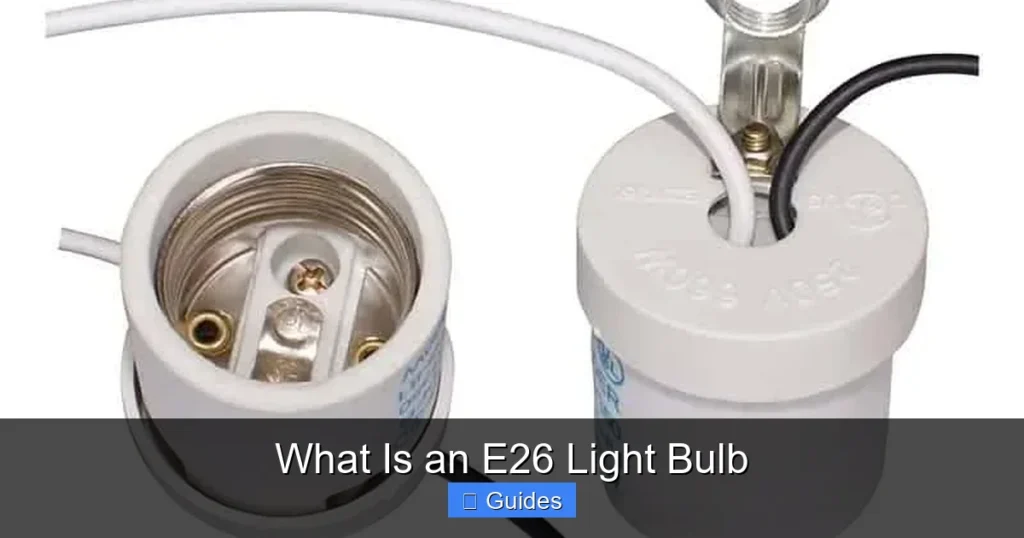
Let’s start with the core definition. The “E” in E26 stands for “Edison Screw,” named after Thomas Edison, who commercialized the screw-in bulb. The “26” refers to the diameter of the screw base in millimeters (mm). So, an E26 light bulb is simply a light bulb with an Edison screw base that measures 26 millimeters across.
This specific dimension makes it the medium-sized standard for screw-in bases in regions operating on 120-volt electricity, primarily North America. If you pick up a typical household light bulb in the United States, Canada, or Mexico, chances are it’s an E26 light bulb. Its widespread adoption means that fixtures are designed to accommodate this size, simplifying replacements and ensuring compatibility throughout your home.
The “Edison Screw” Legacy
The Edison screw base, with its threaded design, revolutionized lighting by providing a simple, secure, and conductive connection between the bulb and the fixture. Before this innovation, various proprietary and often complex base designs made light bulb replacement a confusing task. Edison’s standardized design meant that one type of bulb could fit many different fixtures, paving the way for mass adoption of electric lighting. The E26 light bulb is a direct descendant of this legacy, carrying forward a design principle that has stood the test of time.
Why is E26 so Common?
The reason for the E26 light bulb’s prevalence in North America dates back to the early days of electrification. When electrical grids and standards were being established, a specific voltage (around 120V) and a corresponding base size were chosen for residential and commercial use. The E26 size proved to be robust enough for its purpose, easy to manufacture, and safe for consumer handling. Over decades, this standard became deeply embedded in electrical infrastructure and product design, making the E26 light bulb the undisputed champion of general lighting.
Why E26 is the North American Standard
Visual guide about What Is an E26 Light Bulb
Image source: m.media-amazon.com
While the E26 light bulb is ubiquitous in North America, you might encounter similar-looking bulbs in other parts of the world, like the E27. This can cause some confusion, but understanding the subtle differences is key to safe and effective lighting.
E26 vs. E27: The Voltage Divide
The primary distinction between an E26 light bulb and an E27 light bulb lies in the electrical system they are designed for.
- E26 light bulbs are designed for 120-volt (V) electrical systems, which are standard in North America.
- E27 light bulbs are designed for 220-240V electrical systems, common in Europe, Asia, and many other parts of the world.
Physically, the base dimensions are almost identical. An E26 base measures exactly 26.05 mm in diameter, while an E27 base is typically 26.90 mm. This minuscule difference means an E26 light bulb will often physically screw into an E27 fixture, and vice versa. However, this physical compatibility does *not* mean electrical compatibility.
The Dangers of Mismatching Voltage
Attempting to use an E26 light bulb (rated for 120V) in a 220-240V fixture can lead to immediate failure, a bright flash, a pop, and potentially a fire hazard. The bulb’s components are not designed to handle the higher voltage, causing them to overload rapidly. Conversely, using an E27 light bulb (rated for 220-240V) in a 120V fixture will usually result in the bulb glowing very dimly or not at all, as it’s not receiving enough voltage to operate properly.
Always ensure the voltage rating of your E26 light bulb matches the voltage of your electrical system and fixture. This is a critical safety consideration and ensures your bulbs function as intended for their full lifespan.
The Anatomy of an E26 Light Bulb
Beyond the screw base, an E26 light bulb encompasses several other crucial characteristics that determine its performance and suitability for various applications. Understanding these features will empower you to make informed decisions when purchasing.
Bulb Shape and Size Codes
While “E26” describes the base, the shape and overall size of the glass envelope are denoted by other codes. These shape codes help you choose a bulb that fits your fixture physically and aesthetically.
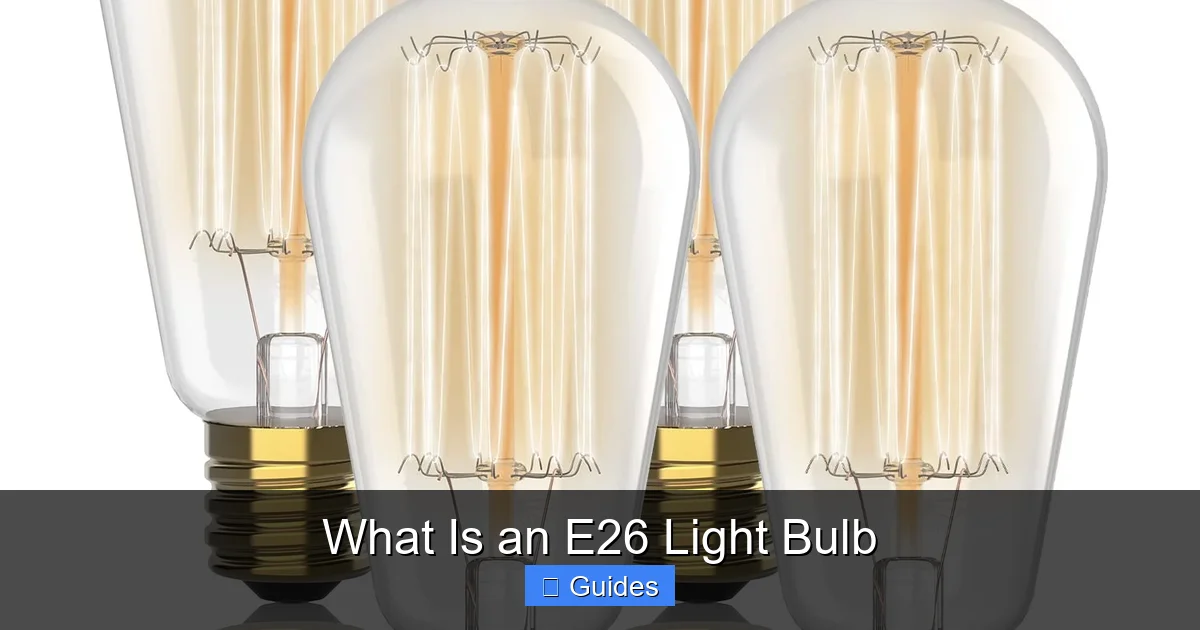
- A19: This is the classic “standard” pear-shaped bulb most people picture. The “A” denotes the arbitrary shape, and “19” indicates its diameter is 19/8ths of an inch (approx. 2.375 inches or 60mm). Most general-purpose E26 light bulbs are A19.
- BR (Bulged Reflector): BR bulbs have a wider, bulged shape designed to spread light over a broad area. Common for recessed lighting. Examples include BR30 (30/8ths inch diameter) and BR40.
- PAR (Parabolic Aluminized Reflector): PAR bulbs are directional, producing a more focused beam of light. They are often used for track lighting or outdoor floodlights. Examples include PAR20, PAR30, and PAR38.
- G (Globe): Globe-shaped bulbs, like G25 or G30, are often used in decorative fixtures where the bulb is visible, such as vanity lights.
- C (Candle): C7, C9, C15 bulbs are slender, often flame-tipped, and ideal for chandeliers or decorative applications.
When buying an E26 light bulb, always consider the required shape to ensure it fits physically and provides the desired light distribution.
Understanding Lumens vs. Watts
For a long time, we associated brightness with wattage. A “100-watt bulb” meant a bright bulb. However, with the advent of energy-efficient technologies, wattage now primarily indicates power consumption, not brightness.
- Lumens (lm): This is the true measure of a light bulb’s brightness. The higher the lumen count, the brighter the E26 light bulb will be. For example, a standard 60-watt equivalent incandescent bulb might produce 800 lumens, while an LED bulb achieving the same brightness might only consume 9-10 watts.
- Watts (W): This measures the amount of electrical power the bulb consumes. Lower wattage for the same lumen output means higher energy efficiency.
When replacing an old E26 incandescent bulb, look for the lumen equivalent rather than just matching the wattage.
Color Temperature (Kelvin)
Color temperature, measured in Kelvin (K), describes the hue of the light emitted by an E26 light bulb.
- Warm White (2700K-3000K): Emits a soft, yellowish light, similar to traditional incandescent bulbs. Ideal for bedrooms, living rooms, and areas where a cozy, relaxing atmosphere is desired.
- Cool White / Bright White (3500K-4100K): A more neutral, whiter light. Good for kitchens, bathrooms, offices, or workshops where clarity and task lighting are important.
- Daylight (5000K-6500K): Mimics natural daylight with a bluish-white hue. Best for areas requiring high visibility, intricate tasks, or promoting alertness.
Choosing the right color temperature for your E26 light bulb can dramatically impact the mood and functionality of a space.
Choosing the Right E26 Light Bulb for Your Needs
With an understanding of the E26 standard and its various specifications, you can now confidently select the ideal E26 light bulb for any application. Here’s a look at the different technologies and factors to consider.
Types of E26 Light Bulbs
The E26 base is incredibly versatile, accommodating various lighting technologies:
- Incandescent: The oldest technology, producing light by heating a filament. These E26 light bulbs offer warm, pleasant light but are highly inefficient, generate a lot of heat, and have a short lifespan. Many are being phased out.
- Halogen: A more efficient form of incandescent, using halogen gas to improve lifespan and light output. Still less efficient than CFLs or LEDs, but known for crisp, bright white light.
- CFL (Compact Fluorescent Lamp): A spiral-shaped E26 light bulb that is more energy-efficient than incandescent but contains mercury and takes time to reach full brightness. They offer a longer lifespan than incandescent but are now largely superseded by LEDs.
- LED (Light Emitting Diode): The most energy-efficient and longest-lasting option available. E26 LED light bulbs come in various shapes, brightnesses, and color temperatures, consume very little power, and offer instant full brightness. They are the clear choice for modern lighting.
For most applications, an E26 LED light bulb is the superior choice due to its efficiency, longevity, and versatility.
Practical Examples and Tips for Selection
* Living Room Ambiance: Opt for E26 LED A19 bulbs with 800-1100 lumens (60-75W equivalent) in a warm white (2700K-3000K) color temperature. If your fixture is dimmable, ensure you buy “dimmable E26 LED” bulbs for adjustable mood lighting.
* Kitchen Task Lighting: Choose brighter E26 LED A19 or BR30 bulbs (1100-1600 lumens, 75-100W equivalent) in a cool white (3500K-4100K) or daylight (5000K) color temperature for clarity when cooking.
* Outdoor Floodlights: Look for weather-resistant E26 PAR38 LED bulbs with high lumen output (1500+ lumens) and a durable construction. Daylight (5000K-6500K) is often preferred for security.
* Decorative Fixtures (Chandeliers, Vanity): Select E26 C-shape (candle) or G-shape (globe) LED bulbs with appropriate lumens and color temperature to complement the fixture’s design. Filament LEDs can offer a vintage look.
* Recessed Lighting: E26 BR30 or PAR30 LED bulbs are often best for recessed cans, as their reflector design helps direct light downward effectively.
Always check the fixture’s maximum wattage rating. Even if you’re using an E26 LED light bulb that consumes much less power, it’s a good habit to stay within the recommended limits.
Installation, Maintenance, and Safety Tips for E26 Bulbs
Installing and maintaining E26 light bulbs is generally straightforward, but a few key practices ensure safety and extend the life of your bulbs and fixtures.
Simple Installation Steps
Installing an E26 light bulb is as easy as screwing it in, but always follow these steps:
- Turn off the power: The most crucial step. Always switch off the light fixture at the wall switch and, for added safety, turn off the circuit breaker that controls the fixture.
- Allow cooling: If replacing an old incandescent or halogen bulb, let it cool down before touching, as it can be very hot.
- Unscrew the old bulb: Twist the old bulb counter-clockwise until it comes out. If it’s stuck, a rubber glove or a bulb changer tool can help.
- Screw in the new E26 light bulb: Gently screw the new E26 bulb clockwise into the socket until it is finger-tight. Do not overtighten, as this can damage the socket or the bulb.
- Restore power: Turn the circuit breaker back on, then the wall switch, and enjoy your new light!
Maintenance and Lifespan
Modern E26 LED light bulbs require very little maintenance beyond occasional dusting. Their long lifespan (20,000-50,000 hours or more) means replacements are infrequent.
* Dusting: Periodically wipe down bulbs with a dry or slightly damp cloth (when the power is off) to ensure maximum light output.
* Dimmer Compatibility: If using a dimmer, ensure your E26 LED light bulb is explicitly labeled as “dimmable.” Using non-dimmable LEDs on a dimmer can cause flickering, buzzing, and damage to the bulb or dimmer. Also, ensure your dimmer switch is compatible with LED technology (many older dimmers are designed for incandescent loads).
* Proper Disposal: Incandescent and halogen E26 bulbs can generally be disposed of with regular household waste. CFL bulbs contain mercury and should be recycled at designated collection points. E26 LED light bulbs should ideally be recycled at electronic waste facilities due to their electronic components.
Safety First
* Match Voltage: As discussed, ensure your E26 light bulb’s voltage matches your electrical supply.
* Respect Wattage Limits: Never exceed the maximum wattage rating of your light fixture. Even if an LED consumes less power, this rating is for safety, preventing overheating of the wiring and socket.
* Outdoor Use: Use only E26 bulbs rated for outdoor or damp locations in outdoor fixtures. These often have specialized seals or robust construction.
* Inspect Sockets: Before screwing in a new E26 light bulb, quickly inspect the socket for any signs of damage or corrosion. If you see any, consult an electrician.
The Future of E26: Energy Efficiency and Smart Lighting
The journey of the E26 light bulb is far from over. While the base standard remains, the technology within the bulb continues to evolve at a rapid pace, primarily driven by advancements in LED and smart home technology.
The Dominance of E26 LED Light Bulbs
E26 LED light bulbs have already revolutionized home lighting, offering unparalleled energy efficiency, durability, and versatility. The future will see even further improvements:
* Higher Efficiency: LEDs will continue to become more efficient, providing more lumens per watt, further reducing energy consumption.
* Better Light Quality: Expect improvements in color rendering index (CRI), making colors appear more vibrant and true under LED light.
* Smaller Form Factors: E26 LED bulbs will likely become even more compact, allowing for greater design flexibility in fixtures.
E26 and Smart Home Integration
The E26 light bulb is at the forefront of the smart home revolution. Smart E26 LED bulbs can be controlled wirelessly via smartphones, voice assistants, or smart home hubs. This allows for:
* Remote Control: Turn lights on/off, dim, or change color from anywhere.
* Scheduling: Set lights to come on and off at specific times.
* Tunable White and Color-Changing: Adjust the color temperature from warm to cool white, or even choose from millions of colors to create dynamic ambiance.
* Integration with Scenes: Create custom lighting “scenes” for different activities (e.g., “movie night,” “reading,” “dinner”).
* Energy Monitoring: Some smart E26 bulbs can even track energy usage, helping you understand and manage your consumption.
As smart home technology becomes more mainstream, the E26 light bulb will continue to be a key component, seamlessly integrating into our connected lives and offering unprecedented levels of control and customization. The future of the E26 is not just about illumination; it’s about intelligent, adaptive lighting that enhances our environments and our lives.
Conclusion
From its humble beginnings as an “Edison Screw” standard, the E26 light bulb has evolved into the cornerstone of North American lighting. It’s more than just a piece of glass and metal; it’s a symbol of standardization, innovation, and progress in how we illuminate our world.
By understanding what an E26 light bulb is, why it’s the standard, and the various factors that influence its performance – from lumens and Kelvin to bulb shape and technology – you are now equipped to navigate the light bulb aisle with confidence. Embrace the efficiency and versatility of modern E26 LED light bulbs, and consider venturing into the exciting world of smart lighting. With the right E26 bulb, you can transform any space, enhance your daily routines, and enjoy brilliant, energy-saving illumination for years to come.
Frequently Asked Questions
What is the most common E26 bulb shape?
The most common E26 bulb shape is the A19, which is the traditional pear-shaped bulb familiar to most households. The “A” refers to its arbitrary shape, and “19” indicates its diameter is 19/8ths of an inch.
Can an E26 light bulb be used outdoors?
Yes, E26 light bulbs can be used outdoors, but it’s essential to ensure both the bulb and the fixture are rated for outdoor or damp locations. Look for specific outdoor-rated E26 LED bulbs, often PAR or BR shapes, that can withstand weather elements.
How long do E26 LED light bulbs typically last?
E26 LED light bulbs have an impressively long lifespan, typically ranging from 15,000 to 50,000 hours or even more. This can translate to several years of use, significantly reducing the frequency of bulb replacements compared to older technologies.
Do I need a special dimmer for an E26 LED light bulb?
Yes, if you want to dim an E26 LED light bulb, you must use a bulb explicitly labeled “dimmable” and an LED-compatible dimmer switch. Older dimmer switches designed for incandescent bulbs may cause flickering, buzzing, or damage to LED bulbs.
What’s the difference between “warm white” and “daylight” E26 light bulbs?
The difference lies in their color temperature, measured in Kelvin (K). “Warm white” E26 bulbs typically range from 2700K-3000K, emitting a cozy, yellowish light. “Daylight” E26 bulbs are usually 5000K-6500K, producing a bright, bluish-white light similar to natural daylight.
Are all E26 light bulbs interchangeable regardless of brand?
As long as the E26 light bulb has the correct E26 base, voltage, and the physical shape fits your fixture, bulbs from different brands are generally interchangeable. However, quality, light output, color accuracy, and dimming performance can vary between brands.
