


As an Amazon Associate, We earn from qualifying purchases.
The invention of the light bulb wasn’t the work of a single genius but the culmination of centuries of experimentation and the contributions of many brilliant minds. While Thomas Edison is widely celebrated for developing the first commercially practical and long-lasting incandescent light bulb, other inventors like Humphry Davy, Joseph Swan, and many more played crucial roles in laying the groundwork and improving the technology. It was a collaborative effort, building upon previous discoveries to illuminate our world.
Hello there! Have you ever found yourself wondering, “Who made the light bulb?” It’s one of those classic questions, isn’t it? And if you’re like most people, a very famous name probably popped into your head almost immediately: Thomas Edison. It’s a name synonymous with innovation, and indeed, his contribution to bringing electric light into our homes was absolutely monumental.
But here’s a little secret that’s not so secret among historians of science: the story of who made the light bulb is far richer and much more complex than a single inventor having a sudden “eureka!” moment. In reality, the journey from early flickering experiments to the reliable glow we take for granted today involved countless brilliant minds, decades of painstaking research, and a fascinating blend of competition and collaboration across continents. It’s a tale of incremental progress, failed experiments, and persistent ingenuity, truly showing that even the brightest ideas stand on the shoulders of many giants.
So, let’s embark on a fascinating journey to explore the true history behind this world-changing invention. We’ll peel back the layers of popular myth and discover the unsung heroes and pivotal moments that illuminated our world, helping us understand that “who made the light bulb” is a question with a multi-faceted, captivating answer.
Key Takeaways
- No Single Inventor: The light bulb, as we know it, was not invented by one person but evolved through the contributions of numerous scientists and inventors over many decades.
- Humphry Davy’s Early Work: In the early 19th century, Humphry Davy demonstrated the first electric arc lamp, providing an initial step toward practical electric lighting.
- Joseph Swan’s Breakthrough: British inventor Joseph Swan developed a functional incandescent light bulb with a carbonized paper filament and a good vacuum in the 1860s and 70s, independently of Edison.
- Thomas Edison’s Commercial Success: Thomas Edison is largely credited for inventing the *first commercially practical and long-lasting* incandescent light bulb, focusing on a robust filament and an entire electrical distribution system.
- The Importance of the System: Edison’s genius lay not just in the bulb itself, but in creating a complete, economically viable system of electricity generation, distribution, and a durable bulb that could be used in homes.
- Continuous Innovation: The light bulb continued to evolve significantly after Edison and Swan, with improvements like the tungsten filament, leading to greater efficiency and lifespan, and eventually to modern LED technology.
- Collaboration and Iteration: The story of the light bulb is a powerful example of how major inventions are often the result of continuous iteration, shared knowledge, and the work of many minds building on each other’s discoveries.
Quick Answers to Common Questions
Who is often credited with inventing the light bulb?
Thomas Edison is most commonly credited with inventing the light bulb due to his development of the first commercially practical and long-lasting incandescent bulb.
Did Thomas Edison invent the very first electric light?
No, Edison did not invent the very first electric light. Early forms, like the electric arc lamp, were demonstrated by Humphry Davy decades before Edison.
Who was Joseph Swan and what was his role?
Joseph Swan was a British physicist and chemist who developed an independent and effective incandescent light bulb with a carbon filament and good vacuum around the same time as Edison.
What made Edison’s light bulb so revolutionary?
Edison’s light bulb was revolutionary because it was long-lasting, affordable, and, crucially, part of a complete system for generating and distributing electricity, making it practical for widespread home use.
When did the first commercially successful light bulb system debut?
Thomas Edison launched the world’s first central power plant and electrical distribution system on Pearl Street in New York City in 1882, making his light bulbs widely available.
📑 Table of Contents
- The Dawn of Electric Light: Early Pioneers and Their Flickers of Genius
- The Race for a Practical Bulb: Joseph Swan’s Independent Breakthrough
- Thomas Edison’s Genius: Innovation and Commercialization
- The War of the Currents and Further Innovations
- Why the Misconception Persists: The Power of Narrative
- Conclusion: A Collaborative Glow
The Dawn of Electric Light: Early Pioneers and Their Flickers of Genius
The idea of creating light from electricity wasn’t born in a single workshop in the late 19th century. Far from it! The seeds were sown much earlier, with scientists and inventors exploring the very nature of electricity. Long before anyone was talking about a practical light bulb for homes, people were experimenting with making things glow.
The Arc Lamp Predecessors: Humphry Davy’s Contribution
One of the earliest and most significant pioneers was the British chemist Humphry Davy. Back in 1802, using a powerful electric battery, he demonstrated what we now call an electric arc lamp. By connecting two charcoal electrodes to a battery and bringing them close together, he created an intensely bright, dazzling arc of light. He even named it the “electric arc.” While incredibly bright, these arc lamps weren’t exactly practical for home use. Imagine trying to read by a light that hissed, flickered wildly, and produced an immense amount of heat and fumes! They were brilliant for public spaces or lighthouses, but not for your living room. Still, Davy’s work was a fundamental step, showing that electricity could indeed produce light. It proved that “who made the light bulb” would be a long story.
Early Incandescent Ideas: The Heat and the Light
The concept of incandescent lighting – where light is produced by heating a filament until it glows – also began to surface throughout the 19th century. Many inventors realized that if you could run an electric current through a thin wire, it would get hot and eventually glow. The challenge, however, was making that glow last. Early attempts often resulted in filaments that quickly burned out, melted, or simply weren’t bright enough to be useful.
People like Warren de la Rue, an English astronomer, experimented with platinum filaments in a vacuum in 1840. He found that the high melting point of platinum made it durable, but the cost of platinum was prohibitive. Then there was Joseph Wilson Swan, another British chemist, who in the 1860s and 70s made significant strides toward a practical bulb. He showed some promising results with carbonized paper filaments, which is a key part of our “who made the light bulb” narrative. His work laid crucial groundwork, bringing us closer to the kind of light bulb we might recognize today.
The Race for a Practical Bulb: Joseph Swan’s Independent Breakthrough
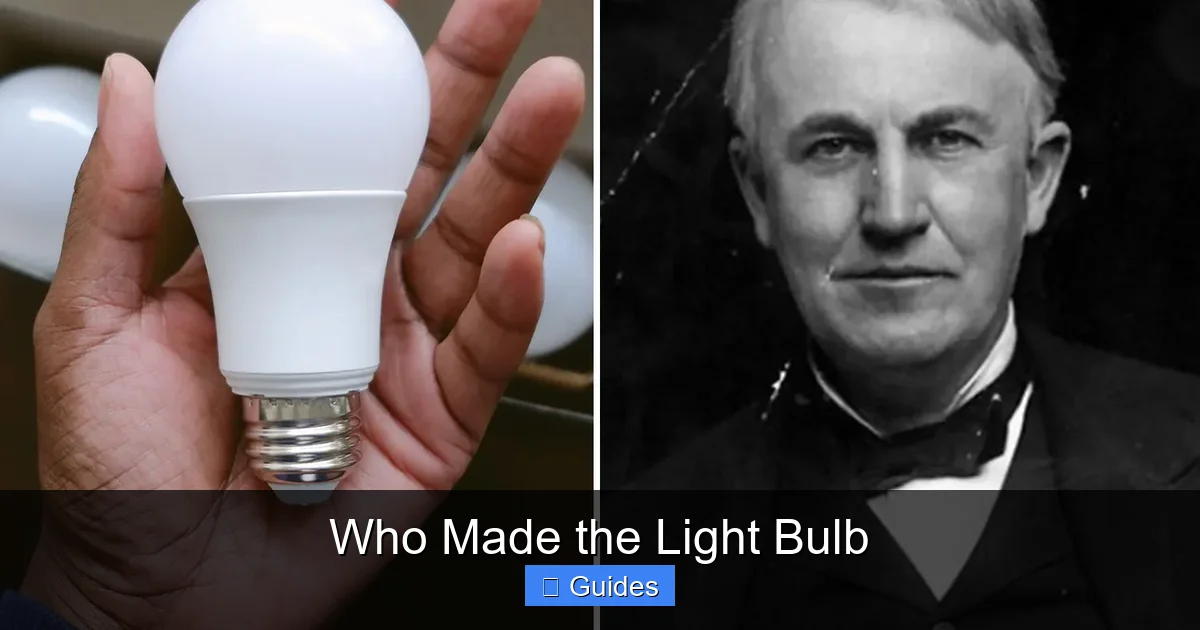
Visual guide about Who Made the Light Bulb
Image source: the-sun.com
While many envision Thomas Edison as the sole inventor, the story of who made the light bulb truly involves a parallel, equally impressive development across the Atlantic. Joseph Swan, a brilliant British physicist and chemist, was meticulously working on his own version of the incandescent light bulb.
Swan’s Filaments and Vacuum: Paving the Way
Swan’s dedication to the light bulb problem began as early as 1848, but it was in the 1860s and 1870s that he made his most significant advances. He recognized the two main challenges: finding a suitable filament material that wouldn’t quickly burn out and creating a strong vacuum inside the bulb to prevent the filament from oxidizing (burning up) in the presence of oxygen.
By 1860, Swan demonstrated a working incandescent light bulb using a carbonized paper filament enclosed in an evacuated glass bulb. However, the vacuum pumps available at the time weren’t good enough, and his bulbs still didn’t last very long. It wasn’t until the mid-1870s, with improved vacuum pump technology, that Swan was able to perfect his design. In 1878, just a year before Edison’s famous breakthrough, Swan publicly demonstrated a long-lasting light bulb using a carbon fiber filament made from specially treated cotton thread. It was highly effective and practical! This truly changes the simple answer to “who made the light bulb.”
Commercialization in Europe: Swan’s Success
Swan’s invention wasn’t just a lab curiosity; it was a commercial success in Britain. He installed his light bulbs in homes and public buildings across England, including the prestigious Savoy Theatre in London in 1881, which was the first public building in the world to be lit entirely by electricity. He even founded the Swan Electric Light Company. So, when people in England asked “who made the light bulb?”, Joseph Swan was often the answer.
Thomas Edison’s Genius: Innovation and Commercialization
Now, let’s turn our attention to the name most people associate with the invention: Thomas Edison. If others were experimenting and even succeeding, why does Edison get so much credit when we ask “who made the light bulb”? The answer lies in his unique approach and his relentless pursuit of a *complete system*, not just a single component.
The Menlo Park Approach: Systematic Innovation
Edison’s laboratory in Menlo Park, New Jersey, was unlike any other at the time. It was an “invention factory,” a place where a team of skilled engineers and scientists worked systematically through problems, testing thousands of different materials and configurations. Edison himself was a master of iterative design – trying, failing, learning, and trying again. He wasn’t necessarily looking for an *invention* but a *solution* to the problem of practical, affordable electric lighting for everyone.
The Carbonized Cotton Breakthrough: A Long-Lasting Glow
After thousands of experiments with various materials – including platinum, iridium, and even human hair – Edison and his team made their crucial discovery in October 1879. They found that a carbonized cotton thread filament, placed in a near-perfect vacuum, could glow for an astonishing 13.5 hours. This was a monumental leap in longevity compared to previous attempts. He later improved this, extending the life to over 1,200 hours by using a bamboo fiber filament, which became the standard for many years. This durable, long-lasting filament was a game-changer and a huge part of why we credit him when asking “who made the light bulb.”
Beyond the Bulb: The Complete System
Edison understood that a light bulb, no matter how good, was useless without a way to power it. His real genius lay in developing an entire electrical system: dynamos (generators) to produce electricity, wiring to distribute it safely, meters to measure usage, switches to turn lights on and off, and even the screw-in socket for easy replacement. He wasn’t just asking “who made the light bulb?”; he was asking “who will make electric light practical for every home and business?”
In 1882, Edison launched the world’s first central power plant on Pearl Street in New York City, demonstrating the feasibility of his entire electrical system. This was the true magic that cemented his legacy. He transformed electric light from a scientific curiosity into a practical, accessible, and essential utility, forever changing daily life.
The War of the Currents and Further Innovations
The story doesn’t end with Edison and Swan. The early days of electricity were filled with competition and further innovation, making the answer to “who made the light bulb” even more dynamic.
Improving Efficiency: From Carbon to Tungsten
While Edison’s carbon filament bulbs were a massive success, inventors continued to seek improvements. Carbon filaments were relatively inefficient, converting much of the electricity into heat rather than light. The search for a better filament material continued.
* Osmium and Tantalum: In the early 20th century, materials like osmium and tantalum were experimented with, offering better efficiency but still having their drawbacks.
* The Tungsten Breakthrough: The real game-changer came with the introduction of the tungsten filament. In 1904, Austrian chemists Aladar Pacz and Alexander Just developed a method to produce ductile (drawable into wire) tungsten. This was a huge step, as tungsten has the highest melting point of any metal, allowing it to glow much brighter and more efficiently at higher temperatures without melting.
* Gas-Filled Bulbs: In 1913, Irving Langmuir, an American chemist, found that filling the bulb with an inert gas like argon or nitrogen significantly reduced the evaporation of the tungsten filament, extending its life even further.
These innovations made light bulbs brighter, more energy-efficient, and longer-lasting, making the cost of electric light even more affordable and accessible.
The Modern Era: LEDs and Beyond
The incandescent bulb reigned supreme for over a century, but the quest for efficiency continued. The answer to “who made the light bulb” expanded to include fluorescent lights (invented in the early 20th century) and then, most recently and dramatically, Light Emitting Diodes (LEDs).
LED technology has roots in early 20th-century discoveries, but practical, commercial LEDs only became widespread in the late 20th and early 21st centuries. With incredibly long lifespans and superior energy efficiency, LEDs represent the latest evolution in the story of artificial light, moving far beyond the simple glowing filament.
Why the Misconception Persists: The Power of Narrative
Given the rich history and the many contributors, why does Thomas Edison stand alone in the popular imagination when we ask “who made the light bulb?”
Marketing and Mythology: Building a Brand
Edison was not only a brilliant inventor but also a shrewd businessman and a master of self-promotion. He understood the power of public image and worked tirelessly to ensure his inventions, and his name, were at the forefront of the public mind. His systematic approach, combined with aggressive patenting and successful commercialization, ensured that his name became inextricably linked with electric light. When he launched his power company and lit up New York, it was a massive public spectacle that captivated the world.
The American Inventor Archetype: A Symbol of Progress
Edison also fit neatly into the American ideal of the self-made inventor, a symbol of ingenuity and progress. This narrative was powerful and enduring, making it easy to simplify the complex history into a single, heroic figure. While Joseph Swan made incredible contributions, his story didn’t capture the global imagination in the same way.
The truth, as often is the case, is more nuanced. Edison’s genius was in taking existing concepts and technologies, relentlessly refining them, and, crucially, building the *infrastructure* to make them practical and widespread. He didn’t invent the concept of electric light, nor was he the first to create a functional incandescent bulb. But he was the one who packaged it all together, making it accessible to millions. That’s why, when we ponder “who made the light bulb,” his name is the first to shine.
Conclusion: A Collaborative Glow
So, when we ask “who made the light bulb,” the answer isn’t a simple name and date. It’s a testament to human ingenuity, perseverance, and the often-collaborative nature of innovation. From Humphry Davy’s fiery arc lamp to Joseph Swan’s carbonized filaments and Thomas Edison’s complete electrical system, each individual built upon the work of those who came before.
The light bulb, a seemingly simple device, represents a monumental leap in human civilization. It extended our productive hours beyond daylight, transformed industries, revolutionized entertainment, and fundamentally changed the way we live. It liberated us from the limitations of natural light, forever altering our sleep patterns, our work-life balance, and our understanding of what’s possible.
Next time you flip a switch and your room floods with light, take a moment to appreciate not just the genius of one person, but the collective brilliance of countless inventors, scientists, and engineers who, over centuries, contributed to this incredible invention. The light bulb’s story is a shining example that true progress often comes not from a single spark, but from a persistent, collaborative glow.
🎥 Related Video: The Real Inventor of The Light Bulb!
📺 The Curious Collective
Subscribe Here! ➡️- https://www.youtube.com/channel/UCm1_7L_1spH950PNk0DqX8Q?sub_confirmation=1 Thomas Edison …
Frequently Asked Questions
Was the light bulb invented by one person?
No, the light bulb was not invented by one person. It was the result of a long process of development, with numerous scientists and inventors contributing to its evolution over many decades, each building upon previous discoveries.
What was Humphry Davy’s contribution to electric lighting?
Humphry Davy, a British chemist, created the first electric arc lamp in 1802. While not a practical light bulb for homes, his work was a foundational step, demonstrating that electricity could produce light and inspiring further research.
How did Joseph Swan’s light bulb compare to Edison’s?
Joseph Swan developed a highly effective incandescent light bulb with a carbonized cotton thread filament and a good vacuum, independently demonstrating it around the same time as Edison. His bulbs were also successfully commercialized, particularly in Europe, predating some of Edison’s public installations.
Why is Edison credited more than other inventors for the light bulb?
Edison is credited more because he developed not just a long-lasting light bulb, but also an entire, economically viable system for generating, distributing, and using electricity. His relentless pursuit of a practical, accessible solution for everyday homes and businesses, coupled with effective marketing, cemented his legacy.
What material was key to making light bulbs more efficient after Edison’s initial design?
The key material for improving light bulb efficiency after Edison’s early designs was tungsten. Its incredibly high melting point allowed for brighter, more efficient light production and longer filament life compared to the earlier carbon filaments.
How has the light bulb continued to evolve since the incandescent era?
The light bulb has evolved significantly, moving from carbon to tungsten filaments, then to gas-filled bulbs for increased lifespan. More recently, fluorescent lighting offered greater efficiency, and today, Light Emitting Diodes (LEDs) represent the pinnacle of energy efficiency and longevity in lighting technology.
