


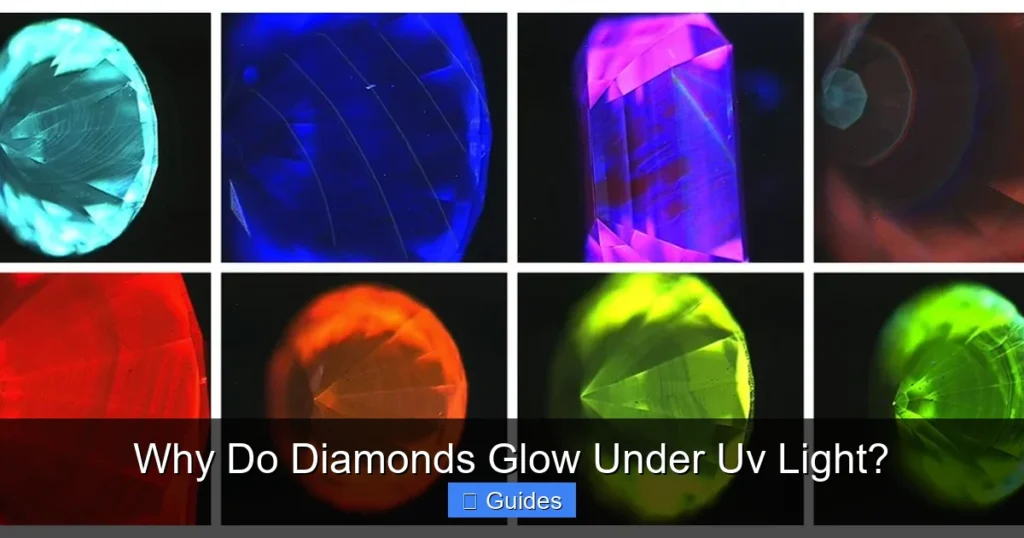
Diamonds glow under UV light primarily due to the presence of trace elements, such as nitrogen or boron, or structural defects within their crystal lattice. This intriguing phenomenon, called fluorescence, occurs when the diamond absorbs high-energy UV radiation and then re-emits it as visible light, most often appearing blue. Affecting about 25-35% of natural diamonds, the intensity and color of this captivating glow can vary, making each fluorescent diamond uniquely stunning.
Have you ever been in a nightclub, perhaps a bowling alley, or even just a well-lit jewelry store, and noticed certain diamonds sparkling in an almost otherworldly way under a special light? It’s a captivating sight, a subtle shimmer that sets them apart. This isn’t magic; it’s a fascinating natural phenomenon known as diamond fluorescence, and it’s the answer to the question, “Why do diamonds glow under UV light?”
For many, the idea of a diamond glowing under ultraviolet (UV) light can be a bit mysterious. Some might even wonder if it’s a sign of a fake diamond, or perhaps an indicator of exceptional quality. The truth, like many things in the intricate world of gemstones, is more nuanced and incredibly interesting. Understanding this glow not only demystifies your sparkling treasures but also equips you with valuable insights, whether you’re a seasoned collector or just admiring your engagement ring.
Today, we’re going to embark on a journey deep into the heart of a diamond to understand exactly why some of these precious stones react so vibrantly to UV rays. We’ll explore the science, debunk common myths, and give you practical knowledge that will make you look at diamonds—and UV light—in a whole new way. So, let’s peel back the layers and discover the captivating secret behind why do diamonds glow under UV light.
Key Takeaways
- Understand Fluorescence: Diamonds glow by absorbing UV light and re-emitting visible light.
- Nitrogen is the Cause: Trace nitrogen impurities are the main reason for blue fluorescence.
- Other Impurities Vary Color: Boron and other defects can cause rare yellow or orange glows.
- Observe Commonality: About 25-35% of natural diamonds exhibit some degree of fluorescence.
- Assess Fluorescence Impact: Strong blue fluorescence can influence a diamond’s perceived color and value.
- Check GIA Reports: Diamond grading reports specify the presence and intensity of fluorescence.
Quick Answers to Common Questions
Why do diamonds glow under UV light at all?
Diamonds glow under UV light because of trace elements, like nitrogen or boron, trapped within their crystal structure. These elements absorb the high-energy UV radiation and then re-emit it as lower-energy visible light, causing the stunning glow.
What color do diamonds usually glow under UV light?
Most diamonds that exhibit fluorescence glow blue under UV light, but you can also find them glowing yellow, green, white, or even red! The specific color depends on the unique combination of trace elements and structural defects present in that particular diamond.
Do all diamonds glow under UV light?
Not at all! Only about 25-35% of natural diamonds display fluorescence. Many diamonds simply don’t have the specific atomic structures or trace elements needed to absorb and re-emit UV light in this way.
Does a diamond’s glow under UV light affect its value?
Generally, a diamond’s glow under UV light doesn’t significantly impact its value, especially if it’s faint or medium. Only very strong fluorescence that makes a diamond appear milky or oily in normal daylight might negatively affect its price.
Is it good or bad if a diamond glows under UV light?
It’s neither good nor bad – it’s simply a unique natural characteristic! For most diamonds, their ability to glow under UV light is undetectable in everyday lighting and doesn’t impact their beauty or durability, making it a fascinating scientific property.
📑 Table of Contents
- The Basics of Diamond Fluorescence: What Is It, Exactly?
- The Science Behind the Sparkle: Why Diamonds Glow
- The Role of Nitrogen and Other Impurities
- Different Colors of Fluorescence and Their Causes
- Is Diamond Fluorescence Good or Bad? Debunking Myths
- Practical Tips for Buyers and Enthusiasts
- Fluorescence Colors and Their Primary Causes: A Quick Reference
- Conclusion: The Radiant Truth About Diamond Fluorescence
The Basics of Diamond Fluorescence: What Is It, Exactly?
Before we dive into the deep science of why do diamonds glow under UV light, let’s get a clear understanding of what fluorescence actually is in the context of diamonds. Simply put, diamond fluorescence is the visible light emitted by a diamond when it’s exposed to invisible ultraviolet (UV) light. Think of it like a tiny, temporary light show happening within the diamond itself, but only when a specific “trigger” (UV light) is present.
When you take the diamond out of the UV light, the glow disappears almost instantly. It’s not like a glow-in-the-dark toy that charges up and then glows for a while in the dark. It’s an immediate reaction. The most common color of this glow is blue, but as we’ll explore later, diamonds can also fluoresce in other colors, such as yellow, green, or even red, though these are much rarer. This fluorescence is a completely natural characteristic, present in varying degrees in about 25% to 35% of all diamonds.
How is Fluorescence Graded?
When you look at a diamond’s grading report, especially from reputable labs like the Gemological Institute of America (GIA), you’ll often see a section dedicated to fluorescence. The GIA grades fluorescence based on its intensity when viewed under a long-wave UV lamp in a dark room. The grades are usually:
- None: No fluorescence is observed.
- Faint: A very slight, almost imperceptible glow.
- Medium: A noticeable but not overpowering glow.
- Strong: A distinct and often easily visible glow.
- Very Strong: A highly pronounced glow.
Understanding these grades is key, as the intensity can sometimes influence a diamond’s appearance and perceived value, which brings us to the exciting part: understanding the atomic secrets behind this enchanting light. It’s not just about seeing a light; it’s about appreciating the subtle atomic dance that answers the question, why do diamonds glow under UV light?
The Science Behind the Sparkle: Why Diamonds Glow
The real magic behind why do diamonds glow under UV light lies deep within their atomic structure. Diamonds are essentially pure carbon, crystallized under immense heat and pressure deep within the Earth. However, they are rarely 100% pure. During their formation, tiny amounts of other elements, often called “trace elements” or “impurities,” can get trapped within the carbon lattice. These impurities are the primary culprits responsible for a diamond’s ability to fluoresce.
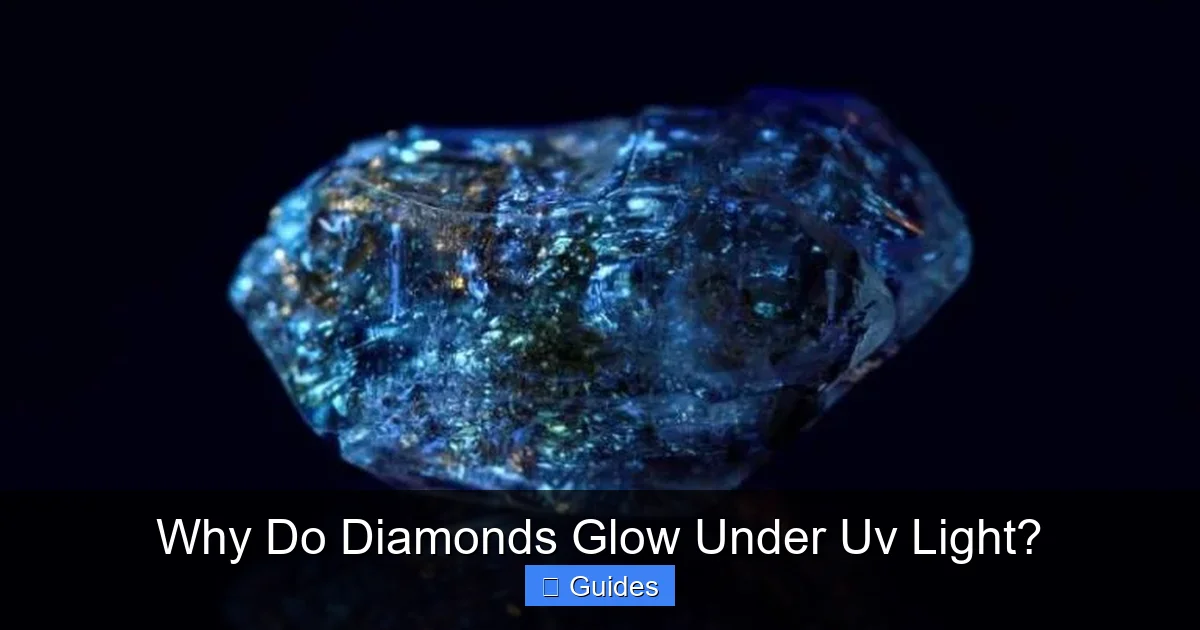
Visual guide about Why Do Diamonds Glow Under Uv Light?
Image source: diamond101.com
To put it simply, here’s how it works at a subatomic level: When a diamond containing these specific trace elements is exposed to UV light, the energy from the UV photons is absorbed by electrons within these impurity atoms. This absorption of energy excites the electrons, causing them to jump to a higher energy level. Think of it like a tiny spring being compressed – it stores energy.
The Electron’s Journey: Excitation and Emission
However, electrons don’t like to stay in these higher, excited energy states for long; they prefer to return to their stable, lower energy levels. When an excited electron falls back to its original energy state, it releases the absorbed energy. This released energy isn’t just dissipated as heat; a portion of it is emitted as visible light. This emission of visible light is what we perceive as fluorescence.
The key here is that UV light is a higher energy form of light than visible light. When the UV energy is absorbed, some of it is lost (often as heat), and the remaining energy is emitted as visible light, which is lower in energy than the original UV light. This shift in energy level is why you see a different color light being emitted than the light that caused it. This process is incredibly efficient and fast, which is why the glow appears instantly and ceases just as quickly when the UV source is removed. It’s a fundamental principle of quantum mechanics and spectroscopy, and it elegantly explains why do diamonds glow under UV light.
The Role of Nitrogen and Other Impurities
Now that we understand the basic mechanism, let’s zoom in on the specific “impurities” that cause this captivating phenomenon. For diamonds, the most common and significant trace element responsible for fluorescence, especially blue fluorescence, is nitrogen. Nitrogen atoms can substitute for carbon atoms in the diamond’s crystal structure, creating “defects” or “color centers” that interact with UV light.
When nitrogen atoms are incorporated into the diamond’s lattice, they don’t always do so uniformly. They can exist in various configurations, such as isolated single atoms (Type Ib diamonds) or, more commonly, in small clusters of two or three atoms (Type Ia diamonds). These different arrangements create specific energy levels within the diamond that are capable of absorbing UV light and then re-emitting it as visible light.
Beyond Nitrogen: Other Contributing Elements
While nitrogen is the dominant player, it’s not the only impurity that can cause a diamond to fluoresce. Other trace elements, though much rarer, can also contribute to fluorescence and are often responsible for the less common fluorescent colors. For instance:
- Boron: Typically responsible for the rare natural blue color of Type IIb diamonds (like the Hope Diamond), boron can also influence fluorescence, although its primary role is usually in the diamond’s body color.
- Hydrogen and Nickel: In extremely rare cases, combinations involving hydrogen or nickel can contribute to unusual fluorescent colors like green or red.
- Lattice Vacancies: Sometimes, it’s not even an impurity atom, but a missing carbon atom in the lattice (a vacancy) that, when combined with an impurity like nitrogen, creates the specific energy levels needed for fluorescence.
The type, concentration, and specific arrangement of these trace elements within the carbon lattice determine whether a diamond will fluoresce, how intensely it will glow, and what color that glow will be. It’s a complex interplay of atomic physics and geological history that ultimately explains why do diamonds glow under UV light in such diverse ways.
Different Colors of Fluorescence and Their Causes
While blue is by far the most prevalent fluorescent color in diamonds, the spectrum of emitted light can be surprisingly varied. Each color tells a unique story about the diamond’s formation and the specific trace elements trapped within its structure. Understanding these color variations further deepens our appreciation for why do diamonds glow under UV light.
The Dominant Blue Fluorescence
As mentioned, blue fluorescence accounts for the vast majority (around 95%) of all fluorescent diamonds. This blue glow is predominantly caused by the presence of nitrogen atoms within the diamond’s crystal structure. Specifically, it’s often attributed to clusters of nitrogen atoms, which create specific energy centers that absorb UV light and re-emit it as blue light. This blue light can sometimes make a diamond with a slight yellowish tint appear whiter under daylight or fluorescent lighting, as blue is complementary to yellow and can visually neutralize it. This is a fascinating aspect of why do diamonds glow under UV light, as it can sometimes enhance a diamond’s appearance.
Rarer Fluorescent Hues: Yellow, Green, and Red
While blue dominates, other colors are observed, albeit infrequently:
- Yellow/Orange Fluorescence: Yellow fluorescence is typically associated with different configurations of nitrogen within the diamond, sometimes involving single nitrogen atoms or more complex defects. It can also be related to nickel impurities. When a diamond exhibits yellow fluorescence, it generally indicates a slightly different atomic environment than those causing blue fluorescence.
- Green Fluorescence: Green fluorescence is quite rare and often linked to defects involving nitrogen and sometimes hydrogen or silicon. It can create a truly unique effect, though it’s not something you’ll commonly encounter.
- Red/Orange-Red Fluorescence: Extremely rare, red fluorescence is often associated with structural defects involving nickel impurities. Seeing a red fluorescent diamond is a truly exceptional event, highlighting the diverse geological conditions under which diamonds form.
Each of these distinct colors, caused by specific atomic arrangements and impurity types, contributes to the rich tapestry of diamond characteristics. The specific wavelength of light emitted—and thus the color we see—is directly dependent on the precise energy drop of the electron and the unique “color center” formed by the impurities. This diversity is a beautiful testament to the natural complexity inherent in every diamond, explaining in vivid detail why do diamonds glow under UV light in such an array of colors.
Is Diamond Fluorescence Good or Bad? Debunking Myths
When discussing why do diamonds glow under UV light, one of the most common questions that arise is whether fluorescence is a desirable trait or a flaw. There are many myths surrounding fluorescence, often leading to misunderstandings about its impact on a diamond’s beauty and value. Let’s clear the air.
For decades, there was a prevalent belief, particularly in certain markets, that fluorescence was always a negative characteristic, diminishing a diamond’s value. This perception often stemmed from early observations where very strong fluorescence in some diamonds could cause them to appear “milky,” “oily,” or “hazy” in strong daylight. This effect, while real, is exceedingly rare. The GIA estimates that fewer than 0.2% of fluorescent diamonds exhibit this hazy appearance. So, for the vast majority of fluorescent diamonds, the effect is either imperceptible or, surprisingly, beneficial.
The Potential Benefits of Fluorescence
One of the most interesting aspects of fluorescence, especially blue fluorescence, is its potential to improve the visual appearance of certain diamonds. For diamonds with a slight yellowish tint (grades I, J, K, etc., on the GIA color scale), a medium or strong blue fluorescence can actually make the diamond appear whiter or colorless under natural light or fluorescent lighting. This is because blue and yellow are complementary colors; the blue light emitted by the fluorescence counteracts the yellow body color, making the diamond seem brighter and whiter to the naked eye. In these cases, fluorescence can be a distinct advantage, often allowing a buyer to get a diamond that looks like a higher color grade for a lower price.
When to Be Cautious
The only time fluorescence might be considered “bad” is in those extremely rare instances (less than 0.2%) where it causes the diamond to appear milky or oily. This effect is usually only seen in diamonds with very strong fluorescence, and it is something that reputable jewelers and graders would note. For diamonds that are already high color grades (D, E, F), strong blue fluorescence can sometimes, though rarely, impart a slightly blueish tint, which might not be desired. However, for most diamonds, particularly those in the near-colorless range, fluorescence is either neutral or beneficial.
Therefore, it’s essential to understand that fluorescence is neither inherently good nor bad. Its impact is highly dependent on the individual diamond, its color grade, and the intensity of the fluorescence. The key is to assess the diamond directly, rather than relying on outdated prejudices about why do diamonds glow under UV light.
Practical Tips for Buyers and Enthusiasts
Understanding why do diamonds glow under UV light isn’t just a fascinating piece of science; it also has practical implications, especially for those looking to purchase a diamond or simply appreciate their existing ones. Here are some actionable tips to help you navigate the world of diamond fluorescence:
Consult the GIA Report
Always, always look at the diamond’s grading report from an independent and reputable laboratory like the GIA. The report will clearly state the presence and intensity of fluorescence (None, Faint, Medium, Strong, Very Strong). This is your primary source of factual information. Don’t rely solely on what you hear; verify it with the official documentation.
See the Diamond in Different Lights
The best way to understand the impact of fluorescence is to observe the diamond yourself under various lighting conditions. Ask the jeweler to show you the diamond:
- Under regular incandescent light.
- Under fluorescent light (like in an office).
- Under direct daylight (if possible).
- And, of course, under UV light (using a UV lamp).
This allows you to see if the fluorescence (especially if it’s medium or strong) has any visible effect on the diamond’s appearance in everyday settings. Remember, the glow from “Why do diamonds glow under UV light?” is only visible under UV light; the concern is how it affects overall appearance in normal light.
Consider Color Grades and Price
If you’re looking at diamonds in the near-colorless range (G, H, I, J), a medium or strong blue fluorescence can be a secret weapon. It might make the diamond appear whiter without increasing its price, potentially offering excellent value. Many buyers specifically seek out these diamonds for this reason. However, for D-F color diamonds, some people prefer no fluorescence to ensure there’s absolutely no possibility of a blue tint, though this is a very rare occurrence.
Don’t Fear Fluorescence Unnecessarily
The myth of fluorescence always being a negative characteristic has led many beautiful diamonds to be undervalued. Unless you visually detect a milky or oily appearance (which, again, is incredibly rare), there’s no inherent reason to avoid a diamond with medium or even strong fluorescence. Focus on what you see, not on an arbitrary label. Your personal preference is paramount.
By keeping these tips in mind, you can make an informed decision and appreciate the unique characteristics that fluorescence brings to a diamond. It transforms the question “Why do diamonds glow under UV light?” from a scientific query into a practical tool for diamond appreciation and selection.
Fluorescence Colors and Their Primary Causes: A Quick Reference
To further solidify our understanding, let’s look at a summary of the most common fluorescent colors and their primary causes. This table provides a quick reference for enthusiasts and buyers alike, illuminating the fascinating connection between atomic impurities and the luminous spectacle of “Why do diamonds glow under UV light?”.
| Fluorescence Color | Primary Cause (Trace Element/Defect) | Prevalence | Notes/Impact on Appearance |
|---|---|---|---|
| Blue | Nitrogen clusters (e.g., N3 centers) | Most common (95%) | Can make yellowish diamonds appear whiter; rarely causes haziness in very strong cases. |
| Yellow/Orange | Single Nitrogen atoms (Type Ib) or complex defects | Rare | Less common, usually does not enhance color. |
| Green | Nitrogen-related defects, sometimes with Hydrogen/Silicon | Very Rare | Unique, typically no significant impact on transparency. |
| Red | Nickel impurities (Ni-related defects) | Extremely Rare | Highly sought after by collectors for its rarity. |
This table underscores the diversity hidden within diamonds and the specific roles that various atomic imperfections play in creating the captivating glow that answers the question, “Why do diamonds glow under UV light?”
Conclusion: The Radiant Truth About Diamond Fluorescence
We’ve journeyed from the initial flicker of an unknown glow to the intricate atomic dance that explains why do diamonds glow under UV light. What started as a simple observation has unfolded into a fascinating exploration of crystallography, quantum physics, and the subtle beauty of natural imperfections. We’ve learned that this captivating phenomenon, known as fluorescence, is a completely natural characteristic, a direct result of trace elements like nitrogen being incorporated into the diamond’s structure during its formation deep within the Earth.
The mystery of the glowing diamond is now clear: it’s the excitement and subsequent relaxation of electrons within these impurity atoms, absorbing high-energy UV light and re-emitting it as visible light, most commonly a beautiful blue. This blue glow, far from being a flaw, often serves a beneficial purpose, subtly enhancing the apparent whiteness of many diamonds, offering a unique blend of science and aesthetic appeal.
So, the next time you see a diamond shimmer under a UV lamp, you’ll not only appreciate its ethereal beauty but also understand the complex, natural processes at play. You’ll know the radiant truth behind why do diamonds glow under UV light, armed with knowledge that transforms a simple sparkle into a profound connection with the Earth’s geological wonders. Embrace the glow; it’s just another incredible facet of what makes each diamond truly unique and endlessly captivating.
🎥 Related Video: Does your diamond GLOW??
📺 Zach Emigh Jewelry
Diamond Fluorescence – When exposed to ultraviolet (UV) light, some diamonds emit a glow due to trace elements within them.
Frequently Asked Questions
Why do some diamonds glow under UV light?
Diamonds glow under ultraviolet (UV) light due to a phenomenon called fluorescence. This occurs when trace elements within the diamond’s crystal structure absorb the UV radiation and then re-emit that energy as visible light.
What causes a diamond to fluoresce under UV light?
The primary cause of fluorescence in diamonds is the presence of specific trace impurities, most commonly nitrogen atoms, within their carbon crystal lattice. These nitrogen defects, or sometimes boron, absorb the higher-energy UV photons and release lower-energy visible light photons.
What colors do diamonds typically glow under UV light?
The most common color of diamond fluorescence is blue, accounting for the vast majority of fluorescent diamonds. However, diamonds can also glow in other colors such as yellow, green, orange, or very rarely, red, depending on the specific impurities present.
Are all diamonds fluorescent under UV light?
No, not all natural diamonds exhibit fluorescence under UV light. Approximately 25% to 35% of natural diamonds show some degree of fluorescence, while the rest are inert. Lab-grown diamonds can also be fluorescent depending on their growth process.
Does fluorescence affect a diamond’s quality or value?
For the vast majority of diamonds, fluorescence has little to no impact on their visual appearance or value, especially in normal viewing conditions. In extremely rare instances, very strong blue fluorescence in certain diamonds can cause a milky or oily appearance, which might slightly lower their market value.
Can UV light be used to identify a real diamond?
While many diamonds do fluoresce under UV light, this characteristic alone cannot be used as a definitive test for authenticity. Many diamond simulants also glow, and a significant percentage of real diamonds do not fluoresce at all, making it an unreliable standalone identification method.
