



When exposed to ultraviolet (UV) light, the fur of a platypus emits a striking blue-green glow, a phenomenon known as biofluorescence. This surprising discovery in 2020 has sparked intense scientific curiosity, leading researchers to explore the unique pigments within their fur that absorb UV light and re-emit it at a different wavelength. While the exact evolutionary purpose remains a mystery, theories suggest it might play a role in intraspecific communication or camouflage within their dim, aquatic habitats, offering new insights into these enigmatic monotremes.
Why Do Platypus Glow Under Uv Light?
Imagine strolling through a dimly lit museum, a quiet exhibit showcasing the wonders of the animal kingdom. Suddenly, a special light illuminates a display, and a familiar creature, one you thought you knew inside and out, reveals an entirely new, dazzling secret. That’s essentially what happened in 2020 when scientists pointed a UV light at a platypus specimen and discovered something truly astonishing: these iconic Australian monotremes glow a vibrant blue-green! It was a revelation that sent ripples of excitement through the scientific community and captivated nature enthusiasts worldwide.
For generations, the platypus has puzzled scientists with its unique blend of mammalian, reptilian, and avian characteristics. A duck-billed, egg-laying, venomous mammal with webbed feet and a beaver-like tail – it already sounds like something out of a fantastical bestiary. But now, adding biofluorescence to its list of bizarre traits makes the platypus even more extraordinary. This incredible discovery begs a fundamental question: why do platypus glow under UV light? Is it a secret language, a hidden defense, or just a beautiful accident of nature? Let’s dive deep into the fascinating world of glowing platypuses and uncover the mysteries behind this luminous phenomenon.
Key Takeaways
- The Discovery: In 2020, scientists revealed that platypuses exhibit biofluorescence, meaning their fur glows blue-green under ultraviolet (UV) light, a previously unknown trait in this iconic Australian mammal.
- Biofluorescence vs. Bioluminescence: It’s important to differentiate biofluorescence (absorbing UV light and re-emitting it) from bioluminescence (generating light through a chemical reaction). Platypuses are biofluorescent, not bioluminescent.
- The Science Behind the Glow: The platypus’s fur contains specific pigments, likely pteridines, which absorb high-energy UV radiation and then re-emit it as lower-energy visible light, causing the characteristic glow.
- Potential Evolutionary Purposes: While not definitively proven, leading theories suggest the glow could aid in communication among platypuses in low-light environments, act as a form of camouflage against UV-sensitive predators, or even serve a role in mate selection.
- Habitat and Behavior Link: As crepuscular and nocturnal animals, platypuses spend much of their active time in dimly lit or dark conditions, where biofluorescence could be more visible or advantageous.
- Broader Mammalian Phenomenon: The discovery in platypuses led to further investigations, revealing that other mammals, like opossums and flying squirrels, also exhibit biofluorescence, indicating it might be more widespread than once thought.
- Conservation Implications: Understanding this unique trait could offer new ways to study and monitor platypus populations, potentially aiding in conservation efforts for this vulnerable species.
Quick Answers to Common Questions
What causes the platypus’s glow?
The platypus’s fur contains special pigments, likely pteridines, that absorb invisible ultraviolet (UV) light and then re-emit it as visible blue-green light, a process called biofluorescence.
Is the platypus glow visible to the naked eye?
No, the glow is only visible when the platypus is exposed to an ultraviolet (UV) light source, also known as a black light. It is not visible under normal daylight conditions.
Is the platypus bioluminescent or biofluorescent?
The platypus is biofluorescent. This means it absorbs external UV light and re-emits it as visible light, rather than producing its own light through a chemical reaction (bioluminescence).
Why do scientists think platypuses glow?
Scientists theorize the glow could be for intraspecific communication (e.g., mate attraction or species recognition) or a form of camouflage against UV-sensitive predators in their low-light, aquatic environments.
Are platypuses the only mammals that glow under UV light?
No, the discovery in platypuses led to findings that other mammals, such as flying squirrels and opossums, also exhibit biofluorescence.
📑 Table of Contents
The Astonishing Discovery: Platypus Biofluorescence Revealed
The story of the glowing platypus began not in the wild, but within the hushed halls of a museum. Researchers at the Field Museum of Natural History in Chicago, led by Dr. Paula Spaeth Anich, were studying biofluorescence in flying squirrels. Curious if other mammals might share this trait, they decided to examine some preserved specimens, including one of the most unique mammals on Earth: the platypus. What they found under the UV lamp was nothing short of spectacular. The platypus fur, usually a drab brown, erupted in a vivid blue-green glow.
How Scientists Uncovered This Secret
The process was relatively simple yet profound. Scientists used a UV flashlight, often called a “black light,” in a darkened room. When the UV light hit the platypus specimens (both male and female, from different collections and time periods), their fur immediately absorbed the invisible UV radiation and re-emitted it as visible light, creating the characteristic blue-green luminescence. This wasn’t a one-off fluke; repeated tests on multiple specimens confirmed the phenomenon. This discovery wasn’t just interesting; it opened a whole new avenue for understanding platypus biology and behavior.
What is Biofluorescence Anyway?
Before we delve deeper into why do platypus glow under UV light, it’s crucial to understand what biofluorescence is and how it differs from other light-producing phenomena.
* Biofluorescence: This is the process where an organism absorbs light of one color (specifically, shorter, higher-energy wavelengths like UV light) and then re-emits it as light of a different, longer, lower-energy color (like blue or green). The organism itself doesn’t produce the light; it simply transforms it. Think of a fluorescent highlighter pen glowing under a black light – that’s fluorescence.
* Bioluminescence: This is when an organism *generates* its own light through a chemical reaction. Fireflies, anglerfish, and many deep-sea creatures are bioluminescent.
* Biophosphorescence: Similar to fluorescence, but the light emission continues for a period *after* the stimulating light source is removed.
The platypus, therefore, is biofluorescent. It doesn’t create its own light but rather has specialized fur that acts like a natural light transformer when exposed to UV light. This distinction is vital when considering the potential ecological roles of the glow.
The Science Behind the Glow: Pigments and Light
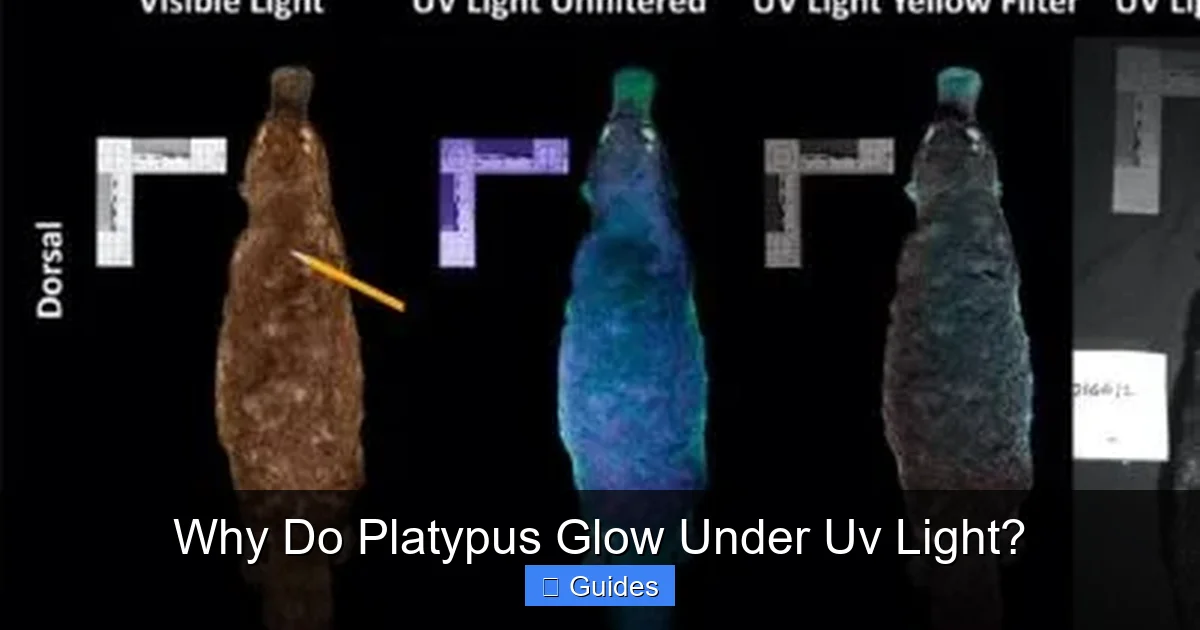
Visual guide about Why Do Platypus Glow Under Uv Light?
Image source: happymag.tv
The immediate question following the discovery was: what makes the platypus glow under UV light? The answer lies in the unique composition of its fur. Scientists believe specific pigments embedded within the fur are responsible for this captivating light show.
The Role of Pteridines
While the exact chemical compounds causing the platypus’s glow are still under investigation, preliminary research points towards a class of pigments called pteridines. These compounds are known to cause biofluorescence in other animals, particularly invertebrates and some fish. Pteridines are widespread in nature, found in the wings of butterflies, the skin of amphibians, and even the eyes of some birds. They have the remarkable ability to absorb UV light and then release it as visible light.
In the case of the platypus, these pteridine-like pigments are likely integrated into the keratin structure of their fur. When invisible UV rays (which are naturally present in sunlight, even on cloudy days, and penetrate shallow water) strike the platypus’s fur, the pigments absorb that energy. Then, almost instantaneously, they release that energy in the form of photons of visible light, specifically in the blue and green spectrum, making the platypus glow under UV light.
How UV Light Interacts with Platypus Fur
The magic happens at a molecular level. UV light has a shorter wavelength and higher energy than visible light. When these high-energy photons hit the fluorescent pigments in the platypus’s fur, the electrons within these pigment molecules get excited and jump to a higher energy level. This state is unstable, so they quickly fall back to their original energy level, releasing the excess energy as photons of visible light. Because some energy is lost in the process (usually as heat), the re-emitted light always has a longer wavelength and lower energy than the absorbed light – hence, UV light (invisible, short wavelength) is transformed into blue-green light (visible, longer wavelength).
Color Spectrum: From Blue to Green
The platypus’s biofluorescence primarily manifests as a blue-green glow. This specific color range is not uncommon in biofluorescent organisms. The exact hue can vary slightly depending on the specific pigments involved, their concentration, and the wavelength of the UV light source. The combination of blue and green is particularly interesting because these colors penetrate water relatively well and are visible in low-light conditions, which are characteristic of the platypus’s aquatic and nocturnal environment.
Why Do Platypus Glow? Unraveling the Evolutionary Mystery
The most intriguing question remains: what is the purpose of this glow? Why do platypus glow under UV light? Since the discovery is so recent, scientists are still theorizing, but several compelling hypotheses have emerged, each offering a glimpse into the potential ecological role of this peculiar trait.
Camouflage or Communication?
One of the leading theories suggests that the biofluorescence could serve as a form of communication or even camouflage within their specific habitat.
* Intraspecific Communication: Platypuses are largely solitary, but they do interact, particularly during mating season. Could the glow be a way for them to signal to each other in the dark or murky waters where they live? Perhaps it helps them identify potential mates or rivals without attracting unwanted attention from predators. If other platypuses can see this glow, it could be a silent, subtle beacon.
* UV Counter-Shading Camouflage: This theory is particularly fascinating. Many aquatic predators, like birds of prey or larger fish, can see in the UV spectrum. If the platypus’s fur absorbs UV light and re-emits it, it might appear differently to a UV-sensitive predator. Imagine a predator looking down into the water. If the platypus absorbs the ambient UV light that would normally make it stand out, and then re-emits it in a way that blends with the UV light filtered through the water, it could effectively “disappear” or become less conspicuous. This is akin to counter-shading, where an animal’s underside is lighter than its top, but applied to the UV spectrum.
A Nocturnal Signal?
Platypuses are crepuscular (active at dawn and dusk) and nocturnal animals. They spend a significant portion of their active lives foraging in low-light conditions. In these environments, visible light sources are scarce, but UV light is still present, even from the moon or filtered sunlight. A glow that is only activated by UV light could be an ideal signaling mechanism that doesn’t rely on bright ambient light and is only visible to those who can either see the glow or see in UV.
Defense Mechanism?
Could the glow be a form of defense? While less likely than communication or camouflage, some researchers ponder if a sudden glow could startle a predator. However, given that the glow requires UV light to be present and isn’t actively generated by the platypus, it seems less probable as a direct defensive display compared to, say, a bioluminescent flash.
The Role of Habitat
The platypus’s habitat is critical to understanding why do platypus glow under UV light. They live in freshwater systems – rivers, creeks, and lakes – across eastern Australia and Tasmania. These environments can be quite dark, especially at night or in deep, turbid waters. The water itself also filters light, with UV light penetrating to certain depths. Any visual signal or camouflage mechanism would need to be effective in these specific light conditions. The blue-green spectrum of their glow is well-suited for transmission through water, lending credence to the idea that it plays an active role in their aquatic lives.
Comparing Platypus Biofluorescence to Other Glowing Animals
The discovery of biofluorescence in platypuses might seem like a one-off oddity, but it’s part of a growing understanding that this phenomenon is far more widespread in the animal kingdom than previously thought, even among mammals.
Mammals That Glow: Opossums and Flying Squirrels
The platypus wasn’t the first mammal found to glow under UV light, nor was it the last. The initial discovery that spurred the platypus investigation was that of **flying squirrels**. Several species of flying squirrels were found to exhibit vibrant pink biofluorescence. Similarly, **opossums** have also been found to glow, particularly their fur, which fluoresces with a pinkish hue. These discoveries, along with the platypus, suggest that mammalian biofluorescence might be an ancestral trait or one that has evolved convergently in different lineages.
Beyond Mammals: From Corals to Scorpions
Biofluorescence is incredibly diverse across the tree of life.
* **Marine Invertebrates:** Many corals, anemones, and jellyfish display stunning biofluorescence, using it potentially for UV protection, attracting prey, or symbiosis with algae.
* **Fish:** Numerous fish species, particularly those living in coral reefs, have biofluorescent patterns, possibly for communication or camouflage among themselves.
* **Amphibians and Reptiles:** Some frogs and chameleons also exhibit biofluorescence, again, possibly for communication or species recognition.
* **Arachnids:** Scorpions are famously biofluorescent, glowing bright blue-green under UV light, though the exact purpose is still debated – theories range from UV protection to attracting mates.
Unique Aspects of the Platypus Glow
What makes the platypus’s biofluorescence particularly noteworthy is a combination of factors:
1. **Monotreme Status:** As one of only five living species of monotremes (egg-laying mammals), any shared trait with placental mammals or marsupials raises interesting evolutionary questions.
2. **Color Spectrum:** The distinct blue-green glow is relatively unique among biofluorescent mammals found so far, which tend to be pink or reddish. This specific color might be optimized for their aquatic, low-light environment.
3. **Habitat Relevance:** Its amphibious, nocturnal lifestyle makes the potential purpose of a UV-activated glow particularly compelling for communication or camouflage within its specific niche.
The Impact on Conservation and Future Research
The discovery of why do platypus glow under UV light isn’t just a scientific curiosity; it has significant implications for how we study and protect this already vulnerable species.
New Tools for Monitoring Platypus Populations
One of the biggest challenges in platypus conservation is simply finding and monitoring these elusive animals. They are shy, crepuscular, and spend a lot of time underwater or in their burrows. Traditional methods often involve trapping, which can be stressful. If their glow is visible in certain light conditions in the wild, it could potentially offer new, non-invasive ways to spot them. While it’s unlikely researchers will be shining UV lights across entire rivers, understanding how ambient UV light interacts with their fur could lead to new observational techniques or enhance existing ones, perhaps by using specialized cameras that can detect the specific wavelengths of their glow.
Understanding Their Nocturnal Lives Better
The fact that platypuses glow under UV light strongly suggests that their visual world, and how they perceive each other and their environment, might be very different from ours. This opens doors to understanding their nocturnal behaviors, social interactions, and predator avoidance strategies in a completely new light. Are other platypuses capable of seeing this glow? Do predators react to it? Answering these questions requires extensive fieldwork and specialized optical equipment.
Conservation Challenges and How Biofluorescence Might Help
Platypuses face numerous threats, including habitat loss, water pollution, climate change, and entanglement in fishing gear. They are listed as “Near Threatened” by the IUCN, with populations declining across much of their range. Any new insight into their biology and ecology, such as their biofluorescence, can contribute valuable data to conservation efforts. For example, if the glow is indeed a form of communication, knowing when and how they use it could inform habitat management strategies, ensuring that critical areas for breeding or foraging are protected in a way that supports these behaviors. It underscores the incredible complexity and hidden marvels of even well-known species, reminding us how much more there is to learn and protect.
Conclusion
The discovery that platypuses glow a mesmerizing blue-green under UV light is a testament to the endless wonders of the natural world and the perpetual surprises that await us, even in species we thought we knew intimately. Why do platypus glow under UV light? While the definitive answer remains an active area of research, the leading theories – ranging from subtle communication to specialized camouflage in their dimly lit, aquatic habitats – paint a vivid picture of adaptation and evolution.
This luminous secret not only adds another layer of mystique to the already enigmatic platypus but also highlights the prevalence of biofluorescence across diverse taxa, including mammals. It encourages us to look at the world, and its creatures, with fresh eyes and a different light spectrum. As scientists continue to unravel the specific pigments, physiological mechanisms, and ecological functions behind this stunning phenomenon, we are reminded that every creature, no matter how familiar, holds untold secrets, urging us to appreciate, protect, and continue exploring the incredible biodiversity that enriches our planet. The glowing platypus is more than just a scientific marvel; it’s a glowing invitation to delve deeper into the mysteries of life.
🎥 Related Video: DID YOU KNOW platypuses glow in UV light? 🤯😱 #shorts
📺 Booo Cunningham
Frequently Asked Questions
When was the platypus’s biofluorescence discovered?
The biofluorescence of platypuses was discovered and published in 2020 by a team of scientists at the Field Museum of Natural History in Chicago. They were initially studying flying squirrels when they decided to investigate other mammals.
Do all platypuses glow, or only certain ones?
Based on the specimens examined, both male and female platypuses exhibit biofluorescence. The phenomenon appears to be a consistent characteristic across the species, suggesting it’s not limited to specific individuals or sexes.
Could the glow be harmful to platypuses?
There’s no indication that the biofluorescence itself is harmful. The glow occurs when their fur interacts with naturally occurring UV light (from the sun or moon), a phenomenon that has likely been present for millennia without adverse effects on the species.
Are there any practical applications of this discovery?
While direct practical applications are still emerging, understanding the platypus’s biofluorescence could lead to new, non-invasive ways to monitor platypus populations or study their behavior in their natural habitat. It might also inspire new bio-inspired materials or technologies.
How does the platypus glow compare to other glowing animals?
The platypus’s glow is distinctive for its blue-green hue, contrasting with the pink or reddish fluorescence seen in some other mammals like flying squirrels and opossums. Its specific color and its role in an aquatic, nocturnal monotreme make it unique among biofluorescent organisms.
What ongoing research is being done on platypus biofluorescence?
Current research aims to identify the exact chemical compounds responsible for the glow, understand if other platypuses can perceive this fluorescence, and investigate its behavioral and ecological significance in wild populations. Scientists are also exploring if it plays a role in UV protection or other physiological processes.
