


As an Amazon Associate, We earn from qualifying purchases.
Many believe Thomas Edison invented the light bulb, but this is a common misconception. While he didn’t create the first light bulb, Edison made crucial improvements, developing a long-lasting, practical filament and an entire electrical distribution system. His work transformed the experimental light bulb into a commercially viable product, bringing electric light into homes and businesses worldwide.
Did Thomas Edison Invent the Light Bulb? Separating Myth from Reality
The name Thomas Edison is synonymous with innovation, a legendary figure often credited with bringing light into the world. Ask almost anyone, “Who invented the light bulb?” and the answer you’ll likely hear is “Thomas Edison.” It’s a powerful, enduring myth, deeply embedded in our collective consciousness, portraying him as the solitary genius behind this transformative invention. But like many historical narratives, the full story is far more complex, a tapestry woven with the contributions of many brilliant minds.
So, did Thomas Edison invent the light bulb? The short answer is no. He did not invent the light bulb from scratch. However, simply saying “no” doesn’t do justice to his monumental contributions. Edison’s true genius lay not in inventing the first electric light, but in perfecting it, making it practical, affordable, and, crucially, scalable for mass adoption. He took an existing concept – the incandescent light bulb – and transformed it from a laboratory curiosity into an everyday essential, forever changing how we live, work, and interact with the world after dark.
This article will pull back the curtain on the real history of electric light. We’ll journey through the efforts of those who came before Edison, explore his pivotal innovations, and understand why his name became so strongly linked with the invention. It’s a story of persistent experimentation, fierce competition, and the remarkable power of systematic innovation that continues to illuminate our lives today.
Key Takeaways
- Edison did not invent the light bulb: Numerous inventors created earlier versions of electric light bulbs, some predating Edison’s work by decades.
- Edison’s genius was in improvement and commercialization: His primary contribution was developing a practical, long-lasting, and affordable incandescent light bulb with a carbonized bamboo filament, which was essential for widespread adoption.
- He built an entire electrical system: Edison’s most significant legacy extends beyond the bulb itself. He designed and implemented the first comprehensive system for generating, distributing, and metering electricity, making electric light feasible for everyday use.
- Early pioneers include Humphry Davy and Joseph Swan: Davy created the arc lamp in 1802, and Swan developed a functional incandescent bulb with a carbonized paper filament in the 1860s and 70s, making significant progress before Edison.
- The path to practical electric light was collaborative: The development of electric lighting was a cumulative effort by many scientists and inventors over decades, each building upon the work of others.
- His innovation changed the world: By making electric light accessible and reliable, Edison’s efforts profoundly impacted society, extending working hours, improving safety, and paving the way for the modern electrical age.
Quick Answers to Common Questions
Who made the first electric light?
Humphry Davy is generally credited with demonstrating the first electric light in 1802 with his arc lamp, though it was very impractical for general use.
What was Joseph Swan’s contribution to the light bulb?
Joseph Swan was a British physicist and chemist who developed a functional incandescent light bulb with a carbonized paper filament in an evacuated glass bulb in the 1860s and 70s, making significant progress before Edison.
What made Edison’s light bulb unique?
Edison’s light bulb was unique because it featured a long-lasting, high-resistance carbonized bamboo filament, combined with a near-perfect vacuum, which made it practical and affordable for widespread use in parallel circuits.
Did anyone challenge Edison’s patents for the light bulb?
Yes, notably Joseph Swan challenged Edison’s patents, leading to legal disputes that eventually resulted in the formation of a joint company, “Ediswan,” in the United Kingdom.
Why is Edison still so strongly associated with the light bulb?
Edison is strongly associated with the light bulb because he not only refined the bulb itself but also created the entire electrical generation and distribution system, making electric light commercially viable and accessible to the masses.
📑 Table of Contents
The Dawn of Electric Light: Before Edison’s Era
Long before Thomas Edison set up his laboratory in Menlo Park, New Jersey, scientists and inventors around the globe were tinkering with the idea of creating light from electricity. The concept of electric illumination wasn’t a sudden flash of insight but a gradual evolution, built on foundational discoveries in electricity and magnetism.
Early Experiments: The Arc Lamp
The earliest form of electric light, known as the “electric arc lamp,” emerged at the very beginning of the 19th century.
Humphry Davy’s Luminous Arch (1802)
The British chemist Humphry Davy is often credited with demonstrating the first electric light. In 1802, using a battery of 2,000 cells and two charcoal rods, he produced an intense, bright arc of light. This “electric arc” was created when electricity jumped across a small gap between the two conductors. While spectacular, Davy’s arc lamp was incredibly impractical for everyday use. It was too bright, consumed too much power, and the carbon rods burned away quickly, requiring constant adjustment. It was more of a scientific curiosity than a practical lighting solution, but it undeniably proved that electricity could create light.
Following Davy, many others, like British inventor Warren de la Rue, tried to improve arc lighting. They experimented with different materials and enclosures, but the fundamental issues of intensity, heat, and rapid consumption of electrodes remained a significant hurdle for widespread domestic use.
Incandescent Beginnings: The Quest for a Filament
The arc lamp was one path, but another, perhaps more promising, avenue involved “incandescence” – making a material glow white-hot by passing an electric current through it. This is the principle behind the modern light bulb.
Joseph Swan’s Breakthroughs (1860s-1870s)
One of the most significant figures in the pre-Edison era was the British physicist and chemist Joseph Swan. As early as 1860, Swan developed an incandescent light bulb using carbonized paper filaments in an evacuated glass bulb. He even achieved a public demonstration of a long-lasting light bulb in Sunderland, England, in 1878, just a year before Edison’s famous demonstration. Swan faced challenges with the vacuum technology of the time, which limited the lifespan of his bulbs. However, he made continuous improvements, and his work was very advanced.
Other Noteworthy Pioneers
Many other inventors contributed to the early development of incandescent lighting:
- James Bowman Lindsay (1835): A Scottish inventor who demonstrated a constant electric light in Dundee, Scotland, stating his intention to illuminate his house with it.
- Frederick de Moleyns (1840): An English inventor who patented an incandescent lamp using powdered charcoal and platinum wires.
- John Wellington Starr (1840s): An American inventor who, tragically, died young but had developed incandescent lamps using platinum filaments in a vacuum.
- Heinrich Göbel (1850s): A German immigrant to the U.S. who claimed to have developed long-lasting light bulbs using carbonized bamboo filaments in a vacuum as early as the 1850s. While Göbel’s claims were subject to legal disputes and skepticism, his ideas certainly explored similar concepts to Edison’s later successes.
These early innovators laid the groundwork, demonstrating that incandescent electric light was possible. The challenge remained: how to make it last longer, burn brighter, cost less, and be easy to produce on a large scale. This is where Thomas Edison truly entered the picture.
Edison’s Approach: Practicality, Persistence, and a System
Thomas Edison wasn’t primarily an inventor in the traditional sense of creating something entirely new. He was an “improver,” a “system builder,” and a relentless experimenter driven by the goal of making inventions practical and commercially viable. When he turned his attention to electric light in the late 1870s, he wasn’t just aiming to make *a* light bulb; he wanted to make *the* light bulb – one that could compete with gas lighting, which was the dominant form of illumination at the time.
The Quest for a Long-Lasting Filament
Edison understood that the key to a practical incandescent bulb was a filament that could glow brightly for many hours without burning out, and that was also affordable to produce. His team at Menlo Park conducted thousands of experiments, testing virtually every conceivable material.
Trial and Error: The Ultimate Experimentation
Edison famously said, “I have not failed 10,000 times. I have successfully found 10,000 ways that will not work.” This epitomizes his approach to the light bulb. He tested materials from platinum and iridium to various plant fibers. In October 1879, after extensive trials, his team achieved a significant breakthrough with a carbonized cotton thread filament, which burned for about 13.5 hours. This was an improvement, but not yet enough.
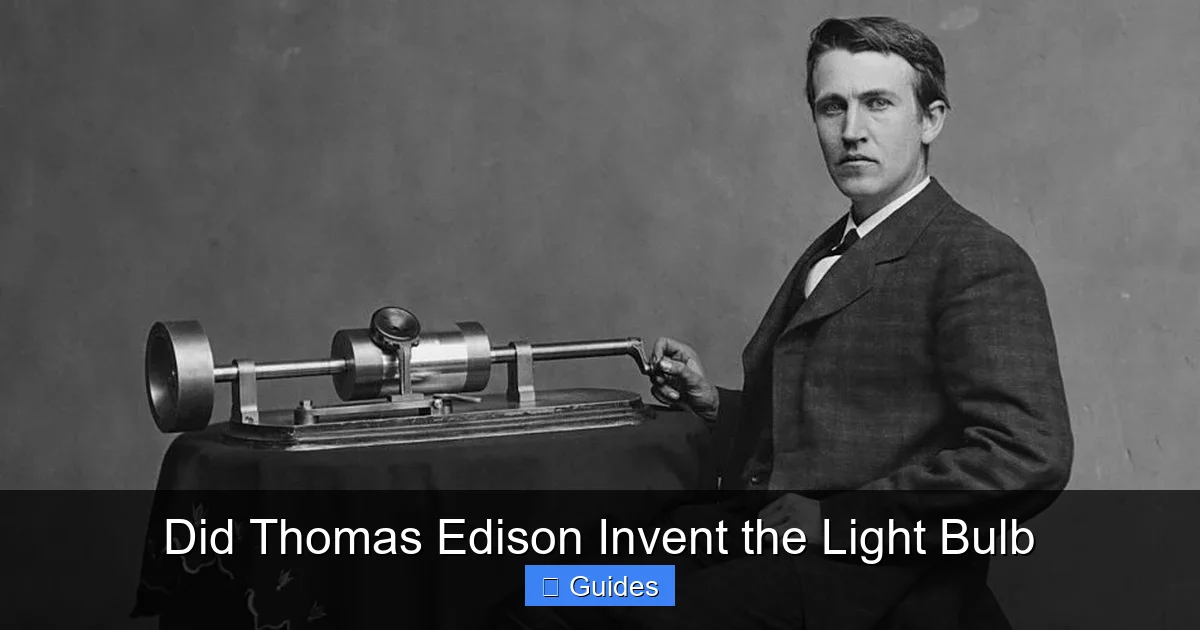
Visual guide about Did Thomas Edison Invent the Light Bulb
Image source: statecollege.com
The Bamboo Fiber Revelation
The real game-changer came in 1880 when Edison and his researchers discovered that a carbonized filament made from a species of bamboo could last for over 1,200 hours. This was a monumental leap in durability and efficiency. The bamboo fiber, chosen after testing thousands of plant samples from around the world, had the perfect combination of resistance, strength, and longevity when carbonized. This new filament allowed for a bulb that was genuinely practical for homes and businesses.
Mastering the Vacuum and High Resistance
Beyond the filament, two other critical factors made Edison’s bulb superior:
A Near-Perfect Vacuum
For a filament to glow without quickly burning up, it needed to be in a near-perfect vacuum. Early vacuum pumps were inefficient, leading to premature filament failure. Edison invested heavily in improving vacuum pump technology, enabling his bulbs to maintain a much stronger vacuum, thereby significantly extending their lifespan.
High Resistance for Parallel Circuits
Edison’s most significant theoretical contribution was recognizing the need for a high-resistance filament. Previous bulbs used low-resistance filaments, which worked best in series circuits (where if one bulb failed, all bulbs went out). For home lighting, a parallel circuit was essential, allowing individual bulbs to be switched on and off independently. A high-resistance filament made parallel circuits practical, consuming less current for a given amount of light, which reduced the cost of the copper wiring needed for distribution.
It was this combination of a long-lasting, affordable filament, a superior vacuum, and a high-resistance design that made Edison’s incandescent bulb a truly revolutionary product, making him a central figure in the story of electric light.
Beyond the Bulb: Creating an Entire Electrical System
Edison’s vision extended far beyond just the light bulb. He understood that a fantastic light bulb was useless without a reliable, efficient, and affordable way to power it. His ultimate achievement was not merely improving the bulb but conceptualizing and building the world’s first comprehensive system for generating, distributing, and utilizing electricity.
From Power Plant to Light Switch
This holistic approach was Edison’s true stroke of genius. He didn’t just invent a product; he invented an industry.
The Dynamo and Central Power Stations
To generate electricity on a large scale, Edison perfected the dynamo (an electrical generator). He then designed central power stations. On September 4, 1882, the Pearl Street Station in lower Manhattan, New York City, began operation. This was the world’s first commercial central power plant, providing electricity to customers in the surrounding area, demonstrating the viability of his direct current (DC) system.
Wiring, Sockets, Switches, and Meters
For electricity to be safely and conveniently delivered to homes and businesses, Edison and his team had to invent or significantly improve nearly every component of the electrical infrastructure. This included:
- Practical wiring: Insulated wires to carry electricity safely indoors and outdoors.
- Screw-in sockets: The standardized “Edison screw” base, still widely used today, made it easy to replace bulbs.
- Switches: To control the light at the point of use.
- Fuses: Essential safety devices to prevent overloads and fires.
- Electric meters: To accurately measure electricity consumption so customers could be billed.
Imagine trying to sell a television without developing broadcasting, antennas, and power outlets. That was the challenge Edison faced, and he tackled it head-on. His work made electric light not just possible, but practical, safe, and accessible to the masses.
The War of the Currents and AC vs. DC
While Edison championed his direct current (DC) system, it had limitations, particularly for long-distance power transmission. DC power suffered significant energy loss over long distances. This led to the famous “War of the Currents” with Nikola Tesla and George Westinghouse, who advocated for alternating current (AC).
Ultimately, AC proved more efficient for transmitting power over vast distances and became the dominant standard we use today. However, Edison’s pioneering work with DC laid the essential groundwork and proved the commercial viability of electric power distribution, paving the way for further advancements.
The Patent Wars and Collaborative Innovation
The story of the light bulb is also a tale of intense competition, legal battles, and the complex nature of intellectual property. As several inventors worked on similar problems simultaneously, disputes over patents were inevitable.
Edison vs. Swan: A Transatlantic Rivalry
Joseph Swan, the British inventor we discussed earlier, had developed his own successful incandescent light bulb around the same time as Edison. His bulbs were being installed in homes and public buildings in Britain, creating a direct conflict with Edison’s interests.
Consolidation and Collaboration
Rather than engaging in endless, costly legal battles, Edison and Swan ultimately decided to merge their interests in the United Kingdom. In 1883, they formed the Edison and Swan United Electric Light Company, commonly known as “Ediswan.” This collaboration allowed them to combine their patents and resources, dominating the British market for electric lighting.
This episode highlights a crucial aspect of innovation: sometimes, collaboration, even between rivals, can lead to greater progress than individual competition. It also underscores that great inventions are often the result of parallel efforts and iterative improvements by multiple individuals over time.
The Broader Patent Landscape
The history of the light bulb is filled with claims and counterclaims. Many patents were filed, some overlapping, others building incrementally. It’s a powerful reminder that “invention” is rarely a single, isolated event. Instead, it’s often a process of collective intelligence, where each inventor contributes a piece to a larger puzzle.
Understanding this context helps us appreciate Edison’s contribution more accurately. He wasn’t the sole creator of the electric light bulb, but he was a masterful synthesist, marketer, and system builder who propelled it into widespread public use.
Edison’s Lasting Legacy and the Modern Light Bulb
While the incandescent bulb Edison perfected has largely been replaced by more energy-efficient alternatives today, his legacy remains profoundly impactful. The question “did Thomas Edison invent the light bulb?” might have a nuanced answer, but his role in shaping the modern world of electricity is undeniable.
The Architect of Modern Electrification
Edison didn’t just give us a better bulb; he gave us the framework for modern electrification. Every time you flip a light switch, charge your phone, or power an appliance, you are benefiting from the foundational principles and infrastructure that Edison and his team pioneered. His direct current system, though later superseded by AC for long-distance transmission, was the proof of concept that launched the electrical age.
Innovation and Entrepreneurship
Edison was a visionary entrepreneur. He understood that an invention’s true value lay in its ability to solve a real-world problem for a vast number of people. He wasn’t just a scientist in a lab; he was a businessman who knew how to turn ideas into profitable realities. His methods of systematic invention, team-based research (creating one of the first industrial research labs), and aggressive patenting set precedents for industrial innovation that are still followed today.
Practical Tip: Think about the products you use daily. Often, their true innovation wasn’t just the initial concept, but the subsequent refinements, cost reductions, and infrastructure built around them to make them ubiquitous and indispensable.
From Incandescent to LED: A Continuous Evolution
Today, we rely on a diverse array of lighting technologies, from compact fluorescent lamps (CFLs) to light-emitting diodes (LEDs). These modern solutions are far more energy-efficient and last much longer than Edison’s incandescent bulbs. However, they all stand on the shoulders of the pioneers who first harnessed electricity for illumination, including Edison.
The journey from Humphry Davy’s flickering arc lamp to a smart LED bulb controlled by your phone is a testament to continuous human ingenuity. Each step, from the early incandescent experiments to Edison’s system, and then to the development of fluorescent and LED technologies, represents an iterative process of improvement, driven by the desire for brighter, cheaper, and more efficient light.
Practical Tip: When you upgrade your home lighting to energy-efficient LEDs, take a moment to appreciate the centuries of innovation that led to that simple, powerful device. It’s a direct lineage from Edison’s efforts to bring light to the masses.
Conclusion: Beyond the Myth
So, did Thomas Edison invent the light bulb? The definitive answer is no, not in isolation. He was one of many brilliant minds who contributed to its development. However, his work was unquestionably pivotal. He took an experimental, temperamental device and, through relentless experimentation, strategic thinking, and a holistic approach, transformed it into a practical, long-lasting, and affordable invention. More importantly, he built the entire electrical ecosystem – the power plants, the distribution networks, the switches, and the meters – that made widespread electric illumination a reality.
Edison’s legacy is not just about a single invention, but about the profound impact of systematic innovation and the commercialization of technology. He showed the world that electric light was not just a scientific marvel but a viable, life-changing utility. While we must credit the many forgotten inventors who sparked the initial idea, it was Thomas Edison’s incandescent bulb and the system he built around it that truly illuminated the modern world and set the stage for all future advancements in electric lighting. His story teaches us that true invention often lies in making an idea useful, accessible, and truly transformative.
Frequently Asked Questions
When did Thomas Edison introduce his practical light bulb?
Thomas Edison introduced his most practical and long-lasting incandescent light bulb with a carbonized bamboo filament in 1880, after extensive research and experimentation by his team at Menlo Park.
What was the main problem with early light bulbs before Edison?
The main problem with early incandescent light bulbs before Edison was their short lifespan. Their filaments would quickly burn out, making them impractical and costly for widespread, continuous use in homes and businesses.
Did Edison invent electricity?
No, Thomas Edison did not invent electricity. The fundamental principles of electricity were discovered by scientists like Benjamin Franklin, Alessandro Volta, Michael Faraday, and others long before Edison’s time. Edison’s contribution was in developing practical applications for electricity, such as the light bulb and the electrical distribution system.
How did Edison make his light bulb affordable?
Edison made his light bulb affordable through a combination of factors: developing a long-lasting, inexpensive filament (carbonized bamboo), designing a high-resistance bulb that reduced the cost of copper wiring in his distribution system, and focusing on mass production techniques.
What role did Edison’s laboratory play in the light bulb’s development?
Edison’s Menlo Park laboratory played a crucial role as one of the first industrial research and development facilities. It allowed a team of scientists and engineers to systematically conduct thousands of experiments, refining existing ideas and inventing necessary components for the light bulb and its supporting electrical system.
What replaced Edison’s incandescent light bulb?
Edison’s incandescent light bulb has largely been replaced by more energy-efficient technologies over time. These include fluorescent lamps (like CFLs) and, most significantly in recent years, light-emitting diodes (LEDs), which offer superior lifespan and energy savings.
