


As an Amazon Associate, We earn from qualifying purchases.
Light bulbs transform electrical energy into visible light through various ingenious methods, a fascinating process that has evolved significantly over time. Incandescent bulbs create light by heating a tiny filament until it glows intensely, while CFLs use electricity to excite gas inside a tube, producing UV light that a special coating converts into visible illumination. Modern LED bulbs, the most energy-efficient option, generate light by passing current through semiconductor materials, showcasing the remarkable journey of how does light bulb work to illuminate our world.
How Does Light Bulb Work? Illuminating the Science Behind Our Everyday Glow
Have you ever stopped to think about one of the most common, yet utterly magical, inventions in human history? We flip a switch, and *poof* – there’s light! It’s such a routine part of our lives that we rarely pause to consider the brilliant engineering and fascinating science behind it. But if you’re curious about the mechanics of everyday wonders, you’ve likely found yourself asking: exactly how does light bulb work?
From the warm glow of Edison’s first successful bulb to the crisp, energy-efficient light of today’s smart LEDs, the technology has come a long way. But at its core, the goal remains the same: transforming electrical energy into visible light. The “how” behind this transformation, however, is a captivating journey through physics, chemistry, and ingenuity. So, grab a cup of coffee, settle in, and let’s pull back the curtain on this amazing invention and explore how does light bulb work, from the inside out!
Key Takeaways
- Incandescent Bulbs: These classic bulbs work by heating a thin wire filament (usually tungsten) to extreme temperatures with electricity. The filament’s resistance causes it to glow brightly, a process known as incandescence.
- CFL (Compact Fluorescent Lamp) Bulbs: CFLs operate by passing an electric current through a tube containing argon gas and a small amount of mercury vapor. This excites the mercury atoms, which emit ultraviolet (UV) light. A phosphor coating inside the tube then absorbs this UV light and re-emits it as visible light.
- LED (Light Emitting Diode) Bulbs: LEDs represent the pinnacle of modern lighting efficiency. They produce light when an electric current flows through a semiconductor material (a diode). This process, called electroluminescence, involves electrons combining with “holes” to release energy in the form of photons (light).
- Energy Efficiency Evolution: Light bulb technology has progressed from converting most electrical energy into heat (incandescent) to directly producing light with minimal heat loss (LEDs), leading to significant energy savings and longer lifespans.
- Key Components: Each type of light bulb has unique essential components: incandescents have a filament and vacuum/inert gas; CFLs feature a gas-filled tube, mercury, phosphor coating, and a ballast; and LEDs rely on semiconductor diodes, a driver, and a heat sink.
- The “How”: While all light bulbs convert electricity into light, the fundamental “how does light bulb work” varies dramatically across technologies, utilizing different physical principles to achieve illumination.
Quick Answers to Common Questions
How does an incandescent light bulb create light?
An incandescent light bulb creates light by passing electricity through a thin tungsten filament. The filament has electrical resistance, which causes it to heat up to extremely high temperatures (around 2,700°C). When it gets this hot, it begins to glow brightly, emitting visible light and a lot of heat.
What is the main difference in how a CFL and an LED bulb produce light?
The main difference lies in their light production mechanisms. A CFL produces UV light by exciting mercury vapor with electricity, which then hits a phosphor coating to convert it into visible light. An LED, on the other hand, directly produces visible light through electroluminescence when an electric current passes through semiconductor materials.
Why are LED bulbs considered more energy-efficient than other types?
LED bulbs are more energy-efficient because they convert a much higher percentage of electrical energy directly into visible light, with very little energy lost as heat. Incandescent bulbs, for example, waste most of their energy as heat, while CFLs have a two-step conversion process that is less direct than an LED’s.
What is the role of the “driver” in an LED light bulb?
The LED driver is an electronic component within an LED bulb that converts the high voltage alternating current (AC) from your home’s electrical supply into the low voltage direct current (DC) that the LEDs require to operate safely and efficiently. It also regulates the current flow to ensure consistent light output.
Do all light bulbs produce heat?
Yes, all light bulbs produce some form of heat as a byproduct of converting electrical energy into light. However, the amount of heat produced varies significantly. Incandescent bulbs produce a lot of heat (as it’s integral to their operation), while CFLs and especially LEDs are much more efficient, producing considerably less heat, making them cooler to the touch.
📑 Table of Contents
- The Incandescent Pioneer: How the Original Light Bulb Works
- Embracing Efficiency: How CFLs (Compact Fluorescent Lamps) Work
- The Rise of LED: How Modern LED Light Bulbs Work
- Other Light Bulb Technologies (A Brief Look)
- The Evolution and Future of Light: Choosing the Right Bulb
- Conclusion: Illuminating Our World
The Incandescent Pioneer: How the Original Light Bulb Works
Let’s start our journey with the grand old patriarch of artificial lighting: the incandescent light bulb. This is probably what most people still picture when they think of a “traditional” light bulb. It’s simple, elegant, and revolutionary for its time, but it’s also a bit of an energy hog by today’s standards. Understanding how does light bulb work in its incandescent form is foundational to appreciating the advancements that followed.
Breaking Down the Incandescent Bulb’s Parts
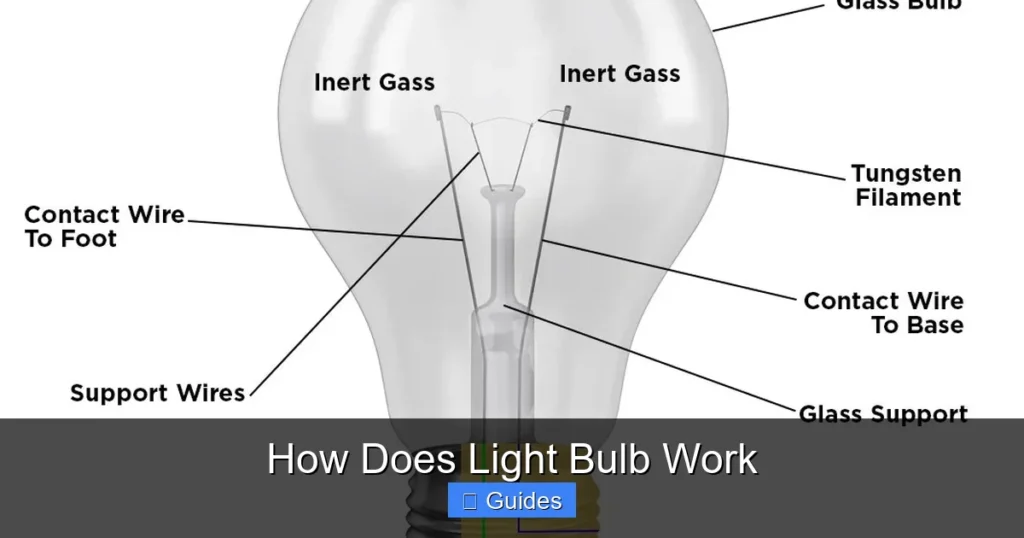
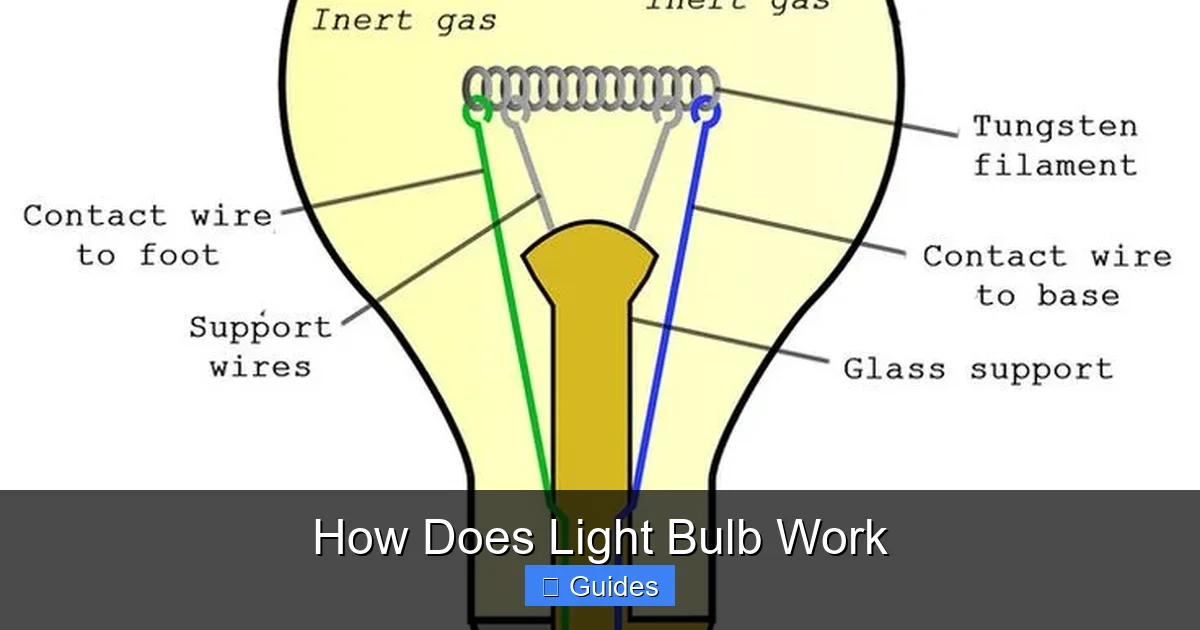
An incandescent light bulb might seem simple, but it’s a marvel of design. At its heart is a very thin, coiled wire called a filament, typically made from tungsten. Tungsten is chosen because it has an incredibly high melting point, allowing it to get extremely hot without disintegrating. This filament is housed inside a glass bulb, which is either a vacuum (meaning all air is removed) or filled with an inert gas like argon or nitrogen. This special atmosphere prevents the filament from burning up too quickly when it gets hot. The bulb also has electrical contacts at the base, which connect to your lamp or fixture, and a support wire to hold the filament in place.
The Science of Incandescence
So, how does light bulb work in this classic design? It all comes down to a scientific principle called “incandescence.” When you flip the switch, electricity flows from the base of the bulb, through the support wires, and into the tungsten filament. Tungsten is a good conductor of electricity, but it also has electrical resistance. This means it resists the flow of electrons. As electrons push their way through the narrow tungsten wire, they collide with the tungsten atoms, generating friction and heat. Lots of heat!
Think of it like rubbing your hands together very fast – they get warm. The filament, being so thin and resistant, gets incredibly hot, often reaching temperatures of around 2,700°C (4,900°F). When any material gets this hot, it begins to glow, first red, then orange, then yellow, and eventually white. This glowing is the visible light we see. Most of the energy, however, is released as heat, which is why incandescent bulbs get so hot to the touch. This heat is essentially wasted energy, which is why they are not very efficient. That’s the basic rundown of how does light bulb work in an incandescent design!
Why Did Incandescent Bulbs Fade Out?
For decades, incandescent bulbs were king. But their inefficiency was their downfall. Only about 5-10% of the electrical energy they consumed was converted into visible light; the rest was lost as heat. This led to higher electricity bills and a shorter lifespan for the bulbs themselves. As environmental awareness grew and energy costs climbed, the push for more efficient lighting technologies became a global priority, paving the way for the next generation of how does light bulb work.
Embracing Efficiency: How CFLs (Compact Fluorescent Lamps) Work
Visual guide about How Does Light Bulb Work
Image source: i.pinimg.com
Enter the Compact Fluorescent Lamp, or CFL. These spiral-shaped bulbs became a popular energy-saving alternative to incandescents. While their light quality sometimes sparked debate, they offered a significant leap in efficiency. Learning how does light bulb work in a CFL reveals a completely different set of scientific principles.
The CFL’s Inner Workings: Gas, Mercury, and UV Light
A CFL bulb doesn’t rely on heating a filament to produce light. Instead, it uses a chemical reaction involving gases. Inside the twisted glass tube of a CFL, there’s a low-pressure mixture of argon gas and a tiny amount of mercury vapor. The inner surface of the glass tube is coated with a special substance called phosphor.
When you turn on a CFL, electricity flows into the bulb and through a component called a ballast (more on that in a moment). The ballast sends a high voltage surge that “excites” the electrons in the mercury atoms within the tube. These excited electrons jump to higher energy levels and then fall back down, releasing energy in the form of ultraviolet (UV) light. Now, UV light isn’t visible to the human eye, so how does light bulb work to give us visible light? That’s where the phosphor comes in!
The Role of the Phosphor Coating
The UV light produced by the excited mercury atoms hits the phosphor coating on the inside of the glass tube. Phosphor is a fluorescent material, meaning it absorbs UV radiation and then re-emits it as visible light. Different phosphor blends produce different colors of light, allowing CFLs to offer various “color temperatures,” from warm white to cool daylight. This two-step process – generating invisible UV light and then converting it to visible light – is the clever mechanism behind how does light bulb work in a CFL.
Ballasts: The Unsung Heroes of CFLs
You might notice that CFLs take a moment to “warm up” to full brightness. This is partly due to the ballast. The ballast is a crucial electronic component inside the base of the CFL. Its job is twofold: first, it provides the initial high voltage surge needed to ionize the gas and start the arc (the flow of current) inside the tube. Second, once the arc is established, the ballast regulates the current flow to maintain a stable, continuous discharge. Without the ballast, the current would increase uncontrollably, quickly burning out the bulb. Modern electronic ballasts are much more efficient and quieter than older magnetic ballasts found in larger fluorescent tubes, making CFLs more practical for home use. They are an essential part of understanding how does light bulb work in this particular setup.
The Rise of LED: How Modern LED Light Bulbs Work
If incandescent bulbs were the past and CFLs were the transition, then LED (Light Emitting Diode) bulbs are definitively the present and future of lighting. LEDs have revolutionized how does light bulb work, offering unparalleled energy efficiency, incredible longevity, and versatile design options. These tiny wonders operate on a completely different, purely electronic principle.
From Semiconductors to Photons: The LED Principle
At the heart of every LED bulb is a semiconductor material called a diode. Semiconductors are materials like silicon or gallium arsenide that are neither great conductors nor great insulators, but fall somewhere in between. An LED is made from two different types of semiconductor material, called P-type and N-type, joined together. The P-type material has an abundance of “holes” (a deficit of electrons), and the N-type material has an excess of electrons.
When an electric current is applied to the LED in the correct direction (this is called “forward bias”), electrons from the N-type material are pushed across the junction into the P-type material. In the P-type material, these electrons meet and combine with the “holes.” When an electron drops into a hole, it loses energy. In certain semiconductor materials used for LEDs, this energy is released in the form of a photon – a tiny particle of visible light. This process is called electroluminescence. The specific materials used in the semiconductor determine the color of the light emitted (red, green, blue, etc.). This direct conversion of electricity into light is the fundamental answer to how does light bulb work in an LED.
The LED Package: Diodes, Drivers, and Heatsinks
A single LED diode is tiny, often only a few millimeters across. To create a modern LED light bulb, many individual LEDs are mounted together on a circuit board. But there’s more to it than just the diodes.
- LED Driver: LEDs operate on a low DC (direct current) voltage, typically between 1.5V and 3V. However, your home electricity is high voltage AC (alternating current). An essential component in an LED bulb is the LED driver, which is a small electronic circuit that converts the AC household current into the precise DC voltage and current required by the LEDs. It’s like the ballast in a CFL but tailored for diodes, and it plays a critical role in controlling how does light bulb work reliably.
- Heat Sink: While LEDs are incredibly efficient, they do produce some heat. Unlike incandescents where heat *is* the light, in LEDs, heat is a byproduct that needs to be managed. Excessive heat can damage the semiconductor material and shorten the LED’s lifespan. Therefore, LED bulbs often incorporate a heat sink, typically made of aluminum, which draws heat away from the diodes and dissipates it into the surrounding air. This ensures the LEDs operate at optimal temperatures, guaranteeing their long life.
- Diffuser: Often, there’s a frosted plastic or glass dome over the LEDs. This isn’t just for aesthetics; it helps to diffuse the bright, concentrated light from the individual diodes, spreading it out more evenly and reducing glare, creating a more pleasant light output.
Why LEDs Are So Energy Efficient
The efficiency of LEDs stems from their direct light production. Instead of generating a lot of heat to make light (like incandescents) or converting UV light (like CFLs), LEDs directly emit photons from the flow of electrons. This means very little energy is wasted as heat, making them incredibly efficient at converting electricity into illumination. They also have an incredibly long lifespan, often lasting 25,000 to 50,000 hours or more, significantly reducing the frequency of bulb changes. This unmatched efficiency and longevity are why LEDs dominate the market when considering how does light bulb work best in modern homes and businesses.
Other Light Bulb Technologies (A Brief Look)
While incandescent, CFL, and LED cover the main evolutionary path, it’s worth briefly touching on a couple of other lighting technologies that answer the question of how does light bulb work, each with its specific applications.
Halogen Lamps: Incandescence, Refined
Halogen lamps are essentially an improved version of the incandescent bulb. They still use a tungsten filament, but it’s housed in a much smaller, quartz envelope filled with a halogen gas (like iodine or bromine). The halogen gas plays a crucial role in a chemical process called the halogen cycle. This cycle re-deposits evaporated tungsten atoms back onto the filament, which significantly extends the bulb’s lifespan and allows the filament to burn at a higher temperature. Higher temperature means brighter, whiter light and slightly better efficiency than traditional incandescents, though still far behind CFLs and LEDs. So, how does light bulb work here? It’s still about heating a filament, but with a clever chemical trick to make it last longer and shine brighter.
High-Intensity Discharge (HID) Lamps
HID lamps, which include technologies like mercury vapor, metal halide, and high-pressure sodium lamps, are powerful lights often used in streetlights, sports arenas, and car headlights. These bulbs work by passing an electric arc through a mixture of gas and metal salts at high pressure. This creates a very intense light output. They are significantly more efficient than incandescents and even CFLs for very high brightness applications, but they take a long time to warm up and cool down, making them unsuitable for general home lighting. The core principle of how does light bulb work for HIDs involves ionizing gases and metal vapors to produce an extremely bright light, making them perfect for large-scale illumination.
The Evolution and Future of Light: Choosing the Right Bulb
We’ve traveled through the fascinating history and science of how does light bulb work, from the simple yet revolutionary incandescent to the sophisticated and super-efficient LED. Each step forward has brought us closer to more sustainable and versatile lighting solutions.
Comparing the Technologies: Pros and Cons
Understanding how does light bulb work for each type helps us appreciate their differences:
- Incandescent:
- Pros: Inexpensive to buy, excellent color rendering, instant on, dimmable.
- Cons: Very inefficient (lots of heat), short lifespan, phased out in many regions.
- CFL:
- Pros: More energy-efficient than incandescents, longer lifespan, lower heat output.
- Cons: Contain mercury (requires special disposal), slower warm-up time, dimming can be problematic, light quality sometimes not preferred.
- LED:
- Pros: Extremely energy-efficient, very long lifespan, durable, instant on, excellent dimming capabilities (with compatible fixtures), mercury-free, wide range of color temperatures and designs.
- Cons: Higher initial cost (though prices have significantly dropped), can be sensitive to heat if not properly engineered (hence the heatsink).
Making an Informed Choice Today
Given all this knowledge about how does light bulb work, what’s the best choice for your home today? For most general lighting purposes, the answer is overwhelmingly LED. While their upfront cost might be slightly higher than some other options, their energy savings and incredibly long lifespan mean they are significantly cheaper to operate over time. They also offer unmatched versatility, from tunable white light to smart home integration, allowing you to personalize your lighting experience like never before. The journey of how does light bulb work has truly culminated in an era of intelligent and sustainable illumination.
Conclusion: Illuminating Our World
The humble light bulb, an object we often take for granted, is truly a testament to human ingenuity and scientific advancement. From the simple glow of a superheated wire to the complex dance of electrons and photons in a semiconductor, the story of how does light bulb work is a narrative of constant innovation, driven by the desire to make our lives brighter and more efficient.
Next time you flip a switch and your room fills with light, take a moment to appreciate the incredible journey that technology has taken. Whether it’s the classic incandescent, the transitional CFL, or the cutting-edge LED, each light bulb embodies a unique scientific marvel that transforms invisible electricity into the visible light that illuminates our homes, our cities, and our understanding of the world. Knowing how does light bulb work gives us a deeper appreciation for the silent, shining heroes that brighten our everyday lives.
🎥 Related Video: How Does a Light Bulb Work?
📺 ScienceABC II
Have you ever wondered what happens inside a light bulb when you flip the switch? The incandescent bulb, first patented by …
Frequently Asked Questions
What is the most energy-efficient type of light bulb?
LED (Light Emitting Diode) bulbs are by far the most energy-efficient type of light bulb currently available for general consumer use. They convert electricity into light with minimal heat loss, making them incredibly effective at reducing energy consumption and lowering electricity bills.
Do CFL bulbs contain mercury?
Yes, CFL bulbs contain a small amount of mercury vapor inside their glass tubes, which is essential for their operation. Because of this, CFLs should be disposed of properly at designated recycling centers to prevent mercury from entering the environment.
How long do LED bulbs typically last compared to incandescent bulbs?
LED bulbs have an exceptionally long lifespan, typically lasting 25,000 to 50,000 hours or even more. In contrast, traditional incandescent bulbs usually only last about 750 to 1,000 hours, meaning LEDs can last 25 to 50 times longer.
Can I use any dimmer switch with an LED bulb?
No, not all dimmer switches are compatible with LED bulbs. LEDs require specific “LED-compatible” or “universal” dimmer switches. Using an incompatible dimmer can lead to flickering, buzzing, or even damage the LED bulb or dimmer itself.
Why does an incandescent bulb burn out?
An incandescent bulb typically burns out when its tungsten filament eventually breaks. As the filament heats and cools repeatedly, tiny amounts of tungsten evaporate. Over time, this makes the filament thinner and weaker at certain points until it finally breaks, interrupting the electrical circuit.
Are smart light bulbs different from regular LEDs in how they work?
The core mechanism of how smart light bulbs produce light is the same as regular LEDs (electroluminescence). However, smart bulbs include additional internal electronics like Wi-Fi or Bluetooth modules and microcontrollers, allowing them to connect to networks, be controlled remotely, change colors, and integrate with smart home systems.
