



As an Amazon Associate, We earn from qualifying purchases.
Have you ever stopped to think about how a simple light bulb works? The process is surprisingly straightforward yet brilliant. At its core, an incandescent light bulb works by passing electricity through a thin wire filament, usually made of tungsten. This causes the filament to heat up to an extreme temperature, making it glow intensely and emit visible light, a phenomenon called incandescence. The glass bulb protects this glowing filament from oxygen, preventing it from burning out instantly.
How Does the Incandescent Light Bulb Work
The humble light bulb. It’s one of those inventions so ubiquitous, so ingrained in our daily lives, that we rarely stop to think about the magic within. For over a century, the incandescent light bulb was the primary source of artificial illumination in homes and businesses around the world. Even as newer, more energy-efficient technologies like LEDs and CFLs take over, understanding the classic incandescent bulb offers a fascinating peek into fundamental physics and engineering.
Have you ever looked at a glowing light bulb and wondered, “How does the incandescent light bulb work?” It seems simple enough: you flip a switch, and light appears. But behind that simple act lies a brilliant interplay of electricity, resistance, and extreme heat. This article will pull back the curtain, explaining every component and principle that allows an incandescent light bulb to banish the darkness with a warm, familiar glow. Let’s explore the ingenious design that brought light to the masses!
A Journey from Darkness to Light: The Incandescent Revolution
Before the advent of the incandescent light bulb, lighting our homes after sunset was a laborious and often dangerous affair. Candles flickered, oil lamps smoked, and gaslights required elaborate plumbing and posed fire risks. Thomas Edison is widely credited with inventing a practical, long-lasting incandescent light bulb in the late 19th century, though many inventors contributed to its development. His genius lay in combining existing technologies and refining them into a commercially viable product. The widespread adoption of the incandescent light bulb revolutionized daily life, extending productive hours, improving safety, and making modern living possible.
Key Takeaways
- The Core Principle: An incandescent light bulb works by heating a thin, high-resistance filament (typically tungsten) to extreme temperatures, causing it to glow brightly and emit light. This process is known as incandescence.
- Filament’s Role: The tungsten filament is crucial. Its high melting point allows it to get incredibly hot (up to 2,700°C or 4,900°F) without melting, enabling it to produce a broad spectrum of visible light.
- Vacuum or Inert Gas: The glass bulb surrounding the filament contains either a vacuum or an inert gas like argon or nitrogen. This prevents the filament from reacting with oxygen and rapidly burning out, significantly extending the bulb’s lifespan.
- Energy Conversion: While effective at producing light, the incandescent light bulb is highly inefficient. Around 90% of the electrical energy it consumes is converted into heat, with only about 10% actually turning into visible light.
- Basic Components: Key parts include the glass bulb, the tungsten filament, lead-in wires, a support wire, a glass mount, and the screw base (or bayonet base) which connects to the electrical circuit.
- Black-Body Radiation: The light emitted by an incandescent bulb is a form of black-body radiation. The color and intensity of the light depend on the filament’s temperature – hotter means brighter and whiter light.
- Simplicity and Legacy: Despite their inefficiency and eventual phase-out in many regions, incandescent light bulbs represent a fundamental and elegant application of electrical and thermal physics, illuminating homes for over a century.
Quick Answers to Common Questions
What is incandescence?
Incandescence is the emission of light from an object due to its high temperature. When the filament of an incandescent light bulb gets hot enough, it glows and produces visible light.
Why do incandescent bulbs use tungsten filaments?
Tungsten is used because it has an extremely high melting point, allowing it to reach the very high temperatures needed to glow brightly without melting. It also has high electrical resistance and a low evaporation rate at these temperatures.
What gas is inside an incandescent light bulb?
Modern incandescent light bulbs typically contain an inert gas like argon or a mixture of argon and nitrogen. This gas prevents the hot tungsten filament from oxidizing and burning out, and it also reduces the rate of tungsten evaporation, extending the bulb’s life.
Why do incandescent light bulbs get hot?
Incandescent light bulbs get hot because about 90% of the electrical energy they consume is converted into heat (infrared radiation) rather than visible light. This is an inherent part of the incandescence process.
How is light actually produced in an incandescent bulb?
Light is produced when electricity flows through the tungsten filament, encountering high resistance. This resistance causes the filament to heat up to thousands of degrees Celsius, making it glow intensely and emit visible light through the process of incandescence.
📑 Table of Contents
- The Fundamental Principle: Resistance and Incandescence
- Deconstructing the Incandescent Light Bulb: Key Components
- The Electrical Journey: From Socket to Glow
- Understanding Efficiency and Light Spectrum
- Lifespan and Failure of an Incandescent Light Bulb
- The Legacy of Incandescence: A Look Back and Forward
- Conclusion: The Enduring Spark of an Idea
The Fundamental Principle: Resistance and Incandescence
At the heart of how an incandescent light bulb works is a simple yet powerful concept: resistance. When electricity encounters resistance in a conductor, it generates heat. Think about rubbing your hands together vigorously – the friction creates warmth. In an electrical circuit, electrons rushing through a material encounter resistance, causing them to collide with atoms and release energy as heat.
Heating Up to Glow: The Magic of Incandescence
The specific phenomenon at play here is “incandescence.” Incandescence is the emission of light from a body as a result of its high temperature. When a material gets hot enough, its atoms become excited and begin to vibrate intensely. This excitation causes them to release energy in the form of electromagnetic radiation. At lower temperatures, this radiation is mostly infrared (heat). But as the temperature climbs higher and higher, the emitted radiation shifts into the visible spectrum, and the material begins to glow – first red, then orange, yellow, and eventually white as it gets hotter still.
In an incandescent light bulb, the goal is to make a specific part of the bulb incredibly hot. This is achieved by running an electric current through a very thin wire, which is designed to have a high electrical resistance.
Why Tungsten? The Perfect Filament Material
Not just any wire will do for an incandescent light bulb. The material needs to meet some very specific criteria:
- High Melting Point: It needs to get extremely hot without melting.
- High Electrical Resistance: It needs to generate a lot of heat when electricity passes through it.
- Malleability: It needs to be drawable into a very thin wire.
- Low Evaporation Rate: It should not evaporate quickly at high temperatures, which would thin the filament and shorten its life.
Tungsten fits this bill perfectly. It has the highest melting point of all metals (around 3,422°C or 6,192°F). When electricity flows through a tungsten filament, it heats up rapidly, typically reaching temperatures between 2,200°C and 2,700°C (4,000°F to 4,900°F). At these extreme temperatures, the tungsten filament glows brilliantly, emitting the warm light we associate with the incandescent light bulb.
Deconstructing the Incandescent Light Bulb: Key Components
To truly understand how the incandescent light bulb works, let’s break it down into its core components. Each part plays a vital role in enabling the filament to do its job safely and efficiently (at least, as efficiently as an incandescent bulb gets!).
The Glass Bulb (or Envelope)
This is the most obvious part – the transparent outer shell that gives the incandescent light bulb its familiar shape. Its primary purpose is to create an enclosed environment for the filament. This enclosure serves two critical functions:
- Protection from Oxygen: If the super-hot tungsten filament were exposed to oxygen in the air, it would instantly oxidize and burn out, much like a fuse blowing. The glass bulb creates a sealed space, preventing this chemical reaction.
- Containing Inert Gas or Vacuum: Early incandescent light bulbs used a vacuum inside the glass bulb to prevent oxidation. While effective, the vacuum caused tungsten atoms to evaporate from the hot filament over time, depositing on the inside of the glass and causing it to blacken. Modern incandescent light bulbs often contain an inert (non-reactive) gas, such as argon or a mixture of argon and nitrogen. These gases don’t react with the hot tungsten. They also reduce the rate of tungsten evaporation, allowing the filament to run hotter for longer, which increases both light output and bulb lifespan.
The Tungsten Filament
As discussed, this is the star of the show. It’s an incredibly thin wire, often coiled into a tiny spring-like helix, and sometimes coiled again into a double helix. This coiling allows a long length of wire to be packed into a small space, increasing its resistance and thus its heat and light output without making the bulb excessively large.
Lead-in Wires
These wires carry the electricity from the electrical contacts in the base of the incandescent light bulb to the filament. They are typically made of a material that conducts electricity well but has a lower resistance than the filament itself, so they don’t heat up significantly. These wires must also have a similar coefficient of thermal expansion to the glass they pass through, preventing cracks as the bulb heats and cools.
Support Wires
The delicate tungsten filament needs support to prevent it from sagging or breaking due to vibration or its own weight when it’s super hot and soft. Small support wires, often made of molybdenum, hold the coiled filament in place.
The Glass Mount (or Stem)
This is the central glass structure inside the bulb that holds the lead-in wires and support wires. The base of this stem is usually where the glass bulb is sealed after the air has been removed and replaced with inert gas.
The Base (Screw or Bayonet)
This is the part of the incandescent light bulb that screws into a light socket. It has two main functions:
- Electrical Connection: It provides the electrical contacts to complete the circuit. For a screw base, one contact is the threaded metal shell, and the other is a small metal button at the very bottom.
- Mechanical Support: It physically holds the bulb in place in the fixture.
Inside the base, cement secures the glass envelope and electrical connections.
The Electrical Journey: From Socket to Glow
So, we know the parts, but how do they all work together in practice? Let’s trace the path of electricity through an incandescent light bulb.
Completing the Circuit
When you screw an incandescent light bulb into a socket and flip the switch, you complete an electrical circuit. Electricity flows from the power source, through the wiring in your home, and into the light fixture.
From the socket, electricity enters the incandescent light bulb through its base. Typically, the current flows into the small metal button at the bottom of the base, travels up one of the lead-in wires, and reaches the tungsten filament.
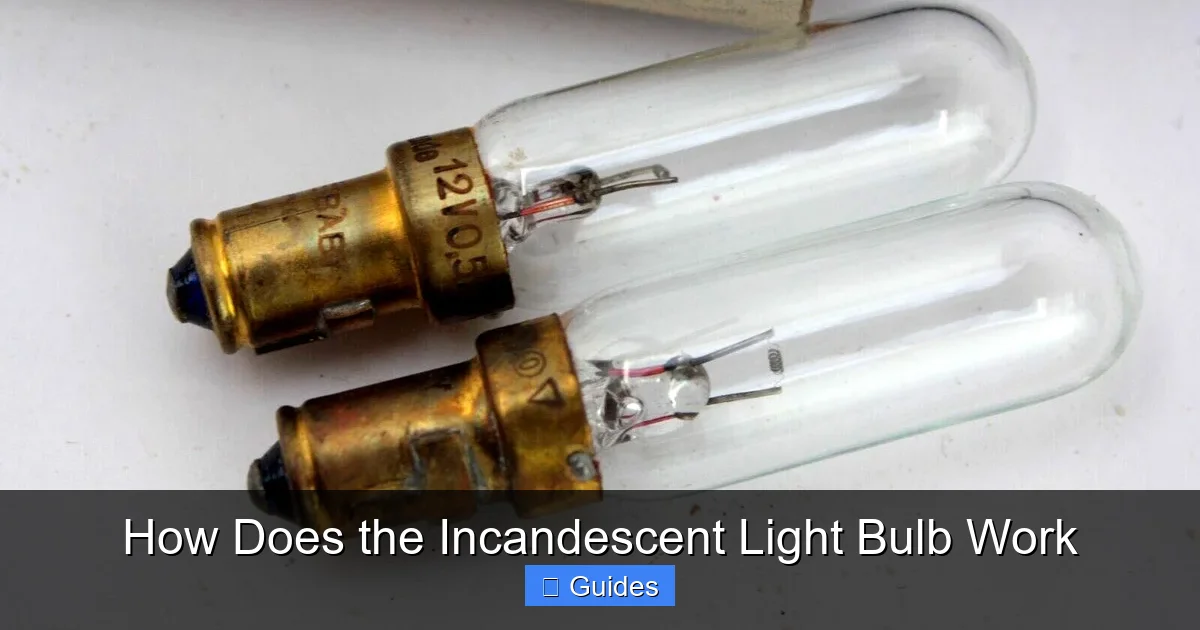
Visual guide about How Does the Incandescent Light Bulb Work
Image source: storables.com
Resistance and Heat Generation
As the electrons encounter the thin, high-resistance tungsten filament, they face significant opposition to their flow. This resistance causes the electrical energy to be converted primarily into heat energy. The filament heats up almost instantly, reaching temperatures hot enough to glow. This is the moment when the incandescent light bulb truly starts to work, transforming electrical energy into visible light.
The Return Path
After passing through the filament, the current travels down the second lead-in wire, through the threaded metal shell of the base, and back into the electrical circuit, returning to the power source. This completes the circuit, allowing a continuous flow of electricity and a continuous glow from the filament.
Understanding Efficiency and Light Spectrum
While the mechanism of how an incandescent light bulb works is straightforward, its efficiency is a key point of discussion, especially in modern times.
Why Incandescent Bulbs are “Inefficient”
As mentioned, the primary method of light production in an incandescent light bulb is heating a filament until it glows. The vast majority of the energy put into the bulb is converted into heat – infrared radiation – not visible light. In fact, typically only about 5-10% of the energy consumed by an incandescent bulb is converted into visible light; the rest is lost as heat. This is why an incandescent bulb gets so hot to the touch.
This inefficiency led to the development of more energy-efficient alternatives. Modern lighting technologies like Light Emitting Diodes (LEDs) and Compact Fluorescent Lamps (CFLs) produce light through different mechanisms that are far more efficient, converting a much higher percentage of electrical energy into visible light and far less into heat.
The Incandescent Light Spectrum: A Warm Glow
The light emitted by an incandescent light bulb is a continuous spectrum, meaning it produces all colors of visible light. However, because it operates at a relatively lower temperature compared to, say, the sun, it emits more light in the red and yellow parts of the spectrum and less in the blue. This gives incandescent light its characteristic warm, yellowish glow, which many people find appealing and comforting. The quality of light, often measured by its Color Rendering Index (CRI), is generally very high for incandescent bulbs, meaning they make colors appear very natural.
Lifespan and Failure of an Incandescent Light Bulb
Even though inert gas helps reduce evaporation, the tungsten filament in an incandescent light bulb doesn’t last forever.
Filament Evaporation and Hot Spots
Over time, tungsten atoms still slowly evaporate from the hot filament. They deposit on the cooler inside surface of the glass bulb, causing the familiar blackening you might see in older bulbs. As the filament loses tungsten atoms, it becomes thinner and more delicate.
This thinning is not uniform. “Hot spots” develop where the filament is slightly thinner or has a small imperfection. These hot spots have even higher resistance, causing them to get hotter than the rest of the filament. This leads to accelerated evaporation at these points, creating a positive feedback loop until the filament becomes so thin at a hot spot that it breaks. This is when an incandescent light bulb “burns out.”
Voltage Fluctuations and Their Impact
The lifespan of an incandescent light bulb is highly sensitive to the voltage supplied. Even a small increase in voltage can significantly shorten the bulb’s life because it makes the filament burn hotter, accelerating tungsten evaporation. Conversely, running a bulb at a slightly lower voltage can dramatically extend its life, though at the cost of reduced light output. This is a practical example of the delicate balance in how an incandescent light bulb works.
The Legacy of Incandescence: A Look Back and Forward
For well over a century, the incandescent light bulb illuminated our world, from grand ballrooms to humble bedside lamps. Its simple, reliable mechanism brought light to countless homes and spurred advancements in electrical infrastructure. Its warm glow is still beloved by many.
However, in an era focused on energy conservation and environmental impact, the inefficiency of the incandescent light bulb became a significant concern. Many countries around the globe have phased out or are phasing out the sale of traditional incandescent bulbs in favor of more energy-efficient alternatives.
Modern Alternatives and Why They’re Different
Understanding how an incandescent light bulb works also helps us appreciate the innovation in modern lighting:
- LEDs (Light Emitting Diodes): These produce light through electroluminescence, where electrons moving through semiconductor material release energy as photons (light) directly, with very little heat. They are highly efficient and durable.
- CFLs (Compact Fluorescent Lamps): These work by passing an electric current through a gas (argon and mercury vapor), which causes it to emit ultraviolet (UV) light. This UV light then strikes a phosphor coating on the inside of the bulb, which converts it into visible light.
Both LEDs and CFLs represent fundamental shifts in how light is generated, moving away from the “heat it until it glows” principle of incandescence.
Conclusion: The Enduring Spark of an Idea
The incandescent light bulb, while slowly fading from our shelves, remains a powerful symbol of innovation and a fundamental lesson in physics. Its mechanism, based on the simple principle of electrical resistance generating extreme heat to produce light through incandescence, transformed human society. From its humble filament to its protective glass envelope, every component is meticulously designed to create that familiar, comforting glow.
So, the next time you encounter an old-fashioned incandescent light bulb, take a moment to appreciate the elegant simplicity of its operation. It’s a testament to the ingenuity that, for over a hundred years, effectively answered the profound question: how does the incandescent light bulb work? It’s a classic invention that truly lit up the world.
🎥 Related Video: How Does a Light Bulb Work?
📺 ScienceABC II
Have you ever wondered what happens inside a light bulb when you flip the switch? The incandescent bulb, first patented by …
Frequently Asked Questions
What causes an incandescent light bulb to burn out?
An incandescent light bulb burns out when its tungsten filament breaks. Over time, tungsten atoms evaporate from the super-hot filament, making it thinner, especially at “hot spots” where resistance is highest. Eventually, the filament becomes too thin to withstand the current and breaks.
Are incandescent bulbs still available for purchase?
In many regions, traditional incandescent light bulbs have been phased out or are no longer manufactured due to their energy inefficiency. However, specialty incandescent bulbs for certain appliances, decorative purposes, or industrial uses may still be available, and in some areas, consumer sales may continue though with dwindling supply.
How does the voltage affect an incandescent bulb’s lifespan and brightness?
A higher voltage than recommended makes the filament burn hotter, increasing brightness but significantly shortening its lifespan due to accelerated tungsten evaporation. Conversely, a lower voltage will extend the lifespan but result in a dimmer light output.
Why is the light from an incandescent bulb often described as “warm”?
The light from an incandescent bulb is described as “warm” because its filament operates at a temperature that causes it to emit more light in the red and yellow parts of the visible spectrum. This gives it a soft, yellowish hue, contrasting with the “cooler” blue-white light of some other light sources.
What is the difference between a vacuum bulb and a gas-filled bulb?
Early incandescent light bulbs had a vacuum to prevent the filament from oxidizing, but tungsten still evaporated and blackened the glass. Modern incandescent light bulbs are filled with an inert gas (like argon) which not only prevents oxidation but also reduces tungsten evaporation, allowing the filament to run hotter and last longer.
Does an incandescent bulb use AC or DC current?
An incandescent light bulb can operate on either AC (Alternating Current) or DC (Direct Current). Most household wiring supplies AC, so incandescent bulbs in homes typically run on AC. The principle of heating a filament through resistance remains the same regardless of the current type.
