


As an Amazon Associate, We earn from qualifying purchases.
Finding the brightest LED light bulb isn’t just about raw power; it’s about understanding lumens, beam angle, and color temperature for your specific application. While no single bulb holds a universal “brightest” title, high-lumen options like corn bulbs can reach over 20,000 lumens, offering incredible illumination for large spaces when chosen correctly. The ideal bulb balances intense light output with efficient distribution and appropriate light quality.
What Is the Brightest Led Light Bulb?
Have you ever found yourself squinting in a dimly lit room, wishing for more light? Or perhaps you’re tired of fumbling in a dark garage, desperate for proper illumination. In our quest for better lighting, the question often arises: “What is the brightest LED light bulb I can get?” It’s a common and excellent question, especially with the rapid advancements in LED technology.
Gone are the days when we simply looked for the highest wattage incandescent bulb. LEDs have revolutionized how we think about light, offering incredible efficiency and longevity. But with so many options out there, understanding what truly makes an LED bulb “bright” and finding the absolute brightest LED light bulb for your specific needs can feel like a daunting task. This article is your friendly guide to navigating the world of high-lumen LEDs, helping you cut through the jargon and find the perfect beacon of brilliance.
We’re going to explore what “brightest” actually means in the context of LED lighting. We’ll dive into the critical metrics, discuss different types of super bright LED bulbs, and provide practical tips to ensure you make an informed choice. So, get ready to shed some light on this illuminating topic and discover how to find the brightest LED light bulb that will transform your space!
Key Takeaways
- Lumens are Key: Forget watts! Lumens (lm) are the true measure of a light bulb’s brightness. The higher the lumen count, the brighter the bulb.
- “Brightest” is Contextual: The “brightest LED light bulb” depends on your specific needs. A focused spotlight might *feel* brighter than a diffuse floodlight with the same lumen count.
- Beam Angle Matters: A narrow beam concentrates light, making an area intensely bright, while a wide beam spreads it out, illuminating a larger space more evenly but less intensely per spot.
- Color Temperature Influences Perception: Cooler color temperatures (5000K-6500K, “daylight” or “cool white”) often *feel* brighter than warmer ones (2700K-3000K, “soft white”) even at the same lumen output.
- High-Lumen Options Exist: For extreme brightness, look for specialty bulbs like LED corn bulbs, which can exceed 20,000 lumens, or high-output A-shape bulbs designed to replace high-wattage incandescents.
- Application is Crucial: Workshops, garages, security lighting, and high-ceiling areas benefit most from very bright LED light bulbs. Consider the space and purpose before buying.
- Don’t Forget Quality: Beyond lumens, consider Color Rendering Index (CRI) for accurate color representation and reputable brands for reliability and longevity.
Quick Answers to Common Questions
What is the brightest LED light bulb available for home use?
For general home use in a standard E26 screw-in base, you can find LED bulbs that replace 150W-200W incandescents, offering around 2600-3000 lumens. For even brighter options like in garages or workshops, LED corn bulbs with 5000-10,000 lumens (often E39 mogul base) are available.
Do more watts mean a brighter LED bulb?
No, not for LED bulbs. Watts measure energy consumption, while lumens measure brightness. An LED bulb can consume very few watts but still produce a high number of lumens, making it very bright.
What are lumens, and why are they important for LED brightness?
Lumens (lm) are the unit of measurement for the total amount of visible light emitted by a source. They are important because they directly tell you how bright a bulb is, unlike watts which only indicate power usage.
Does color temperature affect how bright an LED bulb feels?
Yes, significantly. Cooler color temperatures (5000K-6500K, “daylight”) tend to feel brighter and more intense than warmer ones (2700K-3000K, “soft white”), even if both bulbs have the same lumen output.
Can I put a very bright LED bulb in any light fixture?
While LEDs generate less heat than incandescents, very high-lumen LED bulbs still require heat dissipation. Ensure your fixture is either open or specifically rated for enclosed use if you plan to put a powerful LED in a closed fixture to prevent overheating and shortened bulb lifespan.
📑 Table of Contents
- Understanding Brightness: It’s All About Lumens
- Beyond Lumens: Other Factors Influencing Perceived Brightness
- The Contenders: Types of High-Lumen LED Bulbs
- Choosing the Brightest LED Bulb for *Your* Needs
- Practical Tips for Installation and Safety
- Conclusion: The Brightest LED is the Right LED for You
Understanding Brightness: It’s All About Lumens
When you’re looking for the brightest LED light bulb, the most important term you need to know is “lumens.” For years, we associated brightness with watts. A 100-watt incandescent bulb was brighter than a 60-watt one. But with LEDs, watts measure energy consumption, not brightness. A 15-watt LED bulb can easily be as bright as a 100-watt incandescent, sometimes even brighter!
Watts vs. Lumens: The Key Distinction
Think of it this way: watts are like how much fuel your car uses, while lumens are how fast your car goes. You might have a very fuel-efficient car that still goes incredibly fast. Similarly, an LED bulb uses very few watts but can produce a massive amount of light (lumens). So, when you see a bulb advertised as, say, “1600 lumens,” that’s your real indicator of its brightness. A typical 60-watt incandescent bulb produces about 800 lumens, while a 100-watt incandescent produces around 1600 lumens. When you’re seeking the brightest LED light bulb, always look for the highest lumen count.
How Many Lumens Do You Really Need?
The amount of lumens you need depends entirely on the application. For general ambient lighting in a bedroom, 800-1600 lumens might be sufficient. But for task lighting in a workshop or illuminating a large, high-ceilinged garage, you might be looking at 5,000, 10,000, or even 20,000+ lumens! Understanding your specific requirement is the first step in finding the brightest LED light bulb that suits your situation.
Beyond Lumens: Other Factors Influencing Perceived Brightness
Visual guide about What Is the Brightest Led Light Bulb
Image source: reactual.com
While lumens are the absolute measure of light output, how bright a space *feels* to you is influenced by several other factors. It’s not just about the raw number when searching for the brightest LED light bulb; it’s also about how that light is delivered.
Beam Angle and Light Distribution
Imagine a laser pointer versus a floodlight. Both emit light, but the laser pointer focuses it into a tiny, incredibly bright spot, while the floodlight spreads it widely. This is the concept of beam angle.
- Narrow Beam Angle: Bulbs with a narrow beam angle (e.g., spot lights, PAR bulbs) concentrate their lumens into a smaller area. This makes that specific area intensely bright, giving the *perception* of higher brightness, even if the total lumen output isn’t astronomically high. These are great for accent lighting, task lighting, or high ceilings where you need light to reach the floor directly.
- Wide Beam Angle: Bulbs with a wide beam angle (e.g., A-shape, corn bulbs) distribute their lumens over a larger area. This creates a more general, diffused light that illuminates a wider space more evenly. While no single spot might be as intensely bright as with a narrow beam, the overall room will be well-lit.
So, when seeking the brightest LED light bulb, consider *where* you need the light. Do you need a focused spotlight or a broad wash of illumination?
Color Temperature (Kelvin)
Color temperature, measured in Kelvin (K), describes the hue of the light. It ranges from warm (yellowish-white) to cool (bluish-white).
- Warm White (2700K-3000K): Similar to traditional incandescent bulbs, these create a cozy, inviting atmosphere. They often *feel* less bright even with the same lumen output.
- Neutral White (3500K-4100K): A good middle ground, often used in offices or kitchens.
- Cool White/Daylight (5000K-6500K): These mimic natural daylight and tend to *feel* much brighter and more intense than warmer lights, even if the lumen count is identical. This is because our eyes perceive bluer light as more stimulating and sharper.
If your goal is maximum *perceived* brightness, especially for functional areas like workshops or garages, a bulb with a color temperature in the 5000K-6500K range will often give you the impression of a brighter space, even if its actual lumen output isn’t the highest available.
Color Rendering Index (CRI)
While CRI doesn’t directly impact brightness, it affects the *quality* of the light. CRI measures how accurately a light source reveals the true colors of objects compared to natural daylight. A high CRI (90+) means colors will look vibrant and true-to-life. A low CRI might make colors appear dull or distorted. For general utility areas where you need the brightest LED light bulb, CRI might not be your top priority, but for areas like art studios or retail, it’s crucial.
The Contenders: Types of High-Lumen LED Bulbs
So, you’re looking for the absolute brightest LED light bulb. What specific types of bulbs should you be searching for? There isn’t one single “brightest” bulb, but rather categories of high-output LEDs designed for different applications.
LED Corn Bulbs: The Lumen Champions
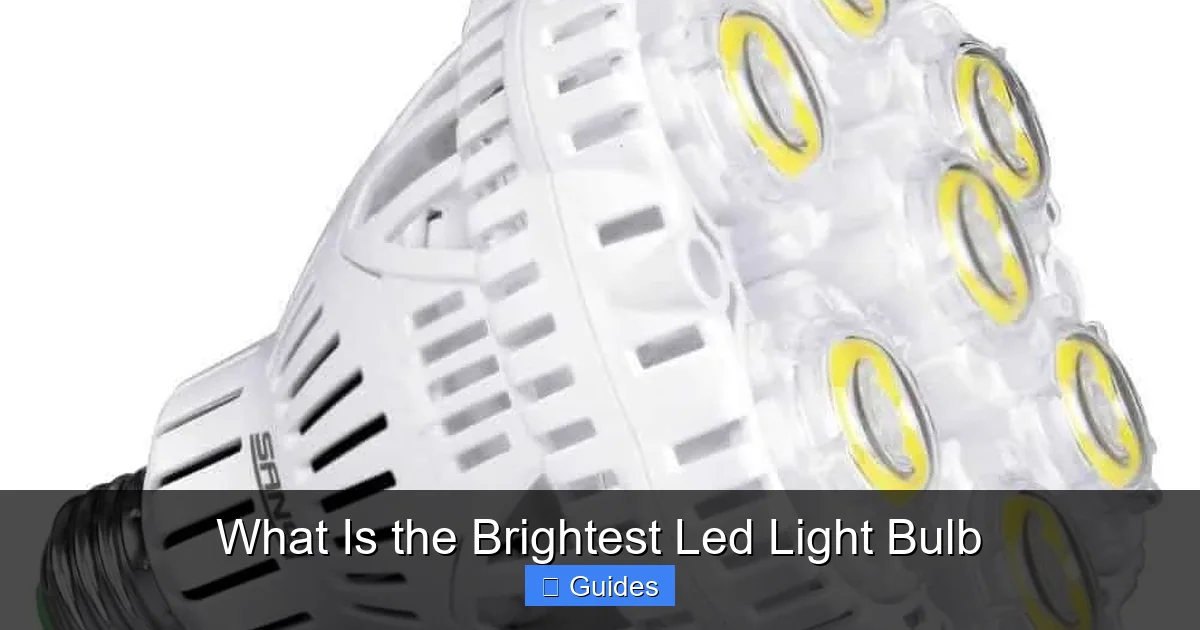
When it comes to sheer lumen output in a screw-in bulb format, LED corn bulbs are often the undisputed champions. They get their name from their appearance – a central stalk with rows of small LED diodes resembling corn kernels.
- Ultra-High Lumens: These bulbs are designed to replace traditional high-wattage HID (High-Intensity Discharge) or high-pressure sodium bulbs often found in industrial settings, streetlights, or very large indoor spaces. You can find LED corn bulbs ranging from 5,000 lumens all the way up to an astonishing 20,000, 30,000, or even 40,000+ lumens!
- Omnidirectional Light: Many corn bulbs offer 360-degree light distribution, making them excellent for broad area illumination.
- Mogul Base: Due to their size and power, many very high-lumen corn bulbs use an E39 (Mogul) base, which is larger than the standard E26 (Edison) base found in most household fixtures. Make sure your fixture has the correct base, or consider using an adapter.
- Applications: Perfect for warehouses, factories, gymnasiums, large garages, workshops, streetlights, and commercial lighting. If you need the brightest LED light bulb for a massive space, a corn bulb is likely your best bet.
High-Output A-Shape and BR/PAR Bulbs
If you need a very bright LED light bulb for more conventional household fixtures, you’ll still find impressive options.
- High-Wattage Equivalent A-Shapes: Standard A-shape (the traditional bulb shape) LEDs can now be found that replace 150-watt or even 200-watt incandescents, offering around 2600-3000 lumens. While not as extreme as corn bulbs, these are significantly brighter than typical household LEDs.
- BR (Bulge Reflector) and PAR (Parabolic Aluminized Reflector) Bulbs: These are often used in recessed lighting, track lighting, or outdoor floodlights. They have built-in reflectors that direct light more efficiently. A high-lumen PAR38 LED, for instance, can produce a powerful, focused beam suitable for security lighting or illuminating specific areas from a distance. You can find PAR38 LEDs offering 1500-2000+ lumens, but their concentrated beam makes them *feel* extremely bright in their target area.
Integrated LED Fixtures
While not strictly “bulbs,” it’s worth mentioning that for the absolute brightest illumination, particularly in new installations or renovations, integrated LED fixtures often provide the highest lumen output and most efficient light distribution. These are fixtures where the LED chips are built directly into the light fitting itself, rather than using a replaceable bulb. They are often found in high bay lights for industrial spaces or powerful outdoor floodlights.
Choosing the Brightest LED Bulb for *Your* Needs
Finding the perfect and brightest LED light bulb for your situation requires a bit of planning. Here’s a step-by-step guide to help you choose wisely.
1. Determine Your Lumen Requirements
This is the most crucial step. Think about the size of the space, the height of the ceilings, and the activities performed there.
- Small Room (e.g., pantry, small bathroom): 400-800 lumens
- Medium Room (e.g., bedroom, dining room): 800-1600 lumens
- Large Room (e.g., living room, kitchen): 1600-3000 lumens
- Workshop, Garage, High-Ceiling Areas, Security: 3000-10,000+ lumens. This is where you’ll be looking for the brightest LED light bulb options like corn bulbs or high-output PARs.
If you’re replacing an old incandescent, use this rough guide:
- 40W Incandescent = 450 lumens
- 60W Incandescent = 800 lumens
- 75W Incandescent = 1100 lumens
- 100W Incandescent = 1600 lumens
- 150W Incandescent = 2600 lumens
- 200W Incandescent = 3000 lumens
Multiply these figures if you need multiple bulbs or significantly more light.
2. Consider Beam Angle and Light Distribution
Do you need focused light for a task or broad ambient light for an entire room?
- For general illumination of a large area, look for wide beam angles (e.g., 200-360 degrees, common in corn bulbs).
- For concentrated task lighting, accent lighting, or long-distance projection (like security lights), choose a narrow beam angle (e.g., 10-45 degrees, common in PAR bulbs).
3. Select the Right Color Temperature
For maximum perceived brightness and clarity, especially in functional spaces, opt for cooler color temperatures (5000K-6500K, “daylight”). If you’re going for brightness but still want a slightly softer feel for a work area, 4000K-4500K (“cool white”) can be a good compromise.
4. Check the Bulb Base and Size
This is critical! Ensure the bulb’s base (e.g., E26 standard, E39 mogul) matches your fixture. Also, make sure the physical size of the bulb will fit within your fixture, especially for larger corn bulbs. Many corn bulbs are quite long and might not fit in enclosed fixtures designed for smaller A-shape bulbs.
5. Dimming Compatibility (If Needed)
If you want the option to dim your brightest LED light bulb, ensure the bulb is explicitly labeled as “dimmable.” Also, verify that your dimmer switch is compatible with LED technology, as older incandescent dimmers might cause flickering or buzzing.
6. Brand Reputation and Warranty
Investing in a very bright LED light bulb means you want it to last. Choose reputable brands known for quality and reliability. Check for certifications like UL or ETL, and look for a good warranty period.
Practical Tips for Installation and Safety
Once you’ve found the brightest LED light bulb for your needs, there are a few practical considerations to keep in mind.
Fixture Compatibility and Heat
LEDs run much cooler than incandescent bulbs, but they still produce some heat. This heat needs to dissipate to ensure the bulb’s longevity. If you place a powerful, brightest LED light bulb inside a fully enclosed fixture, especially one not designed for LEDs, the heat can build up and significantly shorten the bulb’s lifespan. Look for bulbs specifically labeled “suitable for enclosed fixtures” if that’s your application. Otherwise, choose open fixtures or ensure proper ventilation.
Avoiding Glare
A very bright LED light bulb can cause significant glare if not properly managed. Position bulbs to direct light where it’s needed, not directly into people’s eyes. Diffusers or fixtures with frosted glass can help soften the light and prevent uncomfortable glare from extremely bright sources. For workspaces, consider aiming light at the ceiling for indirect illumination, or using task lighting that points directly at the work surface.
Electrical Safety
Always ensure the fixture’s maximum wattage rating is not exceeded, even though LEDs use fewer watts. While an LED that consumes 20 watts can replace a 200-watt incandescent, the fixture’s original wiring was designed for the heat and current of a 200-watt bulb. Using an LED with higher wattage than the fixture’s rating is still not advisable, though it’s less common to encounter high-wattage LEDs that exceed typical fixture ratings. If you’re using E39 mogul base bulbs, ensure your wiring and sockets are robust enough for their intended industrial use. When in doubt, consult a qualified electrician.
Conclusion: The Brightest LED is the Right LED for You
The quest for “what is the brightest LED light bulb” reveals that brightness isn’t a one-size-fits-all answer. It’s a combination of raw lumen output, how that light is distributed, and even its color temperature. While LED corn bulbs can offer tens of thousands of lumens for large industrial spaces, a high-lumen PAR bulb might be the brightest LED light bulb for a focused security light, and a 3000-lumen A-shape bulb might be perfect for your brightly lit kitchen.
By understanding lumens as the true measure of brightness, considering beam angle for light distribution, and choosing the appropriate color temperature, you can confidently select an LED bulb that meets your exact needs. Remember to always check fixture compatibility, bulb base, and look for quality brands. With the right information, you can illuminate any space with remarkable efficiency and brilliance, truly making the brightest LED light bulb work for you. Say goodbye to dimness and hello to a brilliantly lit world!
🎥 Related Video: 100W Halogen VS LED Bulbs – which is brightest?
📺 Headlight Revolution
Shop The Best LED Foward Lighting Upgrades For Your Application Here: …
Frequently Asked Questions
What is the difference between lumens and candelas?
Lumens measure the total light output in all directions from a source, like the total water coming out of a hose. Candelas, on the other hand, measure the intensity of light in a specific direction, like how focused the stream of water is from that hose. While lumens indicate overall brightness, candelas indicate how bright a spot appears.
Are high-lumen LED bulbs safe for my eyes?
Extremely bright LED bulbs, especially those with high lumen outputs and cool color temperatures, can be very intense. Staring directly into them can be uncomfortable and potentially harmful. It’s best to position them to illuminate surfaces rather than directly in your line of sight to avoid glare and discomfort.
What is an LED corn bulb, and why are they so bright?
An LED corn bulb is a type of LED light bulb designed with many small LED chips arranged around a central column, resembling an ear of corn. They are so bright because they can pack a large number of individual high-efficiency LED diodes into a single bulb, allowing them to achieve extremely high lumen outputs, often replacing older, less efficient industrial lighting.
How do I know if a bright LED bulb will fit my existing fixture?
First, check the base type (e.g., E26 for standard household, E39 for mogul base). Then, measure the physical dimensions (length and diameter) of the LED bulb you’re considering and compare them to the available space within your fixture to ensure it will fit without obstruction.
Do bright LED bulbs use a lot of electricity?
No, not compared to traditional bulbs. Even the brightest LED light bulb will use significantly less electricity (watts) than an incandescent bulb of comparable brightness. For example, an LED producing 2000 lumens might only consume 20-25 watts, whereas an incandescent equivalent would use 100-150 watts.
What is the lifespan of a very bright LED light bulb?
High-quality, very bright LED light bulbs typically have impressive lifespans, often rated for 25,000 to 50,000 hours or more. Proper heat dissipation is key to achieving these lifespans, as excessive heat can shorten the life of any LED, regardless of its brightness.
