


As an Amazon Associate, We earn from qualifying purchases.
The invention of the LED light bulb wasn’t a singular event but a century-long journey involving numerous brilliant minds. While H.J. Round observed electroluminescence and Oleg Losev first created a light-emitting diode, Nick Holonyak Jr. is widely credited with inventing the first practical visible-spectrum LED in 1962. However, the modern, energy-efficient white LED light bulb only became a reality thanks to the breakthrough blue LED developed by Shuji Nakamura, Isamu Akasaki, and Hiroshi Amano, paving the way for widespread commercialization and the ultimate replacement of incandescent bulbs.
Have you ever wondered about the tiny, powerful light source behind your smartphone screen, the bright headlights of modern cars, or the super-efficient lamps lighting up your home? We’re talking about the LED light bulb. It seems like they just appeared, quietly revolutionizing how we illuminate our world, offering incredible energy savings and longevity compared to their incandescent predecessors. But who exactly do we thank for this brilliant innovation? Who invented the LED light bulb?
The answer isn’t as simple as pointing to a single person. Unlike the incandescent bulb, which is famously linked to Thomas Edison, the LED light bulb is the product of a long, fascinating journey involving many brilliant minds, incremental discoveries, and significant breakthroughs across more than a century. It’s a story of science, persistence, and collaboration that ultimately brought us the ubiquitous, energy-saving LED lighting we rely on today.
This article will take you on a journey through time, exploring the key moments and pivotal figures who contributed to the development of the LED light bulb. From the very first observations of light-emitting materials to the sophisticated white LED light bulbs that now adorn our homes and offices, we’ll uncover the collective genius that made this technology possible.
Key Takeaways
- Early Discoveries: The phenomenon of electroluminescence, which forms the basis of LED technology, was first observed by H.J. Round in 1907, and the first actual light-emitting diode was created by Oleg Losev in the 1920s.
- The First Practical LED: Nick Holonyak Jr. is widely recognized as the “Father of the LED” for inventing the first practical visible-spectrum (red) LED in 1962 while working at General Electric.
- Expanding the Spectrum: Other scientists like M. George Craford contributed significantly by developing yellow and green LEDs in the following decades, broadening the applications for LED technology.
- The Blue LED Breakthrough: The invention of the high-brightness blue LED by Isamu Akasaki, Hiroshi Amano, and Shuji Nakamura in the early 1990s was a monumental step, earning them the Nobel Prize in Physics, as it allowed for the creation of white light.
- From Diode to Bulb: The “LED light bulb” as a consumer product, replacing traditional incandescent bulbs, came much later, enabled by the blue LED combined with phosphor coatings to produce white light, alongside advancements in packaging and drive electronics.
- A Collective Effort: No single individual invented the “LED light bulb.” It is the result of continuous innovation and collaboration across multiple scientific and engineering disciplines over many decades.
- Ongoing Evolution: The development of LED technology is still ongoing, with continuous improvements in efficiency, color rendering, and miniaturization, making LED lighting increasingly versatile and affordable.
Quick Answers to Common Questions
Who first observed electroluminescence, the basis of LED technology?
H.J. Round, a British radio researcher, first observed electroluminescence in 1907 while experimenting with silicon carbide crystals.
Who is known as the “Father of the LED”?
Nick Holonyak Jr. is widely known as the “Father of the LED” for inventing the first practical visible-spectrum (red) LED in 1962.
What color LED was crucial for creating white light?
The high-brightness blue LED was crucial for creating white light, either by mixing with red and green or, more commonly, by exciting phosphors.
Who won the Nobel Prize for the blue LED?
Isamu Akasaki, Hiroshi Amano, and Shuji Nakamura were awarded the Nobel Prize in Physics in 2014 for their pioneering work on the blue LED.
Why is it difficult to name a single inventor for the LED light bulb?
It’s difficult because the LED light bulb is the result of over a century of contributions from many scientists and engineers, involving discoveries of electroluminescence, practical LED diodes, specific colors like blue, and subsequent engineering for packaging and white light production.
📑 Table of Contents
- The Earliest Sparks: Electroluminescence and the Dawn of Diodes
- The Birth of the Practical LED: Nick Holonyak Jr.’s Red Revolution
- Expanding the Color Palette: From Red to Yellow and Green
- The Holy Grail: Blue LEDs Unlock White Light
- From Diode to “Bulb”: The Evolution of the LED Light Bulb
- A Symphony of Innovators: Why the LED Light Bulb Has No Single Creator
The Earliest Sparks: Electroluminescence and the Dawn of Diodes
The story of the LED light bulb truly begins long before anyone even conceived of a “light-emitting diode.” It starts with the fundamental phenomenon of electroluminescence – the emission of light from a material when an electric current passes through it.
H.J. Round’s Observation (1907)
Our first stop is in 1907 with a British radio researcher named Henry Joseph Round. While experimenting with a silicon carbide crystal and a cat’s-whisker detector (a primitive component used in early radio sets), Round noticed something peculiar. When he applied a voltage, the crystal emitted a yellowish light. He meticulously documented his observations in a brief note to the journal *Electrical World*, making him the first person to officially record electroluminescence. This was a crucial foundational step, even if Round didn’t fully understand its implications at the time, or foresee its eventual application in the LED light bulb.
Oleg Losev’s Creation (1920s)
Fast forward about a decade and a half, to the work of Oleg Losev, a Russian radio technician. Losev went beyond mere observation. In the 1920s, he conducted extensive research on silicon carbide crystals, similar to Round. What Losev did was truly remarkable: he was the first to create and patent a “light-emitting junction” – essentially, the world’s first true light-emitting diode. He observed that light was emitted from these junctions and even envisioned their use in telecommunications. Unfortunately, his pioneering work, published in various Russian, German, and British journals, largely remained obscure in the West during his lifetime, hindering its immediate impact on the development of the LED light bulb.
The Birth of the Practical LED: Nick Holonyak Jr.’s Red Revolution
Visual guide about Who Invented the Led Light Bulb
Image source: storables.com
While Round and Losev laid the groundwork, the practical realization of a visible light-emitting diode, one that could be truly manufactured and utilized, came much later.
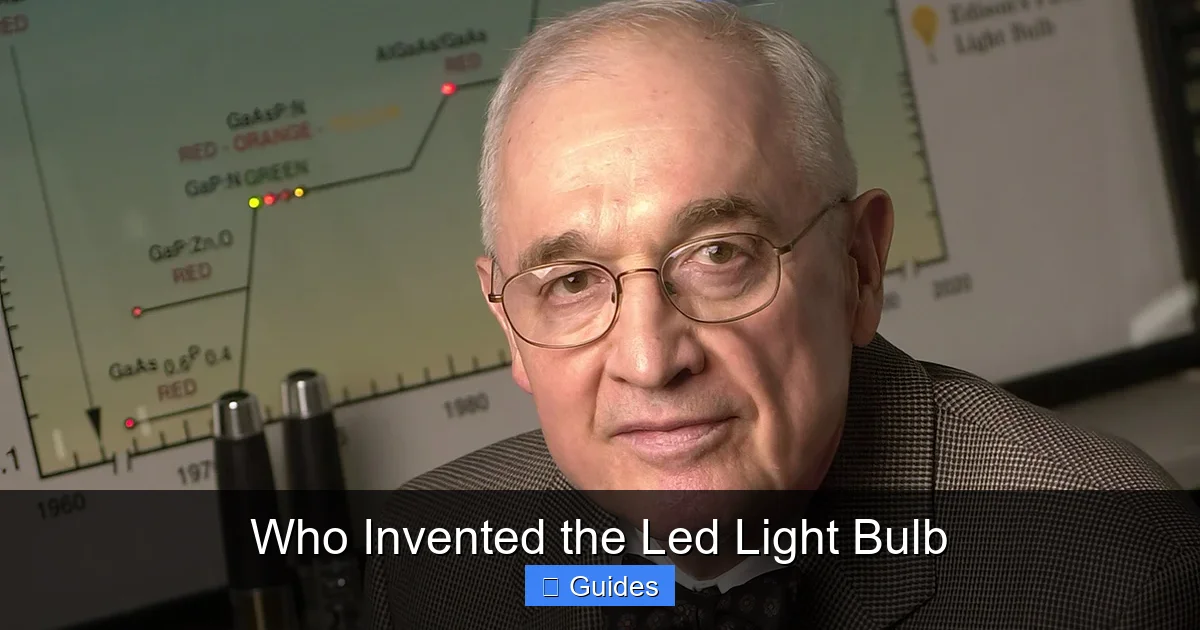
Nick Holonyak Jr.: The “Father of the LED” (1962)
The individual most widely recognized as the inventor of the practical visible-spectrum LED is Nick Holonyak Jr. In 1962, while working as a consulting scientist at General Electric (GE) in Syracuse, New York, Holonyak developed a red light-emitting diode. His LED was made from gallium arsenide phosphide (GaAsP) and emitted visible red light when electricity was passed through it.
Holonyak’s invention was groundbreaking because it was the first LED that produced *visible light* efficiently enough to be considered practical for various applications. Prior to this, infrared (invisible) LEDs had been developed, but Holonyak’s contribution ushered in the era of visible LED technology. He famously described his invention as a “lamp that you could hang out on a clothesline, and it would last forever.” This was a bold prediction, but one that has largely proven true, setting the stage for the eventual LED light bulb revolution.
Holonyak’s team at GE saw the immediate potential for these tiny, durable light sources. While initially expensive and not bright enough for general illumination, they found early uses as indicator lights in electronic devices, calculators, and laboratory equipment. This was the true genesis of the LED as a viable component, moving it closer to the idea of an LED light bulb.
Expanding the Color Palette: From Red to Yellow and Green
Holonyak’s red LED was a fantastic start, but for LEDs to become truly versatile, and eventually form the basis of a full-spectrum LED light bulb, more colors were needed.
M. George Craford and the Early Color Advances
Building on Holonyak’s work, other scientists and engineers continued to push the boundaries of LED technology. One notable figure is M. George Craford, a former graduate student of Holonyak’s. In 1972, while working at Monsanto, Craford successfully developed the first yellow LED and improved the brightness of red LEDs by a factor of ten.
These developments were crucial. With red, yellow, and orange LEDs available, the range of applications expanded significantly. These colored LEDs began to appear in traffic lights, warning lights, and early digital displays. However, a major hurdle remained for creating a versatile LED light bulb capable of producing white light: the lack of an efficient blue LED. Without blue, it was impossible to mix primary colors (red, green, blue) to create white light, or to excite phosphors for white light production, a method that would later become dominant for white LED light bulbs.
The Holy Grail: Blue LEDs Unlock White Light
For decades, the efficient blue LED remained an elusive “holy grail” for scientists. Its absence severely limited the potential for LEDs to replace conventional lighting, making the concept of an LED light bulb for general illumination impossible.
The Nobel Prize-Winning Trio: Akasaki, Amano, and Nakamura (1990s)
The breakthrough finally arrived in the early 1990s, and it was a monumental achievement recognized with the Nobel Prize in Physics in 2014. The credit goes to three Japanese scientists:
* **Isamu Akasaki** (Nagoya University)
* **Hiroshi Amano** (Nagoya University, Akasaki’s student)
* **Shuji Nakamura** (Nichia Corporation)
Working independently and sometimes in competition, these researchers overcame immense challenges to create high-brightness blue LEDs based on gallium nitride (GaN). Akasaki and Amano demonstrated the first high-quality GaN crystals and p-n junctions capable of efficient light emission. Nakamura, meanwhile, focused on pushing the brightness and efficiency to commercial levels, leading to the world’s first high-brightness blue LED light bulb (in diode form) for practical use.
The invention of the blue LED was revolutionary. It completed the “RGB triad” – Red, Green, and Blue – allowing for the possibility of creating any color of the rainbow, including white light, by mixing these three primary colors. More importantly for general illumination, the blue LED provided the necessary high-energy light source to excite phosphors, a technique that would soon lead to the efficient white LED light bulb.
From Diode to “Bulb”: The Evolution of the LED Light Bulb
With blue LEDs finally available, the stage was set for the ultimate transformation: the development of the white LED light bulb that could replace traditional incandescent and fluorescent lamps.
Creating White Light: Phosphor Conversion
While mixing red, green, and blue LEDs can produce white light, it’s often more complex and less efficient than another method: phosphor conversion. This is the technology primarily used in most white LED light bulbs today.
The process typically involves a blue LED chip that shines its light onto a layer of yellow phosphor material. The blue light partially passes through the phosphor, while the rest is absorbed and re-emitted as yellow light. When the blue and yellow light combine, our eyes perceive it as white light. By adjusting the type and amount of phosphor, manufacturers can tune the “color temperature” of the white light, from warm yellow-white (like an incandescent) to cool blue-white.
The Modern LED Light Bulb Takes Shape
The journey from a single LED diode to a functional, consumer-ready “LED light bulb” involved much more than just the diode itself. It required significant engineering advancements in several areas:
* **Packaging:** Developing robust, heat-dissipating packages for the LED chips. Heat is the enemy of LEDs, and proper thermal management is crucial for their longevity.
* **Driver Electronics:** Designing compact, efficient electronic circuits to convert household AC power into the precise DC voltage and current required by the LED chips. These drivers are often hidden within the base of the LED light bulb.
* **Optics:** Crafting lenses and diffusers to shape and spread the light evenly, mimicking the omnidirectional light distribution of traditional bulbs.
* **Manufacturing and Cost Reduction:** Scaling up production and bringing down costs to make LED light bulbs accessible to the mass market.
It was the culmination of these advancements, driven by countless engineers and companies globally, that allowed the LED light bulb to transition from a niche, expensive novelty to the energy-saving standard we see everywhere today. The first commercially viable white LED light bulbs began to appear in the early 2000s, gradually improving in brightness, efficiency, and affordability.
Practical Tips for Understanding Your LED Light Bulb
When you pick up an LED light bulb today, you’re holding a piece of history! Here are a few tips to appreciate and choose them:
- Lumens, Not Watts: Forget watts for brightness. LED light bulbs are rated in lumens. More lumens mean more light.
- Color Temperature (Kelvin): Look for Kelvin (K) ratings to choose your light’s “warmth.” Lower K values (2700K-3000K) are warm white, like incandescents. Higher K values (4000K-5000K+) are cooler, brighter white light.
- CRI (Color Rendering Index): A higher CRI (90+) means the LED light bulb will show colors more accurately, which is important for art, photography, or just making your home look vibrant.
- Energy Savings: An LED light bulb uses significantly less energy than incandescent or even CFL bulbs, saving you money and reducing your carbon footprint.
A Symphony of Innovators: Why the LED Light Bulb Has No Single Creator
As we’ve explored, the question “who invented the LED light bulb?” doesn’t have a simple, singular answer. It’s a testament to the collaborative, cumulative nature of scientific and technological progress.
From H.J. Round’s initial observation of electroluminescence to Oleg Losev’s early diode, Nick Holonyak Jr.’s practical visible LED, and the Nobel-winning work on blue LEDs by Akasaki, Amano, and Nakamura – each step was critical. Moreover, countless other engineers, material scientists, physicists, and manufacturers played indispensable roles in refining the technology, reducing costs, and designing the complete LED light bulb package that sits in your lamp today.
The modern LED light bulb isn’t just one invention; it’s a sophisticated system built upon a foundation of fundamental physics, material science, electrical engineering, and manufacturing innovation. It’s a shining example of how humanity collectively advances, building on the knowledge and discoveries of those who came before. So, the next time you flick on an LED light bulb, remember that you’re witnessing the culmination of over a century of ingenuity and dedication from a global community of innovators.
In conclusion, while Nick Holonyak Jr. is rightfully celebrated for inventing the first practical visible LED, and the Nobel laureates Akasaki, Amano, and Nakamura for their blue LED breakthrough that made white light possible, no single person can claim sole credit for the LED light bulb as we know it today. It truly is a collective masterpiece, illuminating our world one efficient, long-lasting glow at a time.
🎥 Related Video: Invention Of BULB | The Dr. Binocs Show | Best Learning Video for Kids | Preschool Learning
📺 Peekaboo Kidz
Here’s Presenting The Dr. Binocs Show SEASON 2 – Inventions Learn all about the Invention Of BULB from Dr. Binocs himself …
Frequently Asked Questions
Who invented the first light-emitting diode (LED)?
The very first creation of a light-emitting diode is credited to Oleg Losev in the 1920s, a Russian technician who observed light emission from silicon carbide junctions and even patented some of his work.
What made Nick Holonyak Jr.’s LED invention so important?
Nick Holonyak Jr.’s invention in 1962 was significant because it was the first LED to emit visible red light efficiently enough to be practical for commercial applications, paving the way for further development in LED technology.
Why was the invention of the blue LED a game-changer for the LED light bulb?
The blue LED was a game-changer because it allowed for the creation of white light, either by combining it with red and green LEDs or, more commonly, by using the blue light to excite yellow phosphors, making the modern LED light bulb possible.
How do modern LED light bulbs produce white light?
Most modern LED light bulbs produce white light through phosphor conversion. A blue LED chip emits blue light, which then shines onto a layer of yellow phosphor. The combination of the transmitted blue light and the re-emitted yellow light is perceived as white light by our eyes.
When did LED light bulbs become widely available to consumers?
While various LED applications existed for decades, commercially viable white LED light bulbs for general illumination began to appear in the early 2000s, with widespread consumer adoption growing significantly in the 2010s as efficiency improved and costs decreased.
Are there still ongoing developments in LED light bulb technology?
Yes, LED technology is constantly evolving. Researchers and manufacturers continue to improve LED light bulb efficiency, color rendering index (CRI), miniaturization, and smart lighting capabilities, making them even more versatile and sustainable.
