


As an Amazon Associate, We earn from qualifying purchases.
Understanding how does the light bulb work reveals a fascinating journey through science and innovation. Initially, light bulbs created light by heating a filament to incandescence using electricity. Modern bulbs like fluorescents and LEDs employ entirely different, more energy-efficient principles, from gas excitation to semiconductor physics, illuminating our world with diverse and sustainable technologies.
Have you ever stopped to think about one of the most common yet revolutionary inventions in human history? We flip a switch, and instantly, light floods the room. It’s so commonplace we rarely consider the intricate dance of physics and engineering happening inside that glass bulb. But peering into the core of “how does the light bulb work” reveals a story of ingenuity, scientific discovery, and relentless innovation that transformed our world.
From the faint flicker of early gas lamps to the crisp, instant glow of modern LEDs, our ability to control light after sunset has profoundly shaped human civilization. It extended our productive hours, illuminated our homes, made streets safer, and enabled entirely new industries. Understanding the mechanisms behind this everyday miracle isn’t just a technical exercise; it’s an appreciation of the brilliance that literally lights up our lives. So, let’s pull back the curtain and explore the fascinating journey of how does the light bulb work, from the earliest designs to the cutting-edge technology of today.
The Magic of Light: A Brief Overview
At its heart, a light bulb converts electrical energy into visible light. Simple, right? But the “how” varies dramatically depending on the type of bulb. For decades, the incandescent bulb was king, relying on extreme heat to produce its characteristic warm glow. Then came fluorescents, which used a completely different, more energy-efficient method involving gas and chemical coatings. And now, we live in the era of the LED, a marvel of semiconductor physics that is reshaping how we think about illumination. Each technology represents a significant leap forward in efficiency, longevity, and quality of light.
Key Takeaways
- Incandescent Bulbs: These traditional bulbs produce light by heating a thin filament, typically made of tungsten, to extreme temperatures until it glows.
- Halogen Lamps: An evolution of incandescent technology, halogen lamps use a halogen gas within the bulb to regenerate the tungsten filament, extending its lifespan and improving efficiency.
- Fluorescent Lamps: These bulbs generate light through a multi-step process involving an electrical discharge through a gas, creating ultraviolet (UV) light, which then excites a phosphor coating to emit visible light.
- LEDs (Light Emitting Diodes): Representing the forefront of lighting technology, LEDs produce light through electroluminescence, where a semiconductor material emits light when an electric current passes through it.
- Efficiency Matters: Modern light bulbs like LEDs and fluorescents are significantly more energy-efficient than incandescents, converting a much larger percentage of electrical energy into light rather than heat.
- Key Specifications: When choosing a light bulb, understanding terms like lumens (brightness), kelvin (color temperature), and wattage (power consumption) helps you select the right bulb for your needs.
- Technological Evolution: The journey of how does the light bulb work showcases continuous innovation, driven by the desire for brighter, more efficient, and longer-lasting light sources, from Edison’s early designs to today’s smart lighting solutions.
Quick Answers to Common Questions
What is the main principle of an incandescent light bulb?
An incandescent light bulb produces light by heating a thin filament (usually tungsten) to extreme temperatures until it glows, a process known as incandescence.
How do fluorescent light bulbs create light?
Fluorescent bulbs generate light by passing an electrical current through mercury vapor, which produces UV light. This UV light then strikes a phosphor coating on the inside of the bulb, causing it to emit visible light.
What does “lumens” measure?
Lumens measure the total amount of visible light emitted by a light source, indicating its brightness, as opposed to watts which measure power consumption.
Are LED light bulbs more efficient than incandescent ones?
Yes, LED light bulbs are significantly more energy-efficient than incandescent ones because they convert a much higher percentage of electrical energy into light rather than wasted heat.
What is the purpose of inert gas in an incandescent bulb?
Inert gas (like argon) in an incandescent bulb helps reduce the evaporation rate of the tungsten filament, extending the bulb’s lifespan and preventing the glass from darkening.
📑 Table of Contents
The Incandescent Light Bulb: The Original Glow
For over a century, when you asked “how does the light bulb work,” most people would picture the familiar incandescent bulb. It’s the classic design, often associated with Thomas Edison, though many inventors contributed to its development. This bulb’s operation is wonderfully simple yet remarkably effective for its time.
Filament, Vacuum, and Resistance
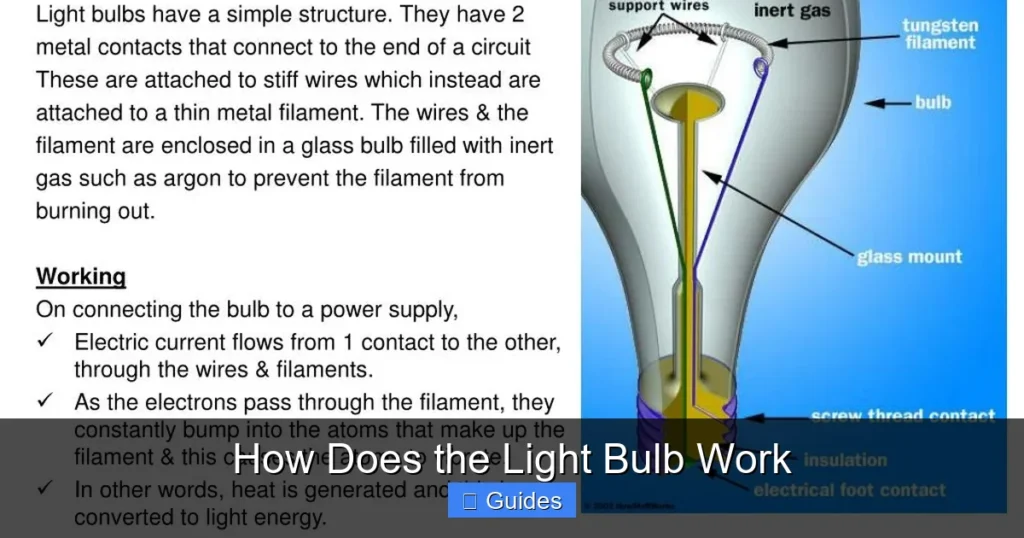
The core of an incandescent bulb is a tiny, delicate wire called a **filament**. This filament is usually made from tungsten, a metal chosen for its incredibly high melting point. The filament is coiled, often into a double helix, to pack a long length of wire into a small space. This increases its resistance and surface area for light emission.
When you flip the switch, electricity flows into the bulb and through this tungsten filament. Tungsten is a conductor, but it also has electrical **resistance**. As electrons push their way through the narrow, high-resistance filament, they encounter friction, causing the filament to heat up intensely. We’re talking temperatures of around 2,700 to 3,300 Kelvin (about 4,400 to 5,500°F!).
At these scorching temperatures, the filament doesn’t just get hot; it starts to **incandesce**. This means it emits light as a result of being heated. Think of how a blacksmith heats metal until it glows red, then orange, then white-hot. That’s incandescence in action. The hotter the filament gets, the brighter and whiter the light it produces.
Why the Glass Bulb and Inert Gas?
If you simply exposed a hot tungsten filament to the air, it would react with oxygen almost instantly and burn out. This is where the glass bulb comes in. Early incandescent bulbs had a near-perfect vacuum inside to prevent this oxidation. However, even in a vacuum, at such high temperatures, tungsten atoms would slowly evaporate from the filament, depositing on the inside of the glass and darkening it, eventually causing the filament to thin and break.
To combat this, modern incandescent bulbs are typically filled with an **inert gas**, such as argon or a mixture of argon and nitrogen. These gases don’t react with the hot tungsten. The presence of these heavier gas atoms reduces the rate at which tungsten atoms evaporate from the filament, allowing the bulb to last longer and run at slightly higher temperatures for better light output. This is a crucial part of understanding how does the light bulb work efficiently for its type.
The Downside: Heat, Not Just Light
While incandescent bulbs gave us light, they were notoriously inefficient. A significant amount of the electrical energy put into an incandescent bulb is converted into **heat**, not light. In fact, only about 5-10% of the energy is converted into visible light; the rest is wasted as heat. This inefficiency is what eventually led to the development of alternative lighting technologies.
Halogen Lamps: A Brighter Incandescent
Visual guide about How Does the Light Bulb Work
Image source: lihpao.com
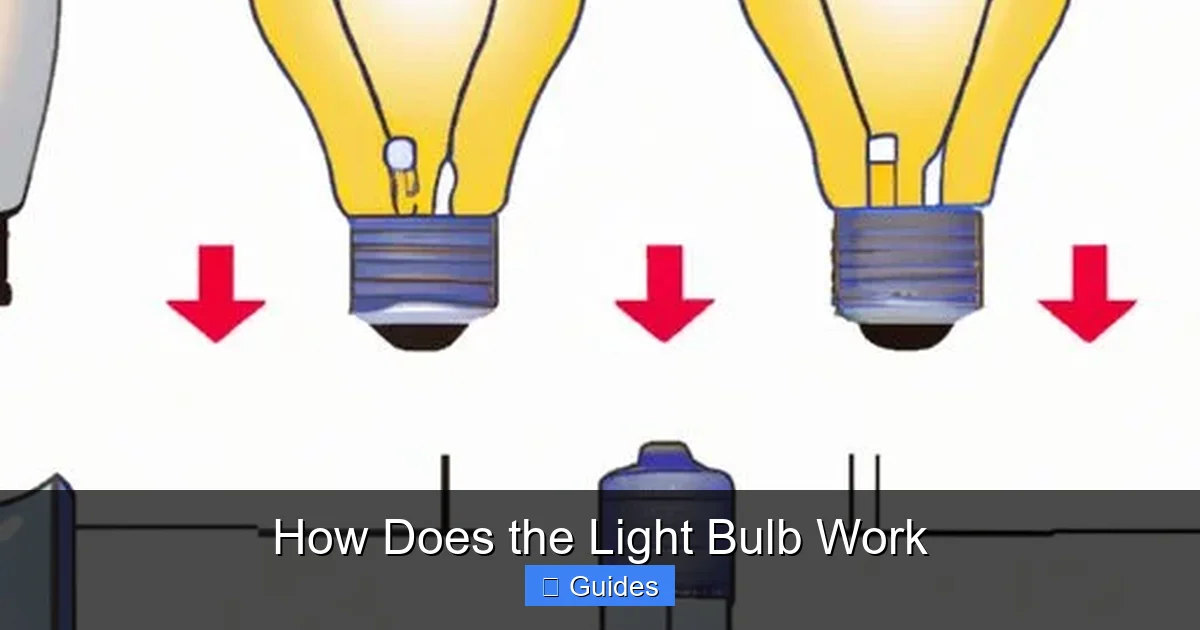
Halogen lamps are essentially an improved version of the incandescent bulb, addressing some of its limitations. So, when considering how does the light bulb work in a halogen lamp, you’ll find a familiar principle but with a clever chemical twist.
The Halogen Cycle
Like an incandescent, a halogen lamp uses a tungsten filament heated to incandescence. However, it’s housed in a much smaller, quartz envelope (which can withstand higher temperatures) and filled with a **halogen gas** (such as iodine or bromine).
Here’s the trick: when tungsten atoms evaporate from the hot filament, they combine with the halogen gas within the bulb. Instead of simply depositing on the glass, this tungsten-halogen compound travels back towards the hot filament. When it gets close enough, the extreme heat breaks the compound apart, redepositing the tungsten back onto the filament. This “halogen cycle” helps regenerate the filament, significantly extending the bulb’s lifespan and preventing the bulb from darkening.
Because of this cycle, halogen lamps can operate at even higher temperatures than standard incandescents, producing a brighter, whiter light and slightly better efficiency (though still far from perfect).
Fluorescent Lighting: A Different Kind of Glow
Fluorescent lamps represent a completely different answer to the question of how does the light bulb work. Instead of heat, they use a process involving gas excitation and phosphor coatings.
Gas Discharge and UV Light
The long, tubular glass of a fluorescent lamp is filled with a low-pressure **argon gas** and a tiny amount of **mercury vapor**. At each end of the tube are electrodes, often coated with a material that emits electrons easily when heated.
When electricity flows through the lamp, it creates an electrical discharge, essentially a controlled spark, between the electrodes. This discharge excites the mercury atoms within the tube. When these excited mercury atoms return to their normal energy state, they release energy in the form of **ultraviolet (UV) light**.
The Role of Phosphor
Now, UV light isn’t visible to the human eye, so how do fluorescent bulbs produce visible light? The inside of the glass tube is coated with a special material called **phosphor**. When the invisible UV light strikes this phosphor coating, the phosphor absorbs the UV energy and then re-emits it as **visible light**. Different combinations of phosphor materials can produce different colors of visible light, allowing for warm white, cool white, or daylight-balanced lamps.
Ballasts: The Essential Component
Fluorescent lamps can’t simply be plugged directly into an AC power source. They require a device called a **ballast**. The ballast’s job is twofold:
- It provides a high voltage surge to start the lamp (to create the initial electrical discharge).
- It then limits the current to a steady level once the lamp is operating, preventing it from drawing too much power and destroying itself.
Without a ballast, a fluorescent lamp would quickly self-destruct. Early ballasts were electromagnetic and sometimes caused a flicker or hum; modern electronic ballasts are much more efficient and eliminate these issues.
Compact Fluorescent Lamps (CFLs)
You might be more familiar with **Compact Fluorescent Lamps (CFLs)**. These are simply fluorescent tubes that are bent into a compact shape, often spiral, and incorporate a small electronic ballast directly into the base so they can screw into standard incandescent sockets. They offer significant energy savings over incandescent bulbs and a much longer lifespan.
LED Technology: The Modern Marvel
The most impactful answer to how does the light bulb work today comes from **LEDs – Light Emitting Diodes**. These small semiconductor devices represent the pinnacle of energy efficiency and longevity in lighting.
Semiconductors and Electroluminescence
An LED doesn’t have a filament, gas, or mercury. Instead, it relies on a phenomenon called **electroluminescence**. At its core, an LED is a semiconductor device, typically made from layers of different materials like gallium arsenide, gallium nitride, or indium gallium nitride. These materials are “doped” to create regions with an excess of electrons (N-type material) and regions with a deficit of electrons, known as “holes” (P-type material).
When an electric current passes through the LED, electrons from the N-type material move across a junction into the P-type material to fill the holes. As an electron falls into a hole, it releases energy in the form of **photons** – particles of light. This is electroluminescence.
Color of Light and Phosphor Coating
The specific materials used in the semiconductor determine the wavelength (and thus the color) of the light emitted. For example, some materials naturally emit red, green, or blue light. To create white light, a common method is to use a blue LED and coat it with a yellow phosphor. The blue light from the LED excites the phosphor, which then emits yellow light. The combination of the blue light from the LED and the yellow light from the phosphor creates a bright white light that appears visible to our eyes. This is why many white LEDs have a slightly yellowish tint when turned off.
Efficiency and Longevity
LEDs are incredibly efficient. They convert a very high percentage of electrical energy directly into light, with very little wasted as heat. This is a significant improvement over incandescent bulbs. This efficiency, combined with the fact that they don’t rely on a filament that can burn out or gas that needs excitation, gives LEDs an extraordinarily long lifespan – often tens of thousands of hours, far outstripping incandescents and fluorescents. This means you might not need to change an LED bulb for a decade or more!
The Rise of Smart Lighting
Beyond efficiency, LEDs have enabled the rapid growth of “smart” lighting. Because they are semiconductor devices, they can be easily controlled digitally. This allows for features like dimming without color shifts, changing color temperature, full-color control (RGB LEDs), and integration with smart home systems for remote control, scheduling, and automation. The flexibility in how does the light bulb work with LEDs has opened up a whole new world of lighting possibilities.
Understanding Light Bulb Specs: What to Look For
Now that you have a grasp of how does the light bulb work across different technologies, it’s helpful to understand the key specifications you’ll encounter when buying bulbs. Knowing these terms ensures you choose the right light for your needs.
Watts vs. Lumens: Brightness Demystified
For a long time, we associated brightness with **watts**. A 100-watt incandescent bulb was “bright,” a 40-watt was “dim.” However, watts measure **power consumption**, not light output. With the advent of more efficient bulbs, a 10-watt LED can produce the same amount of light as a 60-watt incandescent.
This is why **lumens** are now the standard measure of brightness. A lumen is a unit of luminous flux, indicating the total amount of visible light emitted by a source. So, if you want a bulb as bright as an old 60-watt incandescent, look for an LED or CFL that produces around 800 lumens, regardless of its wattage. This is a critical distinction for understanding modern lighting.
Color Temperature (Kelvin): Setting the Mood
The **color temperature** of a light bulb describes how warm or cool the light appears. It’s measured in **Kelvin (K)**.
- Warm White (2700K – 3000K): This is similar to the yellowish glow of an incandescent bulb, ideal for living rooms, bedrooms, and creating a cozy atmosphere.
- Cool White / Neutral White (3500K – 4100K): A more balanced, less yellow light, suitable for kitchens, offices, and workspaces where you need good visibility.
- Daylight (5000K – 6500K): Mimics natural daylight, very bright and bluish-white. Great for task lighting, garages, or areas where true color representation is important.
Understanding Kelvin helps you choose a light that matches the desired ambiance of a room.
Color Rendering Index (CRI): Seeing True Colors
The **Color Rendering Index (CRI)** is a measure (on a scale of 0 to 100) of how accurately a light source renders the colors of objects compared to natural sunlight. A high CRI (90+) means colors will appear vibrant and true-to-life under that light. Lower CRI values can make colors look dull or washed out. For general lighting, a CRI of 80+ is usually sufficient, but for art studios, retail displays, or anywhere accurate color perception is crucial, a higher CRI is preferred.
Dimmability: Adjusting the Light
Not all bulbs are dimmable. Incandescent and halogen bulbs are inherently dimmable. However, many CFLs and LEDs require special “dimmable” versions and might also need a compatible dimmer switch designed for their technology. Using a non-dimmable LED on a standard dimmer can cause flickering, buzzing, or premature failure. Always check the packaging if dimming is important to you.
Conclusion: Illuminating Our Future
The journey of how does the light bulb work is a compelling narrative of human ingenuity, from the humble incandescent filament to the sophisticated semiconductor magic of LEDs. What started as a way to extend our days beyond sunset has evolved into a highly specialized field, constantly striving for greater efficiency, better light quality, and smarter control.
Today, incandescent bulbs are largely being phased out due to their inefficiency. Fluorescent lamps, particularly CFLs, offered a good interim solution, but LEDs are now firmly establishing themselves as the dominant lighting technology. Their incredible energy efficiency, long lifespan, durability, and versatility have made them the preferred choice for almost every application, from our homes and offices to streetlights and complex displays.
As technology continues to advance, we can expect even more innovation in lighting. Smart lighting systems that adapt to our presence, mood, or time of day are becoming increasingly common. The light bulb, once a simple invention, is now a cornerstone of smart homes and sustainable living, continually reshaping our relationship with light and energy. So, the next time you flip a switch, take a moment to appreciate the remarkable science and innovation behind that everyday glow.
Frequently Asked Questions
How long do different types of light bulbs typically last?
Lifespans vary significantly by bulb type. Incandescent bulbs typically last about 750-1,000 hours. CFLs offer a much longer life of 8,000-15,000 hours, while modern LED bulbs boast the longest lifespans, often ranging from 25,000 to over 50,000 hours.
Why do incandescent bulbs get so hot?
Incandescent bulbs get hot because they convert a significant portion of the electrical energy they consume into heat, rather than light. Only about 5-10% of the energy is converted to visible light, making them quite inefficient compared to newer technologies.
Can I replace any old bulb with an LED?
In most cases, yes, you can replace an old incandescent or CFL bulb with an LED bulb of the same base type (e.g., E26 or E27 screw-in). However, for dimming, ensure the LED bulb is specified as “dimmable” and that your dimmer switch is compatible with LED technology.
What does “color temperature” mean for a light bulb?
Color temperature, measured in Kelvin (K), describes the hue of the light emitted, ranging from “warm” (yellowish, lower Kelvin numbers like 2700K) to “cool” (bluish-white, higher Kelvin numbers like 5000K+). It influences the ambiance and mood of a room.
Are light bulbs recyclable?
The recyclability of light bulbs depends on their type. Incandescent and halogen bulbs are generally not widely recyclable through standard curbside programs. CFLs contain small amounts of mercury and should be recycled at special collection points. LEDs are electronic waste and should also be recycled at designated e-waste facilities.
What is a ballast and why is it needed for fluorescent lamps?
A ballast is an electrical device that provides the initial high voltage to start a fluorescent lamp and then regulates the current to maintain a stable light output. Without a ballast, the lamp would draw too much current and quickly burn out.
