


As an Amazon Associate, We earn from qualifying purchases.
Understanding how many watts a light bulb uses is key to energy efficiency. While older incandescent bulbs consumed significant wattage for light, modern LEDs produce far more brightness (lumens) for a fraction of the power. This guide clarifies the difference between watts and lumens, helping you choose the right bulbs, understand what wattage a light bulb uses, and save money on your electricity bills.
Have you ever stared at a light bulb package, feeling a little puzzled by all the numbers? Specifically, the “watts” number. For decades, it was our go-to guide for how bright a bulb would be. A 60-watt bulb was standard, a 100-watt bulb was brighter. Simple, right?
But then, something changed. New types of bulbs appeared – CFLs, then LEDs – and suddenly, a “60-watt equivalent” might only be 9 watts. What gives? How many watts does a light bulb *actually* use, and why do the numbers seem so different now?
Understanding what wattage a light bulb uses is more important than ever for two big reasons: your wallet and the planet. This comprehensive guide will shine a light on everything you need to know about watts, lumens, and how to make the smartest choices for your home and energy bill. We’ll demystify the numbers and help you confidently answer the question: how many watts does a light bulb use?
Key Takeaways
- Watts Measure Power Consumption: Watts indicate the amount of electrical power a light bulb consumes, not its brightness. Higher watts mean more electricity used.
- Lumens Measure Brightness: Lumens are the true measure of a light bulb’s brightness. When choosing a bulb, prioritize lumens to get the light level you need, then look at the watts to assess efficiency.
- LEDs Offer Superior Efficiency: LED bulbs use significantly fewer watts than incandescent or CFL bulbs to produce the same amount of light (lumens), making them the most energy-efficient option available today.
- The Shift from Watts to Lumens: Modern light bulb packaging emphasizes lumens and “wattage equivalency” because comparing how many watts a light bulb uses across different technologies no longer accurately reflects brightness.
- Calculate Your Energy Costs: You can estimate the energy cost of your light bulbs by multiplying their wattage by usage hours and your electricity rate per kilowatt-hour (kWh). Switching to lower-wattage bulbs can lead to substantial savings.
- Dimmers Reduce Wattage: Using a dimmer switch with compatible bulbs can reduce the actual wattage a light bulb uses and save energy, in addition to adjusting light levels.
- Choosing the Right Bulb Saves Money: Selecting bulbs based on desired lumens, color temperature, and energy efficiency (low watts) not only provides better lighting but also contributes to lower electricity bills and a reduced environmental footprint.
Quick Answers to Common Questions
How many watts does a standard LED bulb use?
A standard LED bulb that produces brightness equivalent to a 60-watt incandescent bulb typically uses about 8-10 watts of power.
Does a dimmer switch reduce how many watts a light bulb uses?
Yes, a dimmer switch, when used with compatible dimmable bulbs, reduces the power supplied to the bulb, thereby decreasing the actual wattage a light bulb uses and saving energy.
Why do new light bulb packages show “60W Equivalent” but only say 9W?
The “60W Equivalent” indicates that the new 9-watt LED bulb produces the same amount of light (lumens) as an old 60-watt incandescent bulb. The 9W is its actual power consumption.
Is higher wattage always brighter?
No, not anymore. While higher wattage meant brighter with old incandescent bulbs, modern energy-efficient bulbs like LEDs produce much more light (lumens) for significantly fewer watts. Lumens are the true measure of brightness.
How can I calculate the energy cost of my light bulbs?
You can calculate the energy cost by using the formula: (Bulb’s Watts × Hours Used Per Day × Days Used Per Year) / 1000 × Cost Per kWh = Annual Cost.
📑 Table of Contents
- What Exactly Are Watts? Understanding Power Consumption
- The Evolution of Light Bulbs: From Watts to Lumens
- Lumens vs. Watts: What You Really Need to Know About Brightness
- Calculating Your Light Bulb’s Energy Cost and Savings
- Factors Influencing a Light Bulb’s Actual Wattage Use
- Choosing the Right Bulb: Tips for Efficiency and Savings
- Conclusion: Shedding Light on Smart Energy Choices
What Exactly Are Watts? Understanding Power Consumption
Before we dive deep into specific bulb types, let’s get back to basics: what exactly is a watt? In the simplest terms, a watt (W) is a unit of power. When we talk about how many watts a light bulb uses, we’re referring to the rate at which it consumes electrical energy.
Think of electricity like water flowing through a pipe. Voltage is the “pressure” that pushes the water, and current (measured in amperes or amps) is the “volume” of water flowing. Watts are the result of multiplying voltage by current (Watts = Volts x Amps). It’s the total “oomph” the bulb needs to operate. So, when you see a bulb rated at 60 watts, it means it’s drawing 60 joules of energy per second to produce light and heat.
Watts vs. Kilowatt-Hours (kWh): The Difference Between Power and Energy
It’s crucial to distinguish between watts and kilowatt-hours (kWh). Watts represent instantaneous power consumption – how much power the bulb is using *right now*. Kilowatt-hours, on the other hand, represent energy consumption over time. Your electricity bill charges you based on kilowatt-hours, not just watts.
One kilowatt (kW) is 1,000 watts. If a 100-watt bulb is left on for 10 hours, it uses 1,000 watt-hours, or 1 kilowatt-hour (100 W * 10 hours = 1000 Wh = 1 kWh). Understanding this difference is key to calculating how many watts a light bulb uses translates into your actual electricity costs.
The Evolution of Light Bulbs: From Watts to Lumens
For a long time, understanding how many watts a light bulb uses was fairly straightforward because incandescent bulbs were the dominant technology. More watts generally meant more light. But technology evolved, and with it, our understanding of bulb efficiency.
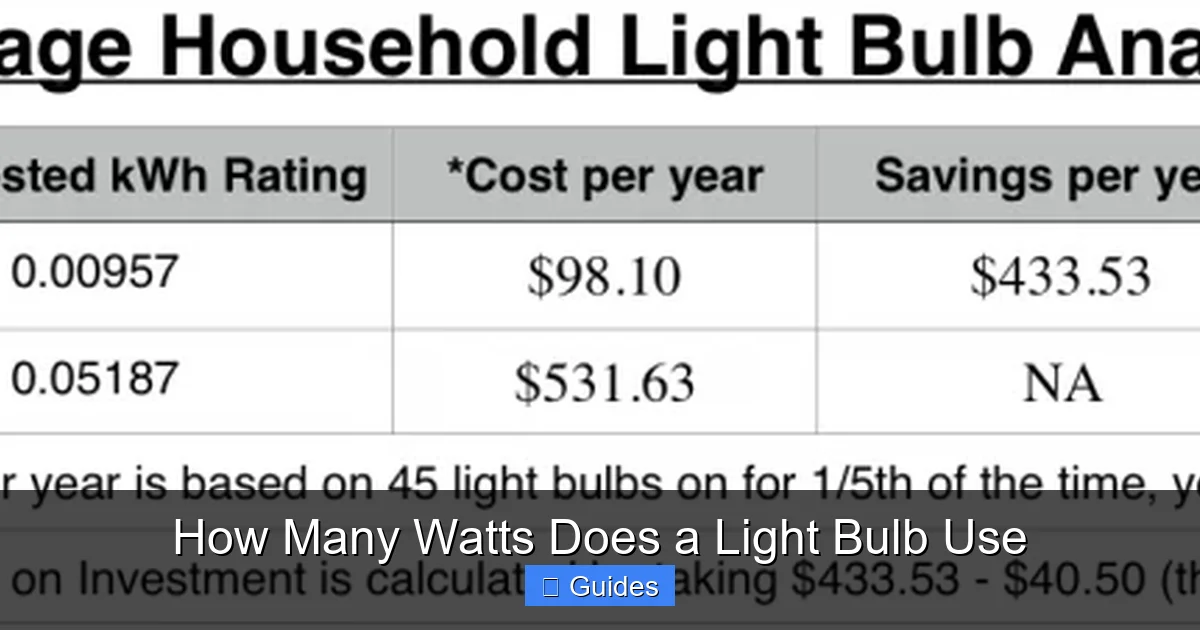
Visual guide about How Many Watts Does a Light Bulb Use
Image source: lucenthomeinspections.com
Incandescent Bulbs: The Original Wattage Kings
Incandescent bulbs have been around for over a century. They work by heating a thin wire filament (usually tungsten) until it glows. This process is very inefficient; about 90% of the energy consumed is released as heat, and only about 10% is converted into visible light. This is why these bulbs used a lot of watts to produce a moderate amount of light.
- A typical 60-watt incandescent bulb produced around 800 lumens of light.
- A 100-watt incandescent bulb produced about 1600 lumens.
When someone asked, “how many watts does a light bulb use?”, they were often thinking of these power-hungry bulbs.
CFLs: A Step Towards Efficiency
Compact Fluorescent Lamps (CFLs) emerged as an energy-saving alternative. These bulbs work by passing an electric current through a tube containing argon and a small amount of mercury vapor, exciting mercury atoms to produce ultraviolet (UV) light. A phosphor coating on the inside of the tube then converts this UV light into visible light.
CFLs were a significant improvement in efficiency. They used about 75% less energy than incandescents to produce the same amount of light. This is where the confusion about watts began for many people. Suddenly, a 13-watt CFL could produce the same light as a 60-watt incandescent.
- A 13-15 watt CFL produced about 800 lumens (equivalent to a 60W incandescent).
- A 23-26 watt CFL produced about 1600 lumens (equivalent to a 100W incandescent).
The answer to “how many watts does a light bulb use” was suddenly much lower for the same perceived brightness.
LEDs: The Modern Energy Savers
Light Emitting Diodes (LEDs) are the latest and most efficient lighting technology. They work by passing an electric current through a semiconductor material, which emits light. LEDs are incredibly efficient, converting most of their energy into light with very little heat waste.
LEDs represent a massive leap in energy efficiency. They use even less energy than CFLs to produce the same amount of light, last much longer, and contain no mercury. This is where the true revolution in understanding how many watts does a light bulb use has happened.
- A 8-10 watt LED bulb produces about 800 lumens (equivalent to a 60W incandescent).
- A 14-16 watt LED bulb produces about 1600 lumens (equivalent to a 100W incandescent).
As you can see, the wattage a light bulb uses for the same amount of brightness has plummeted across these technologies.
Lumens vs. Watts: What You Really Need to Know About Brightness
Given the dramatic differences in efficiency between bulb types, focusing solely on watts to gauge brightness is no longer effective. This is why manufacturers and energy experts now emphasize “lumens.”
Understanding Lumens: The True Measure of Light
A lumen (lm) is the international unit of luminous flux, which basically means it’s the total amount of visible light emitted by a source. The higher the lumen rating, the brighter the light bulb will appear. This is the crucial metric for choosing your bulbs today.
Instead of asking, “how many watts does a light bulb use to be bright?”, you should now ask, “how many lumens do I need for this space?”.
- For ambient lighting in a small room: 450-800 lumens
- For general room lighting: 800-1100 lumens
- For task lighting or large rooms: 1100-1600+ lumens
Decoding the Packaging: Lumens, Watts, and Equivalency
Light bulb packaging today reflects this shift. You’ll typically see:
- Lumens: This is the most important number for brightness.
- Watts: This tells you how much electricity the bulb actually consumes.
- Wattage Equivalency: This indicates what traditional incandescent wattage the bulb replaces in terms of brightness (e.g., “Replaces 60W Incandescent”). This helps you relate the new efficient bulbs back to what you’re used to, but it’s important to remember that it’s just an equivalency for brightness, not actual power use.
- Color Temperature (Kelvin): Describes the warmth or coolness of the light (e.g., 2700K for warm white, 5000K for daylight).
So, when you see an LED bulb marked “9W LED, 800 Lumens, 60W Equivalent,” it means the LED uses only 9 watts of power, provides 800 lumens of light (the brightness you’d get from a 60-watt incandescent), and dramatically changes how many watts a light bulb uses for your home.
Calculating Your Light Bulb’s Energy Cost and Savings
Understanding how many watts does a light bulb use directly impacts your electricity bill. Let’s look at how to calculate the energy cost and see the significant savings modern bulbs offer.
The Basic Formula for Energy Cost
To calculate the annual energy cost of a single light bulb, you need three pieces of information:
- The bulb’s wattage (W).
- How many hours per day it’s used.
- Your electricity rate (cost per kilowatt-hour, kWh), found on your utility bill.
Here’s the formula:
(Bulb's Watts × Hours Used Per Day × Days Used Per Year) / 1000 × Cost Per kWh = Annual Cost
We divide by 1000 because your electricity rate is typically per kilowatt-hour, and our wattage is in watts.
Real-World Example: Incandescent vs. LED
Let’s compare the annual cost of a 60-watt incandescent bulb versus an 8-watt LED bulb, both providing about 800 lumens of light. Assume the bulb is on for 4 hours a day, 365 days a year, and your electricity rate is $0.15 per kWh.
Incandescent Bulb (60 watts):
- (60 W × 4 hours/day × 365 days/year) / 1000 × $0.15/kWh
- (87,600 Wh) / 1000 × $0.15/kWh
- 87.6 kWh × $0.15/kWh = $13.14 per year
LED Bulb (8 watts):
- (8 W × 4 hours/day × 365 days/year) / 1000 × $0.15/kWh
- (11,680 Wh) / 1000 × $0.15/kWh
- 11.68 kWh × $0.15/kWh = $1.75 per year
That’s a saving of over $11 per bulb, per year! Imagine if you have 20-30 bulbs in your home. The savings quickly add up. This calculation clearly shows the financial impact of how many watts a light bulb uses.
Factors Influencing a Light Bulb’s Actual Wattage Use
While a light bulb’s listed wattage is a good baseline, several factors can influence the actual power it consumes in real-world use.
The Impact of Dimmers
Many people use dimmer switches to adjust the ambiance of a room. If you use a dimmer with a compatible light bulb (most LEDs specify if they are “dimmable”), you are effectively reducing the power supplied to the bulb. This means the actual wattage a light bulb uses will decrease when it’s dimmed. Not only does this save energy, but it also extends the lifespan of the bulb.
- Important Note: Always ensure your LED bulbs are rated as “dimmable” and that you are using an LED-compatible dimmer switch. Using an old incandescent dimmer with non-dimmable LEDs can cause flickering, buzzing, or even damage to the bulb.
Smart Bulbs and Dynamic Wattage
Smart light bulbs, which can be controlled via apps, voice commands, or smart home systems, often offer dynamic wattage control. They can be dimmed or have their color temperature adjusted. When you dim a smart bulb, its power consumption decreases, similar to a traditional dimmer. Some smart bulbs even have modes that might slightly alter their wattage for specific effects, though typically the primary function affecting how many watts a light bulb uses is brightness adjustment.
Environmental Factors and Age
While usually minor, environmental factors and the age of a bulb can theoretically impact its wattage. For example, extreme temperatures might slightly affect efficiency, but this is generally negligible for household use. Over a very long lifespan, some older LED drivers might slightly degrade, potentially leading to a marginal increase or decrease in power draw, but again, this is usually not a significant concern for the average consumer when thinking about how many watts does a light bulb use.
Choosing the Right Bulb: Tips for Efficiency and Savings
Now that you understand the difference between watts and lumens, and how many watts does a light bulb use across various technologies, here’s how to make the best choices for your home.
Match Lumens to Your Needs, Not Just Watts
Forget the old “60-watt equivalent” mentality for actual power use. Instead, think about the light output you truly need. Check the lumen rating on the packaging. Here’s a rough guide:
- Low light (nightlights, accent): 50-200 lumens
- Small tasks, ambiance: 200-450 lumens
- General room lighting (e.g., bedroom, living room): 450-800 lumens
- Task lighting (e.g., kitchen, office): 800-1100 lumens
- Bright areas, workshops: 1100-1600+ lumens
By choosing the correct lumen output, you ensure you get the light you need without overspending on wattage you don’t. This is key to optimizing how many watts a light bulb uses.
Beyond Watts and Lumens: Color Temperature and Dimmability
Don’t just consider how many watts a light bulb uses; think about the quality of light:
- Color Temperature (Kelvin): This describes the “warmth” or “coolness” of the light.
- 2700K – 3000K: Warm White (cozy, yellowish light, similar to incandescent). Ideal for living rooms, bedrooms.
- 3500K – 4000K: Neutral White (more balanced, less yellow). Good for kitchens, bathrooms, offices.
- 5000K – 6500K: Daylight (bright, bluish-white light). Suitable for task lighting, garages, utility rooms.
- Dimmability: If you plan to use a dimmer, make sure the bulb is explicitly labeled as “dimmable.” Also, verify it’s compatible with your dimmer switch.
Embrace Smart Lighting for More Control
Smart bulbs offer unparalleled control over your lighting. You can adjust brightness, color temperature, and even color from your phone or voice assistant. This allows you to fine-tune your lighting for different moods and activities, all while potentially reducing how many watts a light bulb uses by dimming when full brightness isn’t needed. Many smart bulbs also offer scheduling features, ensuring lights are only on when you need them.
Look for Certifications
When buying new bulbs, especially LEDs, look for certifications like ENERGY STAR. This label indicates that the product meets strict energy efficiency guidelines set by the U.S. Environmental Protection Agency. ENERGY STAR certified LEDs use significantly less energy and last longer than conventional bulbs, further reducing the wattage a light bulb uses and your electricity costs.
Conclusion: Shedding Light on Smart Energy Choices
The question of “how many watts does a light bulb use” has become more nuanced with the advent of energy-efficient technologies. While watts still tell us about power consumption, lumens are now the critical metric for understanding brightness.
By shifting your focus from watts to lumens, embracing modern LED technology, and understanding how to calculate your energy costs, you can make informed decisions that benefit both your wallet and the environment. Upgrading your home’s lighting is one of the simplest and most effective ways to reduce your energy footprint and enjoy better, more versatile illumination. So go ahead, shed some light on efficiency, and make smart choices for your home’s lighting needs!
Frequently Asked Questions
What is the difference between watts and lumens?
Watts measure the amount of electrical power a light bulb consumes, indicating its energy use. Lumens, on the other hand, measure the total amount of visible light emitted by a bulb, serving as the true indicator of its brightness.
Do all light bulbs use the same amount of watts for the same brightness?
No, different types of light bulbs vary greatly in efficiency. For instance, an LED bulb uses significantly fewer watts than an incandescent bulb to produce the same level of brightness (lumens), making LEDs much more energy-efficient.
Why should I care about how many watts a light bulb uses?
Understanding how many watts a light bulb uses is crucial for two main reasons: it directly impacts your electricity bill, as higher wattage means higher energy consumption and cost, and it affects your environmental footprint due to energy demand.
Are higher wattage bulbs more expensive to run?
Generally, yes. Bulbs with higher actual wattage ratings consume more electricity per hour of use. This translates to higher operating costs on your utility bill, regardless of the brightness they produce.
How does dimming affect the wattage a light bulb uses?
When you dim a compatible light bulb, you reduce the electrical power it consumes. This means the actual wattage a light bulb uses decreases, leading to energy savings and potentially extending the bulb’s lifespan.
Should I replace all my old high-wattage bulbs with low-wattage LEDs?
Yes, upgrading to low-wattage LED bulbs is highly recommended. LEDs provide the same or better light quality for a fraction of the energy cost, last much longer, and significantly reduce how many watts a light bulb uses in your home.
