


As an Amazon Associate, We earn from qualifying purchases.
Thomas Edison did not invent the light bulb from scratch, but he famously perfected it for widespread practical use. His most significant breakthrough came in October 1879, when his team developed a commercially viable incandescent light bulb with a carbonized cotton thread filament that lasted for many hours. This innovation, coupled with a complete electrical distribution system, made electric light accessible and changed the world.
When Did Thomas Edison Make the Light Bulb
Have you ever wondered about the precise moment history was illuminated, about when did Thomas Edison make the light bulb? It’s one of those questions that seems simple enough, yet the answer is far richer and more nuanced than a single date or event. Most people picture Thomas Edison, often dubbed “The Wizard of Menlo Park,” simply inventing the light bulb in a flash of genius. However, the true story is a fascinating journey of relentless experimentation, incredible perseverance, and the genius of practical application that fundamentally reshaped our world.
The idea of electric light was not Edison’s alone, nor was he the first to create a bulb that glowed. Long before Edison entered the scene, scientists and inventors around the globe were tinkering with ways to harness electricity for illumination. Early attempts often resulted in bulbs that were either too dim, too short-lived, or too expensive and impractical for everyday use. What Edison did, brilliantly and decisively, was to take these fledgling ideas and transform them into a commercially viable product – an affordable, long-lasting incandescent light bulb that could be used in every home and business. He didn’t just invent a bulb; he invented a system.
So, when did Thomas Edison make the light bulb that truly mattered? We’re going to dive deep into that question, exploring the historical context, the challenges Edison faced, his pivotal breakthroughs, and the lasting legacy of his work. Get ready to peel back the layers of a common myth and discover the real story behind one of humanity’s most transformative inventions.
Key Takeaways
- Edison didn’t invent the light bulb: Many inventors before Edison contributed to the development of electric light, including Humphry Davy and Joseph Swan.
- Edison’s key breakthrough was in 1879: In October 1879, Edison and his team achieved a significant milestone with a high-resistance, long-lasting incandescent light bulb using a carbonized cotton filament.
- Focus on practicality and commercialization: Edison’s genius lay in creating a bulb that was durable, affordable, and could be mass-produced, along with the entire infrastructure to power it.
- The 40-hour bulb was a game changer: While not the final design, the 1879 bulb’s ability to glow for extended periods (initially 13.5 hours, then 40+) made it revolutionary.
- Japanese bamboo filament improved longevity: Further research led to a carbonized bamboo filament in 1880, which could last over 1,200 hours, making electric light truly practical for homes and businesses.
- More than just the bulb: Edison also developed the complete system – generators, wires, switches, and meters – necessary to distribute electricity and make his light bulb usable for everyone.
Quick Answers to Common Questions
When exactly did Thomas Edison perfect the light bulb?
Thomas Edison and his team achieved their significant breakthrough in perfecting a commercially viable light bulb with a carbonized cotton thread filament in October 1879.
Did Edison invent the very first light bulb?
No, Edison did not invent the first light bulb. Many inventors before him, such as Humphry Davy and Joseph Swan, experimented with and created forms of electric light.
What made Edison’s light bulb revolutionary compared to earlier versions?
Edison’s light bulb was revolutionary because it combined a long-lasting filament (initially 40+ hours, later 1200+ hours), a high vacuum, and high resistance, making it practical, affordable, and suitable for widespread use.
What material did Edison initially use for his breakthrough filament in 1879?
In October 1879, Edison initially used a carbonized cotton sewing thread for the filament in his breakthrough light bulb.
Besides the bulb itself, what other major contribution did Edison make to electric lighting?
Edison’s equally significant contribution was developing a complete electrical distribution system, including generators, wiring, switches, and meters, to power and distribute electricity to multiple light bulbs.
📑 Table of Contents
The Dawn of Electric Light: A World Before Edison
Before we pinpoint when did Thomas Edison make the light bulb that changed everything, it’s crucial to understand the scientific landscape he stepped into. The concept of using electricity to create light wasn’t new. For decades, brilliant minds had been exploring the possibilities, laying foundational groundwork that Edison would later build upon.
Early Experiments with Incandescence
The very idea of incandescence – light produced by heat – dates back to the early 19th century. In 1802, Humphry Davy, a British chemist, invented the electric arc lamp. He demonstrated how electricity could produce a brilliant light by connecting wires to a battery and a piece of charcoal. This created an “electric arc” that gave off intense light. While impressive, these arc lamps were incredibly bright, consumed vast amounts of power, and quickly burned through their carbon rods, making them unsuitable for home use. Imagine having a light so bright it could blind you, and so fleeting it needed constant maintenance!
Many others followed Davy’s lead. Inventors like Warren de la Rue, a British astronomer, experimented with platinum filaments in vacuum tubes in 1840. He achieved a bulb that lasted longer, but the cost of platinum made it completely impractical. Joseph Swan, also British, developed a long-lasting light bulb using carbonized paper filaments in the 1860s, which he refined and patented in 1879. He even conducted public demonstrations. Then there was Heinrich Goebel, a German immigrant to the U.S., who claimed to have developed a practical incandescent light bulb as early as the 1850s using bamboo filaments, though his claims were largely unproven and fell into obscurity until much later.
The Need for a Practical Solution
The problem wasn’t a lack of ideas or even working prototypes. The challenge was creating an electric light that met several key criteria:
- Longevity: It needed to last more than a few minutes or hours.
- Affordability: It had to be cheap enough for the average person to buy and use.
- Efficiency: It couldn’t consume massive amounts of power.
- Brightness: It needed to provide sufficient, steady light without being blinding.
- Safety: It had to be safe for indoor use.
No one had successfully combined all these elements into a single, cohesive, and scalable solution. This was the void that Edison aimed to fill.
Edison’s Methodical Approach: The Menlo Park “Invention Factory”
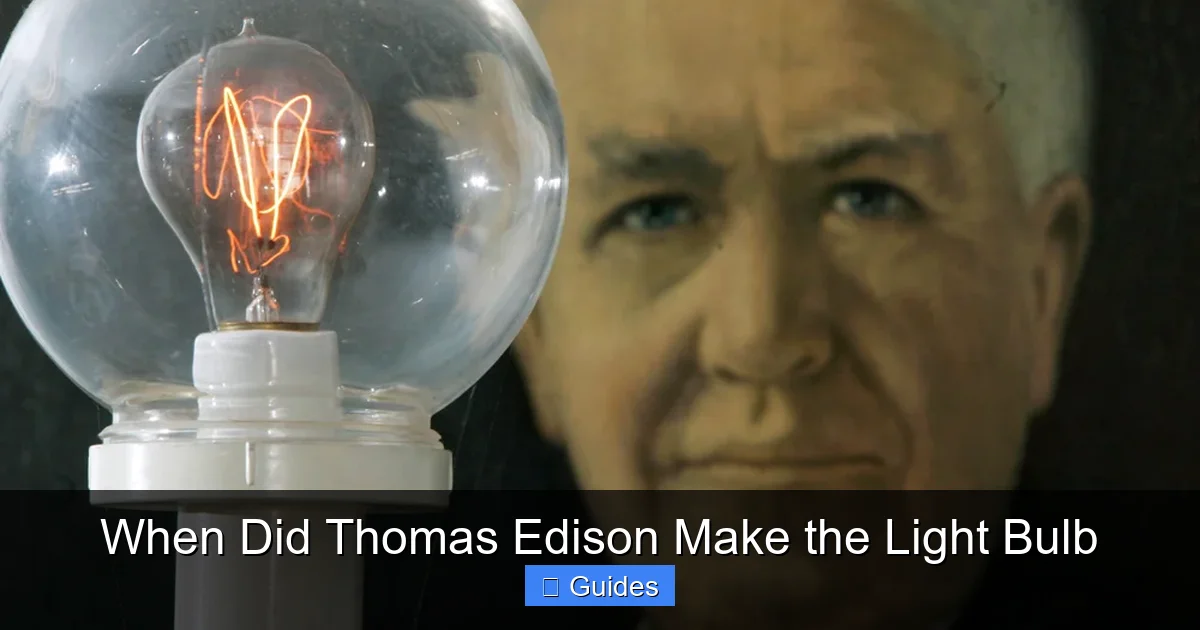
Visual guide about When Did Thomas Edison Make the Light Bulb
Image source: media2.s-nbcnews.com
When Thomas Edison turned his attention to electric lighting in the mid-1870s, he didn’t approach it as a solitary genius having a sudden eureka moment. Instead, he applied his systematic, industrial approach to invention at his famed laboratory in Menlo Park, New Jersey. His team, a group of skilled engineers and machinists, worked tirelessly, often round the clock, testing thousands of different materials and designs.
Identifying the Core Problems
Edison understood that making a filament glow was only one part of the puzzle. He identified three main challenges that needed to be overcome to create a truly practical incandescent light bulb:
- The Filament: The material that would glow had to have high electrical resistance (so it wouldn’t need enormous currents), a high melting point, and be inexpensive.
- The Vacuum: The filament needed to be in a vacuum to prevent it from rapidly burning out (oxidizing) in the presence of oxygen.
- The System: A complete, economical system for generating and distributing electricity to multiple bulbs was essential. A single bulb was useless without power.
This holistic approach was what set Edison apart. He wasn’t just trying to make a better bulb; he was trying to build an entire infrastructure for electric illumination. This comprehensive strategy is key to understanding when did Thomas Edison make the light bulb viable for the masses.
The Breakthrough: October 1879
This is the moment many people pinpoint when did Thomas Edison make the light bulb that truly mattered. After countless failures, trying everything from platinum and iridium to carbonized paper, Edison and his team struck gold with a surprisingly simple material.
The Carbonized Cotton Thread Experiment
In October 1879, after nearly two years of intense experimentation, Edison’s team tried a new filament material: a thin piece of cotton sewing thread, carbonized by baking it at high temperatures in an oxygen-free oven. This process turned the cotton into a pure carbon filament. It was painstakingly delicate work to mount these tiny, brittle threads inside a glass bulb from which almost all air had been removed using an improved vacuum pump.
On October 22, 1879, one such bulb, equipped with the carbonized cotton filament, was tested. The team watched, mesmerized, as it glowed steadily. It didn’t burn out in minutes or hours; it kept glowing for an astonishing 13.5 hours. This was a remarkable improvement over previous attempts and a huge step forward in the quest for a practical light bulb.
The 40-Hour Bulb: A Public Sensation
Edison and his team didn’t stop there. They continued to refine the design and the vacuum technology. By early November 1879, they had created a bulb that could burn for 40 hours. This was the significant milestone that Edison was ready to present to the world. Imagine the impact! For the first time, people saw an electric light that could reliably replace flickering gas lamps and dangerous candles.
Edison publicly demonstrated his incandescent light bulb at his Menlo Park laboratory on December 31, 1879. Thousands flocked to witness this marvel. The newspapers were ablaze with headlines, hailing Edison’s “subdivision of the electric light.” This public display, showcasing a practical, long-lasting bulb, cemented in the public consciousness the idea of when did Thomas Edison make the light bulb. It wasn’t just a lab curiosity anymore; it was a glimpse into the future. This date, late 1879, is the most commonly cited answer to when did Thomas Edison make the light bulb that transformed society.
Refinement and Commercialization: Beyond the First Success
Edison’s work didn’t end with the 1879 breakthrough. That was merely the beginning of the commercialization phase, an equally challenging endeavor that required further innovation and system building.
The Japanese Bamboo Fiber Filament
While the carbonized cotton thread was revolutionary, Edison sought even greater longevity. His team scoured the globe for suitable materials. They discovered that a carbonized bamboo fiber filament, sourced from specific regions of Japan, offered significantly better performance. In 1880, bulbs equipped with this bamboo filament were capable of lasting over 1,200 hours – a truly practical duration for everyday use! This particular filament became the standard for Edison’s bulbs for nearly a decade.
This continuous improvement highlights Edison’s dedication not just to invention, but to refinement and optimization. He wasn’t satisfied with “good enough”; he always pushed for better.
Developing the Complete Electrical System
Perhaps Edison’s greatest, yet often overlooked, contribution was the creation of a complete, integrated electrical distribution system. A light bulb, however brilliant, is useless without a reliable power source and a way to deliver that power. Edison understood this intimately. He designed and patented:
- Generators: Powerful, efficient dynamos to produce electricity.
- Wiring: Safe and effective methods for distributing current through buildings and streets.
- Switches and Sockets: Devices for turning lights on and off, and connecting bulbs.
- Meters: Ways to measure electricity consumption so customers could be billed.
This was an unprecedented undertaking. He wasn’t just answering “when did Thomas Edison make the light bulb”; he was answering “how do we bring electric light to every home and business?”
The Pearl Street Station: Lighting Up New York
The culmination of this systematic effort was the opening of the Pearl Street Station in lower Manhattan on September 4, 1882. This was the first central power station in the United States, providing direct current (DC) electricity to 59 customers, illuminating 400 incandescent light bulbs. Imagine the excitement and wonder! Suddenly, a portion of New York City was bathed in a steady, clean light, free from the hazards and fumes of gas lamps. It was an undeniable demonstration of the practicality and potential of Edison’s vision.
This event solidified the answer to when did Thomas Edison make the light bulb a practical reality for urban living. It was no longer a laboratory curiosity but a fully functioning utility.
Edison’s Enduring Legacy and Impact
The question “when did Thomas Edison make the light bulb” leads us directly to the profound impact he had on the world. His contributions transformed society in countless ways, shaping the modern world as we know it.
The Proliferation of Electric Light
Following the success of the Pearl Street Station, electric power stations began to pop up in cities across the globe. Homes, businesses, and streets were increasingly illuminated by Edison’s incandescent bulbs. This brought about:
- Increased Productivity: Factories could operate longer hours, and offices could function more efficiently.
- Enhanced Safety: Electric lights reduced the risk of fires from candles and gas lamps, and made streets safer at night.
- Social Changes: Nightlife flourished, and people had more leisure time after dark in their homes. Education also benefited as people could read and study longer.
- Urbanization: Cities became more attractive and livable with reliable lighting.
It’s difficult to overstate the seismic shift caused by the widespread adoption of electric light. It truly revolutionized daily life.
The Spirit of Innovation
Beyond the physical invention, Edison’s legacy is also tied to his spirit of innovation, his belief in hard work (“1% inspiration and 99% perspiration”), and his methodical approach to problem-solving. He established a model for industrial research and development that is still followed today. His Menlo Park lab was essentially the world’s first industrial research laboratory, a place dedicated solely to invention. This approach allowed him to rapidly iterate and refine, crucial in determining when did Thomas Edison make the light bulb effective enough for the world.
Even today, as we transition to LED and other advanced lighting technologies, the fundamental principles of electrical illumination and distribution owe a massive debt to Edison’s pioneering work. His impact is woven into the very fabric of our electrified world.
Debunking the Myth: Why “Inventor” is Misleading
It’s important to reiterate that while we often ask “when did Thomas Edison make the light bulb,” calling him the sole “inventor” is technically inaccurate. This isn’t to diminish his genius, but rather to properly credit the cumulative nature of scientific progress.
The Cumulative Nature of Innovation
No single invention truly springs forth from a vacuum. Every great technological leap builds upon the work of those who came before. Edison himself stood on the shoulders of giants like Humphry Davy, Joseph Swan, and many others who explored the properties of electricity and incandescence. His brilliance was in synthesis, refinement, and practical application. He didn’t just have an idea; he made it work on a massive, commercial scale. He turned a scientific curiosity into a global industry.
Acknowledging Other Contributors
Joseph Swan, for instance, had developed and patented a long-lasting light bulb in the UK at almost the same time as Edison. There were patent disputes between the two, which eventually led to a joint company, the Edison & Swan United Electric Light Company, in Britain. This collaboration further underscores that the development of practical electric light was a race involving many brilliant minds.
So, when did Thomas Edison make the light bulb? It was specifically in October 1879 that he achieved a significant breakthrough with a durable filament and a viable system. But his greatest contribution was transforming the abstract idea of electric light into a tangible, accessible reality that powered a new era of progress and innovation. He made electric light practical, affordable, and widespread, ultimately illuminating the modern world.
In conclusion, while many tried, it was Thomas Edison who, through relentless effort and systematic innovation, definitively answered the call for practical electric illumination. His breakthrough in October 1879, followed by continuous improvements and the creation of a complete electrical system, truly brought light to the world. He didn’t just make a bulb; he forged the dawn of the electrical age.
Frequently Asked Questions
Who invented the light bulb before Edison?
Several individuals made significant contributions to electric lighting before Edison. Humphry Davy created the electric arc lamp in 1802, and Joseph Swan developed and patented a carbon filament incandescent light bulb in the 1860s, which he demonstrated publicly in 1879.
What was Edison’s light bulb made of?
Edison’s breakthrough light bulb in October 1879 used a carbonized cotton thread filament. Later, in 1880, his team discovered that carbonized bamboo fibers made for an even more durable filament, lasting over 1,200 hours, which became the standard for his early bulbs.
How long did Edison’s first practical light bulb last?
Edison’s initial successful light bulb in October 1879, with a carbonized cotton thread filament, glowed for about 13.5 hours. Through continued refinement, particularly with a better vacuum and filament, they quickly extended this to over 40 hours, and later to 1,200+ hours with bamboo filaments.
What year was the first public demonstration of Edison’s light bulb?
The first major public demonstration of Thomas Edison’s practical, long-lasting incandescent light bulb took place on December 31, 1879, at his laboratory in Menlo Park, New Jersey. Thousands attended to witness this revolutionary display.
How did Edison’s work change the world?
Edison’s work on the light bulb and the entire electrical distribution system revolutionized daily life by providing safe, affordable, and widespread artificial light. This led to increased productivity, enhanced safety, extended leisure time, and fundamentally shaped the development of modern cities and industries.
Were there patent disputes over the light bulb?
Yes, there were significant patent disputes, notably between Thomas Edison and Joseph Swan, who had independently developed similar incandescent light bulbs around the same time. In Britain, these disputes were eventually resolved by forming a joint company, the Edison & Swan United Electric Light Company.
