


As an Amazon Associate, We earn from qualifying purchases.
Curious about how much power your light bulb uses? The amount varies greatly by type: traditional incandescents are power-hungry, while modern LEDs are incredibly efficient, using significantly less energy for the same brightness. Understanding watts, lumens, and your electricity rate allows you to easily calculate the cost of powering your lights and make smarter choices to save energy and money.
Have you ever stopped to think about the humble light bulb and its role in your daily life? It’s probably one of the most ubiquitous devices in your home, silently providing illumination from dawn until dusk (and often beyond). But while you might appreciate its glow, have you ever really considered how much power does a light bulb use?
It’s a fundamental question that touches upon everything from your monthly electricity bill to your home’s environmental impact. Understanding light bulb power consumption isn’t just for electricians or eco-warriors; it’s for anyone who pays a utility bill or cares about making smart choices for their home. The answer isn’t always straightforward, as it depends on the type of bulb, how you use it, and even the technology behind it. Let’s shed some light on this illuminating topic.
In this comprehensive guide, we’re going to demystify the power usage of light bulbs. We’ll explore the different kinds of bulbs out there, from the old-school incandescents to the modern, super-efficient LEDs. We’ll help you understand the key terms like watts and lumens, show you how to calculate your costs, and offer practical tips to reduce your energy footprint. By the end, you’ll be well-equipped to make informed decisions about the lighting in your home and truly understand how much power does a light bulb use.
Key Takeaways
- Power Varies Greatly by Bulb Type: Incandescent bulbs use the most power (e.g., 60W), followed by halogens (40-50W for equivalent), CFLs (13-15W for equivalent), and LEDs being the most efficient, using as little as 6-9W for the same brightness.
- Watts Measure Power Consumption, Lumens Measure Brightness: Don’t confuse the two. A lower wattage LED can produce the same or more lumens (brightness) than a higher wattage incandescent, indicating superior efficiency.
- You Can Calculate Your Energy Costs: Multiply the bulb’s wattage (in kW) by its hours of use and your electricity rate (per kWh) to determine the exact cost of running your light bulbs.
- Energy Efficiency Saves Money and Reduces Environmental Impact: Switching from older, inefficient bulbs to LEDs can lead to significant savings on your electricity bill and a smaller carbon footprint due to reduced energy demand.
- Usage Habits and Dimmers Also Impact Power Use: Turning off lights when not needed and using dimmer switches (especially with compatible LEDs) can further reduce the amount of power a light bulb uses over time.
- LEDs Offer the Best Value and Efficiency: Despite a higher upfront cost, LEDs pay for themselves quickly through lower energy bills, longer lifespan, and superior performance, making them the most economical choice in the long run.
Quick Answers to Common Questions
How many watts is a typical incandescent light bulb?
A typical incandescent light bulb usually ranges from 40 watts to 100 watts, with a common household bulb being 60 watts.
How many watts does an LED bulb use compared to an incandescent?
An LED bulb uses significantly less power. For the same brightness (e.g., 800 lumens), an LED bulb might use only 9-10 watts, while an incandescent bulb would use around 60 watts.
Do dimmer switches save electricity?
Yes, dimmer switches can save electricity by reducing the amount of power supplied to the bulb, which in turn lowers its wattage and light output. This is most effective with incandescent and dimmable LED bulbs.
What is a lumen, and why is it important for understanding light bulb power?
A lumen is a unit of brightness, telling you how much light a bulb produces. It’s important because it helps you compare the actual light output for different wattages, allowing you to choose the most efficient bulb (highest lumens per watt).
Is it worth replacing old bulbs with LEDs just to save power?
Absolutely! Replacing old, inefficient bulbs (especially incandescents) with LEDs is one of the quickest and most effective ways to save electricity, reduce your energy bill, and lessen your environmental impact due to the significant difference in how much power a light bulb uses.
📑 Table of Contents
- Understanding “Power”: Watts, Lumens, and Efficiency
- The Different Types of Light Bulbs and Their Power Usage
- Calculating Your Light Bulb’s Energy Cost
- Factors Influencing Power Consumption Beyond the Bulb Itself
- Tips for Reducing Light Bulb Power Usage
- The Environmental Impact of Light Bulb Power Usage
- Conclusion
Understanding “Power”: Watts, Lumens, and Efficiency
Before we dive into specific bulb types, let’s get a handle on the basic terms. These are crucial for understanding how much power does a light bulb use and how efficient it is at turning that power into light.
What is a Watt? The Measure of Power
When you look at a light bulb package, the most prominent number you’ll often see is its wattage, like “60W” or “9W.” A watt (W) is a unit of power. In simple terms, it tells you how much electrical energy a device consumes per unit of time to operate. So, a 60-watt light bulb uses 60 watts of power when it’s on. It’s a direct measure of its electricity appetite.
However, here’s a crucial point: a higher wattage doesn’t necessarily mean more light. It just means more power is being consumed. This is where efficiency comes in, which we’ll discuss shortly.
Lumens vs. Watts: Brightness vs. Power Consumption
For decades, we associated brightness with watts. “I need a 100-watt bulb” really meant “I need a bright bulb.” But with newer, more efficient technologies, watts no longer tell you how bright a bulb is. This is why lumens (lm) have become the standard measure of brightness.
- Watts (W): How much power the bulb uses.
- Lumens (lm): How much visible light the bulb produces.
Think of it this way: if a car uses a lot of fuel (watts) but doesn’t go very fast or far (lumens), it’s not very efficient. A truly efficient light bulb uses fewer watts to produce a high number of lumens. Modern bulb packaging will often show an “equivalent wattage” (e.g., “9W LED equivalent to 60W incandescent”) to help you transition from the old way of thinking about brightness.
Energy Efficiency Explained
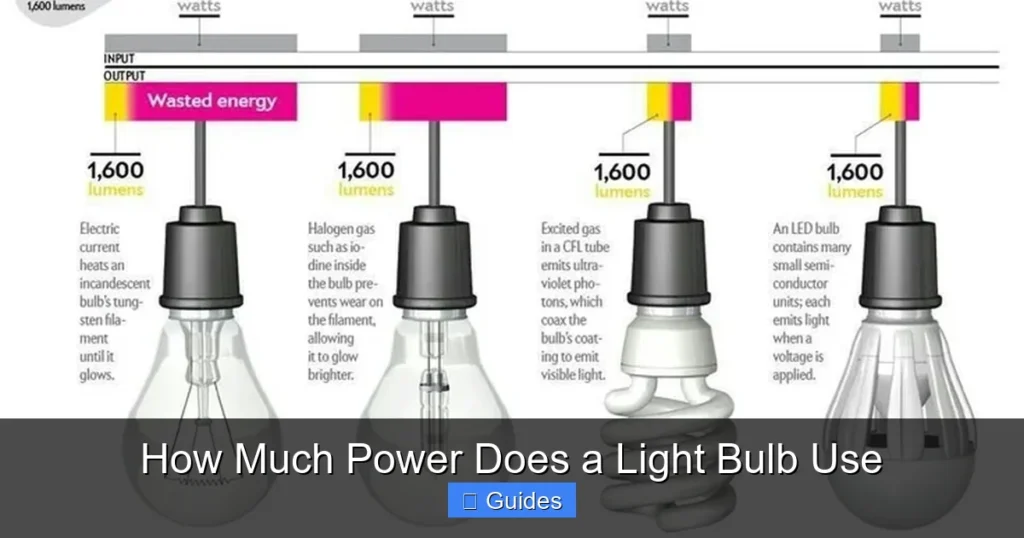
Energy efficiency for light bulbs is all about how effectively they convert electrical power into visible light, rather than wasted energy like heat. An incandescent bulb, for example, is notoriously inefficient because a large percentage of the power it consumes (watts) is released as heat, with only a small fraction converted into light. An LED, on the other hand, converts a much higher percentage of its power into light, making it far more efficient.
So, when you ask how much power does a light bulb use, you’re not just asking about its wattage. You’re implicitly asking about its efficiency in delivering light for that power.
The Different Types of Light Bulbs and Their Power Usage
The type of light bulb you choose dramatically influences how much power does a light bulb use. Let’s break down the main contenders.
Visual guide about How Much Power Does a Light Bulb Use
Image source: nenpower.com
Incandescent Bulbs: The Power Guzzlers
These are the traditional bulbs with a thin wire filament that glows when heated by electricity. They’ve been around for over a century, providing that familiar warm glow.
- Typical Wattage: 40W, 60W, 75W, 100W
- Efficiency: Very low. Only about 10-15% of the energy consumed is converted into visible light; the rest is lost as heat.
- Example: A standard 60W incandescent bulb might produce around 800 lumens.
While inexpensive to buy, incandescents are the most expensive to run due to their high power consumption. They significantly contribute to how much power does a light bulb use in older homes.
Halogen Bulbs: A Step Up
Halogen bulbs are a type of incandescent bulb, but they contain halogen gas which allows the filament to burn hotter and last longer. They produce a brighter, whiter light.
- Typical Wattage: 29W, 43W, 72W (often marketed as replacements for 40W, 60W, 100W incandescents)
- Efficiency: Slightly better than traditional incandescents, but still relatively low. About 15-20% efficient.
- Example: A 43W halogen bulb can produce around 750 lumens, similar to a 60W incandescent.
Halogens offer a minor improvement in how much power does a light bulb use compared to standard incandescents, but they still generate a lot of heat.
CFL Bulbs: The Spiral Savers
Compact Fluorescent Lamps (CFLs) were the first widely available energy-efficient alternative to incandescents. They work by passing electricity through a tube containing argon and a small amount of mercury vapor, which then excites a phosphor coating to produce light.
- Typical Wattage: 9W, 13W, 23W (often equivalent to 40W, 60W, 100W incandescents)
- Efficiency: Good. About 25-30% efficient.
- Example: A 13W CFL can produce around 800 lumens, equivalent to a 60W incandescent.
CFLs significantly reduced how much power does a light bulb use compared to incandescents, but they have drawbacks like a warm-up time, containing mercury, and often not being dimmable.
LED Bulbs: The Efficiency Kings
Light Emitting Diodes (LEDs) are the current champions of lighting efficiency. They produce light through the movement of electrons in a semiconductor material.
- Typical Wattage: 6W, 9W, 15W (often equivalent to 40W, 60W, 100W incandescents)
- Efficiency: Excellent. Up to 80-90% efficient, converting almost all energy into light with minimal heat waste.
- Example: A 9W LED bulb can produce 800-900 lumens, equivalent to a 60W incandescent.
LEDs use dramatically less power to produce the same amount of light, last much longer, and come in a vast array of colors and designs. They are the go-to choice if you want to minimize how much power does a light bulb use.
Let’s put it into perspective: to get 800 lumens (roughly equivalent to a 60W incandescent):
- Incandescent: 60 watts
- Halogen: 43 watts
- CFL: 13 watts
- LED: 9 watts
That’s a massive difference in power consumption!
Calculating Your Light Bulb’s Energy Cost
Understanding how much power does a light bulb use is one thing; understanding what that costs you is another. It’s actually quite simple to calculate.
The Formula: Watts to Kilowatt-hours (kWh)
Electricity is typically billed in kilowatt-hours (kWh). A kilowatt-hour is the amount of energy you use if you run a 1,000-watt (1 kW) appliance for one hour. Most light bulbs are measured in watts, so we need to convert them to kilowatts first.
Here’s the basic formula:
(Bulb Wattage / 1000) × Hours Used × Electricity Rate (per kWh) = Cost
Finding Your Electricity Rate
Your electricity rate is usually found on your monthly utility bill. It’s often expressed in cents per kWh (e.g., 15 cents/kWh) or dollars per kWh (e.g., $0.15/kWh). Make sure you use the correct decimal form in your calculation.
Putting It All Together with an Example
Let’s say you have a light fixture with three bulbs, and they are on for an average of 4 hours per day. Your electricity rate is $0.15 per kWh.
Scenario 1: Old Incandescent Bulbs
- Bulb Type: 3 x 60-watt incandescent bulbs
- Total Wattage: 3 bulbs * 60W/bulb = 180W
- Convert to Kilowatts: 180W / 1000 = 0.18 kW
- Daily Use: 4 hours
- Daily Cost: 0.18 kW * 4 hours * $0.15/kWh = $0.108
- Monthly Cost (30 days): $0.108 * 30 = $3.24
- Yearly Cost: $3.24 * 12 = $38.88
For just three incandescent bulbs in one fixture, you’re looking at almost $40 a year. Imagine that across your entire home!
Scenario 2: Energy-Efficient LED Bulbs
- Bulb Type: 3 x 9-watt LED bulbs (equivalent brightness to 60W incandescents)
- Total Wattage: 3 bulbs * 9W/bulb = 27W
- Convert to Kilowatts: 27W / 1000 = 0.027 kW
- Daily Use: 4 hours
- Daily Cost: 0.027 kW * 4 hours * $0.15/kWh = $0.0162
- Monthly Cost (30 days): $0.0162 * 30 = $0.486
- Yearly Cost: $0.486 * 12 = $5.83
The difference is staggering! Switching those three bulbs from incandescent to LED saves you over $30 a year for just one fixture. This vividly illustrates how much power does a light bulb use can impact your wallet.
Factors Influencing Power Consumption Beyond the Bulb Itself
While the bulb type is the biggest factor, other elements can also affect how much power does a light bulb use.
Dimmer Switches: Do They Save Power?
Yes, often they do! When you dim a light, you’re effectively reducing the amount of power supplied to the bulb, which in turn reduces its light output and power consumption. However, the exact savings depend on the bulb type and dimmer technology.
- Incandescent/Halogen: Dimmers save proportional energy. Dimming by 50% often means 50% less power used.
- CFLs: Most CFLs are not dimmable, and using them with a standard dimmer can damage the bulb or the dimmer. Only specific “dimmable CFLs” should be used, and even then, savings might not be linear.
- LEDs: Dimmable LEDs, when paired with compatible LED dimmers, can offer significant energy savings. The savings are generally proportional to the dimming level, but some older dimmers might not achieve full efficiency with LEDs. Always ensure your LED bulb is labeled “dimmable” and use an LED-compatible dimmer switch for best results.
Smart Bulbs: Convenience and Control
Smart bulbs are essentially LED bulbs with added connectivity (Wi-Fi or Bluetooth). This allows them to be controlled via apps, voice commands, or smart home assistants. While the bulb itself is an LED (and therefore efficient), their “smart” features can further optimize how much power does a light bulb use.
- Scheduling: Set lights to turn off automatically when you leave or at specific times, preventing unnecessary usage.
- Occupancy Sensors: Some smart systems can integrate with motion sensors, ensuring lights are only on when a room is occupied.
- Remote Control: Turn off lights you accidentally left on from anywhere, saving power.
The “smart” part itself uses a tiny amount of power to maintain connectivity, but the energy savings from smarter usage far outweigh this minimal standby consumption.
Your Habits Matter: On vs. Off
This might seem obvious, but it’s worth stating: a light bulb uses no power when it’s off! The most effective way to reduce how much power does a light bulb use is to simply turn it off when you don’t need it. While LEDs consume very little power, running them unnecessarily still adds up over time. Develop the habit of switching off lights in empty rooms.
Tips for Reducing Light Bulb Power Usage
Now that you know how much power does a light bulb use, here are actionable steps to reduce your energy consumption and save money.
1. Switch to LEDs
This is by far the most impactful tip. Replace all your incandescent and halogen bulbs with LED equivalents. The initial cost might be slightly higher, but the long-term savings on your electricity bill and the extended lifespan of LEDs make them an excellent investment. Prioritize frequently used lights first.
2. Use Dimmers Wisely
Install dimmers on lights in areas where full brightness isn’t always necessary (e.g., living rooms, bedrooms). Remember to use dimmable LED bulbs with compatible LED dimmers. Dimming your lights even slightly can significantly reduce how much power does a light bulb use.
3. Optimize Lighting Zones
Think about how you use each room. Do you need one bright overhead light, or could task lighting (like a desk lamp or reading lamp) suffice for specific activities? By only lighting the areas you need, you can reduce the overall power consumption.
4. Harness Natural Light
Maximize natural daylight during the day. Open blinds, draw back curtains, and consider lighter paint colors for walls and ceilings to reflect light. Arrange your furniture to take advantage of windows. This delays when you need to turn on artificial lights and thereby reduces how much power a light bulb uses.
5. Turn Them Off!
The simplest and often overlooked tip. Make it a habit to switch off lights when you leave a room, even if you’ll be back in a few minutes. If you have children, teach them this habit too. Consider installing motion sensors in low-traffic areas like pantries, laundry rooms, or hallways.
The Environmental Impact of Light Bulb Power Usage
Beyond your wallet, how much power does a light bulb use has a broader environmental impact. Most electricity generation still relies on burning fossil fuels, which releases greenhouse gases into the atmosphere. By reducing your light bulb’s power consumption, you’re contributing to a lower demand for electricity, which in turn can lead to reduced carbon emissions. Switching to LEDs is a tangible way to make a positive environmental difference in your home.
Conclusion
Understanding how much power does a light bulb use is more than just a technical curiosity; it’s a key to smarter energy consumption, cost savings, and a more environmentally friendly lifestyle. We’ve explored the drastic differences between bulb types, seen how to calculate actual costs, and learned about various factors that influence power usage.
From the power-hungry incandescent to the incredibly efficient LED, the evolution of lighting technology has provided us with remarkable options. By making informed choices – primarily by switching to LEDs, utilizing dimmers, and adopting mindful habits – you can significantly reduce your electricity bill and your carbon footprint. So go ahead, dim those lights, turn them off when you leave, and enjoy the savings and peace of mind that come with smart lighting choices!
🎥 Related Video: How Does a Light Bulb Work?
📺 ScienceABC II
Have you ever wondered what happens inside a light bulb when you flip the switch? The incandescent bulb, first patented by …
Frequently Asked Questions
How can I find out the wattage of my current light bulbs?
The wattage of your light bulb is typically printed directly on the bulb itself, usually on the base or the glass. If you can’t find it there, check the original packaging or the manufacturer’s website for the model number.
Do light bulbs consume power even when turned off?
No, most traditional light bulbs consume no power when fully turned off at the switch. However, some smart bulbs or those with integrated sensors might draw a very tiny amount of “standby” power to maintain connectivity, but this is usually negligible.
What is the typical lifespan of different light bulb types?
Lifespans vary greatly: incandescents last around 750-1,000 hours, halogens around 1,000-2,000 hours, CFLs between 8,000-10,000 hours, and LEDs are the longest-lasting, often rated for 25,000-50,000 hours or more.
Does the color temperature (warm white vs. cool white) affect power consumption?
No, the color temperature (measured in Kelvin) of a light bulb does not affect how much power it consumes. It only refers to the perceived color of the light itself, from a yellowish warm glow to a bluer cool light.
Are there government regulations or standards for light bulb power usage?
Yes, many countries have energy efficiency standards and regulations for light bulbs, often leading to the phasing out of inefficient incandescent bulbs in favor of more energy-saving alternatives like CFLs and LEDs.
How does the usage time impact the overall power consumption of a light bulb?
The longer a light bulb is on, the more power it consumes. Power consumption is calculated by multiplying the bulb’s wattage by the number of hours it is used, so longer usage directly translates to higher energy bills.
