


As an Amazon Associate, We earn from qualifying purchases.
When asking “who made the light bulb first,” most people instinctively say Thomas Edison. However, the truth is far more complex and collaborative. No single individual invented the light bulb; it was a culmination of decades of research and improvements by numerous brilliant minds. While Edison played a crucial role in developing a *practical, long-lasting, and commercially viable* incandescent light bulb system, many others laid the groundwork and even created functional bulbs before him.
Few inventions have had as profound an impact on human civilization as the light bulb. It transformed nights, extended working hours, and fundamentally reshaped daily life, from homes and factories to cities around the globe. Ask anyone who made the light bulb first, and the answer you’re most likely to hear is “Thomas Edison.” His name has become almost synonymous with the invention of electric light.
But like many monumental inventions, the true story of who made the light bulb first is far more complex and, frankly, more fascinating than a single name suggests. It’s a tale of incremental improvements, relentless experimentation, and the collective genius of many brilliant minds spanning decades. While Edison certainly played a pivotal role in popularizing and perfecting the incandescent light bulb, he stood on the shoulders of giants. Let’s peel back the layers of history and shed some light on the true origins of this luminous innovation.
Key Takeaways
- No Single Inventor: The light bulb, as we know it, was not invented by one person. It was the result of a long evolutionary process involving many scientists and inventors over several decades.
- Early Pioneers Paved the Way: Before Edison, figures like Humphry Davy, Warren de la Rue, and Joseph Swan made significant contributions, experimenting with various filaments, vacuum technology, and power sources.
- Joseph Swan’s Notable Achievements: British inventor Joseph Swan developed a functional and relatively long-lasting incandescent light bulb years before Edison’s most famous breakthrough, using carbonized cotton filaments in a vacuum.
- Thomas Edison’s Crucial Contribution: Edison’s genius lay in creating a *practical, commercially viable, and long-lasting* incandescent bulb, particularly with his high-resistance carbonized bamboo filament and the development of an entire electrical lighting system.
- The Importance of a System: Edison didn’t just invent a bulb; he created a complete system of electricity generation, distribution, and a bulb that could work within it, making electric light accessible and affordable for the masses.
- Collaboration and Competition: The history of the light bulb is marked by both fierce competition and eventual collaboration (like Edison-Swan Company), highlighting how innovation often builds on shared knowledge.
- Debunking the Myth: The popular belief that Thomas Edison solely invented the light bulb is an oversimplification, overlooking the vital contributions of his predecessors and contemporaries.
Quick Answers to Common Questions
Question 1?
Was Thomas Edison the only person to invent the light bulb?
Answer 1?
No, Thomas Edison was not the only inventor of the light bulb. Many scientists and inventors contributed to the development of electric light over several decades before Edison’s major breakthroughs.
Question 2?
Who made the light bulb first before Edison?
Answer 2?
Joseph Swan, a British inventor, developed a functional and relatively long-lasting incandescent light bulb using carbonized cotton filaments in a vacuum as early as 1860, and significantly improved it in 1878.
Question 3?
What was Edison’s main contribution to the light bulb?
Answer 3?
Edison’s main contribution was creating a practical, long-lasting (over 1,200 hours with bamboo filament), high-resistance incandescent light bulb and, crucially, a complete electrical generation and distribution system that made electric light commercially viable and accessible to the public.
Question 4?
What material did Edison use for his famous long-lasting filament?
Answer 4?
Edison’s team discovered that a carbonized bamboo fiber filament provided exceptional longevity and high resistance, leading to his most famous and practical light bulb design.
Question 5?
Did Edison and Swan ever work together?
Answer 5?
Yes, after initial patent disputes, Thomas Edison’s and Joseph Swan’s companies merged their interests in Great Britain in 1883, forming the “Edison & Swan United Electric Light Company” (Ediswan).
📑 Table of Contents
- The Genesis of Electric Light: Before Incandescence
- Joseph Swan: A Major Player in the Race for Light
- Thomas Edison’s Contribution: The Practical, Commercial Bulb
- The Patent Wars and the Edison-Swan Company
- Beyond Edison and Swan: The Continuous Evolution of Light
- Why the Confusion? Marketing, Patents, and Simplicity
- Conclusion: A Collective Brilliance
The Genesis of Electric Light: Before Incandescence
The journey to the light bulb didn’t begin with a filament in a vacuum; it started with fundamental discoveries about electricity itself. Long before anyone conceived of a practical light source for every home, scientists were experimenting with electricity’s ability to produce light.
Humphry Davy and the Arc Lamp
One of the earliest pioneers was the British chemist Humphry Davy. In 1802, using a powerful electric battery, Davy demonstrated how electricity could make carbon glow brightly. He created what became known as the “electric arc lamp.” This involved connecting two charcoal electrodes to a battery and bringing them close together, causing an intense, brilliant arc of light to jump between them. While incredibly bright, Davy’s arc lamp was far too intense, short-lived, and impractical for widespread use. It consumed vast amounts of power, was dangerously hot, and quickly burned through its carbon rods. However, it proved that electric light was possible and inspired future generations of inventors.
Early Attempts at Incandescence
The arc lamp’s drawbacks spurred inventors to seek a more stable and less intense form of electric light – incandescent light, which works by heating a filament until it glows. The challenge was finding a material that could withstand extreme heat without rapidly burning up, ideally in a vacuum to prevent oxidation. This quest became the central theme for many who sought to answer who made the light bulb first.
- 1820: Warren de la Rue: The British chemist Warren de la Rue encased a platinum coil in an evacuated tube and passed an electric current through it. Platinum, with its high melting point, glowed brightly. However, platinum was incredibly expensive, making this design impractical for widespread use.
- 1840: Frederick de Moleyns: Another early patent for an incandescent lamp was granted to Frederick de Moleyns in England. His design used a powdered charcoal filament heated by an electric current in a vacuum container.
- 1841: James Bowman Lindsay: A Scottish inventor, Lindsay, publicly demonstrated an electric lamp that provided constant light. He reportedly lit a room for several hours, but did not patent his work.
Joseph Swan: A Major Player in the Race for Light
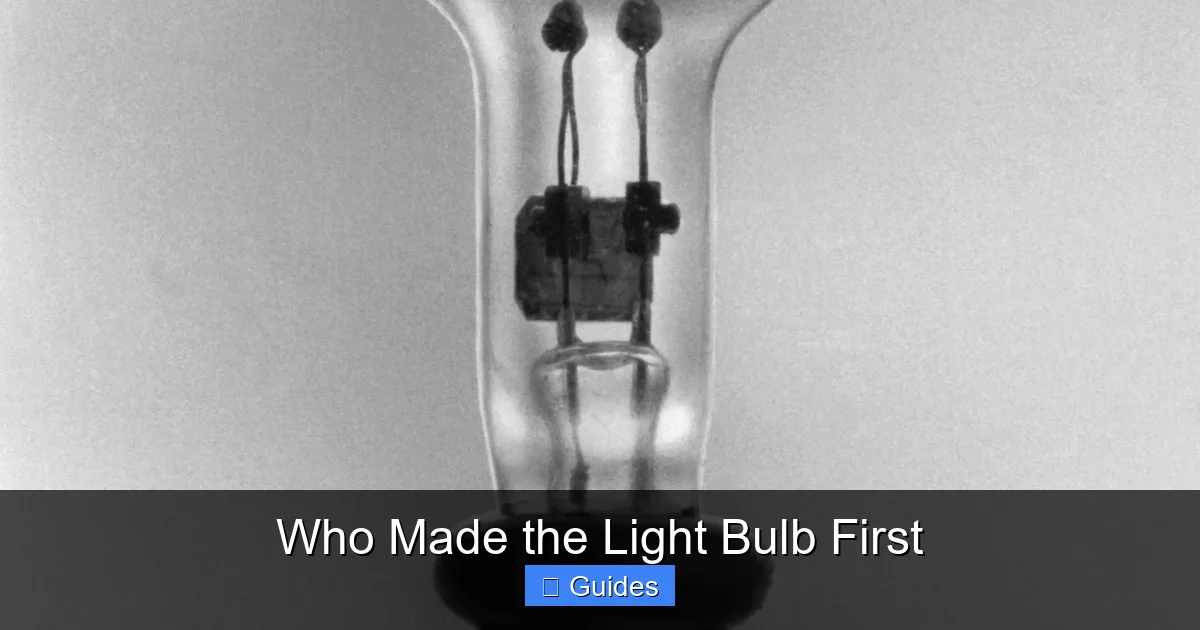
While many experimented, one name stands out prominently among those who significantly advanced the incandescent light bulb before Edison: Joseph Swan.
Visual guide about Who Made the Light Bulb First
Image source: explorepahistory.com
Swan’s Breakthroughs in the 1860s and 1870s
Sir Joseph Wilson Swan, a British physicist and chemist, began experimenting with incandescent lighting in the 1860s. He faced the same challenges as his predecessors: how to create a long-lasting filament and how to achieve a sufficient vacuum to prevent it from burning out quickly. Swan’s initial attempts used carbonized paper filaments in a vacuum bulb. By 1860, he had demonstrated a working incandescent lamp, but the vacuum pumps of the era were not powerful enough to remove all the oxygen, causing the filaments to still burn out relatively fast.
It was in the late 1870s that Swan made his most significant strides. With improved vacuum technology becoming available, he was able to create a much better vacuum inside his glass bulbs. In 1878, he developed a long-lasting light bulb using a thin, carbonized cotton thread (cellulose) filament. This bulb was publicly demonstrated in Newcastle, England, in December 1878 and was soon installed in homes and public buildings across Britain. Many consider Swan’s 1878 lamp to be a strong contender for who made the light bulb first in a practical sense.
The Problem of High Resistance
Despite his success, Swan’s early bulbs, like those of others, had low resistance. This meant they required thick copper wires to carry the high current needed to make them glow, which was expensive and inefficient for distributing power over long distances. This limitation prevented them from becoming a truly widespread and affordable alternative to gas lighting.
Thomas Edison’s Contribution: The Practical, Commercial Bulb
Now, let’s turn our attention to the figure most commonly associated with the invention. Thomas Alva Edison, the “Wizard of Menlo Park,” did not invent the light bulb out of thin air. Instead, his genius lay in his relentless pursuit of a *practical, long-lasting, and economically viable* incandescent lamp that could be integrated into a complete electrical distribution system.
The Quest for a Perfect Filament
Edison and his team began their serious research into electric lighting in 1878, fully aware of the work of Swan and others. Edison famously stated, “I have not failed 10,000 times. I’ve just found 10,000 ways that won’t work.” His focus was on solving the problems that plagued earlier designs: short filament life, high cost, and inefficiency. He understood that a successful bulb needed a high-resistance filament to work efficiently with smaller, cheaper wires and a central power station.
After countless experiments with various materials – platinum, carbon rods, and numerous plant fibers – Edison and his team made their breakthrough in October 1879. They discovered that a carbonized cotton sewing thread could last for an astonishing 13.5 hours. This was quickly improved upon by using a carbonized bamboo fiber filament, which, in 1880, could glow for over 1,200 hours. This was a monumental leap forward in filament longevity, making the bulb practical for everyday use.
The Complete System: Edison’s True Innovation
What truly set Edison apart and cemented his place in history was not just the bulb itself, but his vision for an entire electrical lighting system. He understood that a bulb was useless without a reliable, affordable way to generate and distribute electricity to homes and businesses. Edison’s system included:
- A Long-Lasting Bulb: His high-resistance, carbonized bamboo filament bulb was durable and efficient.
- Improved Vacuum Technology: His team developed better vacuum pumps to ensure the filament burned out slowly.
- Generators: Powerful and efficient dynamos to produce electricity on a large scale.
- Wiring and Meters: A safe and effective network to distribute electricity and measure its consumption.
- Sockets and Switches: User-friendly components to easily turn lights on and off.
In 1882, Edison launched the world’s first central power station on Pearl Street in Manhattan, providing electricity to customers in the surrounding area. This comprehensive approach is why many attribute the practical invention to him, even if he wasn’t the very first to make a bulb glow. He made electric light accessible, affordable, and widespread, ultimately answering who made the light bulb first in terms of commercial viability.
The Patent Wars and the Edison-Swan Company
The simultaneous development of practical light bulbs by Swan and Edison naturally led to legal disputes over patent infringement. Both inventors had compelling claims. Swan had demonstrated his long-lasting carbon filament bulb in 1878, before Edison’s 1879 breakthrough. Edison, however, had patented his complete system and his specific high-resistance filament.
Rather than a protracted legal battle, a more pragmatic solution emerged. In 1883, the two companies merged their interests in Great Britain, forming the “Edison & Swan United Electric Light Company,” commonly known as Ediswan. This collaboration leveraged both inventors’ strengths and patents, effectively consolidating the electric lighting market in the UK and demonstrating that innovation often thrives through shared effort, even after initial competition.
Beyond Edison and Swan: The Continuous Evolution of Light
Even after Edison and Swan brought incandescent light to the masses, the story of the light bulb didn’t end. Innovation continued, making bulbs more efficient, durable, and versatile.
- Tungsten Filaments: Early 20th century, inventors like William D. Coolidge at General Electric developed methods to make ductile tungsten filaments. Tungsten has a much higher melting point than carbon, allowing bulbs to burn brighter and longer, and at higher efficiencies. This was a significant improvement over carbon filaments.
- Gas-Filled Bulbs: Irving Langmuir, also at General Electric, discovered that filling the bulb with an inert gas (like argon or nitrogen) reduced the evaporation of the tungsten filament, allowing it to operate at even higher temperatures without blackening the bulb.
- Fluorescent and LED Lighting: While incandescent bulbs dominated for over a century, the quest for efficiency led to fluorescent lamps in the mid-20th century and, more recently, light-emitting diodes (LEDs). These technologies represent entirely different principles of light generation but owe their existence to the fundamental desire for better, more efficient light that the early incandescent pioneers first ignited.
The light bulb’s evolution underscores a crucial point: no invention truly springs fully formed from a single mind. It is a process of iterative design, scientific discovery, and engineering refinement. Every “new” technology builds upon a foundation laid by countless predecessors.
Why the Confusion? Marketing, Patents, and Simplicity
So, why does Thomas Edison get almost all the credit for who made the light bulb first? Several factors contribute to this popular misconception:
- Marketing and Public Relations: Edison was a brilliant self-promoter and marketer. He understood the importance of public demonstrations and generated immense press coverage for his inventions. His “Wizard of Menlo Park” persona captivated the public imagination.
- The Complete System: As discussed, Edison didn’t just have a bulb; he had a plan for an entire infrastructure. This made his invention immediately practical and scalable, leading to rapid adoption and greater public awareness.
- Patent Strength and Legal Battles: While Swan had strong claims, Edison’s patents, particularly in the United States, were robust and fiercely defended. His company, General Electric, became a dominant force.
- Simplicity in Storytelling: It’s easier to tell a story with a single hero. Attributing the invention to one person simplifies a complex historical narrative, making it more digestible for textbooks and popular culture.
While simplicity might be appealing, it often sacrifices accuracy. Understanding the broader history not only gives credit where it’s due but also provides a more realistic and inspiring view of how innovation truly happens – through persistent effort, collaboration, and building upon the work of others.
Conclusion: A Collective Brilliance
The question of who made the light bulb first is not a simple one with a single answer. It’s a testament to human ingenuity and the cumulative nature of scientific progress. From Humphry Davy’s arc lamp to Warren de la Rue’s platinum coil, from Joseph Swan’s carbonized cotton filament to Heinrich Goebel’s durable bamboo fiber bulbs, and finally to Thomas Edison’s long-lasting filament and comprehensive electrical system, countless individuals contributed to the genesis of practical electric light.
Thomas Edison undeniably transformed electric lighting from a scientific curiosity into an everyday utility, making it accessible and affordable for the masses. His brilliance lay in his perseverance, his systematic approach, and his ability to see the bigger picture beyond just the bulb itself. However, to deny the contributions of those who came before him and worked alongside him would be to tell an incomplete story. The light bulb stands as a shining example of how monumental inventions are almost always the product of collective brilliance, a flickering flame nurtured by many hands before it could truly illuminate the world.
🎥 Related Video: Ask History: Who Really Invented the Light Bulb? | History
📺 HISTORY
Thomas Edison wasn’t the only inventor to lay claim to the light bulb, so whose bright idea was it? Ask History finds out.
Frequently Asked Questions
Who invented the electric light bulb?
The invention of the electric light bulb is a complex story with no single inventor. While Thomas Edison is widely credited for developing a practical and commercially viable long-lasting incandescent bulb, numerous scientists and inventors contributed significantly to its development before and alongside him.
When was the first light bulb invented?
Early forms of electric light, like Humphry Davy’s arc lamp, appeared in the early 1800s. As for the incandescent bulb, experiments began in the 1840s, with Joseph Swan demonstrating a working prototype in 1860 and a more refined, longer-lasting version in 1878, just before Edison’s famous 1879 breakthrough.
What made Edison’s light bulb different from others?
Edison’s bulb was unique because he focused on a high-resistance filament (initially carbonized bamboo) that could last for an extended period (over 1,200 hours) and work efficiently within a central electrical distribution system. His innovation wasn’t just the bulb but the entire ecosystem needed to power it.
Why is Joseph Swan less known than Edison for the light bulb?
Joseph Swan made significant breakthroughs, including a functional bulb before Edison. However, Edison’s success in widely commercializing his bulb and establishing an entire power generation and distribution system, coupled with his strong marketing efforts, led to his greater public recognition.
Were there other inventors besides Edison and Swan who contributed?
Absolutely. Inventors like Humphry Davy (arc lamp), Warren de la Rue (platinum filament), and Heinrich Goebel (durable bamboo filament bulb exhibited years earlier) all made important contributions to the science and technology that eventually led to practical incandescent light.
What was the impact of the light bulb on society?
The light bulb profoundly impacted society by extending daylight hours, enabling work and social activities after dark, improving safety in homes and streets, and driving the establishment of electrical grids, which powered countless other inventions and fundamentally reshaped modern life.
