


As an Amazon Associate, We earn from qualifying purchases.
Choosing the right light bulb can transform your home’s ambiance and save you money. Forget watts; focus on lumens for brightness and Kelvin for color temperature. Prioritize energy-efficient LEDs, consider dimmability, smart features, and the bulb’s physical fit for your fixtures. This guide will teach you how to choose a light bulb effectively, ensuring comfort, efficiency, and the perfect glow for every space.
Welcome, friend! Have you ever stood in the lighting aisle, overwhelmed by the sheer number of options, wondering how to choose a light bulb that’s just right? You’re not alone. It used to be simple: pick a wattage, screw it in, and you were done. But with incredible advancements in lighting technology, especially with the rise of LEDs, the world of light bulbs has become a fascinating, albeit sometimes confusing, place.
Choosing the right light bulb isn’t just about illuminating a room; it’s about setting a mood, enhancing productivity, showcasing decor, and even saving money on your energy bills. A well-lit home feels comfortable, inviting, and functional, while poorly chosen lighting can lead to eye strain, drab interiors, or unnecessarily high utility costs. This guide is here to demystify the process and give you all the tools you need to confidently pick the perfect bulb for every corner of your home. Let’s learn how to choose a light bulb like a pro!
Key Takeaways
- Understand Lumens, Not Just Watts: Lumens measure brightness, which is the primary factor when choosing a light bulb. Forget traditional wattages, as modern energy-efficient bulbs produce more light with fewer watts.
- Color Temperature Sets the Mood: Kelvin (K) indicates a bulb’s color temperature. Lower Kelvin (2700K-3000K) creates warm, cozy light, while higher Kelvin (4000K-5000K+) provides cooler, more invigorating light for tasks.
- LEDs are the Smart Choice: Light Emitting Diodes (LEDs) are the most energy-efficient, long-lasting, and versatile light bulbs available, offering significant savings on energy bills and replacement costs over time.
- Dimmability and Smart Features Add Versatility: If you want to adjust light levels or control your lighting remotely, ensure you choose dimmable bulbs and consider smart bulb options for enhanced convenience and customization.
- Match Bulb Shape and Base to Your Fixture: Always check the existing bulb or fixture specifications to ensure the new bulb has the correct base type (e.g., E26, GU10) and shape to fit properly and safely.
- Consider Color Rendering Index (CRI): For areas where accurate color perception is important (e.g., kitchens, art studios), look for bulbs with a high CRI (80+ is good, 90+ is excellent) to make colors appear more vibrant and true-to-life.
Quick Answers to Common Questions
What is the most important factor when choosing a light bulb?
The most important factor is lumens, which measure the bulb’s brightness. Forget watts; always look at the lumen rating to determine how bright the light will be.
What’s the difference between 2700K and 5000K?
2700K represents “warm white” light, which is cozy and yellowish, similar to traditional incandescents. 5000K represents “daylight” light, which is crisp, bright, and bluish-white, mimicking natural outdoor light.
Are LED bulbs worth the higher upfront cost?
Yes, absolutely! Despite a slightly higher initial price, LED bulbs are significantly more energy-efficient and last much longer than traditional bulbs, leading to substantial savings on electricity bills and replacement costs over their lifespan.
How do I know if a bulb will fit my lamp?
Check the bulb’s base type (e.g., E26, E12, GU10) and shape (e.g., A19, candelabra, floodlight) listed on the packaging. Compare this to the existing bulb or the socket information on your lamp or fixture.
What is CRI and why does it matter?
CRI (Color Rendering Index) measures how accurately a light source reveals the true colors of objects. A higher CRI (80+ or 90+) is important in areas like kitchens or art studios where accurate color perception is desired.
📑 Table of Contents
Understanding Brightness: Lumens, Not Just Watts
For decades, we relied on watts to tell us how bright a light bulb would be. A 60-watt bulb was brighter than a 40-watt bulb, simple right? Not anymore! Watts actually measure how much energy a bulb consumes, not how much light it produces. With energy-efficient technologies like LEDs, you can get the same brightness as a traditional 60-watt incandescent bulb using only 8-10 watts. This is why understanding lumens is the first crucial step in how to choose a light bulb.
What are Lumens?
Lumens (lm) are the true measure of a light bulb’s brightness. The higher the lumen number, the brighter the light. Think of lumens as the actual output of light, while watts are the input of power. When you’re trying to figure out how to choose a light bulb, always look for the lumen rating first.
How Many Lumens Do You Need?
The ideal lumen output depends heavily on the room size and its purpose. Here’s a rough guide to help you get started when figuring out how to choose a light bulb based on brightness:
- Accent Lighting (e.g., nightlights, decorative lamps): 50-200 lumens
- Task Lighting (e.g., reading lamps, under-cabinet lights): 200-500 lumens
- Small Rooms (e.g., powder room, hallway): 300-500 lumens (per fixture)
- Medium Rooms (e.g., bedroom, dining room): 500-1000 lumens (per fixture, multiple might be needed)
- Large Rooms (e.g., living room, kitchen): 1000-2000 lumens (per fixture, often combined with other sources)
Keep in mind that these are general guidelines. If you have multiple light fixtures in a room, the total lumens will add up. For example, a kitchen might need several fixtures, each contributing to the overall illumination. When you are learning how to choose a light bulb, consider the layered lighting approach: general ambient light, task light, and accent light.
Decoding Color Temperature: Kelvin for the Perfect Ambiance
Visual guide about How to Choose a Light Bulb
Image source: img.freepik.com
Brightness isn’t the only factor; the “color” of the light profoundly affects a room’s mood and functionality. This is where color temperature, measured in Kelvin (K), comes into play. It describes how warm (yellowish) or cool (bluish) the light appears. Understanding color temperature is essential when you’re considering how to choose a light bulb for different spaces.
What is Color Temperature?
The Kelvin scale ranges from about 1,000K (very warm, like candlelight) to 10,000K (very cool, like a clear blue sky). For residential lighting, you’ll typically see bulbs in the 2,000K to 6,500K range.
Warm White vs. Cool White vs. Daylight
- Warm White (2700K – 3000K): This is the traditional warm, yellowish glow we associate with incandescent bulbs. It’s cozy, inviting, and relaxing – perfect for living rooms, bedrooms, and dining areas. If you want to create a snug atmosphere, this is a great choice for how to choose a light bulb.
- Cool White / Bright White (3500K – 4100K): This light is less yellow, more neutral, and can have a slight blue tint. It’s often used in kitchens, bathrooms, and home offices where you need good visibility without being overly stark. It’s energizing and great for task-oriented activities.
- Daylight (5000K – 6500K): Mimicking natural daylight, this light is very crisp, clear, and bluish-white. It’s excellent for task-intensive areas like workshops, garages, laundries, and sometimes kitchens, especially for detailed work. Artists and crafters often prefer daylight bulbs for accurate color rendering. When you are determining how to choose a light bulb for these functional spaces, consider daylight.
Choosing the Right Mood for Each Room
When learning how to choose a light bulb, think about the room’s purpose:
- Bedrooms & Living Rooms: Aim for warm white (2700K-3000K) to promote relaxation and comfort.
- Kitchens & Bathrooms: Often a mix or cooler whites (3500K-4100K) for better visibility and a cleaner feel. Some prefer daylight (5000K+) in kitchens for task lighting.
- Home Offices & Studies: Bright white (3500K-4100K) or daylight (5000K+) can boost concentration and reduce eye strain.
- Workshops & Garages: Daylight (5000K-6500K) is usually best for maximum visibility and detail work.
Consider the existing decor too. Warm colors (reds, oranges, yellows) pop under warm light, while cool colors (blues, greens, purples) look better under cooler light. This is a subtle but important point when deciding how to choose a light bulb.
Energy Efficiency and Bulb Types: The Modern Shift
Gone are the days when the incandescent bulb was your only option. Today, we have several types, with LEDs dominating the market for good reason. Understanding the types is fundamental when you are trying to understand how to choose a light bulb.
Incandescent Bulbs
The classic bulb with a glowing filament. They produce warm, inviting light but are very inefficient, converting most of their energy into heat rather than light. They are rapidly being phased out due to their high energy consumption and short lifespan (around 750-1,000 hours). While nostalgic, they are generally not recommended when you’re thinking how to choose a light bulb for efficiency.
Halogen Bulbs
An improved version of incandescent, using a halogen gas to increase efficiency and lifespan (around 2,000 hours). They offer bright, crisp light and are often dimmable. However, they still run hot and are less efficient than CFLs or LEDs.
CFLs (Compact Fluorescent Lamps)
These spiral-shaped bulbs were once the go-to for energy efficiency. They use much less energy than incandescents and last longer (around 8,000-10,000 hours). However, they contain mercury (requiring special disposal), often have a warm-up time, and can struggle with dimming. While a step up, they are largely superseded by LEDs.
LEDs (Light Emitting Diodes)
LEDs are the undisputed champions of modern lighting. Here’s why they are the best choice for how to choose a light bulb:
- Energy Efficiency: They use up to 90% less energy than incandescents for the same light output.
- Lifespan: LEDs last an incredibly long time – 15,000 to 50,000 hours or more! This means fewer bulb changes over decades.
- Durability: No filament, so they are more resistant to breakage.
- Instant On: Full brightness immediately, no warm-up time.
- Versatility: Available in a vast range of lumens, color temperatures, shapes, and special features like dimmability and smart capabilities.
- Environmentally Friendly: Most don’t contain mercury.
While the upfront cost of an LED bulb might be higher than an incandescent, the energy savings and long lifespan quickly make them the most cost-effective choice in the long run. When you are contemplating how to choose a light bulb for your home, LEDs should be your primary consideration.
Special Features and Considerations
Beyond brightness and color, modern light bulbs offer a host of features that can enhance your lighting experience.
Dimmability
If you want the flexibility to adjust the light level, you’ll need dimmable bulbs and a compatible dimmer switch. Not all LED bulbs are dimmable, and some dimmable LEDs require specific types of dimmer switches to avoid flickering or buzzing. Always check the bulb’s packaging for a “dimmable” label when you are learning how to choose a light bulb for flexibility.
Smart Bulbs
Smart bulbs connect to your home Wi-Fi network or a hub, allowing you to control them via a smartphone app, voice assistant (like Alexa or Google Assistant), or smart home system. They can offer features like:
- Adjustable brightness and color temperature.
- Millions of color options (RGB bulbs).
- Scheduling and timers.
- Geofencing (lights turn on/off when you arrive/leave).
- Integration with other smart home devices.
Smart bulbs are a fantastic option if you’re looking for ultimate control and convenience when considering how to choose a light bulb.
Bulb Shapes and Bases
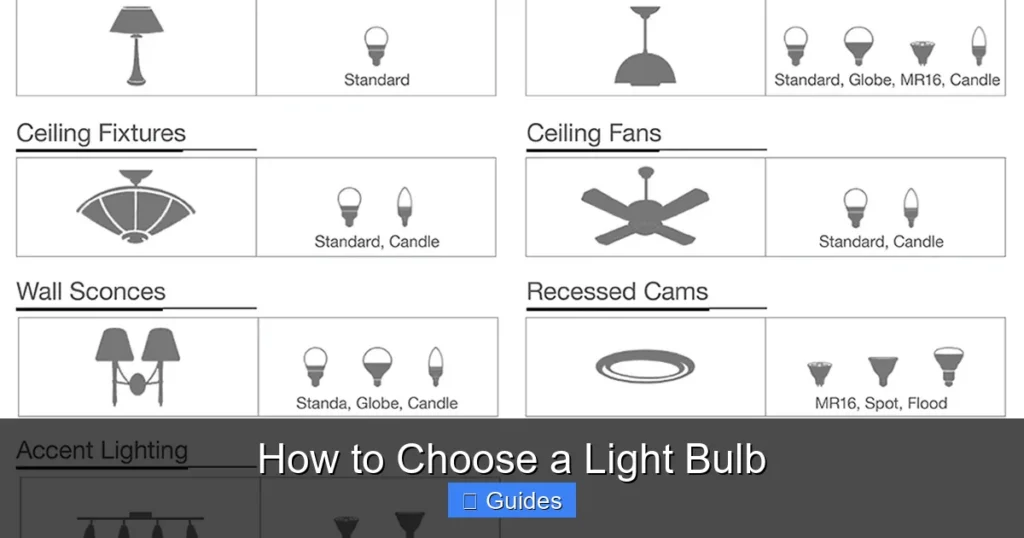
Light bulbs come in various shapes (e.g., A19, candelabra, floodlight, globe) and base types (e.g., E26 standard screw-in, GU10 twist-and-lock, MR16 pin base). Always match the bulb shape to the aesthetic of your fixture and, crucially, ensure the base type matches your lamp or fixture socket. The packaging will clearly state the shape and base type. This is a practical, often overlooked, aspect of how to choose a light bulb.
Beam Angle (Spotlight vs. Floodlight)
For recessed lighting or track lighting, beam angle is important.
- Narrow Beam (Spotlight): Creates a focused cone of light, ideal for highlighting artwork or specific areas.
- Wide Beam (Floodlight): Spreads light over a broader area, great for general room illumination.
Check the packaging for beam angle specifications, usually measured in degrees.
CRI (Color Rendering Index)
CRI measures how accurately a light source reveals the true colors of objects compared to natural light. A CRI of 100 is perfect, like natural sunlight.
- CRI 80+: Good for most general home applications.
- CRI 90+: Excellent for areas where color accuracy is crucial, such as kitchens, bathrooms (for makeup application), art studios, or display areas.
If color perception is important to you, pay attention to the CRI rating when deciding how to choose a light bulb.
Practical Tips for Choosing Your Bulb
Now that you’re armed with knowledge, let’s put it into practice. Here are some actionable tips for how to choose a light bulb.
1. Start with the Fixture
Before you even think about lumens or Kelvin, look at the lamp or fixture itself.
- What kind of base does it require (e.g., standard screw-in, candelabra, pin base)?
- Is there a maximum wattage (or more accurately, a maximum *equivalent* wattage for LEDs) or bulb size limit? Some enclosed fixtures trap heat, which can shorten an LED’s lifespan, so check for “suitable for enclosed fixtures” if needed.
- What shape of bulb looks best or fits within the shade?
2. Consider the Room’s Purpose and Activities
Revisit the questions:
- What activities happen in this room? (Reading, relaxing, cooking, working, entertaining?)
- What mood do you want to create? (Cozy, bright, productive, sophisticated?)
- Are there specific areas that need focused task lighting?
This will guide your lumen and Kelvin choices for how to choose a light bulb.
3. Don’t Forget Aesthetics
The visible parts of a bulb, especially in open fixtures or decorative lamps, contribute to the overall look. Edison-style LED bulbs with visible filaments offer a vintage charm, while frosted bulbs provide diffused light. The physical appearance is part of how to choose a light bulb that matches your decor.
4. Read the Label
Modern light bulb packaging is much more informative than it used to be. Look for the “Lighting Facts” label, which clearly lists:
- Lumens (brightness)
- Estimated annual energy cost
- Lifespan in years
- Color Temperature (Kelvin)
- Equivalent wattage (e.g., “replaces 60W incandescent”)
This label is your best friend when you are learning how to choose a light bulb.
5. Buy a Few to Test
Lighting can be very personal. If you’re unsure, buy one or two different bulbs with varying color temperatures or lumen outputs and try them out in your home. See how they feel at different times of the day. It’s much easier to return a couple of bulbs than to live with lighting you don’t love.
Choosing the right light bulb has become a nuanced decision, but it’s one that significantly impacts your daily life and home environment. By focusing on lumens for brightness, Kelvin for color temperature, and prioritizing energy-efficient LEDs, you’re well on your way to mastering the art of illumination. Remember to consider special features like dimmability and smart capabilities, and always ensure the bulb’s physical characteristics match your fixture. With this guide, you now have the confidence and knowledge to tackle the lighting aisle head-on and truly understand how to choose a light bulb that brightens your world in all the right ways. Happy lighting!
🎥 Related Video: How to Choose a Lightbulb | Lowe's How-to
📺 Lowe’s Home Improvement
There are so many lightbulbs to choose from, so how do you know which one will work for you? Join DIY expert Caroline as she …
Frequently Asked Questions
How do I replace a 60-watt incandescent bulb with an LED?
When replacing a 60-watt incandescent, you’ll want an LED bulb that offers a similar lumen output, which is typically around 800 lumens. The LED bulb will likely consume only 8-12 watts, but its packaging will state “replaces 60W incandescent” for easy comparison.
Can I use a regular LED bulb in a dimmer switch?
No, not all LED bulbs are compatible with dimmer switches. You must choose LED bulbs specifically labeled as “dimmable” and ensure your dimmer switch is compatible with LED technology to avoid flickering or performance issues.
What is the ideal light color temperature for a bedroom?
For a bedroom, a warm white color temperature between 2700K and 3000K is generally ideal. This range promotes relaxation and creates a cozy, inviting atmosphere suitable for unwinding and sleep.
Do LED bulbs get hot?
While LEDs are much more energy-efficient and convert less energy into heat than incandescents, they do produce some heat. However, this heat is managed through a heat sink at the base of the bulb, keeping the light-emitting components cool and prolonging the bulb’s lifespan.
How long do LED bulbs typically last?
LED bulbs have an exceptionally long lifespan, typically ranging from 15,000 to 50,000 hours or even more. This translates to many years of use, significantly reducing the frequency of bulb replacements compared to older lighting technologies.
What does it mean if a light bulb is “smart”?
A “smart” light bulb is one that can be controlled wirelessly via a smartphone app, voice commands (through devices like Amazon Alexa or Google Assistant), or a smart home hub. They often offer advanced features such as dimming, color changing, scheduling, and remote access.
