


As an Amazon Associate, We earn from qualifying purchases.
The common belief that Thomas Edison solely invented the light bulb is a myth. In reality, the incandescent light bulb was the culmination of decades of research and improvements by numerous scientists and inventors worldwide. Edison’s genius lay in creating a practical, long-lasting, and commercially viable version, building upon the foundational work of many predecessors like Humphry Davy, Joseph Swan, and Lewis Latimer, making light accessible to the masses.
Who Actually Invented the Light Bulb?
When you think about the light bulb, a single name often springs to mind: Thomas Edison. He’s the iconic figure, the prolific inventor, the wizard of Menlo Park. His name is practically synonymous with the invention of practical electric light, and for good reason – his contributions were undeniably monumental. But here’s a little secret: the story of who actually invented the light bulb is far more complex, fascinating, and collaborative than the simple narrative we often hear.
Imagine a world plunged into darkness every evening, lit only by flickering gas lamps, dangerous candles, or dim oil lanterns. The dream of clean, safe, and readily available electric light captivated inventors for much of the 19th century. Many brilliant minds, working across different continents, chipped away at this immense challenge, each adding a crucial piece to the puzzle. Edison’s achievement was not inventing electric light from scratch, but rather perfecting it, making it accessible, and building an entire system around it that changed the world forever.
So, if it wasn’t just Edison, then who were these other unsung heroes? What did they contribute? And why did Edison’s name become the one etched into history? Let’s peel back the layers of this incredible invention story and discover the true journey of the light bulb, from fleeting sparks to widespread illumination.
Key Takeaways
- No Single Inventor: The light bulb was not invented by one person but was the result of a long evolutionary process involving many scientists and engineers over decades.
- Early Precursors: Sir Humphry Davy demonstrated the electric arc lamp in 1802, marking one of the earliest forms of electric light, long before the incandescent bulb.
- Joseph Swan’s Contributions: British physicist Joseph Swan developed a functional incandescent light bulb with a carbonized paper filament and better vacuum techniques in the 1860s and 70s, predating Edison’s commercial success.
- Thomas Edison’s Breakthrough: Edison and his team’s major contribution was creating a *practical* and *commercially viable* incandescent light bulb in 1879, notably with a long-lasting carbonized bamboo filament and an effective vacuum.
- Focus on System and Commercialization: Edison’s genius extended beyond the bulb itself; he also developed the entire electrical utility system – generators, wiring, and distribution – necessary to make electric light widespread.
- Collective Innovation: Many other inventors, like Lewis Latimer (improving carbon filaments) and Hiram Maxim (competing designs), also made significant advancements, highlighting the collaborative nature of invention.
- Evolution, Not Revelation: The light bulb’s story is a prime example of how major technological advancements often involve incremental improvements and collective effort rather than a singular “aha!” moment.
Quick Answers to Common Questions
Who is commonly credited with inventing the light bulb?
Thomas Edison is commonly credited with inventing the practical, commercially viable incandescent light bulb.
Did Thomas Edison invent electric light from scratch?
No, Edison did not invent electric light from scratch. He significantly improved upon existing concepts and made the light bulb practical and long-lasting, building an entire system around it.
Who was Joseph Swan?
Joseph Swan was a British physicist who developed a functional incandescent light bulb with a carbonized paper filament and improved vacuum techniques prior to Edison’s widely recognized success.
What was Lewis Latimer’s contribution to the light bulb?
Lewis Latimer significantly improved the manufacturing process for carbon filaments, making them more durable and efficient, which was crucial for the light bulb’s commercial viability.
Why is Edison so famous for the light bulb if others worked on it?
Edison’s fame stems from his successful creation of a practical, long-lasting, and affordable bulb, combined with his development of the entire electrical generation and distribution system needed to make electric light widely accessible.
📑 Table of Contents
- The Dawn of Electric Light: Before Incandescence
- Joseph Swan: The British Pioneer of Practical Light
- Thomas Edison: The Architect of Modern Illumination
- Other Key Players and Their Vital Contributions
- The Legal Battles and Legacy: Why Edison Reigns Supreme
- The Light Bulb: An Evolution, Not a Single Invention
The Dawn of Electric Light: Before Incandescence
Long before anyone even dreamed of a light bulb as we know it today, the very concept of electric light was being explored. The journey began with much simpler, though often less practical, forms of illumination. Understanding these early steps is key to appreciating the later breakthroughs.
Sir Humphry Davy and the Arc Lamp (1802)
The earliest significant demonstration of electric light came in 1802 from the brilliant British chemist Sir Humphry Davy. Using a powerful electric battery, Davy connected wires to charcoal electrodes and produced a brilliant, albeit short-lived, arc of light. He famously called it the “electric arc lamp.” While incredibly bright, these arc lamps were far too intense and quickly burned out, making them unsuitable for home use. They found utility in public spaces, lighthouses, and large industrial settings, but they were a far cry from the gentle glow needed for a living room. Davy’s work, however, proved that electricity could indeed produce light, sparking interest among scientists worldwide.
The Quest for Incandescence: Early Filaments
The goal quickly became to create light by incandescence – heating a material until it glows – rather than through an electric arc. This required a filament material that could withstand high temperatures without burning up quickly and a way to protect it from oxygen. Many tried, often failing spectacularly.
In 1840, British scientist Warren de la Rue created an early incandescent light bulb using a coiled platinum filament in a vacuum tube. Platinum was a great choice because it has a high melting point, but it was incredibly expensive. This made his bulb impractical for widespread use. Other inventors like Joseph Wilson Swan and Heinrich Goebel were also experimenting with various materials, including carbonized paper and bamboo filaments, attempting to make them last longer. These early efforts often struggled with inadequate vacuum technology and inconsistent filament materials, leading to bulbs that would only glow for a few minutes or hours.
Joseph Swan: The British Pioneer of Practical Light
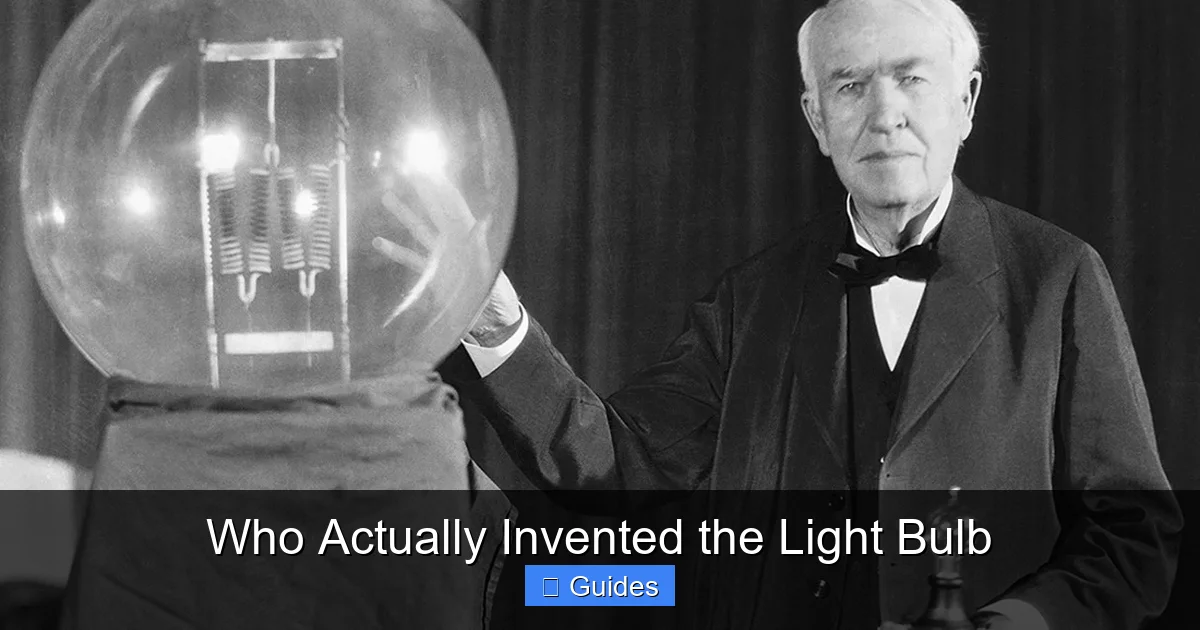
Visual guide about Who Actually Invented the Light Bulb
Image source: allthatsinteresting.com
While many were experimenting, one name stands out as making substantial and very early progress towards a practical incandescent bulb: Joseph Swan. A British physicist and chemist, Swan dedicated decades to solving the light bulb puzzle.
Swan’s Early Attempts and Challenges
Swan began experimenting with incandescent light as early as 1848. His initial attempts, like others, faced significant hurdles. His carbonized paper filaments would quickly burn out due to residual oxygen inside the glass bulb. Creating a good vacuum was a major technological challenge at the time. Without a near-perfect vacuum, the oxygen inside the bulb would rapidly combine with the hot filament, causing it to disintegrate.
Breakthroughs in the 1860s and 1870s
By the 1860s, improvements in vacuum pump technology, particularly the Sprengel mercury pump, allowed Swan to create much better vacuums in his bulbs. In 1860, he patented a method of preparing carbonized paper filaments. However, it wasn’t until the late 1870s that he made his most significant strides. By 1878, Swan publicly demonstrated a long-lasting light bulb using a thin, high-resistance carbon filament made from carbonized cotton thread, enclosed in an evacuated glass bulb. His bulbs were quite effective and durable for the time. He even lit homes and public buildings in England with his bulbs before Edison’s major breakthrough.
Swan’s work was pioneering. He had a functional, albeit expensive and somewhat fragile, incandescent light bulb that could burn for hundreds of hours. His patents and demonstrations clearly establish him as a critical figure in the invention of the practical light bulb, predating Edison’s famous announcement.
Thomas Edison: The Architect of Modern Illumination
Now, let’s talk about Thomas Edison. If others had working light bulbs, what was so special about Edison’s contribution that earned him such widespread fame? The answer lies in his systematic approach, his relentless pursuit of perfection, and his vision to not just invent a bulb, but to create an *entire system* for electric light.
The Menlo Park Method: Systematic Innovation
Edison didn’t work alone. He famously ran an “invention factory” in Menlo Park, New Jersey, where he employed a team of skilled scientists, machinists, and engineers. This collaborative environment allowed for rapid experimentation and problem-solving. When Edison decided to tackle the light bulb in 1878, he approached it with an unmatched rigor. He understood that a successful light bulb needed to be:
- Long-lasting: Not just a few hours, but hundreds or even thousands.
- Economical to manufacture: Affordable for the masses.
- Operate at high resistance: This was crucial for efficient power distribution. Lower resistance filaments would require thicker, more expensive copper wires.
- Reliable: Consistent performance for everyday use.
The Quest for the Perfect Filament (1879)
Edison and his team embarked on an exhaustive search for the ideal filament material. They tested thousands of different substances: platinum, various metals, paper, wood, fibers, and even human hair! This methodical trial-and-error approach, often involving late nights and countless failures, eventually led them to a breakthrough.
In October 1879, after extensive testing, they found success with a carbonized cotton thread filament, which burned for over 13 hours. While this was a great step, it wasn’t quite long-lasting enough. The real breakthrough came shortly after, when they experimented with a carbonized bamboo fiber filament. This bamboo filament, carefully prepared and sealed in a near-perfect vacuum, burned for an astonishing 1,200 hours! This was a game-changer. It was durable, relatively inexpensive, and offered a practical solution for general lighting.
Beyond the Bulb: The System Builder
Edison’s genius wasn’t limited to the bulb itself. He realized that a light bulb, no matter how good, was useless without an infrastructure to power it. He and his team designed and implemented the entire electrical utility system:
- Generators: To produce electricity.
- Wiring and Conduits: To distribute electricity safely.
- Meters: To measure electricity consumption for billing.
- Sockets and Switches: For practical use in homes.
This holistic approach is what truly set Edison apart. His company, the Edison Electric Light Company (later General Electric), not only provided the bulbs but also the means to power them, transforming how communities operated. The opening of his Pearl Street power station in New York City in 1882 marked the beginning of modern electrical utility. This comprehensive system is why Edison is so widely credited with bringing electric light to the world.
Other Key Players and Their Vital Contributions
The story of the light bulb is a tapestry woven by many hands. While Swan and Edison are central figures, many others played crucial roles, often overshadowed but no less significant.
Lewis Howard Latimer: The Unsung Hero of Filaments
Born into slavery, Lewis Latimer became a brilliant draftsman and inventor who worked with both Hiram Maxim and Thomas Edison. Latimer’s contributions were invaluable. In 1881, while working for Maxim, he patented a method for manufacturing carbon filaments that were more durable and efficient than earlier designs. This patent was critical for the widespread adoption of incandescent light. Later, at Edison Electric Light Company, Latimer’s expertise in electric lighting and patent drafting was indispensable. He co-authored “Incandescent Electric Lighting: A Practical Description of the Edison System” (1890), a foundational textbook for the burgeoning electrical industry. Latimer’s work improved the very heart of the light bulb, making it more practical and affordable.
Hiram Maxim and the Competitive Landscape
Hiram Maxim, an American inventor best known for inventing the Maxim machine gun, was also a prominent figure in early electric lighting. He developed and patented his own version of the incandescent light bulb, often competing directly with Edison and Swan. Maxim’s bulbs used different filament materials and methods, contributing to the diversity of early electric lighting technology. The competition between inventors like Maxim and Edison spurred innovation, pushing everyone to make better, more efficient products.
William Sawyer and Albon Man: Early American Innovators
In the United States, William Sawyer and Albon Man also developed an incandescent light bulb with a carbon filament in the late 1870s, around the same time as Edison and Swan. They received a U.S. patent for their invention in 1878. Their work, alongside others, demonstrated the widespread interest and parallel development in electric lighting across different research groups. This period was characterized by intense research, competition, and frequent patent disputes as inventors raced to secure their claims.
The Legal Battles and Legacy: Why Edison Reigns Supreme
With so many individuals working on similar inventions, it was inevitable that patent disputes would arise. The late 19th century saw numerous legal battles over who truly invented the light bulb and who held the rights to commercialize it.
The Patent Wars
Both Joseph Swan and Thomas Edison held patents for their incandescent light bulbs in their respective countries (Swan in the UK, Edison in the US). This led to legal clashes. In the UK, Edison’s company actually merged with Swan’s in 1883 to form the Edison & Swan United Electric Light Company, commonly known as “Ediswan,” acknowledging Swan’s earlier and significant work in that market. In the US, fierce competition and patent litigation were common, but Edison’s comprehensive system and robust legal team often gave him an advantage.
The Power of Commercialization and Public Perception
Edison’s ultimate success in public memory can be attributed to several factors:
- A superior, long-lasting product: The carbonized bamboo filament was a major step forward in durability.
- A complete system: He didn’t just invent the bulb; he invented the *infrastructure* to support it, making electric light accessible on a large scale.
- Marketing and Public Relations: Edison was a master showman, adept at garnering public attention for his inventions. His large-scale public demonstrations of electric light were electrifying (pun intended!) and captured the public imagination.
- American Entrepreneurial Spirit: In the context of American history, Edison became a symbol of ingenuity and industrial progress.
While Swan and others were true pioneers, Edison’s ability to turn a scientific curiosity into a widespread, practical utility cemented his legacy as the person who brought electric light to the world. He made it work for everyone, everywhere.
The Light Bulb: An Evolution, Not a Single Invention
The story of who actually invented the light bulb is a powerful reminder that groundbreaking innovations are rarely the product of a single genius working in isolation. Instead, they are typically the culmination of continuous research, incremental improvements, and the collaborative efforts of many brilliant minds, often competing but collectively pushing the boundaries of what’s possible.
From Sir Humphry Davy’s arc lamp to Joseph Swan’s carbon filament bulbs, and finally to Thomas Edison’s practical, long-lasting, and systematically integrated lighting system, the light bulb evolved over decades. Each inventor built upon the knowledge and failures of their predecessors, adding their own unique insights and solving specific problems. Lewis Latimer, Hiram Maxim, and countless others played crucial supporting roles, refining materials, improving manufacturing processes, and contributing to the overall advancement of electric lighting.
So, the next time you flip a switch and your room fills with light, remember that you’re witnessing the legacy of not just one inventor, but a grand symphony of human ingenuity. It’s a testament to how collective effort and persistent dedication can truly illuminate the world.
🎥 Related Video: The Real Inventor of The Light Bulb!
📺 The Curious Collective
Subscribe Here! ➡️- https://www.youtube.com/channel/UCm1_7L_1spH950PNk0DqX8Q?sub_confirmation=1 Thomas Edison …
Frequently Asked Questions
Was the first electric light an incandescent bulb?
No, the very first demonstrations of electric light, such as Sir Humphry Davy’s arc lamp in 1802, were based on creating a bright arc between two electrodes. These arc lamps were very powerful but not suitable for everyday home lighting, unlike the later incandescent bulbs.
What challenges did early light bulb inventors face?
Early inventors faced numerous challenges, including finding a filament material that could glow brightly without quickly burning out, creating a high-quality vacuum inside the bulb to prevent filament oxidation, and developing efficient and cost-effective ways to generate and distribute electricity.
How long did Edison’s famous bamboo filament light bulb last?
Edison’s breakthrough carbonized bamboo filament light bulb, introduced around 1879-1880, was able to burn for an impressive 1,200 hours. This significantly longer lifespan was crucial for its commercial success and practicality compared to earlier designs.
Were there any patent disputes over the light bulb?
Yes, there were significant patent disputes, particularly between Thomas Edison and Joseph Swan. Both inventors held patents in their respective countries, leading to legal battles that sometimes resulted in mergers, such as the formation of the Edison & Swan United Electric Light Company in the UK.
Why is it important to know that many people contributed to the light bulb?
Understanding the collaborative history of the light bulb highlights that major inventions are often an evolutionary process, built on the work of many individuals over time. It promotes a more nuanced view of innovation, recognizing the collective human effort behind technological progress rather than solely crediting one person.
What impact did the light bulb have on society?
The widespread adoption of the practical light bulb revolutionized society by extending working and social hours beyond daylight, improving safety by replacing fire-prone gas and oil lamps, and enabling the development of modern urban centers and industrial practices. It fundamentally changed how people lived, worked, and interacted.
