


As an Amazon Associate, We earn from qualifying purchases.
Navigating the world of light bulbs can be tricky, especially when it comes to matching the base to your fixture. The standard light bulb base in North America is typically the E26 Edison screw, while much of Europe uses the E27. However, many other types exist, from smaller candelabra bases (E12) to bipin bases (GU10, G9) and bayonet styles, each designed for specific applications like spotlights, decorative fixtures, or specialty lighting. Understanding these common bases ensures you always pick the correct bulb for brightness and fit.
Stepping into the lighting aisle of any home improvement store can feel a bit like entering a foreign country. You see a dazzling array of light bulbs, all promising different brightness levels, color temperatures, and energy efficiencies. But then you look closer, and the real confusion begins: why do some have screw threads, others have two pins, and some just push in? And what on earth is an E26?
This often-overlooked detail – the light bulb base – is perhaps the most critical factor in ensuring you buy the right bulb for your lamp or fixture. It’s the essential connection point that delivers power to the bulb and secures it in place. Without the correct base, even the most perfect bulb for brightness or style simply won’t work. Let’s demystify the world of light bulb bases and uncover what truly constitutes a “standard” light bulb base.
Understanding the Basics: What is a Light Bulb Base?
At its heart, a light bulb base is the part of the bulb that connects to the electrical socket of your lighting fixture. Think of it as the plug for your light bulb. Its primary functions are twofold: to provide a secure physical connection, keeping the bulb firmly in place, and to establish an electrical connection, allowing power to flow from your home’s wiring to the bulb’s filament or LED array.
The design of a light bulb base isn’t arbitrary. Different types have evolved over time to suit various applications, safety standards, and regional electrical systems. From the earliest days of incandescent lighting to today’s advanced LEDs, the base has remained a crucial, unchanging component that dictates compatibility. Understanding these different types is key to making informed decisions when replacing bulbs, whether you’re tackling a simple lamp or a complex recessed lighting system.
The Edison Screw Base: The “Standard” Everyone Knows
When most people think about a “standard light bulb base,” they’re almost certainly picturing an Edison screw base. Named after the legendary inventor Thomas Edison, who patented one of the earliest practical incandescent light bulbs, these bases are characterized by their threaded design that screws directly into a matching socket. They are by far the most widespread type globally, but even within this category, there are crucial variations.
E26 vs. E27: Are They Interchangeable?
The two most common Edison screw bases are the E26 and the E27.
The “E” in both designations stands for “Edison Screw.” The number that follows indicates the diameter of the base in millimeters. So, an E26 base has a diameter of 26mm, and an E27 has a diameter of 27mm. That’s a tiny difference, right?
* E26: This is the official standard light bulb base in North America (the United States and Canada). It’s also used in parts of South America, Central America, and Japan. When you buy a regular household light bulb in these regions, it will almost certainly have an E26 base.
* E27: This is the official standard light bulb base in most of Europe, Australia, and many other countries around the world.
Now, for the million-dollar question: can you use an E26 bulb in an E27 socket, or vice versa? Generally, yes, with a caveat. The difference in diameter (1mm) is so slight that E26 bulbs will typically screw into E27 sockets, and E27 bulbs will fit into E26 sockets. The threading is similar enough.
However, the primary distinction isn’t just the physical size but the electrical standards they adhere to. E26 is designed for 120V electrical systems, while E27 is for 220-240V systems.
If you’re using an E26 bulb in an E27 socket, or vice versa, in the correct voltage system for the bulb, you’re usually fine. For instance, using an E27 bulb rated for 240V in a 240V E26 socket (common in places like Australia where E26 fixtures might exist) is generally safe, assuming the bulb’s voltage rating matches the supply. The critical takeaway here is to always ensure the bulb’s *voltage* matches your region’s voltage supply, regardless of the subtle base difference. Many modern LED bulbs are “multi-voltage” (e.g., 100-240V), making interchangeability even less of a concern.
Other Edison Screw Sizes (E12, E17, E39/E40)
Beyond the main standard light bulb base types, Edison screws come in several other sizes for more specialized applications:
* E12 (Candelabra Base): This diminutive base has a 12mm diameter and is commonly found on smaller decorative bulbs, often shaped like candles, used in chandeliers, nightlights, and some small accent lamps. If you have a multi-arm chandelier, chances are it uses E12 bulbs.
* E17 (Intermediate Base): With a 17mm diameter, this base sits between the candelabra and the standard sizes. It’s less common than E12 or E26/E27 but can be found in certain appliances, track lighting, and older decorative fixtures.
* E39 (Mogul Base) / E40 (Goliath Base): These are much larger bases, with diameters of 39mm and 40mm respectively. They are designed for very high-wattage bulbs used in industrial settings, streetlights, or large commercial fixtures where a greater amount of light is needed. E39 is the North American mogul standard, while E40 is the European Goliath standard. Like E26/E27, they are often physically interchangeable but voltage-specific.
Beyond Edison: Other Common Light Bulb Base Types
While Edison screw bases hold the crown for the “standard light bulb base” in many homes, a vast world of other base types exists, each serving particular functions and fixture designs. Let’s explore some of these important alternatives.
Bipin Bases (GU, G)
Bipin bases are characterized by two pins that either push into a socket or twist and lock. The “G” in their designation stands for “glass,” reflecting their original construction, and the number indicates the distance between the centers of the two pins in millimeters. The “U” in GU types signifies that the base has a locking mechanism, often requiring a twist to secure it.
* GU10: This is a popular bipin twist-and-lock base, frequently used for halogen and LED spot or floodlights (often found in MR16 or PAR16 bulb shapes). The pins have small “feet” that twist into place, providing a secure connection. You’ll often see these in track lighting, recessed lighting, and display lighting.
* G4: A very small bipin base with pins spaced 4mm apart. G4 bulbs are typically low-voltage (12V or 24V) and are used in small decorative lamps, under-cabinet lighting, RVs, and some landscape lighting applications.
* G9: Similar in application to G4 but with a larger pin spacing of 9mm. G9 bulbs are usually mains voltage (120V or 240V) and are commonly found in more compact decorative fixtures, crystal chandeliers, and some wall sconces where space is at a premium.
* GX5.3 (MR16): This base also has two pins, but the “X” indicates a specific type of pin (usually slightly thicker than a “G” series). The 5.3 refers to the 5.3mm spacing between pins. GX5.3 is almost exclusively associated with MR16 reflector bulbs, which are often low-voltage (12V) and used in track lighting, recessed lighting, and landscape lighting where a focused beam is desired.
Bayonet Bases (B)
Bayonet bases are another very common type, especially outside North America. Instead of screwing in, these bulbs push into the socket and then twist slightly to lock into place using side pins that engage with slots in the socket. The “B” stands for “bayonet,” and the number refers to the diameter of the base.
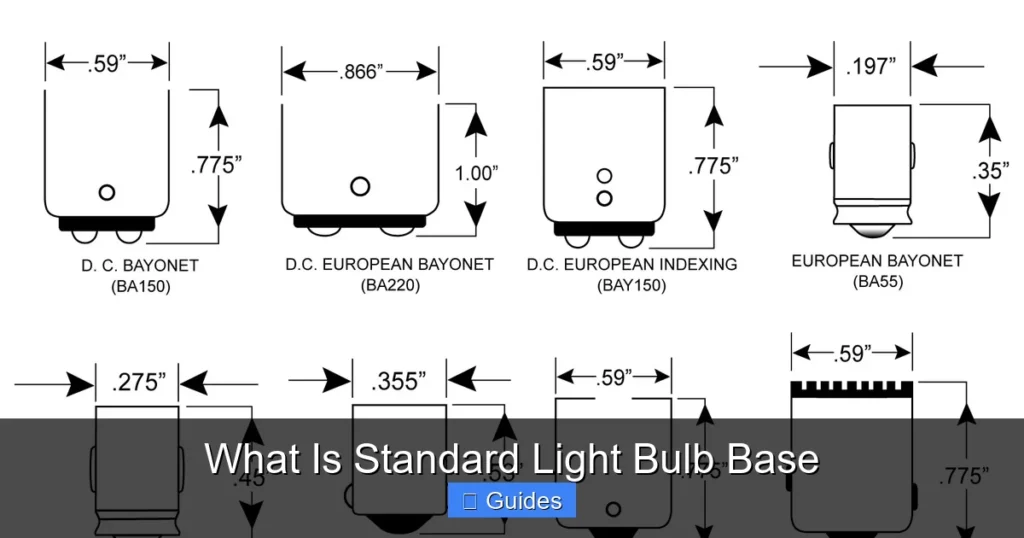
* B22d (Double Contact Bayonet): This is the primary standard light bulb base in the United Kingdom, Australia, India, and other Commonwealth countries. It has a 22mm diameter base with two contact points at the bottom and two locking pins on the sides.
* BA15d (Single Contact Bayonet): This base has a 15mm diameter and is often found in older appliances, automotive lights, and some specialty marine or industrial applications. Variations exist with single or double contacts at the base.
Bayonet bases offer a quick and secure way to install bulbs, especially in situations where vibration might be a concern.
Wedge Bases (Wedge)
Wedge bases are characterized by their glass or plastic bases that simply push into a socket. They have no threads or pins in the traditional sense; instead, the wire leads extend directly from the bulb into the socket, forming a “wedge” connection.
* T5, T10, T20 (and others): These are commonly found in automotive lighting (dashboard lights, side markers), some landscape lighting, and small decorative or accent lights. The “T” refers to the tubular shape, and the number usually indicates the base width in eighths of an inch (though this can vary). They are designed for easy, tool-free insertion and removal.
Fluorescent Tube Bases (G13, G5)
Fluorescent tubes, whether traditional or LED replacements, also have specific base types. These are always bipin, designed to fit into sockets at both ends of the tube.
* G13: This is the most common base for T8 (1-inch diameter) and T12 (1.5-inch diameter) fluorescent tubes. The pins are spaced 13mm apart. You’ll find these in office buildings, garages, and utility rooms.
* G5: Used for smaller T5 (0.625-inch diameter) fluorescent tubes, with pins spaced 5mm apart. T5 tubes are known for their efficiency and smaller profile, often used in task lighting, under-cabinet lighting, and display cases.
Why So Many Bases? Understanding the Purpose and Evolution
At first glance, the sheer number of light bulb base types might seem excessive, even confusing. But each design decision was made for specific reasons, often rooted in history, safety, electrical standards, and practical application.
1. **Historical Evolution:** Early lighting systems were largely proprietary. As electricity became standardized, so did bulb bases, but different regions adopted different “standard light bulb base” designs based on their electrical grids and manufacturing capabilities. Thomas Edison’s screw base gained traction in North America, while the bayonet base became popular in the UK.
2. **Voltage Differences:** As discussed with E26 and E27, base types often correspond to regional voltage standards (120V vs. 220-240V). While physical interchangeability might exist, the underlying electrical compatibility is paramount for safety and bulb longevity.
3. **Application-Specific Needs:**
* Security and Fit: Screw bases (Edison) provide a secure, threaded connection ideal for general household use. Bayonet bases offer a robust twist-and-lock mechanism, useful in environments with vibration or where a quick bulb change is needed. Bipin bases (GU10, G9) are excellent for small, focused lights like spotlights where compact design is key.
* Size and Aesthetics: Small bases like E12 (candelabra) and G4/G9 allow for miniature bulbs that fit into decorative fixtures, chandeliers, or appliances where a large bulb would be unsightly or impossible to fit.
* Heat Dissipation: Larger bases, like the E39/E40 Mogul bases, are needed for high-wattage bulbs that generate significant heat, ensuring a larger contact surface for stability and heat management.
* Safety: Certain bases are designed to prevent the insertion of a bulb that might be unsafe for a particular fixture (e.g., preventing a high-wattage bulb in a low-wattage fixture).
The development of LED technology has somewhat blurred these lines. Many LED bulbs are now designed to fit existing incandescent sockets, meaning you can often find an LED with an E26 or B22d base. However, specialty LED fixtures or integrated LED systems might use proprietary connectors that aren’t interchangeable with standard bulbs.
Choosing the Right Light Bulb Base: Practical Tips and Common Mistakes
Navigating the world of light bulb bases doesn’t have to be a headache. With a few simple tips, you can confidently choose the correct bulb every time.
Always Check the Fixture or Old Bulb First
This is the golden rule. The easiest and most reliable way to determine the correct light bulb base is to look at the bulb you are replacing or the fixture itself.
* Old Bulb: Unscrew or remove the old bulb. Look at the base. Is it threaded? Does it have two pins? Are there markings like “E26,” “GU10,” or “B22d” printed on it? Often, the base type and even wattage are clearly indicated.
* Fixture: If you don’t have an old bulb, inspect the socket within the fixture. Does it have threads for screwing in? Are there two small holes for pins? What does the opening look like? Sometimes, the fixture itself will have a sticker indicating the required bulb type and maximum wattage.
Take a picture of the old bulb’s base or the fixture’s socket with your phone if you’re unsure, and bring it to the store.
Matching Voltage and Wattage (or LED Equivalent)
Once you know the base type, don’t forget these crucial electrical considerations:
* Voltage: Ensure the new bulb’s voltage rating matches your region’s electrical supply (e.g., 120V in North America, 220-240V in Europe). Most modern LED bulbs are multi-voltage, simplifying this, but always double-check.
* Wattage: Never exceed the maximum wattage rating printed on your fixture. Overloading a fixture can cause overheating, fire, and damage. For LED bulbs, which consume far less power, look at the “equivalent wattage” (e.g., an 8W LED bulb might be equivalent to a 60W incandescent) and ensure the LED’s *actual* wattage is below the fixture’s maximum.
Adapters: When to Use, When Not To
You might encounter adapters that allow you to convert one base type to another (e.g., an E12 candelabra socket to an E26 standard light bulb base socket).
* When to use: Adapters can be useful in a pinch if you have a specific bulb and only one fixture it might fit, or for specialty applications where a particular light effect is needed.
* When to be cautious: Adapters add length to the bulb, which might cause it to protrude unpleasantly or even prevent it from fitting under a lampshade or inside an enclosed fixture. They also introduce another point of connection, which can theoretically increase resistance or potential points of failure. Most importantly, never use an adapter to put a bulb with a higher *actual* wattage than the fixture is rated for. For instance, putting a 100W incandescent bulb into a fixture rated for 60W, even with an adapter, is unsafe. Stick to matching bases whenever possible for safety and aesthetics.
LED Conversions
Many people are converting old fixtures to use modern, energy-efficient LED bulbs. The good news is that most common LED bulbs are designed with standard bases (like E26, E12, GU10, B22d) to directly replace their incandescent or halogen counterparts. This means you can often upgrade your lighting without needing to change your fixtures. Just ensure the LED bulb’s physical size (shape, length) fits within the fixture, especially if it’s enclosed.
Conclusion
The seemingly small detail of a light bulb base is anything but insignificant. It’s the critical link between your lighting fixture and the illumination it provides, dictating compatibility, safety, and function. While the Edison screw base, particularly the E26, reigns as the “standard light bulb base” in many parts of the world, understanding the diversity of other bases – from bipin to bayonet – empowers you to make confident lighting choices for every corner of your home.
So, the next time you need a new bulb, take a moment to peek at the old one or the fixture. Identify that base type, match the voltage, consider the wattage, and you’ll illuminate your space perfectly, avoiding frustration and ensuring a safe, bright outcome. Knowing your bases makes you a true lighting pro!
Key Takeaways
- Edison Screw Bases are Dominant: The E26 is the most common “standard light bulb base” in North America, while E27 is prevalent in Europe and other regions. These are largely interchangeable in terms of fit for voltage differences.
- Size Matters (and the Number Tells You): The “E” stands for Edison, and the number (e.g., E26) indicates the base’s diameter in millimeters. Smaller E12 (candelabra) and E17 (intermediate) bases are also common.
- Beyond Edison: Many other base types exist for specific purposes, including bipin bases (GU10, G9, G4, GX5.3) for spotlights and small lamps, and bayonet bases (B22d) common in the UK and some older fixtures.
- Always Check Your Fixture: Before buying a new bulb, always inspect the existing bulb or the fixture itself to determine the required base type and size. This is the most reliable way to avoid mistakes.
- Voltage and Wattage are Crucial: Beyond the base type, ensure the new bulb’s voltage matches your electrical supply and that its wattage (or LED equivalent wattage) does not exceed the fixture’s maximum rating.
- Adapters Exist, But Use Caution: While adapters can convert one base type to another (e.g., E12 to E26), they add length and can sometimes pose fit or electrical compatibility issues. Use them sparingly and with care.
Quick Answers to Common Questions
What is the most common standard light bulb base in North America?
The most common standard light bulb base in North America (USA and Canada) is the E26, which is an Edison screw base with a 26mm diameter.
Can I use an E26 bulb in an E27 socket?
Generally, yes, E26 bulbs will physically fit into E27 sockets, and vice versa, due to their very similar diameters. However, always ensure the bulb’s voltage rating matches your electrical supply.
What does “GU” mean in a light bulb base, like GU10?
In a light bulb base like GU10, “G” typically stands for glass, referring to the original construction, and “U” indicates that the base has a locking mechanism, requiring a slight twist to secure it.
Are there different sizes for bayonet light bulb bases?
Yes, bayonet bases come in different sizes, such as B22d (22mm diameter, common in the UK) and BA15d (15mm diameter, often for specialty applications or automotive use).
What should I do if my new bulb’s base doesn’t match my fixture?
If your new bulb’s base doesn’t match your fixture, the best practice is to return the bulb and get one with the correct base. While adapters exist, they can add length, potentially cause fit issues, and are generally not recommended for long-term use, especially if they make the bulb exceed the fixture’s safe wattage limits.
Frequently Asked Questions
What do the numbers in light bulb bases like E26 or G9 mean?
The numbers in light bulb bases usually indicate the diameter of the screw base in millimeters (e.g., E26 is 26mm) or the distance between the centers of the pins in millimeters for bipin bases (e.g., G9 has 9mm between pin centers). This numbering system provides a precise measurement for compatibility.
Is there a universal light bulb base?
No, there isn’t a single universal light bulb base. While the E26 (in North America) and E27 (in Europe) are widely considered “standard” for general household use in their respective regions, many other specialized base types exist for different applications, voltages, and fixture designs.
Can I use an LED bulb in a fixture designed for incandescent bulbs?
Yes, in most cases, you can use an LED bulb in a fixture designed for incandescent bulbs, provided the LED bulb has the correct base type (like E26 or B22d) and fits physically. Always check that the LED’s actual wattage does not exceed the fixture’s maximum wattage rating, although this is rarely an issue due to LEDs’ low power consumption.
What are the common light bulb bases for spotlights or track lighting?
For spotlights and track lighting, common light bulb bases include GU10 (a twist-and-lock bipin base) and GX5.3 (a bipin base often found on MR16 bulbs). These bases are designed to provide a secure connection for directional lighting applications.
How do I know the correct base type if the old bulb is missing or broken?
If the old bulb is missing or broken, carefully inspect the light fixture’s socket. Look for threads for screw-in bases, pinholes for bipin bases, or any labels or markings on the socket itself that might indicate the required base type and maximum wattage. A picture can often help you identify it at the store.
Are E26 and E27 bulbs safe to interchange?
Physically, E26 and E27 bulbs are largely interchangeable due to their very similar diameters. However, the critical safety factor is ensuring the bulb’s voltage rating matches your region’s electrical supply. Modern multi-voltage LED bulbs often make this less of a concern, but always verify voltage compatibility.
