


As an Amazon Associate, We earn from qualifying purchases.
The A19 light bulb is the most common bulb shape used in homes across North America, recognized by its classic pear-like or arbitrary (A) shape and 19/8ths of an inch diameter. Originally incandescent, modern A19 light bulbs are predominantly energy-efficient LEDs, offering a wide range of brightness, color temperatures, and smart features for everyday lighting needs. Understanding the A19 helps you select the perfect bulb for any fixture.
What Is an A19 Light Bulb?
Have you ever walked into a store, stared at the overwhelming array of light bulbs, and just picked the one that “looked right”? For most of us, that “right” bulb is likely an A19. It’s the quintessential light bulb shape, the one you probably picture in your mind when someone says “light bulb.” But what does “A19” actually mean, and why is this particular bulb so ubiquitous in our homes?
Understanding the humble A19 light bulb is more than just knowing a technical term; it’s about making informed choices for your home’s lighting. From saving energy to setting the perfect ambiance, the A19 plays a crucial role. This guide will demystify the A19, exploring its meaning, history, features, and how to pick the best one for every corner of your living space. Get ready to illuminate your knowledge about this everyday essential!
Let’s dive in and shine a light on everything you need to know about the versatile and ever-present A19 light bulb. You’ll soon see why this particular bulb remains a go-to choice for homeowners and designers alike, offering a blend of tradition, efficiency, and modern capabilities.
Key Takeaways
- Universal Standard: The A19 light bulb is the most prevalent light bulb shape for residential use in North America, fitting standard E26 screw-in sockets.
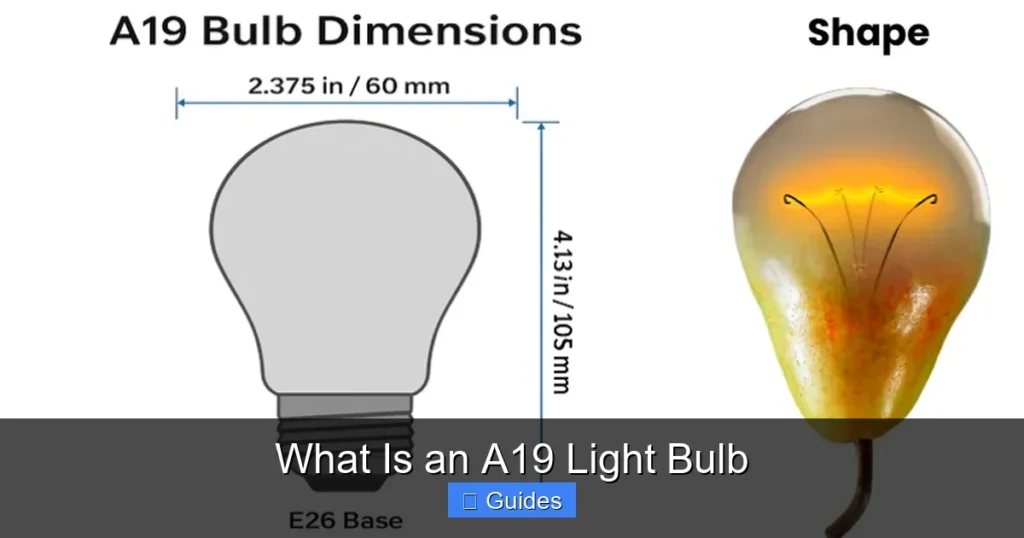
- Shape and Size Defined: “A” denotes its arbitrary, classic pear-like shape, while “19” indicates its maximum diameter is 19 eighths of an inch (approximately 2.375 inches or 60mm).
- Evolution to LED: While historically incandescent, the vast majority of A19 light bulbs sold today are energy-efficient LEDs, offering significant energy savings and longer lifespans.
- Key Specifications: Beyond shape, consider lumens (brightness), Kelvin (color temperature), CRI (color rendering index), and dimmability when choosing an A19 light bulb.
- Versatile Application: A19 bulbs are incredibly versatile, used in everything from table lamps and ceiling fixtures to pendant lights, making them ideal for general-purpose lighting.
- Smart Home Integration: Many modern A19 light bulbs offer smart features, allowing for control via apps, voice assistants, and integration into home automation systems.
Quick Answers to Common Questions
What is the “A” in A19?
The “A” in A19 refers to the classic, arbitrary or pear-like shape of the light bulb, which is the most common and traditional bulb silhouette.
What does the “19” in A19 signify?
The “19” in A19 indicates the maximum diameter of the bulb at its widest point, measured in eighths of an inch. So, 19/8ths of an inch, or 2.375 inches.
What type of base does an A19 light bulb typically have?
In North America, an A19 light bulb almost universally has an E26 medium screw base, which is the standard size for most household fixtures.
Are all A19 light bulbs energy-efficient?
While historically A19s were incandescent, today the vast majority of new A19 light bulbs are highly energy-efficient LEDs. Always check the packaging for LED technology if efficiency is your goal.
Can an A19 light bulb fit in any lamp?
An A19 light bulb with an E26 base will fit any standard E26 socket. However, its physical size (2.375 inches diameter) might be too large for very small or decorative fixtures, so always check the fixture’s clearance.
📑 Table of Contents
- 1. What Exactly Does “A19” Mean? The Shape and Size Story
- 2. A Brief History: From Incandescent to LED
- 3. Understanding the Anatomy of an A19 Light Bulb (Beyond Shape)
- 4. Why Choose an A19 Light Bulb? Common Applications and Benefits
- 5. Tips for Choosing the Right A19 Light Bulb for Your Needs
- 6. A19 Light Bulb vs. Other Bulb Types (Brief Comparisons)
1. What Exactly Does “A19” Mean? The Shape and Size Story
The name “A19” might sound technical, but it’s actually a straightforward code that tells you two crucial things about the light bulb: its shape and its size. Understanding this code is the first step to becoming a savvy light bulb shopper.
The “A” for Arbitrary
The “A” in A19 stands for “Arbitrary.” This doesn’t mean random; rather, it refers to the traditional, classic pear-like shape that has been common for light bulbs since their invention. Think of it as the default, iconic bulb silhouette. This smooth, rounded design allows for a broad distribution of light, making it ideal for general ambient lighting in a wide range of fixtures. When you visualize a typical light bulb, you’re almost certainly thinking of an A-shaped bulb.
The “19” for Diameter
The “19” in A19 refers to the maximum diameter of the bulb at its widest point. This number isn’t in inches or centimeters directly; instead, it represents the diameter in eighths of an inch. So, “19” means 19/8ths of an inch.
Let’s do the math:
19 ÷ 8 = 2.375 inches.
In metric, this is approximately 60 millimeters.
So, an A19 light bulb is an “arbitrary” shaped bulb with a maximum diameter of about 2.375 inches. This standardized sizing ensures that an A19 bulb will fit comfortably into the vast majority of standard light fixtures designed for household use, making it incredibly versatile.
Why Shape and Size Matter
The shape and size of an A19 light bulb are important for several practical reasons:
- Fit: The standardized A19 size ensures it fits into most lamps, ceiling fixtures, and recessed cans without sticking out awkwardly or being too small.
- Light Distribution: The “A” shape is excellent for omnidirectional light, meaning it spreads light evenly in all directions. This is perfect for general room illumination.
- Aesthetics: The classic shape is unobtrusive and visually pleasing in open fixtures or when exposed.
Knowing these details helps you confidently select the right A19 light bulb for your needs, ensuring it looks good and performs well in its intended fixture.
2. A Brief History: From Incandescent to LED
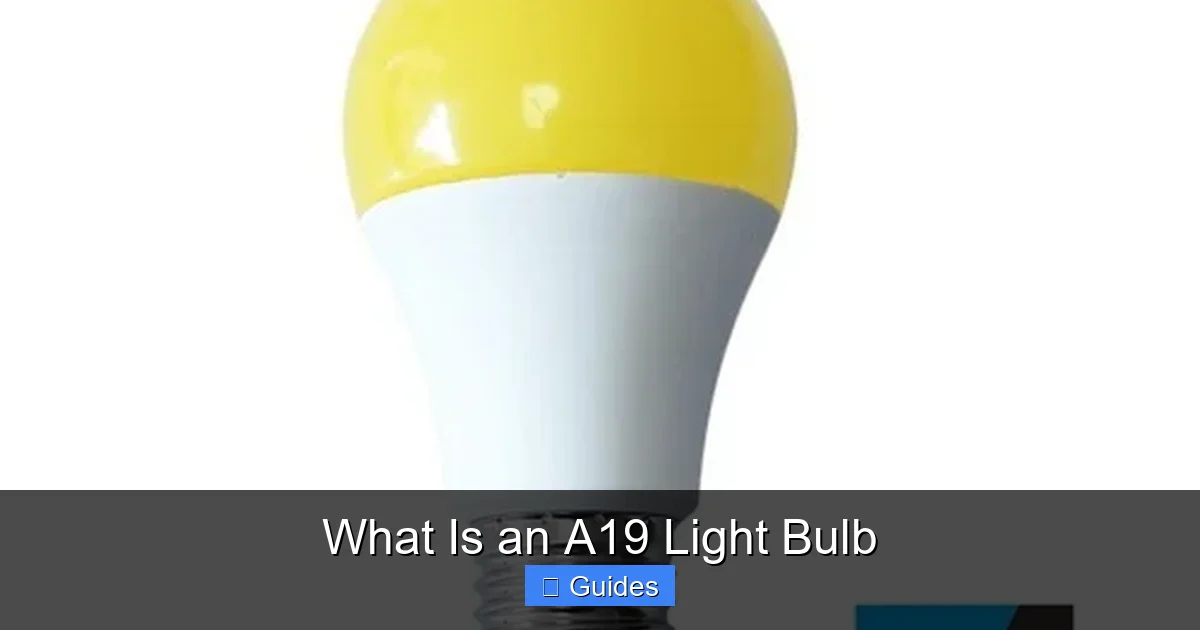
Visual guide about What Is an A19 Light Bulb
Image source: ueeshop.ly200-cdn.com
The A19 light bulb has quite a history, mirroring the evolution of lighting technology itself. While the shape has remained remarkably consistent, the technology inside has transformed dramatically.
The Incandescent Era
For over a century, the A19 light bulb was synonymous with the incandescent bulb. These bulbs created light by heating a tungsten filament until it glowed. They were affordable to manufacture and provided a warm, familiar glow. However, incandescent A19 light bulbs were notoriously inefficient, converting only about 10% of their energy into visible light, with the rest lost as heat. Their lifespans were also relatively short, typically around 750-1,000 hours. Despite these drawbacks, they were the standard for generations, shaping our perception of what a light bulb should look like and how it should illuminate a space.
The Rise of CFLs (and their decline)
In the late 20th and early 21st centuries, Compact Fluorescent Lamps (CFLs) emerged as an energy-efficient alternative. Many CFLs were designed in a spiral shape, but some were enclosed in an A19-shaped glass shell to mimic the traditional bulb. CFL A19 light bulbs used much less energy than incandescents and lasted significantly longer. However, they had their own set of challenges: they often took time to warm up to full brightness, contained small amounts of mercury, and didn’t always dim smoothly. These factors, combined with the rapid advancements in LED technology, eventually led to their decline in popularity.
LEDs: The Modern A19 Light Bulb
Today, the vast majority of new A19 light bulbs you’ll find on store shelves are Light Emitting Diodes (LEDs). LED A19 light bulbs represent a revolution in lighting. They are incredibly energy-efficient, using up to 90% less energy than incandescents to produce the same amount of light. Their lifespans are astonishingly long, often 15,000 to 25,000 hours or more, meaning they can last for years or even decades.
Modern LED A19 light bulbs offer:
- Instant Brightness: No warm-up time; they reach full brightness immediately.
- Durability: No delicate filaments, making them more resistant to shocks and vibrations.
- Variety: Available in a huge range of brightness levels, color temperatures, and dimming capabilities.
- Smart Features: Many LED A19s integrate smart technology, allowing for control via apps, voice commands, and home automation systems.
This transition to LED technology has made the A19 light bulb more versatile, sustainable, and cost-effective than ever before.
3. Understanding the Anatomy of an A19 Light Bulb (Beyond Shape)
While the “A19” specifies the shape and size, there’s much more to an A19 light bulb than just its external appearance. To truly choose the best bulb, you need to understand some key specifications and features.
The Base (E26: The Standard Socket)
For A19 light bulbs in North America, the base is almost universally an E26. The “E” stands for Edison screw, named after Thomas Edison. The “26” indicates the diameter of the screw base in millimeters. This is the standard medium screw base found in nearly all household lamps, ceiling fixtures, and light sockets. When you buy an A19 light bulb, you can be confident it will screw right into your standard fixtures.
Lumens vs. Watts: Brightness Explained
Forget watts when thinking about brightness for modern A19 light bulbs. Watts measure energy consumption, not light output. Lumens (lm) are the true measure of a bulb’s brightness.
- Watts (W): How much electricity the bulb consumes. An LED A19 might use 8-10 watts to produce the same brightness as an old 60-watt incandescent.
- Lumens (lm): How much visible light the bulb produces. For a common 60-watt equivalent A19 light bulb, you’re looking for around 800 lumens.
Always check the lumen rating to know how bright an A19 light bulb will actually be.
Color Temperature (Kelvin Scale)
Color temperature, measured in Kelvins (K), describes the perceived warmth or coolness of the light.
- Warm White (2700K – 3000K): Similar to traditional incandescent A19 light bulbs, this light has a yellowish hue, creating a cozy, inviting atmosphere. Ideal for living rooms, bedrooms, and dining areas.
- Cool White / Bright White (3500K – 4100K): A more neutral, less yellow light that feels brighter and more energetic. Good for kitchens, bathrooms, and offices where task lighting is needed.
- Daylight (5000K – 6500K): Mimics natural daylight with a bluish-white appearance. Excellent for reading nooks, workshops, or areas where true color representation is important.
Choosing the right color temperature for your A19 light bulb can significantly impact the mood and functionality of a room.
CRI: Seeing True Colors
The Color Rendering Index (CRI) measures how accurately a light source reveals the true colors of objects compared to natural sunlight. CRI is rated on a scale from 0 to 100.
- CRI 80+: Generally good for most residential applications.
- CRI 90+: Excellent for areas where accurate color representation is crucial, like art studios, kitchens, or bathrooms where you want to see true makeup colors.
Higher CRI A19 light bulbs make colors look richer and more vibrant.
Dimmability: A Key Feature
Not all LED A19 light bulbs are dimmable. If you plan to use a dimmer switch, always look for “dimmable” explicitly stated on the packaging. Using a non-dimmable LED with a dimmer switch can lead to flickering, buzzing, or even damage to the bulb. Also, ensure your dimmer switch is compatible with LED technology, as older incandescent-only dimmers might not work properly.
Smart Features: The Future of the A19 Light Bulb
Many modern LED A19 light bulbs now come with smart capabilities. These can connect to your home Wi-Fi or Bluetooth, allowing you to:
- Control them via a smartphone app.
- Use voice commands with assistants like Alexa or Google Assistant.
- Schedule on/off times.
- Change brightness and color temperature (tunable white) or even full RGB colors.
- Integrate with other smart home devices for scenes and automation.
Smart A19 light bulbs offer unparalleled convenience and customization for your lighting.
4. Why Choose an A19 Light Bulb? Common Applications and Benefits
The A19 light bulb has endured as the standard for good reason. Its combination of design, efficiency, and versatility makes it an excellent choice for a wide array of lighting needs.
Versatility in Home Lighting
The most compelling reason to choose an A19 light bulb is its incredible adaptability. Its standard shape and E26 base mean it fits almost anywhere.
- Table and Floor Lamps: The classic choice for ambient and task lighting in living rooms and bedrooms.
- Ceiling Fixtures: Perfect for overhead lighting in hallways, kitchens, and utility rooms, especially in semi-flush and flush-mount fixtures.
- Pendant Lights: Many decorative pendants are designed to showcase the clean lines of an A19 light bulb.
- Sconces: Provides good wall-washing light without being overly directional.
- Recessed Lighting: While reflector bulbs (BR or PAR) are common, many standard recessed cans can accommodate A19 light bulbs, especially for general illumination.
This widespread compatibility means you often only need to stock one type of replacement bulb for most of your home.
Energy Efficiency with LED A19s
Switching to LED A19 light bulbs offers significant energy savings. They use a fraction of the electricity compared to old incandescent bulbs, which translates directly into lower utility bills. An 8-watt LED A19 can provide the same light output as a 60-watt incandescent, reducing energy consumption by over 85%. Over time, these savings really add up, making LED A19 light bulbs a smart financial choice.
Aesthetic Appeal and Design
The classic “A” shape is timeless and unobtrusive. In fixtures where the bulb is visible, an A19 light bulb provides a clean, familiar look that complements most interior designs, from traditional to modern minimalist. Many decorative or clear glass LED A19s are designed to mimic the appearance of vintage incandescent filaments, offering a stylish touch with modern efficiency.
Cost-Effectiveness
While the initial cost of an LED A19 light bulb might be slightly higher than an old incandescent, its long lifespan and energy efficiency lead to substantial savings over its lifetime. You’ll buy fewer replacement bulbs and pay less for electricity, making the overall cost of ownership much lower. It’s an investment that pays for itself many times over.
5. Tips for Choosing the Right A19 Light Bulb for Your Needs
With so many options, picking the right A19 light bulb can still feel daunting. Here are some practical tips to guide your choice:
Match the Socket (Always E26 for A19s in North America)
This is the easiest step. If you’re buying an A19 light bulb, it will have an E26 medium screw base, which is standard for most household fixtures in North America. No need to worry about compatibility here.
Determine Desired Brightness (Lumens)
Think about the function of the room.
- Ambient/General Lighting: For a living room or bedroom, 800-1100 lumens (equivalent to a 60-75W incandescent) is a good starting point per fixture, adjusting based on room size and number of fixtures.
- Task Lighting: For reading lamps or kitchen island pendants, you might want brighter bulbs, perhaps 1100-1600 lumens (75-100W equivalent).
- Accent Lighting: For subtle glow, 450 lumens (40W equivalent) or less might suffice.
Always look for lumens, not watts, when assessing brightness for your A19 light bulb.
Select the Right Color Temperature
Consider the mood and activity:
- Cozy & Relaxing: Stick to 2700K-3000K (Warm White) for bedrooms, living rooms, and dining areas.
- Energetic & Functional: Opt for 3500K-4100K (Cool White) for kitchens, bathrooms, home offices, or utility rooms.
- Vibrant & Detailed: Choose 5000K-6500K (Daylight) for workshops, laundries, or anywhere you need high visibility and accurate color perception.
You can even mix and match in different fixtures within the same room to create zones.
Consider Dimmability
If your fixture is connected to a dimmer switch, *always* choose an A19 light bulb explicitly labeled as “dimmable.” Also, ensure your dimmer is LED-compatible to avoid performance issues.
Look for Energy Star Certification
Energy Star certified A19 light bulbs meet strict energy efficiency and quality guidelines set by the U.S. Environmental Protection Agency. This certification ensures you’re getting a high-quality, long-lasting, and energy-saving product.
Smart Features: Are They for You?
If you love technology and convenience, a smart A19 light bulb could be a fantastic upgrade. They offer unparalleled control and customization. However, if you prefer simplicity, a standard dimmable LED A19 light bulb will serve you perfectly well without the extra cost or setup.
6. A19 Light Bulb vs. Other Bulb Types (Brief Comparisons)
While the A19 light bulb is king for general-purpose lighting, you’ll encounter other bulb types. Here’s a quick look at how the A19 compares to some common alternatives.
A19 vs. A21
The A21 light bulb has the same “Arbitrary” shape as the A19 but is larger in diameter (21/8ths of an inch, or 2.625 inches). A21 bulbs are often chosen when higher lumen output (brighter light, like 100W or 150W incandescent equivalents) is needed, and the fixture can accommodate the slightly larger size. If an A19 doesn’t provide enough light, an A21 might be the answer, provided it fits.
A19 vs. BR30/BR40 (Reflector Bulbs)
BR (Bulged Reflector) bulbs, like BR30 or BR40, are designed to focus light forward. They have a wider, mushroom-like shape with an internal reflective coating that directs light into a beam. These are commonly used in recessed lighting fixtures (canned lights) to provide more directional downlighting. An A19 light bulb, in contrast, provides omnidirectional light and typically wouldn’t be used for focused illumination.
A19 vs. G25 (Globe Bulbs)
G25 (Globe) bulbs are spherical and often have a more decorative appearance. They’re measured by their diameter in eighths of an inch, similar to A-type bulbs (25/8ths of an inch, or 3.125 inches for a G25). G25 bulbs are frequently seen in vanity lights in bathrooms or exposed pendant fixtures where their round shape is part of the aesthetic. While an A19 light bulb might fit in these fixtures, the G25 offers a distinct visual style.
A19 vs. C7/C9 (Candelabra/Christmas Lights)
C-type bulbs, like C7 or C9, are candelabra-shaped or cone-shaped bulbs, often with smaller E12 (candelabra) bases. They are typically used for decorative purposes, such as night lights, chandeliers, or outdoor string lights (like Christmas lights). They are much smaller and less bright than an A19 light bulb, serving entirely different functional and aesthetic purposes.
***
The A19 light bulb is far more than just a simple light source; it’s a testament to timeless design combined with cutting-edge technology. From its humble incandescent beginnings to its current status as an energy-efficient LED powerhouse, the A19 has continuously adapted to meet our lighting needs.
By understanding what “A19” truly means and knowing the key factors like lumens, color temperature, and dimmability, you’re now equipped to make smart choices for your home. This knowledge will not only help you save energy and money but also empower you to craft the perfect ambiance in every room. So, next time you’re shopping for light bulbs, you won’t just pick “the right one”; you’ll pick the *best* A19 light bulb for your unique space and style. Shine on!
Frequently Asked Questions
What is the average lifespan of an LED A19 light bulb?
LED A19 light bulbs have a significantly longer lifespan compared to older technologies. Most LED A19 bulbs are rated to last between 15,000 to 25,000 hours, which can translate to 15-25 years with typical household use (3 hours/day).
Can I replace an old incandescent A19 with an LED A19?
Yes, absolutely! An LED A19 light bulb is designed as a direct replacement for an incandescent A19. It will fit the same E26 socket and often provide the same or greater brightness while using much less energy.
How do I choose the right brightness for an A19 light bulb?
To choose the right brightness, look at the lumen (lm) rating, not watts. For general room lighting, around 800 lumens (equivalent to a 60W incandescent) is a common choice, but adjust higher or lower based on room size and desired light level.
What color temperature is best for an A19 light bulb in a bedroom?
For a bedroom, a warmer color temperature is generally preferred to create a relaxing atmosphere. Look for LED A19 light bulbs in the 2700K to 3000K range, often labeled as “Warm White” or “Soft White.”
Are smart A19 light bulbs worth the extra cost?
Smart A19 light bulbs offer great convenience and customization, allowing you to control brightness, color, and scheduling via apps or voice commands. Whether they’re “worth it” depends on your desire for these features and integration into a smart home system, as they do come at a higher initial price point.
What does “dimmable” mean for an A19 light bulb?
A “dimmable” A19 light bulb means it’s specifically designed to work with dimmer switches, allowing you to adjust its light output smoothly. Using a non-dimmable LED A19 with a dimmer can lead to flickering, buzzing, or damage, so always check the packaging if you plan to dim your lights.
