


As an Amazon Associate, We earn from qualifying purchases.
The history of the light bulb is a tale far richer than just one inventor. It spans millennia, evolving from basic fire and candles to gaslight, then through a series of groundbreaking electrical innovations. This journey involved countless scientists and inventors perfecting the incandescent bulb, and later, developing vastly more efficient technologies like fluorescent, halogen, and LED lighting, fundamentally changing human civilization.
Imagine a world without readily available light after the sun goes down. A world where work stops at dusk, where evenings are spent in semi-darkness illuminated only by flickering flames, and where navigating streets at night is a dangerous endeavor. It’s hard to picture, isn’t it? We flip a switch, and instantly, a room is bathed in light. This everyday miracle is so ingrained in our lives that we rarely pause to think about the incredible journey of innovation that brought it to us.
The story of artificial illumination, specifically the history of the light bulb, is a testament to human ingenuity and persistence. It’s not just about one brilliant inventor having a single “aha!” moment. Instead, it’s a sprawling saga spanning centuries, involving countless minds, failed experiments, incremental improvements, and revolutionary breakthroughs. From the earliest campfires to the glowing filament of an incandescent bulb and the vibrant glow of modern LEDs, humanity’s quest for light has driven progress in ways we often take for granted.
So, let’s turn back the clock and explore this fascinating narrative. We’ll uncover the origins of our ability to conquer the night, tracing the evolution of lighting from ancient times right up to the cutting-edge technologies that light our homes and cities today. Understanding the history of the light bulb gives us a deeper appreciation for the comfort, safety, and productivity that modern lighting provides.
Key Takeaways
- Ancient Illumination: For thousands of years, humans relied on fire, torches, candles, and oil lamps for light, with gas lighting becoming prominent just before electricity.
- Early Electrical Attempts: The concept of electric light dates back to the early 19th century with Humphry Davy’s arc lamp, demonstrating the potential but lacking practicality for home use due to its intensity and short lifespan.
- The Incandescent Breakthrough: While Thomas Edison is widely credited, many inventors contributed to the incandescent light bulb. Edison’s genius lay in perfecting a long-lasting, practical, and affordable bulb (with a carbonized filament) and, critically, building an entire electrical distribution system to power it.
- Continuous Improvement: After Edison, innovations continued, with the introduction of tungsten filaments (much more efficient and durable than carbon) and gas-filled bulbs by inventors like William Coolidge and Irving Langmuir, significantly improving incandescent technology.
- Beyond Incandescence: The 20th century saw the rise of entirely new lighting technologies, including fluorescent lamps (more efficient and cooler) and halogen bulbs (brighter and more compact), diversifying options for various applications.
- The LED Revolution: The late 20th and early 21st centuries ushered in the era of Light Emitting Diodes (LEDs), representing the most significant leap in efficiency, longevity, and versatility, gradually replacing older technologies and continuing to evolve rapidly.
- Transformative Impact: The history of the light bulb isn’t just about technology; it’s about how artificial light transformed society, extending work hours, enabling new industries, improving safety, and fundamentally reshaping human interaction with the night.
Quick Answers to Common Questions
Who invented the first electric light bulb?
While Thomas Edison is widely credited with inventing the first practical, long-lasting incandescent light bulb, Humphry Davy created the first electric arc lamp in 1802, and many other inventors like Joseph Swan made significant progress on incandescent lighting before Edison.
What was the filament material Edison first used for his successful bulb?
Thomas Edison’s significant breakthrough for a long-lasting bulb came with a carbonized cotton thread filament, which he later refined to a carbonized bamboo filament.
Why were tungsten filaments an improvement over carbon?
Tungsten has a much higher melting point than carbon, allowing it to glow brighter and last significantly longer. It also allowed for greater efficiency in converting electrical energy into light.
When did fluorescent lighting become widely available?
Practical fluorescent lamps were developed by General Electric and began to become widely available in the late 1930s, offering a more energy-efficient alternative to incandescent bulbs.
What makes LED lighting so revolutionary compared to older technologies?
LEDs are revolutionary due to their exceptional energy efficiency, extremely long lifespan, durability (no filament to break), and compact, versatile design, consuming much less power while lasting much longer.
📑 Table of Contents
The Dawn of Artificial Light: Pre-Electric Era
For most of human history, darkness was a formidable adversary. Our ancestors relied on very basic forms of artificial light, evolving slowly over millennia.
From Fire to Candles and Gas Lamps
The very first light source was, of course, fire. Campfires and torches provided warmth, protection, and a rudimentary way to see in the dark. As societies developed, so did lighting technology. Oil lamps, typically bowls filled with animal fat or oil with a wick, emerged thousands of years ago in various cultures. These were improvements but still produced dim, smoky light and posed fire hazards.
Later, candles became popular. Made from beeswax or tallow, they offered a more controlled flame but still burned out relatively quickly and had limited light output. Imagine trying to read a book by candlelight – it was a challenging task!
The 19th century brought a significant leap forward with gas lighting. Invented by William Murdoch in the late 18th century, gas lamps began to illuminate streets and eventually homes. Coal gas was piped directly to fixtures, providing a brighter, steadier light than candles or oil lamps. Cities like London and Baltimore were among the first to adopt gas street lighting, transforming urban nightlife. However, gas lighting had its drawbacks: it required a complex infrastructure of pipes, was prone to leaks and explosions, and still produced heat and soot. It was clear that a cleaner, safer, and more efficient light source was desperately needed. This urgent need set the stage for the electric revolution.
Early Scientific Stirrings
Even as gaslight flickered, scientists were already playing with electricity. In the late 17th and 18th centuries, figures like Otto von Guericke and Alessandro Volta were making discoveries about static electricity and batteries. These early experiments laid the theoretical groundwork, showing that electricity could be generated and stored, sparking the imagination of future inventors about its potential for illumination. The idea that electricity could produce light was beginning to take shape, promising a future far beyond the limitations of burning fuels.
The Spark of Electricity: Early Inventors and Discoveries
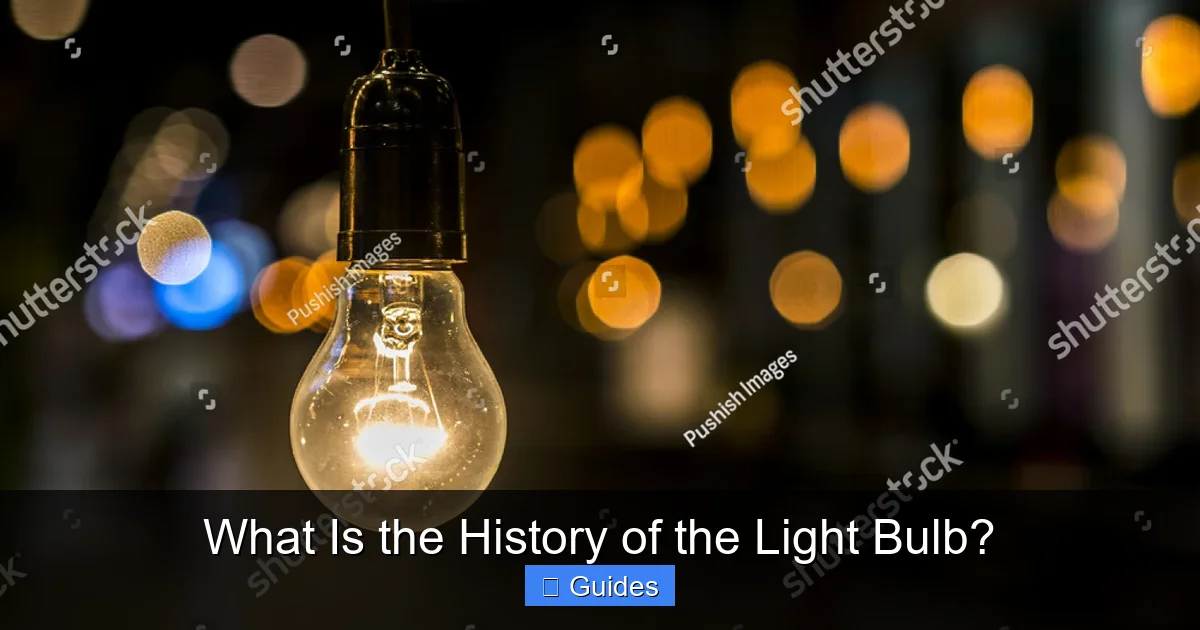
Visual guide about What Is the History of the Light Bulb?
Image source: image.shutterstock.com
The road to the modern light bulb wasn’t a straight line. It was paved with numerous experiments, partial successes, and the relentless pursuit of a practical solution. The true history of the light bulb is a collaborative effort.
Humphry Davy’s Arc Lamp
One of the earliest and most dramatic demonstrations of electric light came from the British chemist Humphry Davy. In 1802, using a powerful electric battery, Davy connected two charcoal rods to the battery terminals and brought them close together. The current arced across the gap, creating an intensely bright, dazzling light – the world’s first electric arc lamp.
While spectacular, Davy’s arc lamp was far from practical for everyday use. It was too bright for indoor settings, produced considerable heat and noise, consumed electrodes rapidly, and required a massive battery. Still, it proved a crucial point: electricity could produce light. For the next few decades, scientists and inventors around the world continued to experiment with arc lamps, primarily for public lighting applications like lighthouses and streetlights, but a solution for home illumination remained elusive. The quest for a safer, gentler, and longer-lasting electric light continued.
The Quest for a Practical Incandescent Light
The challenge was clear: how to create light from electricity without the intense heat and rapid consumption of the arc lamp. The answer lay in incandescence – making a material so hot that it glows. Many brilliant minds tried their hand at this.
In 1840, British scientist Warren de la Rue enclosed a coiled platinum filament in a vacuum tube and passed an electric current through it. Platinum had a high melting point, making it suitable, but it was too expensive and didn’t last long enough to be commercially viable.
Around 1848, another Briton, William Staite, developed a lamp using a platinum-iridium filament, but it also suffered from high cost and short lifespan. Joseph Swan, also from Britain, began experimenting with carbonized paper filaments in a vacuum in the 1860s and achieved some success, demonstrating a working light bulb in 1860. However, the vacuum technology of the time wasn’t good enough to prevent the filament from quickly burning out. These early pioneers were laying the groundwork, each experiment bringing the world a step closer to the ultimate goal of a practical light bulb.
Edison and the Practical Incandescent Bulb
When we think of the history of the light bulb, one name invariably comes to mind: Thomas Edison. While he didn’t “invent” the light bulb from scratch, his contribution was undeniably monumental.
More Than One Inventor
It’s important to understand that by the late 1870s, many inventors across the globe were working on incandescent light. Besides Joseph Swan, others like Henry Woodward and Mathew Evans (Canadian inventors who patented a vacuum electric lamp in 1874) and St. George Lane Fox Pitt (another British inventor) were making significant progress. The concept was in the air, but no one had yet created a truly practical, commercially viable light bulb.
Edison’s Breakthrough: The Carbonized Filament
Edison and his team at Menlo Park, New Jersey, began their intensive research into incandescent lighting in 1878. What set Edison apart was his systematic approach. He wasn’t just looking for a glow; he was looking for a long-lasting, affordable bulb that could be manufactured and sold to the masses. He famously tested thousands of materials for filaments, from plant fibers to human hair.
His major breakthrough came in October 1879, when he successfully tested a carbonized cotton thread filament inside a vacuum bulb. This bulb glowed for an astonishing 13.5 hours. He later refined this to a carbonized bamboo filament, which could last over 1,200 hours. This was it – a practical, durable, and relatively inexpensive light bulb that could realistically illuminate homes and businesses. The light bulb was no longer just a scientific curiosity; it was a consumer product waiting to happen. The invention was a triumph in the history of the light bulb, making electric lighting accessible.
The System Builder
Edison’s genius wasn’t limited to the bulb itself. He understood that a bulb was useless without a system to power it. He didn’t just invent a light bulb; he invented the entire infrastructure needed to bring electric light to the world. This included:
- Efficient dynamos (generators) to produce electricity.
- A practical distribution system of wires and cables.
- Safety fuses and meters.
- Sockets, switches, and other fixtures.
In 1882, Edison opened the Pearl Street Station in New York City, the world’s first central power plant, bringing reliable electricity and incandescent light to a small but growing number of customers. This holistic approach – inventing the product and the means to deliver it – is what truly cemented Edison’s place in the history of the light bulb.
Refining the Incandescent: Beyond Edison
While Edison’s bulb was revolutionary, it was just the beginning. The incandescent light bulb continued to evolve significantly in the decades that followed, becoming more efficient and durable.
Tungsten Filaments and Gas Filling
Carbon filaments, while a huge step up from platinum, still had limitations. They evaporated over time, darkening the inside of the bulb and eventually breaking. Scientists continued the search for a better filament material.
The answer came in the form of tungsten. William David Coolidge, working for General Electric, developed a ductile tungsten filament in 1904 (patented in 1906). Tungsten has an incredibly high melting point (the highest of all metals), allowing it to glow much brighter and last much longer than carbon. By 1910, tungsten filaments became the standard for incandescent light bulbs. This was a critical upgrade in the history of the light bulb.
Another major improvement came from Irving Langmuir, also at General Electric. In 1913, he discovered that filling the bulb with an inert gas, like argon or nitrogen, instead of a vacuum, dramatically reduced the rate at which the tungsten filament evaporated. This further extended the bulb’s lifespan and allowed it to be operated at higher temperatures, producing more light. These innovations made the incandescent bulb even more practical and efficient, solidifying its dominance for much of the 20th century.
Coiled Coils and Improved Efficiency
Further refinements included “coiled coil” filaments, where the tungsten wire itself was coiled, and then that coil was coiled again. This reduced heat loss due to convection and further concentrated the filament’s heat, leading to even greater light output for the same amount of electricity. These continuous improvements made the incandescent light bulb a highly effective and ubiquitous source of illumination for nearly a century. Practical examples of this improvement meant homes could be brighter with fewer bulbs, or the same number of bulbs could use less energy.
A New Era: Beyond Incandescence
While incandescent bulbs were incredibly successful, they had a fundamental inefficiency: most of the energy put into them was converted into heat, not light. This spurred the development of entirely new lighting technologies.
Fluorescent Lighting: Efficiency Takes Center Stage
The next major leap in the history of the light bulb came with fluorescent lighting. The basic principle of fluorescence – using electricity to excite a gas to emit ultraviolet light, which then strikes a phosphorescent coating to produce visible light – had been explored since the late 19th century. Early pioneers like Peter Cooper Hewitt made vacuum-tube mercury vapor lamps in the early 1900s.
However, it was General Electric’s development of practical fluorescent lamps in the late 1930s that truly brought them into widespread use. These long, tubular bulbs quickly became popular in commercial buildings, schools, and industrial settings because they were much more energy-efficient and produced less heat than incandescent bulbs. They also had a much longer lifespan. While they initially had issues with color rendering and flickering, ongoing improvements made them a staple for decades, offering a significantly cheaper way to light large spaces.
Halogen Lamps: Brighter and Smaller
In the 1950s, a new type of incandescent bulb emerged: the halogen lamp. Developed by General Electric, halogen bulbs use a tungsten filament and are filled with a small amount of halogen gas (like iodine or bromine). This gas creates a chemical reaction (the “halogen cycle”) that redeposits evaporated tungsten back onto the filament, extending its life and keeping the bulb clearer.
Halogen lamps produce a brighter, whiter light than traditional incandescents and can be made much smaller. They found popular applications in car headlights, floodlights, and task lighting. While still based on incandescence and therefore less efficient than fluorescent lights, they offered significant advantages in specific uses and represented another important chapter in the history of the light bulb.
LEDs: The Future of Light
The most revolutionary change in lighting technology since Edison’s bulb began to emerge in the late 20th century: the Light Emitting Diode, or LED. The first practical visible-spectrum LED was invented in 1962 by Nick Holonyak Jr. at General Electric, emitting red light. For decades, LEDs were used primarily as indicator lights in electronics.
The real breakthrough for general illumination came with the development of blue LEDs by Shuji Nakamura, Isamu Akasaki, and Hiroshi Amano in the early 1990s. With blue LEDs, it became possible to create white light by combining them with phosphors or by mixing red, green, and blue LEDs.
LEDs have transformed the lighting landscape because they are:
- Incredibly energy-efficient: They use a fraction of the electricity of incandescent or even fluorescent bulbs.
- Extremely long-lasting: Many LEDs are rated for tens of thousands of hours, vastly outliving other types of bulbs.
- Durable: They are solid-state devices with no filaments to break.
- Compact and versatile: They can be integrated into a wide range of fixtures and designs.
Today, LEDs are rapidly replacing all other forms of lighting, from residential homes to streetlights, screens, and even horticulture. They are truly the cutting edge in the ongoing history of the light bulb, offering unparalleled control and sustainability.
The Light Bulb’s Enduring Legacy
The history of the light bulb is not just a chronological list of inventions; it’s a narrative of profound societal change.
Impact on Society and Industry
The advent of practical electric light fundamentally reshaped human civilization.
- Extended Workday and Productivity: Factories could operate around the clock, increasing production and economic output. Offices could extend their hours, leading to greater productivity.
- Urban Transformation: Streets became safer and more vibrant at night, enabling a bustling nightlife and stimulating urban growth. Cities truly “came alive” after dark.
- Education and Leisure: People could read, study, and pursue hobbies well into the evening, expanding educational opportunities and leisure activities beyond daylight hours.
- Safety and Comfort: Homes became safer and more comfortable, reducing reliance on open flames and improving overall living conditions.
- Medical Advancements: Surgeries and medical procedures could be performed with better visibility, even at night.
The simple act of flipping a switch and banishing darkness empowered humanity in countless ways, driving progress in every sector imaginable.
The Continuous Evolution
Even with the dominance of LEDs, the history of the light bulb continues to unfold. Research is ongoing into even more efficient and smarter lighting solutions, such as Li-Fi (light fidelity, using light for wireless communication), tunable white light (changing color temperature), and human-centric lighting (optimizing light for human well-being and circadian rhythms). The pursuit of better, smarter, and more sustainable light sources remains a vibrant field of innovation.
From the first flicker of an arc lamp to the sophisticated, intelligent LED systems of today, the journey of artificial illumination has been nothing short of spectacular. It’s a journey that reminds us that even the most common objects around us have a rich, complex, and deeply impactful history. The humble light bulb, in its many forms, truly lit up the world.
Frequently Asked Questions
Was Thomas Edison the only person working on the light bulb?
Absolutely not! The idea of electric light and even incandescent light was being explored by many scientists and inventors globally long before and during Edison’s time. Joseph Swan in Britain, Henry Woodward and Mathew Evans in Canada, and others all made significant contributions and had working prototypes. Edison’s genius was in perfecting a practical, durable, and commercially viable bulb, and crucially, building the entire electrical system to support it.
How did early light bulbs compare to modern ones in terms of efficiency?
Early incandescent light bulbs were extremely inefficient by today’s standards. Most of the electricity they consumed was converted into heat, with only a small percentage producing visible light. Modern LED bulbs are vastly more efficient, often converting over 80% of their energy into light, drastically reducing electricity consumption and operating costs.
What was the biggest challenge in developing the first practical light bulb?
The biggest challenge was finding a filament material that could glow brightly for a long time without quickly burning out or evaporating. It also needed to be enclosed in a good vacuum to prevent oxidation. Inventors experimented with thousands of materials before Edison settled on carbonized bamboo, which was later superseded by tungsten.
How did the invention of the light bulb change daily life?
The light bulb profoundly transformed daily life by extending the day beyond sunset. It allowed for longer work hours in factories and offices, enabled safer nighttime travel and recreation, facilitated education and reading in the evenings, and improved overall safety and comfort in homes by reducing reliance on open flames and gas lighting.
Why did older incandescent bulbs have a yellowish glow, and why are LEDs different?
Older incandescent bulbs produced a yellowish or warm white glow because their tungsten filaments heated to a specific temperature that naturally emitted light across a warmer part of the visible spectrum. LEDs, on the other hand, generate light differently. They can be engineered to produce a wide range of “color temperatures,” from very warm white to cool white and even daylight white, by using different phosphor coatings or combining different colored LEDs.
Are incandescent light bulbs still used today?
While still available in some niche applications or older fixtures, traditional incandescent light bulbs have largely been phased out or are being phased out in many parts of the world due to their energy inefficiency. They are increasingly being replaced by more energy-efficient alternatives like LEDs, which offer superior performance and a much longer lifespan.
