


As an Amazon Associate, We earn from qualifying purchases.
Light bulbs transform electrical energy into visible light, but how does a light bulb work varies greatly by type. Incandescent bulbs create light by heating a filament until it glows, while fluorescent bulbs use gas and phosphor coatings. Modern LEDs harness semiconductors to emit light much more efficiently, leading the way in energy savings and smart home integration.
How Does a Light Bulb Work?
Have you ever stopped to think about the incredible journey that electricity takes to turn into the light filling your room? It’s a bit like magic, isn’t it? One flick of a switch, and darkness gives way to a comforting glow. This everyday miracle, illuminating our homes, offices, and streets, is all thanks to the humble light bulb. But have you ever truly wondered, in detail, how does a light bulb work?
For many of us, the light bulb is a simple device, something we replace without much thought. Yet, behind its unassuming exterior lies a fascinating world of physics, chemistry, and engineering. From the glowing filament of Edison’s revolutionary invention to the sophisticated semiconductor magic of today’s LEDs, the principles that make a bulb light up have evolved dramatically over time. Join us on a journey to unravel the science and innovation that keeps our world bright. We’ll explore the different types of bulbs, their unique mechanisms, and the brilliant minds who figured out how to bring light into our lives.
Key Takeaways
- Incandescent Light: The most traditional type, incandescent bulbs work by passing electricity through a thin tungsten filament, heating it to such high temperatures (incandescence) that it emits visible light.
- Fluorescent Light: These bulbs operate by using electricity to excite mercury vapor within a glass tube, producing ultraviolet (UV) light. A special phosphor coating inside the tube then converts this UV light into visible light.
- LED Technology: Light Emitting Diodes (LEDs) represent a significant leap in lighting technology. They produce light through electroluminescence in a semiconductor material, where electrons recombine with “holes,” releasing energy as photons (light).
- Efficiency and Longevity: The evolution of light bulbs, especially with the advent of LEDs, has been driven by a pursuit of greater energy efficiency and extended lifespan. LEDs consume significantly less power and last much longer than their incandescent or fluorescent predecessors.
- Smart Lighting: Modern light bulbs, particularly LEDs, can incorporate smart technology, allowing users to control brightness, color, and scheduling via apps or voice commands, and integrate with wider smart home systems.
- Key Components: Regardless of type, all light bulbs require an electrical connection, a light-producing element (filament, gas, or semiconductor), and often a protective enclosure (glass bulb) to function effectively.
Quick Answers to Common Questions
What is the main principle behind an incandescent light bulb?
The main principle is incandescence, where a thin tungsten filament is heated by electrical current to such a high temperature that it glows and emits visible light.
How is light produced in a fluorescent bulb?
In a fluorescent bulb, electricity excites mercury vapor, which produces invisible ultraviolet (UV) light. This UV light then strikes a phosphor coating on the inside of the bulb, causing the phosphor to glow and emit visible light.
What makes LED bulbs so energy-efficient?
LEDs are energy-efficient because they produce light through electroluminescence in semiconductor materials, directly converting electrical energy into light with very little wasted as heat, unlike incandescent bulbs.
Do halogen bulbs work differently from incandescent bulbs?
Halogen bulbs are a type of incandescent bulb, but they incorporate a halogen gas within a smaller, quartz envelope. This gas creates a regenerative cycle that redeposits evaporated tungsten back onto the filament, allowing it to burn hotter and last longer than traditional incandescents.
What is the role of a heat sink in an LED bulb?
Even though LEDs are efficient, they still generate some heat. A heat sink, usually made of aluminum, is essential in an LED bulb to dissipate this heat away from the LED chips, preventing damage and ensuring the bulb’s long lifespan.
📑 Table of Contents
The Incandescent Revolution: How Edison Lit the World
Let’s start with the classic, the bulb that probably springs to mind first: the incandescent light bulb. This is where the story of modern electric lighting truly began, thanks in large part to inventors like Thomas Edison. Understanding how does a light bulb work in its most basic form starts right here.
The Simple Genius of Incandescence
The core principle behind an incandescent bulb is deceptively simple: incandescence. This fancy word just means “emitting light as a result of being heated.” Imagine a blacksmith heating metal in a forge; as it gets hotter, it starts to glow red, then orange, then yellow, and eventually white. An incandescent light bulb does exactly this, but in a much more controlled and efficient way.
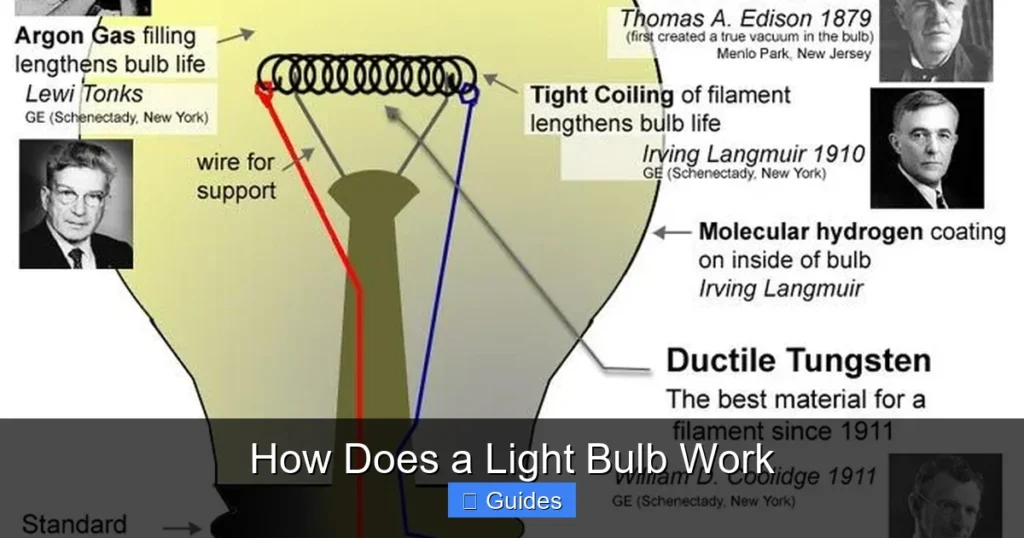
When you flip the switch, electricity flows through a tiny, coiled wire called a filament. This filament is usually made of tungsten, a metal known for its incredibly high melting point. As the electricity encounters the resistance of the filament, it heats up dramatically – often to temperatures exceeding 2,200 degrees Celsius (4,000 degrees Fahrenheit)! At these extreme temperatures, the tungsten filament glows brilliantly, emitting visible light. It’s a direct conversion of electrical energy into heat and then into light.
Inside the Glass Bubble: Key Components
So, what makes up this glowing marvel? Here’s a breakdown of the parts that explain how does a light bulb work in its incandescent form:
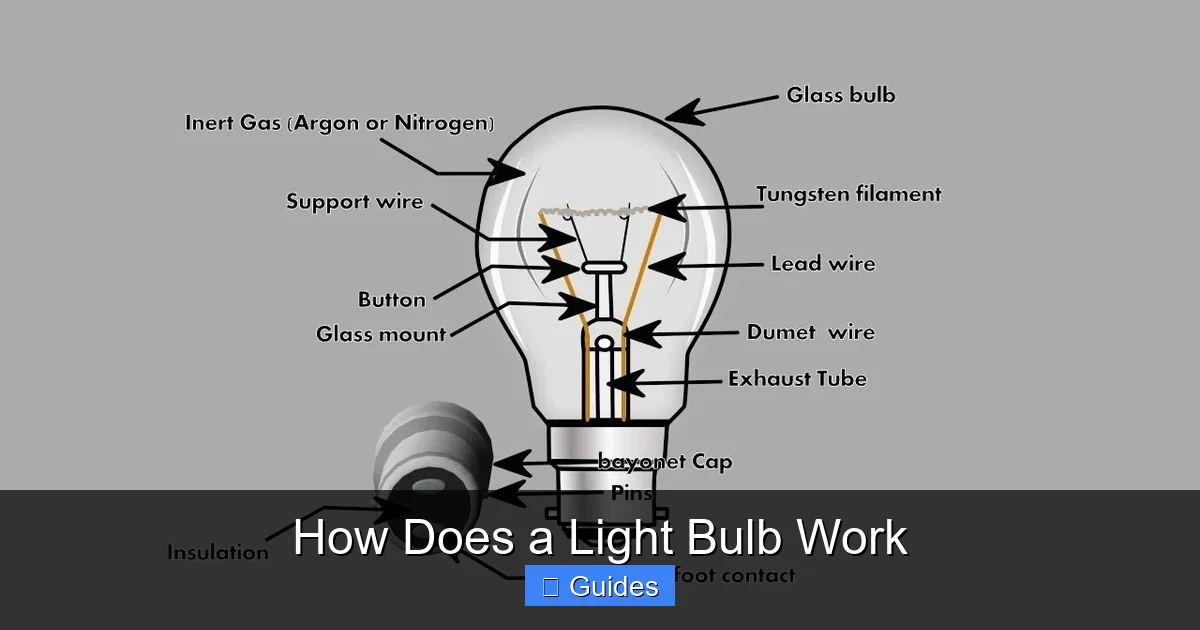
- Filament: The star of the show, typically a thin, tightly coiled tungsten wire. Its high resistance and melting point are crucial for its function.
- Glass Bulb (Envelope): This isn’t just for protection. The glass bulb encloses the filament and is usually filled with an inert gas, like argon or nitrogen, or sometimes a vacuum. The inert gas prevents the tungsten filament from oxidizing and burning out quickly, which would happen instantly in open air. It also slows down the evaporation of the tungsten, extending the bulb’s life.
- Support Wires: These thin wires hold the delicate filament in place within the bulb.
- Lead-in Wires: Thicker wires that connect the filament to the electrical contacts in the base.
- Glass Stem/Mount: This component provides a sturdy platform for the filament and support wires, and creates a sealed environment for the inert gas or vacuum.
- Base: This is the part that screws into your lamp socket (a screw-in or Edison base) or pushes in (a bayonet base). It has electrical contacts that connect the bulb to your home’s power supply.
Understanding these parts helps clarify how does a light bulb work, bringing electricity from your wall to the tiny wire that lights your room.
The Trade-offs: Heat and Lifespan
While revolutionary, incandescent bulbs have their downsides. The biggest one is efficiency. A significant portion of the energy used by an incandescent bulb (around 90%) is converted into heat, not light. This makes them relatively inefficient light sources. Over time, the tungsten filament slowly evaporates, thinning out until it eventually breaks, causing the bulb to “burn out.” This limits their lifespan, usually to around 750-1,000 hours. This inherent inefficiency is what drove the search for better ways to figure out how does a light bulb work more effectively.
Beyond the Glow: Fluorescent and Halogen Lighting
Visual guide about How Does a Light Bulb Work
Image source: i.ytimg.com
As technology advanced, scientists and engineers sought more efficient ways to produce light. This led to the development of other types of bulbs, each with their own ingenious approach to how does a light bulb work.
Unveiling the Fluorescent Secret
Fluorescent bulbs operate on a completely different principle than incandescents. Instead of relying solely on heat, they use a process called fluorescence. Here’s the simplified explanation of how does a light bulb work when it’s fluorescent:
- Gas Excitation: Inside a fluorescent tube, there’s a small amount of mercury vapor and an inert gas (like argon) at low pressure. When electricity flows through the tube, it excites the mercury atoms.
- UV Light Production: These excited mercury atoms emit ultraviolet (UV) light, which is invisible to the human eye.
- Phosphor Coating: The inside of the glass tube is coated with a special material called phosphor. When the invisible UV light strikes this phosphor coating, the phosphor absorbs the UV energy and re-emits it as visible light.
Fluorescent bulbs require a “ballast” – an electrical component that regulates the current and provides the initial voltage surge needed to start the lamp. This ballast also helps explain how does a light bulb work, specifically controlling the electricity flowing through the tube. Because they don’t rely on heating a filament to extreme temperatures, fluorescent bulbs are significantly more energy-efficient than incandescents and last much longer, typically 10,000-20,000 hours.
Compact Fluorescent Lamps (CFLs): A Greener Bridge
Remember those spiral-shaped bulbs? Those are Compact Fluorescent Lamps (CFLs). They brought the efficiency of fluorescent technology into a size and shape more suitable for home use, designed to fit into standard incandescent sockets. They work on the exact same principles as larger fluorescent tubes but are folded into a compact form factor. While groundbreaking for their time in offering energy savings, CFLs contain small amounts of mercury, necessitating proper disposal. This concern further pushed research into how does a light bulb work without mercury.
Halogen Bulbs: A Brighter Incandescent Cousin
Halogen bulbs are actually a type of incandescent bulb, but with a clever twist that improves their performance. They still use a tungsten filament, but the glass bulb is much smaller and made of quartz (which can withstand higher temperatures), and it’s filled with a halogen gas (like iodine or bromine).
Here’s the trick: The halogen gas creates a regenerative cycle. As tungsten evaporates from the hot filament, it combines with the halogen gas. This tungsten-halogen compound then redeposits the tungsten back onto the filament, preventing it from thinning out as quickly. This “halogen cycle” allows the filament to burn at a higher temperature, producing a brighter, whiter light, and significantly extends the bulb’s lifespan compared to traditional incandescents (typically 2,000-4,000 hours). This demonstrates another ingenious way to optimize how does a light bulb work while staying true to the incandescent principle.
The LED Era: Efficiency and Innovation Reign Supreme
If incandescent bulbs were the first act and fluorescents the second, then Light Emitting Diodes (LEDs) are undoubtedly the dazzling third act of lighting technology. LEDs have revolutionized how does a light bulb work, offering unparalleled efficiency, longevity, and versatility.
The Magic of Semiconductors: How LEDs Work
LEDs are completely different from their predecessors. They don’t have filaments, mercury vapor, or gases. Instead, they rely on semiconductors – materials that can conduct electricity under certain conditions. Here’s the simplified science:
- P-N Junction: An LED is a semiconductor device, essentially a tiny “p-n junction.” It consists of two types of semiconductor materials doped with impurities: a “p-type” material with an abundance of positive charge carriers (called “holes”) and an “n-type” material with an abundance of negative charge carriers (electrons).
- Electroluminescence: When electricity is applied to the LED in the correct direction (forward bias), electrons from the n-type material cross the p-n junction and recombine with holes in the p-type material.
- Photon Emission: As electrons fall from a higher energy level to a lower energy level, they release energy in the form of photons – tiny packets of light. This process is called electroluminescence. The color of the light emitted depends on the specific semiconductor materials used.
This direct conversion of electrical energy into light, without generating excessive heat as a byproduct, is the secret to an LED’s incredible efficiency.
Driver, Heat Sink, and Phosphor: The Modern LED’s Anatomy
While the core LED is a tiny chip, a consumer LED “bulb” is a more complex package designed to mimic traditional bulb shapes. To understand how does a light bulb work in its LED form, you need to know its main components:
- LED Chip(s): The actual light-emitting semiconductor device. Modern bulbs often contain multiple chips.
- Heat Sink: Even though LEDs are efficient, they still generate some heat. This heat needs to be dissipated to prevent damage and ensure longevity. A heat sink (often aluminum fins) draws heat away from the LED chips. This is crucial for their long life.
- Driver: This electronic circuit converts the alternating current (AC) from your home’s wiring into the direct current (DC) that LEDs require, and regulates the voltage and current to the LED chips. It’s essentially the “brain” that ensures the LED operates correctly.
- Phosphor Coating (for White LEDs): Most white LEDs actually emit blue light from the semiconductor. To create white light, a yellow phosphor coating is applied to the LED chip. The blue light excites the yellow phosphor, which then emits yellow light. The combination of the blue light passing through and the yellow light emitted by the phosphor appears white to our eyes.
- Diffuser Lens: A plastic or glass cover that helps spread the light evenly and reduce glare.
These sophisticated components are why a modern LED bulb is more than just a light source; it’s a miniature electronic device.
Advantages That Shine Brightly
The LED revolution isn’t just about a new way to answer how does a light bulb work; it’s about a host of benefits:
- Energy Efficiency: LEDs use up to 90% less energy than incandescent bulbs for the same amount of light (lumens).
- Exceptional Lifespan: They can last anywhere from 25,000 to 50,000 hours or even more, meaning you might never have to change a bulb again in certain fixtures.
- Durability: Being solid-state devices (no filaments or glass tubes to break), LEDs are much more robust and resistant to shocks and vibrations.
- Instant-On: LEDs reach full brightness immediately, with no warm-up time.
- Dimmability and Color Control: Many LEDs are dimmable, and “color-tunable” or “RGB” LEDs can change their color output, offering unprecedented control over your lighting environment.
- Environmental Friendliness: They contain no mercury and are often recyclable.
These advantages make LEDs the dominant lighting technology today and the benchmark for understanding how does a light bulb work in the modern age.
The Expanding Universe of Smart Lighting
The evolution didn’t stop with efficient LEDs. The digital age has brought connectivity to our light fixtures, transforming them from simple light sources into intelligent components of our smart homes. So, how does a light bulb work when it’s “smart”?
Connectivity and Control: More Than Just On/Off
Smart bulbs are essentially LED bulbs with integrated communication technology. They connect to your home network or directly to your smartphone, allowing for remote control and automation. The primary ways they connect include:
- Wi-Fi: Many smart bulbs connect directly to your home’s Wi-Fi network, allowing control from anywhere with an internet connection.
- Bluetooth: Some bulbs use Bluetooth for direct, short-range control from your phone, often without needing a separate hub.
- Zigbee/Z-Wave: These are wireless communication protocols specifically designed for smart home devices. Bulbs using these protocols often require a dedicated hub that acts as a bridge between the bulbs and your home network.
This connectivity means you can control your lights from an app on your phone, use voice commands with assistants like Amazon Alexa or Google Assistant, or even set schedules and routines.
Beyond Illumination: Features of Smart Bulbs
The “smart” aspect adds layers of functionality that go far beyond what traditional bulbs can offer:
- Tunable White Light: Many smart bulbs let you adjust the color temperature, from a cool, bright white (good for focus) to a warm, cozy yellow (great for relaxing).
- RGB Color Control: Full-color smart bulbs can produce millions of different hues, allowing you to set the mood for any occasion, from a vibrant party to a tranquil evening.
- Scheduling and Automation: Set your lights to turn on automatically at sunset, gradually brighten to wake you up in the morning, or simulate occupancy when you’re away.
- Integration with Smart Home Ecosystems: Smart bulbs can work in conjunction with other smart devices, like motion sensors (lights turn on when you enter a room) or smart security systems.
- Energy Monitoring: Some smart bulbs provide data on energy consumption, helping you track and optimize your usage.
This integration and control represent the pinnacle of how does a light bulb work today, merging light with lifestyle.
From Filament to Future: The Evolution of Lighting
The journey from Edison’s carbonized bamboo filament to today’s sophisticated smart LEDs is a testament to human ingenuity. Each step in understanding how does a light bulb work has brought us closer to more efficient, versatile, and environmentally friendly lighting.
The Drive for Sustainability
The evolution of lighting has been largely driven by the pursuit of greater energy efficiency and sustainability. Incandescent bulbs, while historically significant, are being phased out in many regions due to their high energy consumption. Fluorescent bulbs offered a significant improvement but introduced concerns about mercury. LEDs, with their low power consumption, long lifespan, and mercury-free design, are currently the gold standard, helping reduce our carbon footprint and electricity bills.
The Future is Bright: Organic LEDs (OLEDs) and Beyond
The innovation in lighting continues. Organic Light Emitting Diodes (OLEDs) are an exciting emerging technology. Unlike traditional LEDs, which are small point sources, OLEDs are thin, flexible sheets that emit light over their entire surface. This opens up possibilities for revolutionary lighting designs, such as transparent light sources, bendable displays, and even “light wallpaper.” Researchers are also exploring other novel lighting solutions, constantly pushing the boundaries of how does a light bulb work and what light can do for us.
Practical Tips for Choosing and Using Light Bulbs
Now that you understand the science behind how does a light bulb work, let’s look at some practical advice for making the best choices for your home.
Understanding Lumens, Watts, and Color Temperature
When shopping for bulbs, especially LEDs, you’ll encounter some new terms:
- Lumens (lm): This is the most important measure of brightness. Forget watts for brightness; lumens tell you how much visible light a bulb produces. The higher the lumen count, the brighter the light. For example, a 60-watt incandescent bulb produces about 800 lumens, while an LED producing 800 lumens might only use 9-12 watts.
- Watts (W): This measures the amount of electricity a bulb consumes. For incandescents, higher watts meant brighter light, but with LEDs, you can get high lumens with very low watts, indicating high efficiency.
- Color Temperature (Kelvin – K): This describes the “warmth” or “coolness” of the light. Lower Kelvin numbers (e.g., 2700K-3000K) produce a warm, yellowish light similar to traditional incandescents, great for relaxing. Higher Kelvin numbers (e.g., 4000K-5000K) produce a cooler, whiter light, suitable for task lighting or kitchens. Very high numbers (6500K+) mimic daylight.
Thinking about these metrics will help you better understand how does a light bulb work for your specific needs.
Eco-Friendly Choices for Your Home
Opting for LED bulbs is one of the easiest and most impactful ways to make your home more eco-friendly. Not only do they save energy and last longer, but they also reduce waste and don’t contain hazardous materials like mercury. When an LED bulb eventually reaches the end of its very long life, remember to check with your local recycling facilities, as some offer specialized recycling for electronics.
The journey of the light bulb is a compelling narrative of human innovation, from a simple glowing wire to a complex, connected device. The question of how does a light bulb work has led us through fascinating scientific principles and technological advancements, continuously shaping the way we live and interact with our environment.
The next time you flip a switch and your room lights up, take a moment to appreciate the remarkable engineering contained within that small glass or plastic sphere. It’s a testament to how far we’ve come and a beacon for the bright future of lighting.
Frequently Asked Questions
What is a lumen and why is it important when buying light bulbs?
A lumen (lm) is the unit of measurement for brightness, or the total amount of visible light emitted by a source. It’s crucial because it tells you how bright a bulb truly is, regardless of its wattage. When buying bulbs, focus on lumens to ensure you get the right amount of light for your space.
Why do incandescent bulbs burn out faster than LEDs?
Incandescent bulbs burn out faster because their tungsten filament slowly evaporates and thins over time due to the extreme heat, eventually breaking. LEDs, being solid-state devices, don’t have a filament and produce light through electron movement, resulting in a much longer lifespan.
Do all LED bulbs produce the same color of light?
No, LED bulbs come in various “color temperatures,” measured in Kelvin (K). Lower Kelvin values (e.g., 2700K-3000K) produce warm, yellowish light, while higher values (e.g., 4000K-5000K) produce cooler, whiter light. Some smart LEDs can even change to millions of colors.
What is a “ballast” and why do fluorescent bulbs need one?
A ballast is an electrical component used in fluorescent lighting systems to regulate the current and provide the initial high voltage surge needed to ignite the gas inside the tube. Without a ballast, the uncontrolled current would quickly destroy the bulb.
Are smart bulbs more difficult to install than regular bulbs?
Typically, smart bulbs are as easy to physically install as regular bulbs, screwing into a standard socket. The “difficulty” might come from the initial setup, which usually involves connecting them to a smartphone app or a smart home hub via Wi-Fi or Bluetooth, but this process is generally user-friendly.
Why are governments phasing out incandescent light bulbs?
Governments are phasing out incandescent bulbs primarily due to their extreme inefficiency. They waste approximately 90% of the energy they consume as heat rather than light, contributing significantly to energy consumption and greenhouse gas emissions compared to modern alternatives like LEDs.
