


As an Amazon Associate, We earn from qualifying purchases.
Choosing what light bulb for bathroom is crucial for both function and ambiance. This guide will help you navigate lumens, color temperature, CRI, and safety ratings like damp or wet-rated bulbs. Prioritize LEDs for energy efficiency and specific bulbs for vanity, shower, and general lighting to create a safe, beautiful, and highly functional bathroom space.
Stepping into your bathroom, do you ever feel like something is just… off with the lighting? Perhaps it’s too dim, making it hard to see yourself in the mirror. Or maybe it’s too harsh, creating an uninviting, sterile atmosphere. The truth is, your bathroom isn’t just a utilitarian space; it’s a place for grooming, relaxation, and sometimes, even a quick escape. And the right light bulb can make all the difference in transforming it into the perfect sanctuary.
Choosing what light bulb for bathroom use might seem like a small decision, but it has a huge impact on functionality, mood, and even your energy bills. From the moment you wake up and get ready for the day to winding down with a warm bath, your bathroom lighting plays a critical role. So, let’s peel back the layers and understand exactly what you need to know to light up your bathroom brilliantly and beautifully.
Forget the days of just screwing in any old bulb. Today, we have a fantastic array of options, each with specific strengths. This guide will walk you through everything, from understanding different bulb types and their characteristics to picking the perfect illumination for every corner of your bathroom. Get ready to banish bad lighting and welcome a perfectly lit space that works for you!
Key Takeaways
- Understand Bathroom Zones: Bathrooms have different lighting needs; task lighting (vanity), ambient lighting (general), and accent lighting (showers) each require specific considerations for brightness and bulb type.
- Prioritize LED Bulbs: LEDs are the top choice for bathrooms due to their energy efficiency, long lifespan, instant-on feature, and versatility in brightness and color temperature. They also handle humidity well.
- Mind Lumens for Brightness: Don’t focus on watts; instead, look at lumens. Aim for 80-100 lumens per square foot for adequate general bathroom lighting, adjusting for specific task areas like vanities which may need more concentrated light.
- Choose the Right Color Temperature (Kelvin): For vanity lighting, a neutral white (3000K-4000K) is often ideal for accurate color representation, while softer whites (2700K-3000K) create a relaxing ambiance for general lighting.
- Don’t Forget CRI (Color Rendering Index): A high CRI (90+) is essential, especially around mirrors, to ensure colors appear true to life, making makeup application and grooming much easier and more accurate.
- Safety First with Damp/Wet Ratings: Always check if a bulb and its fixture are rated “damp” or “wet” for bathroom use. Damp-rated bulbs are suitable for areas exposed to moisture, while wet-rated bulbs are needed for direct water contact, such as inside a shower enclosure.
- Consider Dimmability: Dimmable bulbs offer flexibility, allowing you to adjust the light from bright task lighting to a softer, more relaxing glow, perfect for various bathroom activities.
Quick Answers to Common Questions
What is the most important factor when choosing a light bulb for a bathroom?
The most important factor is the bulb’s safety rating (damp or wet-rated) to ensure it can safely operate in a humid bathroom environment without posing an electrical hazard.
What color temperature is best for bathroom vanity lighting?
For bathroom vanity lighting, a neutral white color temperature between 3500K and 4000K is generally considered best. It provides accurate color rendering, which is ideal for tasks like makeup application and shaving.
How many lumens do I need for a small bathroom?
For a small bathroom (e.g., 50 sq ft), aim for around 4000-5000 total lumens for general ambient lighting, applying the rule of 80-100 lumens per square foot.
Can I use any LED bulb in a bathroom?
No, you cannot use *any* LED bulb. While LEDs are excellent, you must ensure the specific LED bulb and its fixture are rated “damp” or “wet” for safe use in bathroom environments.
Why is CRI important for bathroom lighting?
CRI (Color Rendering Index) is crucial for bathroom lighting, especially around mirrors, because a high CRI (90+) ensures that colors, like your skin tone or makeup, appear true and accurate compared to natural light.
📑 Table of Contents
Understanding Your Bathroom’s Unique Lighting Needs
Your bathroom isn’t a one-size-fits-all lighting scenario. It has distinct zones, each with its own requirements. Thinking about these different areas will help you decide what light bulb for bathroom specific needs is best.
Task Lighting: The Vanity Area
This is arguably the most critical lighting zone in your bathroom. The area around your mirror and vanity needs bright, even, and shadow-free illumination. Why? Because this is where you perform precise tasks like applying makeup, shaving, styling hair, or flossing. Poor lighting here can lead to frustrating mistakes and an inaccurate reflection of yourself. You need light that shows true colors and eliminates harsh shadows.
Ambient Lighting: General Illumination
Ambient lighting is your bathroom’s overall illumination. It’s the general glow that makes the room feel welcoming and prevents you from stumbling in the dark. Often provided by ceiling fixtures like flush mounts, recessed lights, or even a decorative chandelier, ambient lighting sets the general mood for the space. While it needs to be bright enough to navigate safely, it shouldn’t be overly harsh.
Accent Lighting: Adding Style and Safety
Accent lighting isn’t always essential, but it can significantly enhance your bathroom’s aesthetics and functionality. Think about a recessed light inside a shower enclosure, subtle uplighting for a decorative plant, or even toe-kick lighting under a vanity. In the shower, for instance, a dedicated light can improve safety and make the space feel more open. This type of lighting adds depth, highlights features, and contributes to the overall ambiance.
Key Light Bulb Characteristics You Must Consider
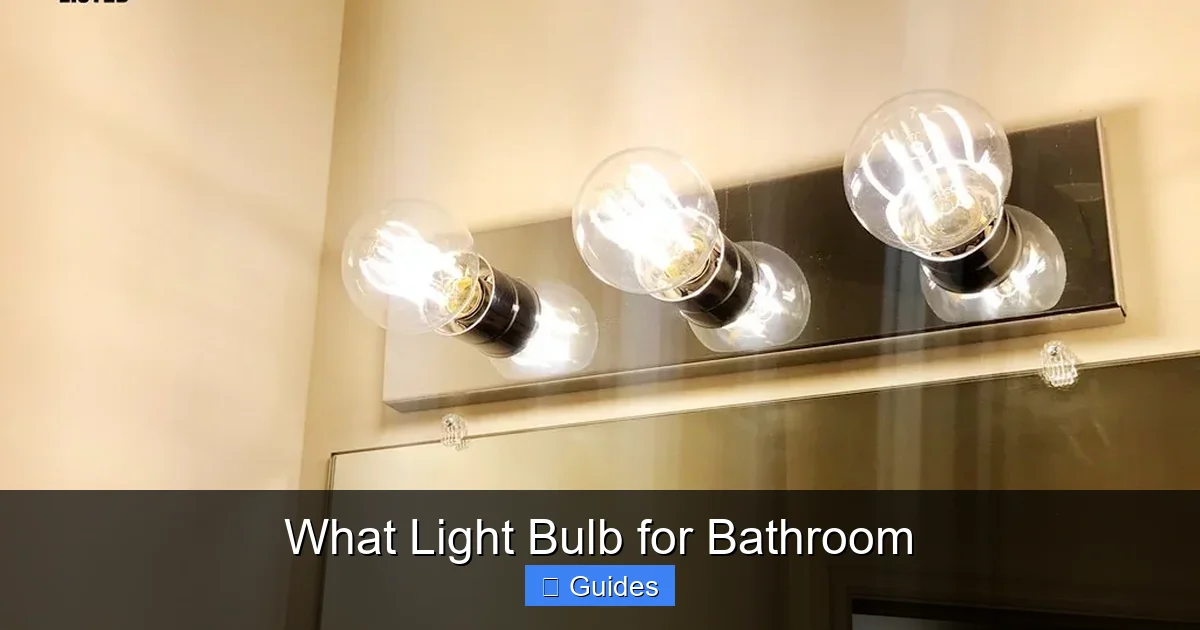
Visual guide about What Light Bulb for Bathroom
Image source: cdn.shopify.com
When you’re trying to figure out what light bulb for bathroom is ideal, it’s not just about the shape. Several technical specifications on the packaging are crucial. Let’s break them down.
Brightness (Lumens, Not Watts!)
For decades, we’ve associated brightness with watts. But watts measure energy consumption, not light output. Lumens (lm) are the true measure of brightness. The higher the lumen count, the brighter the bulb.
* **How much do you need?** For general ambient lighting in a bathroom, a good rule of thumb is 80-100 lumens per square foot. So, a 50 sq ft bathroom (e.g., 5×10 ft) might need 4000-5000 total lumens.
* **Vanity:** For task lighting around the vanity, you’ll want focused, higher lumens. Consider a total of 1500-2000 lumens specifically for the vanity area, distributed across multiple bulbs (e.g., a fixture with two or three 600-800 lumen bulbs).
* **Showers:** A single wet-rated recessed light might need 800-1000 lumens to adequately brighten the shower space.
Color Temperature (Kelvin – K)
Color temperature describes the “warmth” or “coolness” of the light, measured in Kelvin (K). This significantly affects the mood and functionality of your bathroom.
* **Warm White (2700K – 3000K):** Creates a soft, cozy, and inviting atmosphere, similar to traditional incandescent bulbs. Great for relaxation but might not be ideal for precise grooming tasks as it can cast a yellow tint.
* **Neutral White (3500K – 4000K):** Often considered the sweet spot for bathrooms. It’s bright and crisp without being harsh. Excellent for task lighting at the vanity as it provides good color accuracy, making makeup application and shaving much easier.
* **Cool White/Daylight (5000K – 6500K):** Mimics natural daylight, offering a very bright and alert feel. While great for focused work environments, it can feel a bit sterile or too intense in a bathroom if not balanced. Use sparingly or for specific areas where maximum brightness is paramount.
**Tip:** Many experts recommend a neutral white (3500K-4000K) for vanity lighting to ensure accurate color rendering, perhaps complemented by warmer general ambient lighting (2700K-3000K) with a dimmer for versatility.
Color Rendering Index (CRI)
CRI measures how accurately a light source reveals the true colors of objects compared to natural light. It’s scaled from 0 to 100.
* **Why it matters in a bathroom:** A high CRI is crucial, especially around your vanity mirror. If you have a low CRI bulb, your skin tone might look off, and your makeup colors could appear different under natural light than they did in the bathroom.
* **Recommendation:** Look for bulbs with a CRI of 90 or higher, particularly for vanity lights. This ensures that what you see in the mirror is an accurate representation of reality.
Dimmability
A dimmable light bulb gives you flexibility to adjust the light output. This is a fantastic feature for bathrooms, allowing you to switch from bright task lighting for grooming to a soft, relaxing glow for a bath. Always ensure both the bulb *and* the light fixture are labeled as dimmable, and use a compatible dimmer switch.
Energy Efficiency: The LED Advantage
In today’s world, energy efficiency is paramount. Modern light bulbs consume significantly less energy than their predecessors, saving you money on electricity bills and reducing your environmental footprint.
Damp-Rated vs. Wet-Rated: A Crucial Safety Factor
This is non-negotiable for bathroom lighting. Bathrooms are damp, humid environments. Not all light bulbs or fixtures are safe for these conditions.
* **Damp-Rated:** Suitable for areas subject to moisture and condensation, but not direct water contact. This includes most general bathroom ceiling fixtures, wall sconces, and vanity lights.
* **Wet-Rated:** Designed for areas where direct water contact is possible, such as inside a shower or above a bathtub without a full enclosure. These bulbs and fixtures are sealed to prevent water intrusion.
Always double-check the rating on the bulb and fixture packaging. Using an unrated bulb or fixture in a damp or wet area poses a serious electrical hazard.
The Best Types of Light Bulbs for Bathroom Use
Now that you know what characteristics to look for, let’s explore the types of bulbs available and which one is the undisputed champion for bathrooms.
LED (Light Emitting Diode) Bulbs: The Modern Champion
LEDs are, without a doubt, the top recommendation for what light bulb for bathroom applications. They excel in almost every category.
* **Pros:**
* **Energy Efficient:** Uses up to 90% less energy than incandescent bulbs.
* **Long Lifespan:** Can last 15-25 times longer than traditional bulbs (25,000-50,000 hours).
* **Versatile:** Available in a vast range of lumens, color temperatures (from very warm to very cool), and high CRI options. Many are dimmable.
* **Instant On:** No warm-up time; full brightness instantly.
* **Durable:** No fragile filament, more resistant to breakage.
* **Low Heat Emission:** Produce very little heat, which is a bonus in a small, enclosed bathroom.
* **Humidity Resistant:** Many are well-suited for damp environments.
* **Cons:**
* **Higher Initial Cost:** Although prices have come down significantly, the upfront cost can still be higher than other types, but the long-term savings are substantial.
* **Compatibility:** Some older dimmer switches may not work perfectly with all LED bulbs, leading to flickering or buzzing. Always check compatibility.
**Verdict:** For almost any bathroom lighting need, an LED is the smartest and most efficient choice.
Halogen Bulbs: The Incandescent Successor (Less Common Now)
Halogen bulbs are a type of incandescent bulb, offering brighter, whiter light than traditional incandescents.
* **Pros:**
* **Good CRI:** Generally offer excellent color rendering.
* **Dimmable:** Most are naturally dimmable.
* **Instant On:** Full brightness immediately.
* **Cons:**
* **Energy Inefficient:** Still consume a lot more energy than LEDs, though slightly better than traditional incandescents.
* **Short Lifespan:** Much shorter lifespan than LEDs (around 1,000-2,000 hours).
* **Heat Output:** Get very hot, which can be uncomfortable in a small bathroom.
**Verdict:** While offering good light quality, their energy inefficiency and heat output make them less desirable than LEDs for general bathroom use.
CFL (Compact Fluorescent Lamp) Bulbs: The Former Energy Saver
CFLs were once the go-to energy-efficient alternative to incandescents.
* **Pros:**
* **Energy Efficient:** Better than incandescents and halogens.
* **Longer Lifespan:** Longer than incandescents and halogens.
* **Cons:**
* **Warm-up Time:** Often take a moment to reach full brightness.
* **Dimmability Issues:** Not all CFLs are dimmable, and those that are often require specific dimmer switches.
* **Color Quality:** Can have a less appealing color quality, sometimes appearing “flat” or “greenish.”
* **Mercury Content:** Contain a small amount of mercury, requiring special disposal.
* **Humidity:** Some models are not ideal for enclosed fixtures or high humidity.
**Verdict:** Largely superseded by LEDs, CFLs are generally not the best option for what light bulb for bathroom tasks today.
Incandescent Bulbs: The Obsolete Option
Traditional incandescent bulbs are the classic filament bulbs we grew up with.
* **Pros:**
* **Excellent CRI:** Offer very warm, pleasing light and perfect color rendering.
* **Inexpensive:** Lowest upfront cost.
* **Cons:**
* **Energy Hog:** Extremely inefficient, converting most energy into heat, not light.
* **Short Lifespan:** Last only about 750-1,000 hours.
* **Heat Output:** Produce a lot of heat.
**Verdict:** Due to their inefficiency and short lifespan, incandescent bulbs are not recommended for what light bulb for bathroom fixtures anymore.
Choosing the Right Bulb for Specific Bathroom Areas
Let’s bring it all together and consider specific placements.
For the Vanity/Mirror Area
This is where you need light that helps you look your best.
* **Bulb Type:** LED is king here.
* **Lumens:** Aim for around 1500-2000 lumens total from all vanity bulbs. Distribute this evenly, often with two vertical sconces or a horizontal bar above the mirror.
* **Color Temperature:** 3500K-4000K (neutral white) is ideal for accurate grooming and makeup application.
* **CRI:** Definitely 90+ to ensure true color representation.
* **Dimmability:** Highly recommended for versatility.
**Practical Tip:** Avoid a single light directly above the mirror, as it creates harsh shadows on your face. Flank the mirror with sconces or use a well-designed light bar.
For Shower and Bathtub Areas
Safety and proper rating are paramount here.
* **Bulb Type:** LED is the best choice, specifically recessed downlights.
* **Rating:** Absolutely *must* be wet-rated. The fixture itself also needs to be wet-rated.
* **Lumens:** 800-1000 lumens from a single recessed light is usually sufficient for a standard shower.
* **Color Temperature:** 3000K-4000K provides good visibility.
* **CRI:** While not as critical as the vanity, a high CRI is always a plus.
**Safety Note:** Never use a bulb or fixture that isn’t specifically marked “wet-rated” in a shower or directly above a tub.
For General Ceiling Fixtures (Ambient Lighting)
This covers flush mounts, semi-flush mounts, or recessed lighting in the main part of the bathroom.
* **Bulb Type:** LED, whether integrated into the fixture or as replacement bulbs.
* **Rating:** Damp-rated is typically sufficient, as these areas aren’t usually subject to direct water spray.
* **Lumens:** Follow the 80-100 lumens per square foot guideline for total output.
* **Color Temperature:** 2700K-3000K (warm white) for a spa-like, relaxing atmosphere, or 3500K for a brighter, more functional feel.
* **Dimmability:** Excellent for setting different moods throughout the day.
For Exhaust Fan Lights
Many bathroom exhaust fans come with an integrated light.
* **Bulb Type:** Often uses an LED or sometimes a CFL. Replace with the same type or an LED equivalent if available.
* **Lumens/Color Temp:** Choose based on whether it’s the primary light source or supplemental. If primary, aim for higher lumens and a neutral white.
Installation Tips and Safety Considerations
You’ve picked the perfect what light bulb for bathroom – great! Now for installation.
1. **Always Turn Off Power:** Before changing any bulb or working on a fixture, always turn off the power at the circuit breaker. Safety first!
2. **Check Fixture Compatibility:** Ensure the new bulb’s base (e.g., E26 standard screw-in, GU10 twist-and-lock) matches your fixture. Also, verify that the fixture’s maximum wattage (if replacing an incandescent/halogen) isn’t exceeded, although LEDs typically consume far less power anyway.
3. **Read the Labels:** Seriously, read the labels on both the bulb packaging and your existing fixtures. Look for lumen output, color temperature, CRI, and especially the damp or wet rating.
4. **Dimmer Compatibility:** If you’re using dimmable LEDs, make sure your dimmer switch is compatible with LED technology. Older incandescent dimmers can cause flickering or premature bulb failure with LEDs.
5. **Clean as You Go:** A clean bulb and fixture will provide optimal light output. Dust can diminish brightness and even be a fire hazard in rare cases.
Conclusion: Light Up Your Life (and Bathroom!)
Choosing what light bulb for bathroom isn’t just about throwing light into a space; it’s about crafting an environment that supports your daily routines, enhances relaxation, and reflects your personal style. By focusing on the key characteristics—lumens, color temperature, CRI, and crucial safety ratings like damp/wet—you can make informed decisions that transform your bathroom from merely functional to truly brilliant.
Embrace the efficiency and versatility of LED technology. Invest in quality bulbs, especially for your vanity area, where precise grooming demands the best illumination. And always, always prioritize safety with correctly rated bulbs and fixtures. With these insights, you’re now equipped to create a perfectly lit bathroom that’s both beautiful and incredibly practical, helping you start and end your days on a brighter note.
🎥 Related Video: How to Choose a Lightbulb | Lowe's How-to
📺 Lowe’s Home Improvement
There are so many lightbulbs to choose from, so how do you know which one will work for you? Join DIY expert Caroline as she …
Frequently Asked Questions
What is the ideal light bulb type for a bathroom?
The ideal light bulb type for a bathroom is overwhelmingly LED. LEDs are energy-efficient, long-lasting, available in various color temperatures and brightness levels, and many are designed to withstand humid bathroom conditions when properly rated.
Should bathroom lights be dimmable?
Yes, bathroom lights should absolutely be dimmable if possible. Dimmability offers flexibility, allowing you to easily switch between bright task lighting for grooming and a softer, more relaxing ambiance for unwinding in the bath.
What’s the difference between damp-rated and wet-rated bulbs?
Damp-rated bulbs are suitable for areas exposed to moisture and condensation, like most general bathroom areas. Wet-rated bulbs, however, are specifically designed for direct contact with water, making them essential for use inside showers or directly above bathtubs.
How do lumens relate to brightness for bathroom bulbs?
Lumens measure the actual light output, or brightness, of a bulb, unlike watts which measure energy consumption. For bathrooms, aim for 80-100 lumens per square foot for general lighting, with higher, focused lumens for task areas like the vanity.
Is a “daylight” bulb (5000K+) good for a bathroom?
A “daylight” bulb (5000K+) can be too harsh for an entire bathroom, making it feel sterile. While it provides high visibility, a neutral white (3500K-4000K) is generally preferred for vanity lighting, and a warmer white (2700K-3000K) for ambient light to create a more balanced and comfortable atmosphere.
Can I mix different color temperatures in my bathroom?
Yes, you can strategically mix different color temperatures in your bathroom. For example, use a neutral white (3500K-4000K) for vanity task lighting, and a warmer white (2700K-3000K) for general ambient or accent lighting to create a layered and versatile lighting scheme.
