



As an Amazon Associate, We earn from qualifying purchases.
Choosing the what watt light bulb for ceiling fan involves more than just brightness; it’s about safety, efficiency, and the right light for your space. Always respect your fan’s maximum wattage limit to prevent hazards, prioritizing modern LED bulbs for their energy savings and lower heat output. Focus on lumens for brightness and color temperature for ambiance, ensuring a perfect, safe glow.
Ever found yourself staring at a bewildering array of light bulbs in the store, wondering, “what watt light bulb for ceiling fan do I actually need?” You’re not alone! It’s a common dilemma, and one that often leads to confusion, especially with the shift from old incandescent bulbs to the wonderfully efficient world of LEDs.
Choosing the right light bulb for your ceiling fan isn’t just about brightness; it’s about safety, energy efficiency, and creating the perfect ambiance in your room. Put the wrong bulb in, and you could be dealing with anything from a dim, unflattering glow to a potentially dangerous overheating situation. But don’t worry, friend! We’re here to demystify the process and help you confidently pick the ideal light bulb for your ceiling fan.
This comprehensive guide will walk you through everything you need to know, from understanding those tricky wattage limits to decoding lumens and Kelvin temperatures. By the end, you’ll be an expert, ready to brighten up your space safely and stylishly. So, let’s dive in and shed some light on what watt light bulb for ceiling fan is right for you!
Key Takeaways
- Understand Wattage Limits: Always check your ceiling fan’s maximum wattage rating for its light kit. Exceeding this limit can cause overheating, fire hazards, and damage to the fan’s wiring.
- Prioritize Lumens Over Watts for Brightness: With modern LED bulbs, watts measure energy consumption, not brightness. Look for lumens to determine how bright a bulb is; higher lumens mean more light output.
- LED Bulbs are the Best Choice: LEDs are highly energy-efficient, produce significantly less heat than incandescents, last much longer, and fit well within wattage limits while delivering ample light.
- Consider Color Temperature (Kelvin): The Kelvin (K) rating indicates the light’s warmth or coolness. Choose warmer light (2700K-3000K) for cozy areas and cooler light (3500K-5000K) for task-oriented spaces.
- Check for Dimmability: If your ceiling fan has a dimmer switch, ensure you select dimmable LED bulbs. Non-dimmable LEDs can flicker or be damaged when used with a dimmer.
- Bulb Size and Shape Matter: Ensure the bulb you choose physically fits within the fan’s light fixture enclosure, allowing for proper air circulation to prevent overheating.
- Match Lighting to Room Needs: Determine the desired brightness based on room size and function. A general guideline is 100-200 lumens per square foot, but adjust based on personal preference and existing light sources.
Quick Answers to Common Questions
Can I put a higher wattage LED bulb in my ceiling fan?
Yes, you can often use an LED bulb with a higher “incandescent equivalent wattage” (e.g., an LED labeled “replaces 100W incandescent”) even if your fan’s actual wattage limit is lower (e.g., 60W). This is because the LED bulb itself consumes far fewer actual watts (e.g., 15W) than the incandescent it replaces, staying well under the fan’s limit. Always check the LED’s *actual* watt consumption.
What is the most common bulb type for ceiling fans?
The most common bulb type for ceiling fans nowadays is the LED, often with an E26/E27 (standard) or E12 (candelabra) screw base, depending on the fan’s design. These are preferred for their efficiency and low heat output.
How do I know if my ceiling fan light is dimmable?
Check your ceiling fan’s remote control or wall switch. If it has buttons or a slider specifically for dimming, then your fan’s light kit is dimmable. You will then need to purchase LED bulbs specifically labeled as “dimmable” for proper function.
Can I mix different wattages of LED bulbs in my ceiling fan?
Yes, you can mix different actual wattages of LED bulbs in your ceiling fan, as long as each individual bulb’s actual wattage consumption is below the maximum limit for its socket. However, for consistent brightness and appearance, it’s generally best to use bulbs with the same lumen output and color temperature.
What if my ceiling fan says “Max 40W” but I want brighter light?
If your ceiling fan has a “Max 40W” limit, you should use an LED bulb that *consumes* 40 watts or less. You can still achieve much brighter light by choosing an LED with a high lumen output (e.g., 800-1100 lumens) that only consumes 10-15 actual watts, easily staying within your fan’s safe wattage limit.
📑 Table of Contents
- Understanding Your Ceiling Fan’s Wattage Limit: Safety First!
- Watts vs. Lumens: The Modern Way to Choose Your Light
- Types of Light Bulbs for Your Ceiling Fan
- Choosing the Right Brightness (Lumens) and Color Temperature
- Important Considerations and Smart Choices for Ceiling Fan Bulbs
- Installation Tips and Safety Precautions
- Conclusion: Light Up Your Life Safely and Efficiently
Understanding Your Ceiling Fan’s Wattage Limit: Safety First!
The very first, and arguably most important, thing you need to know about choosing a light bulb for your ceiling fan is its wattage limit. Every ceiling fan with a light kit comes with a maximum wattage rating. This isn’t just a suggestion; it’s a critical safety guideline established by the manufacturer and often enforced by electrical safety standards.
Why Do Ceiling Fans Have Wattage Limits?
Ceiling fans, especially their light fixtures, are designed to handle only a certain amount of electrical current and heat. Here’s why these limits are so important:
- Overheating: Light bulbs generate heat. Incandescent bulbs, in particular, generate a lot of it. Exceeding the wattage limit means the fan’s internal wiring, sockets, and even the fixture itself can overheat. This can melt wire insulation, damage components, and lead to electrical shorts.
- Fire Hazard: Overheating is a serious fire risk. If components get too hot, they can ignite surrounding materials, leading to a house fire.
- Damage to the Fan: Even if a fire doesn’t start, prolonged use of bulbs that exceed the wattage limit can significantly shorten the lifespan of your ceiling fan, leading to costly repairs or premature replacement.
- Voiding Warranty: Using bulbs that exceed the recommended wattage may also void your fan’s warranty, leaving you without recourse if something goes wrong.
Where to Find the Wattage Limit
Typically, you can find the maximum wattage for your ceiling fan’s light kit in a few places:
- On the Fan Itself: Look for a sticker or label inside the light fixture, usually near the bulb sockets, or on the fan motor housing.
- Owner’s Manual: The fan’s instruction manual will clearly state the maximum allowed wattage for its light kit.
- Manufacturer’s Website: If you know the make and model of your fan, you can often find this information on the manufacturer’s website.
Always respect this limit. If your fan says “Max 60W per socket,” then you absolutely should not put a 75W or 100W incandescent bulb in it.
Watts vs. Lumens: The Modern Way to Choose Your Light
For decades, we’ve been conditioned to think about light bulb brightness in terms of watts. A 100-watt bulb was bright, a 40-watt bulb was dim. But with the advent of energy-efficient lighting like LEDs, watts no longer tell the full story of brightness. This is crucial when considering what watt light bulb for ceiling fan to choose.
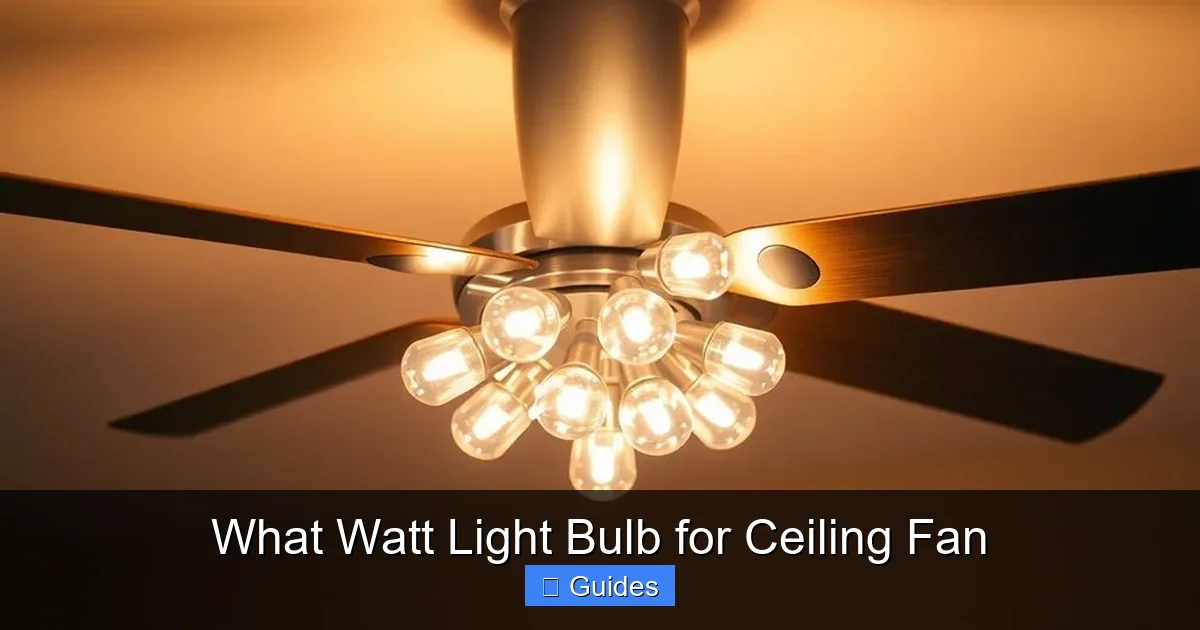
Visual guide about What Watt Light Bulb for Ceiling Fan
Image source: topceilingfans.net
What are Watts?
Simply put, watts measure energy consumption. An incandescent bulb needed a lot of watts to produce light because much of its energy was wasted as heat. LEDs, however, are incredibly efficient. They use far fewer watts to produce the same (or even more) light than an old incandescent bulb.
So, when you see a wattage limit on your ceiling fan, it’s primarily about the electrical load and heat generated, not the light output itself.
What are Lumens?
Lumens (lm) are the true measure of a light bulb’s brightness. The higher the lumen number, the brighter the light output. This is the metric you should focus on when deciding how much light you want in your room.
Here’s a rough comparison for common incandescent equivalents:
- 40W Incandescent: ~450 lumens
- 60W Incandescent: ~800 lumens
- 75W Incandescent: ~1100 lumens
- 100W Incandescent: ~1600 lumens
Notice how an LED bulb can achieve 800 lumens (equivalent to a 60W incandescent) by using only 9-12 watts. This means you can get excellent brightness while staying well within your ceiling fan’s wattage limits.
Types of Light Bulbs for Your Ceiling Fan
While incandescents still exist, and CFLs had their moment, LEDs are now the undisputed champions for ceiling fan lighting. Let’s look at the options when considering what watt light bulb for ceiling fan is right for you:
1. Incandescent Bulbs
- Pros: Inexpensive to buy, warm light quality.
- Cons: Highly inefficient (most energy lost as heat), short lifespan, contribute significantly to the heat inside the fan’s fixture, making them risky for wattage-limited ceiling fans. Often exceed the safe watt limit for modern fans if aiming for good brightness.
Recommendation: Avoid these for ceiling fans if possible. They are typically the reason for strict wattage limits and are a poor choice for energy efficiency.
2. Compact Fluorescent Lamps (CFLs)
- Pros: More energy-efficient than incandescents, longer lifespan.
- Cons: Contain mercury (requiring special disposal), often have a slow warm-up time to full brightness, can have an unappealing light quality, may not be dimmable. Their bulkier size can also be an issue in enclosed fan fixtures.
Recommendation: Better than incandescents, but LEDs are superior.
3. Light Emitting Diodes (LEDs)
- Pros: Extremely energy-efficient (up to 90% less energy than incandescents), very long lifespan (thousands of hours), produce very little heat (critical for ceiling fan safety), instant full brightness, available in a wide range of brightness levels (lumens) and color temperatures. Easily stay within any fan’s wattage limit.
- Cons: Higher upfront cost (though they save money over time), some older dimmer switches may not be compatible with all LED bulbs (look for “dimmable” labels).
Recommendation: LEDs are by far the best choice for what watt light bulb for ceiling fan. They offer the perfect balance of safety, efficiency, and performance.
Choosing the Right Brightness (Lumens) and Color Temperature
Once you’ve settled on LEDs, the next step is to choose the right brightness (lumens) and the right feel (color temperature) for your space.
How Many Lumens Do You Need?
This depends on the size and purpose of your room. Here’s a general guide:
- Ambient Lighting: For general room illumination, aim for 10-20 lumens per square foot. So, a 10×12 foot (120 sq ft) room might need 1200-2400 lumens total.
- Task Lighting: If your ceiling fan is the primary light source for tasks like reading or cooking, you might need more, perhaps 20-40 lumens per square foot, or even higher for specific task areas.
- Mood Lighting: For a cozy, softer feel, you can go lower, around 5-10 lumens per square foot.
Remember, if your fan has multiple sockets (e.g., three or four), the total lumens will be the sum of each bulb’s output. So, three 800-lumen bulbs give you a total of 2400 lumens.
Decoding Color Temperature (Kelvin)
Color temperature, measured in Kelvin (K), describes the hue of the light. It dramatically affects the mood of a room:
- Warm White (2700K-3000K): This mimics traditional incandescent light, offering a cozy, inviting, yellowish glow. Ideal for bedrooms, living rooms, and dining areas where relaxation is key.
- Cool White / Neutral White (3500K-4100K): A more balanced, clean light that’s less yellow than warm white but not stark blue. Good for kitchens, bathrooms, home offices, or hallways where you need clear visibility without being too harsh.
- Daylight (5000K-6500K): A bright, crisp, bluish-white light that simulates natural daylight. Best for task-intensive areas, workshops, garages, or spaces where high visual accuracy is needed. Can feel sterile in living areas.
Choose the Kelvin rating that best suits the function and desired ambiance of your room. Many LED bulbs now offer adjustable color temperature, allowing you to switch between warm, cool, and daylight with a remote or switch.
Important Considerations and Smart Choices for Ceiling Fan Bulbs
Beyond lumens and Kelvin, a few other factors can make a big difference in your ceiling fan lighting experience.
Dimmability
Does your ceiling fan have a dimmer switch? If so, you absolutely need to purchase LED bulbs specifically labeled as “dimmable.” Standard LEDs are not designed for dimming circuits and can flicker, buzz, or fail prematurely if used with a dimmer. Look for bulbs compatible with LED-specific dimmers for the best performance.
Bulb Size and Shape
Ceiling fan light fixtures often have specific size constraints. The enclosure, globe, or shade might be small or oddly shaped. Before buying, measure the available space within your fixture and compare it to the dimensions of the bulb you’re considering. Ensure the bulb fits comfortably, allowing for proper air circulation, even with low-heat LEDs.
Common base types for ceiling fan bulbs include:
- E26/E27 (Standard Base): The most common screw-in base, like traditional household bulbs.
- E12 (Candelabra Base): A smaller screw-in base, often found in decorative fixtures.
- GU10 (Twist-and-Lock): Less common for ceiling fans, but good to be aware of.
Check your existing bulbs or fan manual to confirm the correct base type.
Energy Efficiency and Lifespan
This is where LEDs truly shine. They consume a fraction of the electricity of incandescent bulbs, leading to significant savings on your utility bill. Their extended lifespan (often 15,000 to 50,000 hours compared to an incandescent’s 1,000 hours) means you’ll be replacing bulbs far less frequently, saving you time and money in the long run. This makes the initial investment in LEDs well worth it.
Smart Bulbs
For the ultimate in customization and convenience, consider smart LED bulbs. These can connect to your home’s Wi-Fi or Bluetooth, allowing you to control brightness, color temperature, and even color (RGB) from your smartphone, voice assistant, or smart home hub. They can be set on schedules, synced with other smart devices, and offer a level of flexibility that traditional bulbs can’t match.
Installation Tips and Safety Precautions
Once you’ve chosen what watt light bulb for ceiling fan is perfect for your needs, installing it is usually straightforward, but a few safety tips are essential:
- Turn Off Power: ALWAYS turn off the power to the ceiling fan at the circuit breaker before attempting to change any light bulbs. Simply flipping the wall switch is not enough, as some residual current may still be present.
- Allow Cooling: If you’re replacing incandescent or CFL bulbs, allow the old bulbs to cool down completely before touching them to avoid burns.
- Handle Carefully: Screw in new bulbs gently but firmly. Do not overtighten, as this can damage the bulb or the socket.
- Ensure Fit: Double-check that the new bulb fits properly within the fixture’s enclosure.
- Dispose Properly: Dispose of old bulbs responsibly. Incandescents can go in regular trash, but CFLs contain mercury and should be taken to a recycling center or hazardous waste facility.
Conclusion: Light Up Your Life Safely and Efficiently
Choosing the right what watt light bulb for ceiling fan doesn’t have to be a headache. By understanding the critical role of your fan’s wattage limit, embracing the power of lumens for brightness, and opting for efficient, long-lasting LED technology, you can make an informed decision that enhances both the safety and aesthetic appeal of your home.
Remember to match your light’s brightness and color temperature to your room’s function and desired mood, and don’t forget practical considerations like dimmability and bulb size. With these tips in mind, you’re now equipped to confidently select the perfect light bulbs, transforming your ceiling fan from just a cooling device into a brilliant, efficient, and safe source of illumination for years to come. Happy lighting!
Frequently Asked Questions
What does “Max 60W” mean on my ceiling fan’s light kit?
When your ceiling fan’s light kit says “Max 60W,” it means that each individual light socket is rated to safely handle a bulb consuming no more than 60 actual watts of power. This limit is primarily to prevent overheating and potential fire hazards from excessive electrical load and heat generation, especially when using traditional incandescent bulbs.
Are LED bulbs always safe for ceiling fans with wattage limits?
Yes, LED bulbs are generally very safe for ceiling fans with wattage limits because they consume significantly fewer actual watts and produce far less heat than older bulb types. An LED bulb designed to replace a 60W incandescent might only consume 9-12 actual watts, easily staying well within typical fan wattage restrictions.
How many lumens do I need for a standard bedroom?
For a standard bedroom, you typically want a comfortable and inviting light level. A good starting point is around 1500 to 3000 total lumens, depending on the room’s size, ceiling height, and desired ambiance. If your fan has multiple sockets, you can divide this total among the bulbs (e.g., three 800-lumen bulbs provide 2400 lumens).
What is the best color temperature for a living room ceiling fan?
For a living room, most people prefer a warm, inviting atmosphere, making warm white light (2700K to 3000K) the best choice. This color temperature mimics traditional incandescent bulbs, creating a cozy and relaxing environment suitable for unwinding and socializing.
Can I use smart bulbs in my ceiling fan?
Yes, you can typically use smart bulbs in your ceiling fan, provided they fit physically within the fixture and meet the fan’s wattage limits (which smart LEDs easily do). Ensure your fan’s light kit is always powered on at the switch for the smart bulb to remain connected and controllable via app or voice commands.
Why do my LED bulbs flicker when used with my ceiling fan’s dimmer?
LED bulbs often flicker when used with a ceiling fan’s dimmer switch if the bulbs are not specifically rated as “dimmable” or if the dimmer switch itself is an older model not compatible with LED technology. Older dimmers were designed for the higher resistance of incandescent bulbs, and their minimum load requirements are often not met by energy-efficient LEDs, leading to flickering or buzzing.
