


As an Amazon Associate, We earn from qualifying purchases.
Pinpointing the exact year “what year was the light bulb invented” isn’t straightforward, as its creation was a complex, collaborative effort spanning decades. While Thomas Edison’s 1879 patent for a long-lasting, practical incandescent bulb is often cited, numerous scientists and inventors made crucial contributions from the early 1800s onwards, refining the technology piece by piece. The practical, commercially viable light bulb we recognize today truly emerged through this collective ingenuity.
What Year Was the Light Bulb Invented?
Have you ever wondered about the precise moment humanity first flipped a switch and banished the darkness with electric light? It’s a question that often pops into mind: “What year was the light bulb invented?” Many people instantly think of Thomas Edison and a specific date, perhaps 1879. While Edison certainly played a monumental role in bringing practical electric light to the world, the full story is far more intricate and fascinating than a single inventor or a lone year.
The truth is, the invention of the light bulb, as we understand it today, wasn’t a singular “eureka!” moment. Instead, it was a gradual process, a brilliant relay race of scientific discovery and engineering innovation stretching over many decades and involving numerous brilliant minds across different countries. To truly answer “what year was the light bulb invented,” we need to look beyond one name and one date and appreciate the collaborative, incremental nature of groundbreaking inventions.
This article will take you on a journey through time, exploring the key figures and crucial breakthroughs that illuminate the path to modern electric lighting. We’ll delve into the early experiments, the pivotal advancements, and the ultimate commercialization that transformed our world. So, let’s peel back the layers of history and discover the rich tapestry behind the invention of one of humanity’s most transformative technologies.
Key Takeaways
- No Single “Invention Date”: The light bulb wasn’t invented in one specific year by one person; it was a cumulative invention built upon many prior discoveries and improvements.
- Early Pioneers Paved the Way: Inventors like Humphry Davy (arc lamp, early 1800s) and Joseph Swan (carbon filament, 1860s-1870s) made essential contributions before Edison.
- Edison’s Key Contribution (1879): Thomas Edison’s significant breakthrough in 1879 was developing a long-lasting, practical, and economically viable incandescent light bulb, along with the electrical system to power it.
- The System Was Crucial: Edison’s genius lay not just in the bulb itself, but in creating a complete, integrated system for power generation, distribution, and a durable bulb that could be mass-produced and sold to homes and businesses.
- Global Race and Parallel Development: Many inventors worldwide were working on similar solutions concurrently during the late 19th century, highlighting the widespread need for better lighting.
- Continuous Innovation: The light bulb continued to evolve significantly even after Edison’s patent, with improvements in filament materials, efficiency, and eventually leading to modern LED technology.
- A Collaborative Legacy: The story of the light bulb is a powerful example of how scientific and technological progress often relies on the collective efforts of many individuals over time.
Quick Answers to Common Questions
Question 1?
While Thomas Edison filed a key patent in 1879 for a long-lasting incandescent bulb, the light bulb wasn’t invented in a single year by one person. It was a cumulative process involving many scientists and inventors over decades.
Question 2?
Before Edison, pioneers like Humphry Davy demonstrated the electric arc lamp (early 1800s) and Joseph Swan developed functional, though less practical, carbon filament incandescent bulbs in the 1860s and 1870s.
Question 3?
Edison’s major contribution was creating a commercially viable and practical incandescent light bulb with a long-lasting filament (carbonized bamboo fiber) and, crucially, developing the entire electrical system—including generators, wiring, and sockets—to power it.
Question 4?
No, many inventors worldwide, such as Joseph Swan in England and Hiram Maxim in the United States, were working on similar incandescent lamp designs concurrently with Edison, leading to both collaboration and patent disputes.
Question 5?
The practical light bulb allowed for extended working hours, safer homes, vibrant cities, and spurred the development of vast electrical grids, fundamentally transforming society and daily life.
📑 Table of Contents
The Myth of a Single Inventor and a Single Year
It’s easy to credit one person with a major invention. It makes for a simpler story, one that’s often taught in schools. However, when you ask “what year was the light bulb invented?”, you’re asking about something that evolved rather than being created whole cloth. Think of it like a puzzle where many people contributed pieces over a long period. No single person woke up one day with a fully formed, long-lasting, commercially viable incandescent light bulb.
Beyond Edison: A Collaborative Journey
Thomas Edison is a household name, synonymous with the light bulb, and for very good reason. His work was revolutionary in making electric light practical and widespread. But his achievements were built upon the foundational work of many scientists and inventors who came before him. These early pioneers experimented with electricity and light, laying the groundwork for what was to come. Without their initial sparks of genius, Edison’s ultimate success might not have been possible. So, while 1879 is often cited in response to “what year was the light bulb invented” because of Edison’s patent, it’s just one significant milestone in a much longer timeline.
Defining “Invention”: More Than Just a Patent
Part of the confusion around “what year was the light bulb invented” stems from how we define “invention.” Does it mean the very first time someone created a device that emitted light using electricity, no matter how impractical? Or does it mean the first time someone created a device that was durable, affordable, and could be integrated into a functional electrical system for widespread use? Most historians lean towards the latter when discussing the *impactful* invention of the light bulb. Many patented light-emitting devices existed before Edison’s, but they were often short-lived, inefficient, or too expensive for general use. Edison’s genius was in combining existing knowledge with relentless experimentation to create a *practical* solution.
Early Pioneers and Their Illuminating Contributions (Pre-Edison Era)
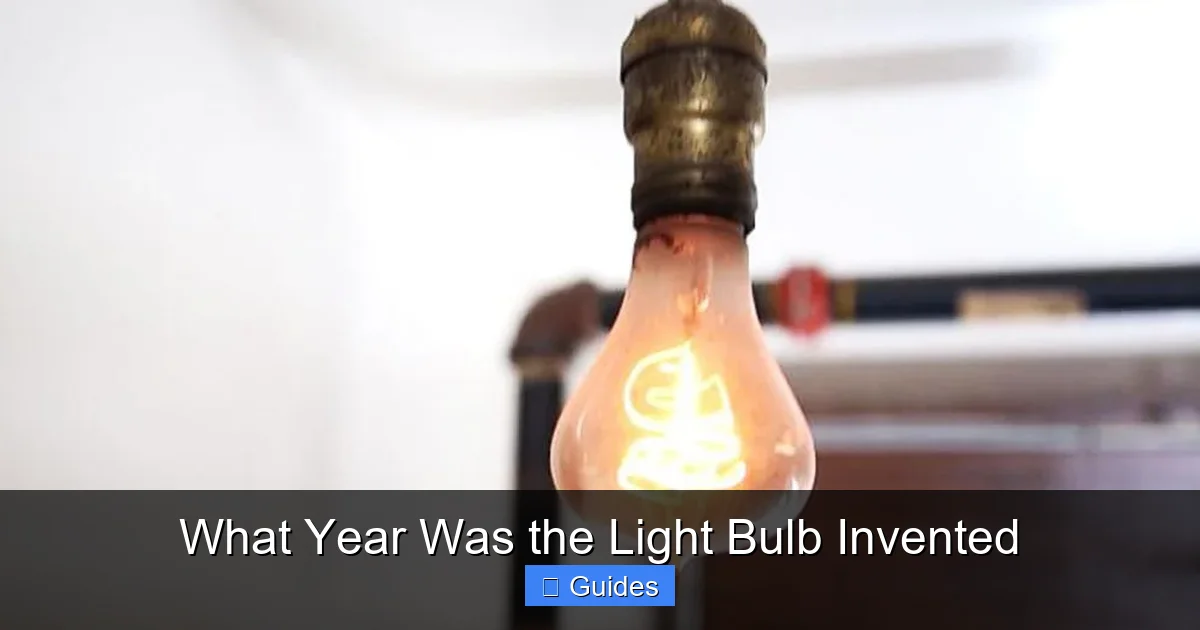
Visual guide about What Year Was the Light Bulb Invented
Image source: s.abcnews.com
Long before Edison’s famous experiments, the seeds of electric light were being sown by various innovators. These early attempts, while not resulting in the light bulb we know today, were crucial steps in understanding how electricity could be harnessed to produce illumination. Their work demonstrates that the answer to “what year was the light bulb invented” cannot be confined to a single decade.
Humphry Davy and the Arc Lamp (Early 1800s)
One of the earliest pioneers in electric lighting was the English chemist Humphry Davy. As early as 1802, Davy demonstrated the incandescent properties of platinum wire, but it was his work with the electric arc lamp that truly made waves. In 1809, using a large battery, he created the world’s first electric light by connecting two charcoal rods to the battery, producing a brilliant electric arc. This “arc lamp” was incredibly bright but also short-lived, impractical for domestic use, and produced significant heat and smoke. Despite its limitations, Davy’s arc lamp was the first significant demonstration that electricity could produce powerful illumination, setting the stage for future developments.
Warren de la Rue’s Platinum Coil (1840s)
Fast forward to the 1840s, and we see another crucial step. British scientist Warren de la Rue enclosed a coiled platinum filament in a vacuum tube and passed an electric current through it. Platinum was chosen for its high melting point, making it a promising material for a filament. The vacuum was important because it reduced the amount of gas in the bulb that could react with the filament and cause it to burn out quickly. While de la Rue’s bulb was effective, the high cost of platinum made it commercially unviable. However, it proved the concept of an incandescent bulb in a vacuum – a principle that would be vital to future successes.
Joseph Swan’s Carbon Filament (1860s-1870s)
By the 1860s and 1870s, another British inventor, Joseph Swan, was making significant strides. Swan experimented with carbonized paper filaments in an evacuated glass bulb. In 1860, he developed a long-lasting light bulb using a carbonized paper filament. However, the lack of a good vacuum pump made his bulbs impractical for widespread use; any remaining oxygen would quickly combust the carbon filament. By 1878, with improved vacuum technology, Swan demonstrated a much more durable and brighter incandescent lamp. He even installed electric lights in a few homes and public buildings in England. His work was remarkably similar to what Edison would achieve shortly after, adding another layer of complexity to “what year was the light bulb invented.” In fact, his innovations led to patent disputes with Edison later on.
Thomas Edison’s Breakthrough: The Practical Incandescent Light (1879 and Beyond)
While many contributed to the idea of electric light, it was Thomas Edison who turned a scientific curiosity into a practical, everyday reality. His work in 1879 is often cited as the definitive answer to “what year was the light bulb invented,” but it’s important to understand *why* his contribution was so transformative.
The Quest for a Long-Lasting Filament
Edison and his team at Menlo Park, New Jersey, were not just trying to make a bulb light up; they were trying to make one that would last for hundreds of hours, use less power, and be cheap enough to replace gas lighting. They tested thousands of different materials for filaments, including platinum, various metals, and even human hair! The breakthrough came in October 1879, when they discovered that a carbonized cotton thread filament could glow for over 13 hours. This wasn’t the final answer, but it was a huge step.
They continued refining, and by late 1879 and early 1880, Edison and his team found that a carbonized bamboo fiber filament could last for over 1,200 hours. This was an astonishing improvement and made the incandescent bulb practical for widespread adoption. This discovery, leading to his U.S. Patent 223,898 on January 27, 1880, for an “Electric-Lamp,” is largely why 1879-1880 is seen as a pivotal time for the question “what year was the light bulb invented.”
The 1879 Patent: A System, Not Just a Bulb
Edison’s true genius extended beyond just the bulb itself. He understood that a functional electric light wasn’t just about a glowing filament; it required an entire system. His 1879 patent, and subsequent work, included not only a long-lasting bulb but also:
- An improved vacuum pump to create a near-perfect vacuum within the bulb.
- A practical and safe screw-in socket.
- Switches for turning lights on and off.
- Generators to produce electricity efficiently.
- A distribution system (wires and conduits) to deliver electricity to homes and businesses.
- Meters to measure electricity consumption.
This comprehensive approach is what truly distinguishes Edison’s contribution. He didn’t just invent *a* light bulb; he invented the *system* that made electric lighting practical, safe, and accessible to the masses. This holistic vision is why his work in the late 1870s is so profoundly important when we discuss “what year was the light bulb invented.”
Building an Electrical Infrastructure
Following his technical breakthroughs, Edison moved swiftly to implement his system. In 1882, he opened the Pearl Street Station in New York City, the world’s first central power plant. This was a monumental undertaking, proving that electricity could be generated and distributed on a large scale, bringing light to homes and businesses across a district. This feat marked the true beginning of the age of electricity and practical electric light. The impact of this infrastructure development cannot be overstated when considering the real-world implications of “what year was the light bulb invented.”
The Global Race and Parallel Innovations
While Edison was making strides in the United States, it’s crucial to remember that scientific inquiry and innovation were global phenomena. Many other inventors around the world were independently pursuing similar goals, demonstrating the widespread need and potential for electric light. This simultaneous development further complicates a simple answer to “what year was the light bulb invented.”
Hiram Maxim, William Sawyer, Albon Man
In the United States, inventors like Hiram Maxim (who later invented the machine gun) also developed incandescent lamps around the same time as Edison. Maxim, working for the United States Electric Lighting Company, created an improved carbon filament lamp and even patented a chemical process for carbonizing filaments. Similarly, William Sawyer and Albon Man, working for the Electro-Dynamic Light Company, filed patents for incandescent lamps, leading to considerable patent battles with Edison’s company in the late 1870s and 1880s. These legal battles highlight just how competitive and active the field was.
In England, as mentioned, Joseph Swan was not only working on his carbon filament bulbs but also installing them in homes and public spaces, even before Edison’s big demonstrations. The eventual resolution involved Edison and Swan merging their interests in the UK to form the Edison & Swan United Electric Light Company, commonly known as “Ediswan,” which became a major manufacturer. This collaboration underscores the fact that the light bulb’s invention was a shared, international endeavor. So, when someone asks “what year was the light bulb invented,” it’s worth noting the global synchronicity of these efforts.
Continuing Refinements and Improvements
Even after the initial widespread adoption of Edison’s and Swan’s bulbs, the innovation didn’t stop. The journey from that early carbon filament to the bulbs we used for much of the 20th century involved continuous improvements:
- Tungsten Filaments: In the early 20th century, the discovery of tungsten as a filament material revolutionized the light bulb. Tungsten has a much higher melting point than carbon, allowing bulbs to burn brighter and last much longer. This key improvement made incandescent bulbs even more efficient and affordable.
- Inert Gas Fillings: Introducing inert gases like argon and nitrogen into the bulb chamber, instead of a complete vacuum, further reduced filament evaporation and increased bulb life and efficiency.
- Coiled Coils: Later designs featured double-coiled filaments (a coil of a coil) to achieve even greater light output and efficiency from a smaller filament.
These developments show that the “invention” of the light bulb was an ongoing process, a continuous quest for better illumination, far beyond the initial answer to “what year was the light bulb invented.”
The Lasting Impact and Evolution of Electric Light
The successful development of the practical incandescent light bulb fundamentally reshaped human civilization. It moved us away from reliance on candles, gas lamps, and oil lamps, offering safer, cleaner, and more convenient illumination. The impact was truly profound, far outweighing the simplicity of the question “what year was the light bulb invented.”
Transforming Society and Daily Life
With electric light, life no longer had to revolve around the sun. Workplaces could operate longer, extending productivity into the night. Homes became safer, free from the fire hazards and soot of open flames. Social life flourished as public spaces and private residences could be brightly lit. Cities were transformed, becoming safer and more vibrant after dark. Education also benefited, as students could study longer. The widespread adoption of electric light spurred the development of entire electrical grids and industries, creating countless jobs and driving technological progress in countless other areas. It allowed for the creation of modern skyscrapers, factories, and entertainment venues that would be impossible without reliable, widespread lighting.
From Incandescent to LED: A Bright Future
While the traditional incandescent bulb, born from the efforts culminating in the late 1870s, dominated for over a century, the evolution of lighting didn’t stop there. The late 20th and early 21st centuries saw the rise of more energy-efficient alternatives:
- Fluorescent Lamps: These became popular for commercial and industrial use due to their efficiency.
- Compact Fluorescent Lamps (CFLs): A smaller, spiral version designed to fit into standard incandescent sockets.
- Light-Emitting Diodes (LEDs): The latest revolution in lighting, LEDs are incredibly energy-efficient, long-lasting, and versatile. They use a completely different principle of light generation (electroluminescence) and represent a significant leap from the incandescent technology.
The journey from Humphry Davy’s arc lamp to Edison’s practical incandescent bulb, and now to the ubiquitous LED, is a testament to continuous innovation. The spirit of invention that drove the answer to “what year was the light bulb invented” continues to drive progress in lighting technology today.
In conclusion, when we ask “what year was the light bulb invented,” we are truly asking about a pivotal moment in a long and winding story of human ingenuity. While Thomas Edison’s patent in 1879 for a durable, practical incandescent lamp marks a critical turning point, it was the culmination of decades of research, experimentation, and incremental improvements by many different individuals. From Humphry Davy’s early arc lamp to Joseph Swan’s carbon filaments, each step was essential. Edison’s genius lay not just in the bulb itself, but in creating an entire system for generating and distributing electricity, making electric light accessible and transformative for society. The light bulb’s story is a shining example of how complex inventions are often the result of collaborative, persistent effort over time, illuminating the world in more ways than one.
🎥 Related Video: Ask History: Who Really Invented the Light Bulb? | History
📺 HISTORY
Thomas Edison wasn’t the only inventor to lay claim to the light bulb, so whose bright idea was it? Ask History finds out.
Frequently Asked Questions
Who is credited with inventing the light bulb?
While Thomas Edison is most famously credited for developing the first commercially practical and long-lasting incandescent light bulb in 1879, it was the result of numerous contributions from scientists and inventors who came before him and worked alongside him.
Was Thomas Edison the first to invent a light-emitting device?
No, Thomas Edison was not the first to invent a device that emitted light using electricity. Earlier inventors like Humphry Davy developed the arc lamp in the early 1800s, and Joseph Swan created functioning incandescent bulbs in the 1860s and 70s.
What made Edison’s light bulb different or more successful?
Edison’s bulb was unique because it featured a highly durable, high-resistance carbon filament that could last for hundreds of hours and was relatively inexpensive to produce. More importantly, he developed the entire electrical system—including generators, switches, and wiring—to make electric light practical and accessible for widespread use.
When did electric lights become common in homes?
Electric lights started becoming common in urban homes in the United States and Europe in the 1880s and 1890s, following the establishment of central power stations like Edison’s Pearl Street Station in 1882. However, widespread adoption across all areas took several more decades.
What materials were used in early light bulb filaments?
Early light bulb filaments experimented with a variety of materials, including platinum by Warren de la Rue, carbonized paper or cotton threads by Joseph Swan and early Edison experiments, and eventually carbonized bamboo fibers, which Edison patented.
Has the light bulb changed much since Edison’s time?
Yes, the light bulb has changed significantly! While incandescent bulbs using tungsten filaments (a post-Edison improvement) were dominant for a century, we now have much more energy-efficient technologies like fluorescent lamps and, most recently, highly advanced Light-Emitting Diodes (LEDs).
