


As an Amazon Associate, We earn from qualifying purchases.
The invention of the light bulb wasn’t a single “eureka!” moment by one person. Many brilliant minds across different countries contributed over decades, each building upon previous discoveries. While Thomas Edison is often credited, his genius lay in creating a practical, long-lasting, and commercially viable incandescent light bulb, rather than being the sole inventor of the concept itself.
When you think about the light bulb, one name usually springs to mind: Thomas Edison. You might even picture him in his lab in Menlo Park, New Jersey, holding up that iconic glowing glass sphere. It’s a powerful image, one that has been cemented in our collective memory through countless stories, textbooks, and movies. For many, the answer to “where was the light bulb invented?” is simply “Menlo Park, New Jersey,” and “by Thomas Edison.”
But here’s a little secret: the real story is much more complex, fascinating, and, dare we say, illuminating! The truth is, the light bulb didn’t pop into existence in one single moment, in one specific place, or at the hands of just one brilliant mind. Instead, it was the result of a global, incremental effort—a true testament to human ingenuity building upon itself over many decades. It’s a tale of countless experiments, breakthroughs, setbacks, and intense competition spanning several countries.
So, if you’re ready to peel back the layers of popular myth and dive into the true history, let’s explore the incredible journey of how the light bulb came to be. We’ll discover that the answer to “where was the light bulb invented” isn’t a simple address, but a tapestry woven across continents and through time.
Key Takeaways
- No Single Inventor: The light bulb, as we know it, was not invented by one person but was the culmination of decades of work by numerous scientists and inventors worldwide.
- A Global Effort: Contributions to the development of electric illumination came from England, Germany, the United States, and other countries, highlighting a collaborative scientific journey.
- Edison’s Key Contribution: Thomas Edison’s genius lay in perfecting the incandescent light bulb, making it practical, durable, and commercially viable through a high-resistance filament and an effective vacuum.
- Early Precursors: Inventors like Humphry Davy, Joseph Swan, and Heinrich Goebel created earlier forms of electric light and incandescent bulbs long before Edison’s famous patent.
- Systemic Innovation: Edison’s success also involved developing an entire system of power generation and distribution, making electric light accessible for general use, not just the bulb itself.
- Continuous Evolution: The light bulb’s story didn’t end with Edison; it continued to evolve with tungsten filaments, fluorescent lights, and modern LED technology.
- Intellectual Property Battles: The competitive nature of invention led to patent disputes, such as between Edison and Swan, underscoring the simultaneous independent discoveries happening globally.
Quick Answers to Common Questions
Who is often credited with inventing the light bulb?
Thomas Edison is most frequently credited with inventing the light bulb, largely due to his success in creating a practical and commercially viable version.
Was Edison the first person to create an electric light?
No, Edison was not the first. Many inventors before him, such as Humphry Davy and Joseph Swan, had created earlier forms of electric light or incandescent bulbs.
What was Edison’s most significant contribution to the light bulb’s development?
Edison’s primary contribution was perfecting the incandescent light bulb to be practical, long-lasting, and affordable for mass consumption, along with developing the entire system for electricity generation and distribution.
Where did many of the early experiments with electric light take place?
Early experiments occurred in various locations across the globe, including England (Humphry Davy, Joseph Swan), Germany (Heinrich Goebel), and Russia (Alexander Lodygin).
What key element did Edison use for his successful, long-lasting filament?
After many trials, Edison’s successful filament was made from carbonized bamboo fiber, which offered high resistance and a long lifespan for the era.
📑 Table of Contents
- The Global Race to Illumination: Who Really Invented the Light Bulb?
- Early Sparks of Genius: The Precursors to the Modern Light Bulb
- Thomas Edison’s Breakthrough: The Practical, Long-Lasting Light Bulb
- A World of Inventors: Simultaneous Innovations and Patent Wars
- The Light Bulb’s Evolving Legacy: From Carbon to LEDs
- So, Where Exactly Was the Light Bulb Invented? A Complex Answer
The Global Race to Illumination: Who Really Invented the Light Bulb?
It’s easy to credit one person with such a world-changing invention. After all, it gives us a neat, tidy narrative. However, the light bulb, in its most basic form, was a concept that many different inventors tinkered with long before Thomas Edison even stepped into a laboratory. The idea of creating light using electricity wasn’t exclusive to one nation or one inventor. It was a shared intellectual challenge that fascinated bright minds across the globe.
Beyond the Single Eureka Moment
Imagine a world without electric light—a world lit by candles, gas lamps, or simply the sun. The desire for a safer, brighter, and more convenient form of artificial illumination was a powerful driver for scientists and engineers in the 19th century. They were all grappling with the same fundamental problem: how to make a filament glow brightly without quickly burning out, and how to contain that glow in a vacuum to prevent oxidation. This wasn’t a singular “eureka!” moment; it was a long, arduous process of trial and error, with each discovery paving the way for the next. The journey to invent the light bulb was truly a marathon, not a sprint.
Early Sparks of Genius: The Precursors to the Modern Light Bulb
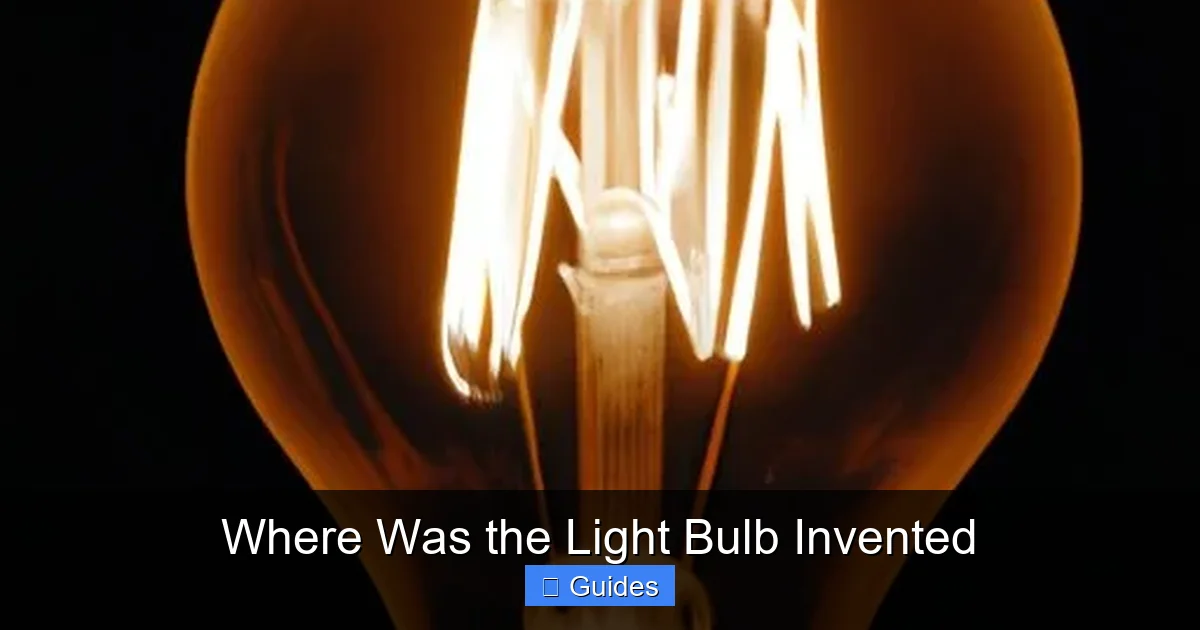
Visual guide about Where Was the Light Bulb Invented
Image source: lihpao.com
The story of the light bulb begins long before Edison. Early experiments with electricity and light date back to the early 1800s, laying the groundwork for what would eventually become the practical incandescent bulb.
Arc Lamps and the Dawn of Electric Light
The very first forms of electric light were actually arc lamps. In 1802, Humphry Davy, a British chemist, invented the electric arc lamp. He demonstrated this by connecting two charcoal rods to a large battery and drawing them apart slightly, creating a brilliant, sustained arc of light. It was astonishingly bright, but also extremely hot, consumed a lot of power, and quickly burned through its carbon rods. While not a “light bulb” in the incandescent sense, Davy’s invention showed the potential of electricity to produce intense light and sparked further interest in electric illumination. This was a crucial first step, showing that electric light was possible.
The Incandescent Idea Takes Hold
As the 19th century progressed, inventors began exploring the idea of incandescent light—making a material glow by heating it with electricity. This required a different approach than arc lamps.
* Warren de la Rue (1840): This British astronomer encased a coiled platinum filament in a vacuum tube and passed an electric current through it. Platinum was a good choice because it has a high melting point, but it was far too expensive to be practical for widespread use. Still, it proved the concept of an incandescent light bulb in a vacuum.
* Joseph Swan (1860): Another British physicist, Joseph Swan, was a key figure. He developed a “light bulb” using carbonized paper filaments in a vacuum glass bulb. His bulbs worked and were demonstrated successfully, but the vacuum pumps of the time weren’t good enough, and the filaments degraded too quickly to be commercially viable. He continued to improve his designs over the years.
* Heinrich Goebel (1850s): A German immigrant to the United States, Heinrich Goebel, claimed to have invented a long-lasting light bulb in the 1850s, using carbonized bamboo filaments inside evacuated perfume bottles. While his claims were later part of legal battles, and his early bulbs weren’t widely commercialized, his work highlighted the potential of bamboo as a filament material and demonstrated the long-held desire to invent the light bulb effectively.
These early efforts, though not commercially successful, were vital. They demonstrated the principles of incandescent light, highlighted the challenges (filament material, vacuum technology, power source), and showed that many minds were independently trying to invent the light bulb.
Thomas Edison’s Breakthrough: The Practical, Long-Lasting Light Bulb
So, if others were experimenting with incandescent light, what exactly did Thomas Edison do? His genius wasn’t in discovering the principle of electric light, but in making it practical, affordable, and durable enough for everyday use. He didn’t just invent the light bulb; he engineered a *system* for it.
The Menlo Park “Invention Factory”
Edison’s laboratory in Menlo Park, New Jersey, wasn’t just a place for random experiments. It was a well-organized “invention factory” where a team of researchers systematically tackled problems. When Edison turned his attention to the light bulb in 1878, he set out with a clear goal: to create an incandescent lamp that would be cheap enough, and last long enough, to compete with gas lighting. This meant he wasn’t just working on the bulb itself, but the entire infrastructure needed to support it.
The Quest for Longevity and Efficiency
Edison and his team embarked on thousands of experiments, testing nearly every conceivable material for the filament. They tried platinum, various metals, and different types of carbon. The key to a long-lasting bulb was finding a filament that had high electrical resistance (so it would glow brightly without needing enormous currents) and wouldn’t burn out quickly.
After countless failures, Edison’s team found their breakthrough: a carbonized cotton thread filament. They later improved this dramatically by using carbonized bamboo fiber. On October 22, 1879, a bulb with a carbonized cotton filament burned for 13.5 hours. Days later, on November 4, 1879, Edison filed his U.S. patent application for an electric lamp using a carbon filament. Further refinements led to a carbonized bamboo filament that could last for over 1,200 hours, a monumental achievement at the time. This was a pivotal moment in the history of the light bulb.
Building an Entire System
Edison understood that a light bulb, no matter how good, was useless without a way to power it. His vision extended beyond just the bulb. He developed:
* Improved Dynamos: More efficient generators to produce electricity.
* Parallel Wiring System: A system that allowed multiple bulbs to be connected without each one affecting the others (unlike series circuits, where if one bulb failed, all of them went out).
* Safety Fuses and Switches: Essential components for practical home use.
* Meters: To measure electricity consumption.
He basically created the world’s first complete electrical utility system. In 1882, he opened the Pearl Street Station in New York City, providing power for the first time to customers in Lower Manhattan. This meant that the answer to “where was the light bulb invented” in a truly practical sense, could arguably include New York City, where the *system* came to life. Edison’s success wasn’t just about his specific light bulb, but about making electric light a safe, reliable, and widespread reality.
A World of Inventors: Simultaneous Innovations and Patent Wars
While Edison was making his breakthroughs in the U.S., other inventors around the world were also hard at work, sometimes making remarkably similar discoveries independently. This often led to fascinating and intense patent battles.
The Swan vs. Edison Rivalry
One of the most prominent examples was the rivalry between Thomas Edison and Joseph Swan. As we mentioned, Swan had been working on incandescent bulbs for decades in England. By 1878, he had developed a long-lasting incandescent light bulb using a treated carbonized cotton filament, which he publicly demonstrated in 1879—the same year Edison filed his patent. Swan’s bulbs were actually performing very well and were installed in homes and public buildings in England.
This led to significant legal disputes over patent infringement. Eventually, the two giants decided to join forces rather than continuously fight. In 1883, they formed the “Edison & Swan United Electric Light Company” (or “Ediswan”), which became one of the largest light bulb manufacturers in the world. This merger perfectly illustrates that the light bulb wasn’t invented in one exclusive corner of the world, but through parallel innovation.
A Global Pursuit
Beyond Edison and Swan, many others contributed to the advancement of electric lighting:
* Alexander Lodygin (Russia): Patented an incandescent lamp in 1874 using a carbon rod filament in a vacuum. He later improved his design with a tungsten filament in the early 20th century.
* William Sawyer and Albon Man (USA): These inventors patented an incandescent electric lamp with a carbon conductor in 1878, leading to their own legal clashes with Edison.
* Lewis Howard Latimer (USA): An African American inventor and draftsman who worked for Edison. Latimer made crucial improvements, including a method for manufacturing durable carbon filaments, which significantly extended the life of Edison’s bulbs. His work was essential in making the light bulb commercially viable.
These simultaneous developments highlight a crucial point: when the conditions are right, and a problem is pressing, similar solutions often emerge from different places at roughly the same time. The “where was the light bulb invented” question really encompasses a global network of intellect.
The Light Bulb’s Evolving Legacy: From Carbon to LEDs
The story of the light bulb didn’t end with Edison’s practical incandescent lamp. The journey of electric illumination continued to evolve dramatically, with each innovation building on the shoulders of previous discoveries.
The Tungsten Revolution
Edison’s carbonized bamboo filament was a major leap, but it wasn’t the final word. Scientists continued to search for more efficient and longer-lasting materials. The next big breakthrough came with tungsten. Tungsten has an incredibly high melting point, allowing filaments to glow hotter and brighter, producing more light with less energy.
In the early 1900s, General Electric’s Willis Whitney and William Coolidge played pivotal roles in developing a ductile tungsten filament that could be drawn into fine wires. By 1907, GE introduced the first commercial tungsten filament light bulb, which was a vast improvement over carbon filaments in terms of efficiency and lifespan. This invention effectively made the carbon filament light bulb obsolete and set the standard for incandescent bulbs for the next century. So, while the initial concept of the practical light bulb was largely refined in Menlo Park, its most successful form came from further innovation elsewhere.
Beyond Incandescent: New Forms of Illumination
The evolution didn’t stop at incandescent bulbs. The 20th century saw the invention and widespread adoption of entirely new types of electric lights:
* Fluorescent Lamps (1930s): These lamps produce light by exciting gases (like mercury vapor) with electricity, causing them to emit ultraviolet light, which then makes a phosphor coating glow. They were significantly more energy-efficient than incandescent bulbs.
* Halogen Lamps (1950s): A type of incandescent lamp that uses a halogen gas to regenerate the tungsten filament, extending its life and allowing it to run hotter for brighter light.
* LEDs (Light-Emitting Diodes, 1960s, popularized later): Initially developed for indicator lights, LEDs have undergone incredible advancements. They are semiconductors that emit light when an electric current passes through them. Today, LED technology is revolutionizing lighting again, offering unparalleled energy efficiency, durability, and versatility. They are slowly replacing traditional light bulbs in homes and businesses worldwide.
Each of these developments pushed the boundaries of what electric light could do, making it more efficient, more versatile, and more sustainable. The journey to invent the light bulb wasn’t a singular event but a continuous process of refinement and re-invention.
So, Where Exactly Was the Light Bulb Invented? A Complex Answer
By now, it should be clear that the question “where was the light bulb invented?” doesn’t have a simple, single answer. It was not invented in one specific location, but rather evolved through a series of discoveries and refinements made by different people in different places.
The earliest concepts of electric light, like Humphry Davy’s arc lamp, emerged from laboratories in England. The first truly incandescent prototypes were explored in places like England (Joseph Swan), Germany (Heinrich Goebel), and even Russia (Alexander Lodygin). The pivotal moment of creating a *practical, long-lasting, and commercially viable* incandescent light bulb system, complete with its power infrastructure, largely took shape at Thomas Edison’s Menlo Park laboratory in New Jersey, USA. But even that achievement was quickly followed by parallel and competing developments in Britain by Joseph Swan.
A Legacy of Collaboration and Innovation
Ultimately, the light bulb is a shining example of how science and innovation truly work: it’s a cumulative process. Each inventor built upon the knowledge and experiments of those who came before them. Edison himself famously said, “I have not failed. I’ve just found 10,000 ways that won’t work.” His success, and the success of others, came from relentless persistence and a deep understanding of previous attempts.
So, the next time you flip a switch and a room fills with light, remember that you’re witnessing the culmination of centuries of human curiosity, experimentation, and collaboration. It’s a light that truly belongs to the world, a testament to global ingenuity rather than a singular moment of invention. The light bulb wasn’t invented in one place; it was invented *everywhere* that a curious mind sought to harness electricity for illumination. It’s a story much richer than any simple myth, and it continues to evolve even today.
Frequently Asked Questions
What was the earliest form of electric light?
The earliest form of electric light was the electric arc lamp, demonstrated by Humphry Davy in 1802. It produced a very bright light but was impractical for general use due to its intense heat and rapid consumption of carbon rods.
What material did Thomas Edison primarily use for his successful light bulb filament?
Thomas Edison primarily used carbonized bamboo fiber for his most successful early light bulb filaments. This material offered a good balance of high electrical resistance and durability, allowing the bulb to burn for hundreds of hours.
Were there other inventors who patented light bulbs before Edison?
Yes, several inventors patented forms of incandescent light bulbs before Edison. Joseph Swan in England and Alexander Lodygin in Russia, for instance, had patents for their own versions of electric lamps well before Edison filed his patent in 1879.
Why is Thomas Edison so widely associated with the invention of the light bulb if others came before him?
Edison’s enduring fame stems from his ability to not only create a durable and affordable light bulb but also to develop the entire system for its practical use, including generators, wiring, and distribution. His systematic approach and strong marketing made electric light accessible to the public.
When did the first incandescent light bulbs begin to appear?
Incandescent light bulbs, in various experimental forms, began to appear as early as the 1840s with inventors like Warren de la Rue. More refined, though still not commercially practical, versions were demonstrated in the 1850s and 1860s by Heinrich Goebel and Joseph Swan.
Has the light bulb continued to evolve since Edison’s time?
Absolutely. The light bulb has undergone continuous evolution, moving from carbon filaments to more efficient tungsten filaments in the early 1900s, then to fluorescent lamps, and more recently to highly energy-efficient LED technology, which continues to advance rapidly.
