


As an Amazon Associate, We earn from qualifying purchases.
The light bulb wasn’t invented by a single person at a single moment, but rather evolved through decades of innovation. Many brilliant minds contributed to its development, improving various components and overcoming significant challenges. While Joseph Swan and others created early versions, Thomas Edison is most famous for perfecting a long-lasting, commercially practical incandescent bulb in 1879, making electric light widely accessible.
Imagine a world without light bulbs. A world where darkness truly falls with the setting sun, where work stops, and social life is dictated by the flicker of candles or dim glow of gas lamps. It’s a challenging thought, isn’t it? Electric light is so deeply embedded in our daily lives that we rarely stop to consider its origin or the incredible journey it took to become what it is today.
Many people instantly associate the invention of the light bulb with one name: Thomas Edison. While Edison undoubtedly played a monumental role in bringing practical, widespread electric light to the world, the story of “when was light bulb invented” is far more complex and fascinating than a single Eureka moment. It’s a tale of numerous brilliant minds, persistent experimentation, and incremental advancements stretching over decades.
So, if you’re asking yourself, “when was light bulb invented?” prepare to embark on a journey through history, exploring the pioneers, the challenges, and the ultimate triumph that illuminated our world. It’s a story not just about an object, but about human ingenuity and the relentless pursuit of progress.
Key Takeaways
- A Collective Effort: The light bulb wasn’t a singular invention but the culmination of contributions from numerous scientists and inventors over decades, each building upon previous work.
- Early Pioneers Set the Stage: Inventors like Humphry Davy, Warren de la Rue, and Joseph Wilson Swan developed early forms of electric light, demonstrating the concept of incandescence long before Edison’s breakthrough.
- The Crucial Role of the Filament: The quest for a durable, high-resistance filament that could glow brightly for extended periods was central to creating a practical light bulb, with carbonized materials proving vital.
- Thomas Edison’s Breakthrough: While not the first to invent an electric light, Thomas Edison is widely credited with inventing the first *commercially practical and long-lasting incandescent light bulb* in 1879.
- Beyond the Bulb Itself: Edison’s true genius extended beyond just the bulb; he developed an entire system for generating and distributing electricity, making electric light feasible and affordable for homes and businesses.
- Impact on Modern Life: The successful invention of the practical light bulb revolutionized industries, extended productivity into the night, and fundamentally changed daily life, paving the way for our electrically lit world.
Quick Answers to Common Questions
Who is generally credited with inventing the practical incandescent light bulb?
Thomas Edison is widely credited with inventing the first commercially practical and long-lasting incandescent light bulb.
When did Thomas Edison invent his famous practical light bulb?
Thomas Edison successfully demonstrated his long-lasting, practical incandescent light bulb in 1879.
What was a major challenge in developing early light bulbs before Edison’s success?
A major challenge was finding a filament material that could glow brightly for an extended period without quickly burning out, along with achieving a near-perfect vacuum inside the bulb.
Were there inventors before Edison who created electric lights or early light bulbs?
Yes, many inventors like Humphry Davy (arc lamp) and Joseph Swan (early carbon filament bulb) made significant contributions to electric light before Edison.
What was revolutionary about Edison’s light bulb beyond just the bulb itself?
Edison’s true revolution was developing an entire integrated system for electric lighting, including generators, wiring, and distribution, making electric light accessible and practical for homes and businesses.
📑 Table of Contents
The Dawn of Electric Light: Early Discoveries and Pioneers
The idea of creating light from electricity wasn’t born in a single year or by a single person. Long before Thomas Edison entered the scene, scientists and inventors around the globe were experimenting with various forms of electric light. Their early discoveries laid the foundational knowledge upon which all later innovations would be built. To truly understand when was the light bulb invented, we must look at these crucial early steps.
Humphry Davy and the Arc Lamp
The very first demonstrations of electric light date back to the early 19th century. In 1802, British chemist Humphry Davy invented what he called the “electric arc lamp.” He achieved this by connecting wires to a battery and attaching charcoal electrodes to the other ends. When he brought these electrodes close together, an intense, brilliant arc of light was produced. Davy’s arc lamp was incredibly powerful and exciting, a marvel of its time. However, it was also impractical for everyday use: it was too bright for indoor spaces, consumed vast amounts of power, and required constant adjustment as the charcoal electrodes burned away quickly. But it was a monumental first step, showing the potential of electricity to create light.
The Quest for Incandescence
While the arc lamp was a powerful demonstration, inventors soon realized that a different principle was needed for practical indoor lighting. This principle was “incandescence” – the emission of light by a body as a result of being heated. The challenge was to find a material that could be heated to incandescence by electricity without quickly burning up or melting. This is where the long and difficult search for the perfect filament began, a key chapter in the story of when was the light bulb invented.
Early experimenters tried various materials. In 1840, British scientist Warren de la Rue enclosed a coiled platinum wire in a vacuum tube and passed an electric current through it. Platinum was an excellent choice because of its high melting point, allowing it to glow brightly without melting. However, platinum was extremely expensive, making this bulb economically unfeasible for widespread use. Other inventors like American John W. Starr also experimented with platinum and carbonized filaments in the 1840s, patenting an incandescent light bulb with a vacuum chamber, but again, longevity and cost were major hurdles.
Joseph Wilson Swan: A Near Breakthrough
One of the most significant figures in the pre-Edison era was Joseph Wilson Swan, another British physicist and chemist. Swan began experimenting with incandescent lighting in the 1850s. By 1860, he developed a “light bulb” using carbonized paper filaments in an evacuated glass bulb. He even demonstrated a working prototype! However, the vacuum technology of the time was not advanced enough to create a truly perfect vacuum, meaning that oxygen traces still remained in the bulb. This caused his filaments to burn out quickly, often within minutes. Despite this, Swan’s work was incredibly important; he was on the right track, grappling with the same fundamental problems Edison would later conquer. His contributions are vital when considering when was light bulb invented.
The Race for a Practical Bulb in the Late 19th Century
By the 1870s, the concept of incandescent light was well-understood, but a truly practical, long-lasting, and affordable light bulb remained elusive. Many inventors around the world were locked in a fierce competition to solve the remaining problems. This period truly highlights the intensity surrounding the question of when was light bulb invented.
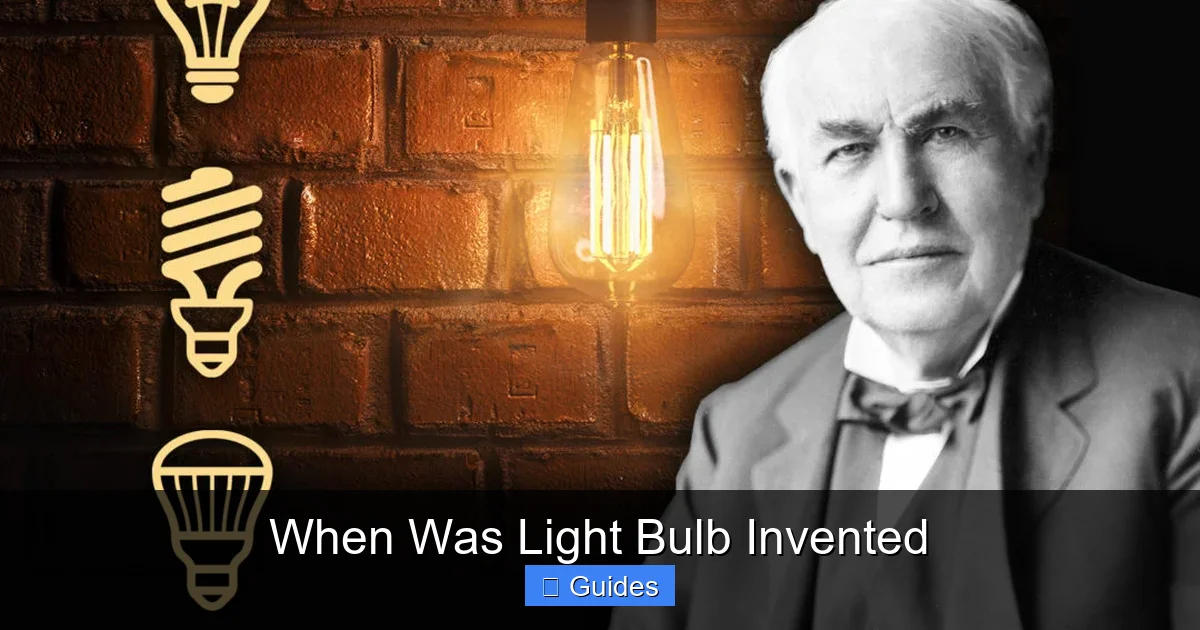
Visual guide about When Was Light Bulb Invented
Image source: opiniondynamics.com
Challenges: Durability, Cost, Brightness
The main challenges facing inventors were multifaceted. Firstly, durability: filaments needed to last for hundreds of hours, not just minutes or a few days. Secondly, cost: the materials and manufacturing process had to be affordable for mass production. Thirdly, brightness: the light needed to be bright enough to illuminate a room effectively, but not blindingly so like the arc lamp. And finally, efficiency: the bulb needed to convert a significant portion of electrical energy into light, rather than wasted heat.
The Importance of a Vacuum
A crucial realization was the absolute necessity of a near-perfect vacuum inside the glass bulb. If even a tiny amount of oxygen remained, the filament, heated to extreme temperatures, would quickly oxidize and burn out, much like a charcoal briquette exposed to air. Advances in vacuum pump technology in the 1870s, particularly the Sprengel pump, were instrumental in making a durable incandescent bulb possible. This technological leap allowed inventors to create bulbs where filaments could glow without immediate combustion, dramatically extending their lifespan.
Other Notable Contributors
While Swan was a prominent figure, he wasn’t alone. Henry Woodward improved on Starr’s earlier work in the US. Russian inventor Alexander Lodygin patented an incandescent lamp in 1874, also using carbon filaments in an evacuated globe. He even demonstrated street lighting in St. Petersburg! Even in Britain, St. George Lane Fox improved on Swan’s design, using treated carbonized grass filaments and achieving reasonable lifespans. Each of these inventors contributed small but significant pieces to the puzzle, pushing the boundaries of what was possible and bringing us closer to understanding when was light bulb invented in a practical sense.
Thomas Edison’s Breakthrough: Persistence and System
When most people ask “when was light bulb invented?” they are usually thinking of Thomas Edison, and for good reason. While he didn’t invent the *concept* of the electric light, he invented the *first commercially practical and long-lasting incandescent light bulb* and, crucially, the entire system to support it. His contribution transformed a scientific curiosity into a global utility.
Edison’s Approach: Iteration and Teamwork
Edison’s genius lay not just in his own intellect but in his methodical approach to invention. At his famous Menlo Park laboratory in New Jersey, he assembled a team of skilled engineers and machinists. They weren’t just guessing; they systematically tested thousands of materials and configurations. Edison famously said, “I have not failed 10,000 times. I have successfully found 10,000 ways that will not work.” This relentless iteration was key to his success.
The Filament Experimentation: Cotton Thread to Bamboo
Edison and his team embarked on an exhaustive search for the ideal filament. They tested an astonishing array of materials: platinum, various metals, and countless carbonized organic substances. Early experiments in 1879 showed promise with a high-resistance platinum filament, but it was still too expensive. The breakthrough came when they tried a carbonized cotton sewing thread filament. On October 22, 1879, a bulb with this filament burned for an incredible 13.5 hours – a significant leap in longevity. This was a critical moment for when was light bulb invented practically.
Following this success, Edison continued to experiment, eventually finding that a carbonized bamboo fiber filament offered an even longer lifespan. In late 1879 and early 1880, bulbs with these bamboo filaments achieved lifespans of up to 1,200 hours. This was the game-changer. Finally, a light bulb existed that was durable enough, bright enough, and efficient enough for widespread use.
More Than Just a Bulb: The Electric Lighting System
Edison understood that a light bulb, no matter how good, was useless without a way to power it. His true visionary stroke was developing an entire, integrated system for electric lighting. This included efficient generators, stable voltage regulation, fuses, durable wiring, meters, and practical lamp sockets. He envisioned and then built the world’s first central power station, opening in Pearl Street, New York City, in 1882. This station provided electricity to customers throughout the area, making electric light accessible to homes and businesses on a grand scale. This holistic approach is why Edison’s answer to “when was light bulb invented” is so definitive for practical application.
The Impact of the Practical Light Bulb
The successful development of a long-lasting and affordable light bulb, coupled with an integrated distribution system, had a profound and immediate impact on society. It wasn’t just an improvement; it was a revolution.
Revolutionizing Homes and Workplaces
Before electric light, homes were lit by candles, whale oil lamps, or gaslight. These methods were often dim, produced significant heat, carried fire risks, and emitted soot and unpleasant odors. Electric light changed everything. Homes became brighter, cleaner, and safer. People could read, socialize, and work much later into the evenings.
In workplaces, the impact was even more dramatic. Factories could operate 24 hours a day, leading to increased productivity and economic growth. Mines became safer. Offices could be better lit, reducing eye strain. The practical light bulb quite literally extended the workday and the active hours of life for millions, redefining human experience and productivity.
Safety and Convenience Over Gaslight
Gaslight, while an improvement over earlier forms, still carried significant risks. Gas leaks could lead to explosions, and open flames were a constant fire hazard. The installation of gas lines was also complex and expensive. Electric light, once properly installed, was far safer and more convenient. No more igniting individual lamps, no more worrying about fumes or carbon monoxide. The flip of a switch brought instant, reliable illumination.
Economic and Social Transformation
The light bulb spurred entire new industries: electrical generation, manufacturing of bulbs and fixtures, wiring installation, and more. It created countless jobs and fostered technological innovation. Cities became brighter and, arguably, safer places after dark. The ability to light public spaces effectively transformed urban nightlife and commerce. The question of when was light bulb invented leads directly to the answer of when the modern, constantly illuminated world began.
Beyond Edison: Continuous Innovation and the Future of Light
While Edison’s 1879 incandescent bulb was a groundbreaking achievement, the story of electric light didn’t end there. Innovation continued, leading to even more efficient and versatile lighting solutions.
Tungsten Filaments and Improved Efficiency
Edison’s carbonized bamboo filament was good, but not perfect. The next major leap in incandescent technology came with the development of the tungsten filament. In 1904, Hungarian inventors Sándor Just and Franjo Hanaman patented a tungsten filament lamp. Tungsten has a much higher melting point than carbon, allowing it to glow brighter and hotter without melting, thus producing more light per watt of electricity. In 1913, General Electric scientist William Coolidge developed a method for making ductile tungsten filaments, which were stronger and more reliable. This made tungsten incandescent bulbs the industry standard for decades, significantly improving the efficiency and lifespan of the basic light bulb that started with Edison’s efforts.
Fluorescent Lighting: A New Era
The mid-20th century saw the introduction of fluorescent lighting. Instead of heating a filament, fluorescent lamps produce light by exciting gases (like mercury vapor) with electricity, causing them to emit ultraviolet light. This UV light then strikes a phosphor coating inside the bulb, which converts it into visible light. Fluorescent lamps were far more energy-efficient and had much longer lifespans than incandescent bulbs, making them ideal for large commercial and industrial spaces. They represented a fundamental shift in how light was produced electrically.
The LED Revolution: Light Today and Tomorrow
Today, we are in the midst of another lighting revolution: Light Emitting Diodes, or LEDs. LEDs produce light when an electric current passes through a semiconductor material. They are incredibly energy-efficient, durable, and have incredibly long lifespans, often lasting tens of thousands of hours. LEDs are rapidly replacing both incandescent and fluorescent lighting in almost every application, from smartphones to streetlights. This ongoing evolution highlights that while we answer “when was light bulb invented” in terms of its practical debut, the journey of lighting technology is never truly finished.
Conclusion
So, when was light bulb invented? The simple answer, often attributed to Thomas Edison, points to 1879. However, the richer, more accurate answer reveals a long and complex history of discovery and invention, stretching back to the early 1800s.
Many brilliant minds laid the groundwork, experimenting with arc lamps, platinum filaments, and early carbon designs. Joseph Swan, in particular, came tantalizingly close to a practical solution years before Edison. What set Edison apart was his relentless pursuit of a *practical* and *commercial* solution, combining a long-lasting filament with an evacuated bulb and, critically, an entire system for generating and distributing electricity.
The light bulb, in its practical form, didn’t just illuminate rooms; it illuminated an entire age, transforming society, industry, and daily life in ways that are still evident today. It stands as a testament to human curiosity, perseverance, and the collaborative spirit of scientific and engineering endeavor, continually evolving to meet our ever-growing need for light.
🎥 Related Video: Invention Of BULB | The Dr. Binocs Show | Best Learning Video for Kids | Preschool Learning
📺 Peekaboo Kidz
Here’s Presenting The Dr. Binocs Show SEASON 2 – Inventions Learn all about the Invention Of BULB from Dr. Binocs himself …
Frequently Asked Questions
Why is Edison often credited if others came before him?
Edison is credited because he not only created a light bulb that was durable and efficient enough for widespread use, but he also developed the entire electrical infrastructure needed to power and distribute it, making electric light a practical reality for the masses. His contribution was about commercial viability and system integration, not just the bulb’s invention.
What kind of filament did Edison use in his 1879 practical bulb?
Edison’s breakthrough 1879 bulb used a carbonized cotton sewing thread filament. After further experimentation, he soon found that a carbonized bamboo fiber filament provided an even longer lifespan, up to 1,200 hours, making it highly practical.
How long did Edison’s first practical light bulb last?
Edison’s initial successful demonstration with a carbonized cotton thread filament in October 1879 lasted for an impressive 13.5 hours. He later improved upon this with carbonized bamboo, achieving lifespans of up to 1,200 hours, which was revolutionary for its time.
Did the invention of the light bulb happen in one specific year?
No, the invention of the light bulb was not a single event in one specific year. It was a gradual process of innovation and improvement spanning several decades, with many scientists and inventors contributing to different aspects of electric lighting technology before Edison’s practical breakthrough.
What was the main disadvantage of early electric lights before Edison?
Before Edison’s practical light bulb, the main disadvantages of early electric lights were their short lifespan (filaments burning out quickly), high cost, and lack of a robust electrical distribution system. This made them impractical for widespread residential or commercial use, despite demonstrating the potential of electric light.
How did the light bulb change daily life?
The light bulb dramatically changed daily life by extending productive hours beyond daylight, making homes and workplaces safer and cleaner compared to gas or oil lamps. It enabled night shifts in factories, boosted urban activity, and provided unprecedented convenience, fundamentally shaping modern society and its economy.
