


As an Amazon Associate, We earn from qualifying purchases.
The incandescent light bulb wasn’t a single invention by one person, but rather the culmination of decades of work by numerous scientists and inventors. While Thomas Edison is widely credited for making the first commercially practical and long-lasting incandescent light bulb in 1879 with his carbonized cotton filament, many others, like Humphry Davy and Joseph Swan, laid crucial groundwork years before. Edison’s genius lay in refining existing concepts, developing a durable filament, and creating an entire electrical system to make the bulb viable for homes and businesses.
When Was the Incandescent Light Bulb Invented?
Imagine a world without light at the flick of a switch. A world where darkness truly meant darkness once the sun set, interrupted only by the flickering glow of candles, oil lamps, or gaslights. It’s hard to picture, isn’t it? Our modern lives are utterly dependent on artificial illumination, and it all began, for most of us, with the humble incandescent light bulb.
But here’s a curious thing: ask anyone who invented the light bulb, and almost universally, you’ll hear one name: Thomas Edison. And while Edison absolutely played a pivotal, undeniable role in bringing practical electric light to the world, the story of the incandescent light bulb is far richer, more complex, and involves a cast of characters much larger than one lone genius. It’s a tale of incremental discovery, scientific experimentation, and relentless perseverance across continents and decades.
So, when *was* the incandescent light bulb invented? The simple answer is, there’s no single “eureka!” moment or an exact date attributed to one person. Instead, it was a long, winding journey of innovation. This article will shine a light on the many brilliant minds who contributed to its development, explain what made Edison’s version so groundbreaking, and trace the path from early sparks to widespread illumination. Let’s peel back the layers of history and discover the full story together!
Key Takeaways
- No Single Inventor: The incandescent light bulb was not invented by one person in a single moment, but evolved through the contributions of many inventors over several decades.
- Early Precursors: Sir Humphry Davy demonstrated the electric arc lamp in 1802, providing early evidence that electricity could produce light, though it wasn’t an incandescent bulb.
- Quest for Practicality: Early inventors like Joseph Swan (UK) and Heinrich Goebel (Germany) made significant strides in the mid-19th century with vacuum bulbs and carbonized filaments, but faced challenges with durability and cost.
- Edison’s Breakthrough (1879): Thomas Edison’s key contribution was not inventing the concept, but making the incandescent light bulb commercially viable. His 1879 patent featured a high-resistance, long-lasting carbonized cotton filament, combined with an improved vacuum pump and an entire electrical distribution system.
- Parallel Developments and Collaboration: Joseph Swan developed a similar long-lasting bulb around the same time as Edison. Their rivalry eventually led to a merger in the UK, forming Ediswan, highlighting the concurrent progress in different parts of the world.
- Systemic Innovation: Edison’s lasting impact was not just the bulb itself, but his creation of a complete system—generators, wiring, meters, and sockets—that allowed electricity and the incandescent light bulb to be practically brought into homes and businesses.
- Evolution, Not Just Invention: The incandescent light bulb continued to evolve after Edison and Swan, notably with the introduction of the tungsten filament in the early 20th century, which significantly improved efficiency and lifespan.
Quick Answers to Common Questions
Question 1?
When is the incandescent light bulb commonly thought to have been invented?
Answer 1?
The incandescent light bulb is commonly associated with Thomas Edison’s work in 1879, who developed a commercially practical and long-lasting version.
Question 2?
Did anyone invent an electric light before Edison?
Answer 2?
Yes, Sir Humphry Davy demonstrated the electric arc lamp in 1802, and several inventors, including Joseph Swan, worked on incandescent bulbs decades before Edison.
Question 3?
What was Edison’s main contribution to the incandescent light bulb?
Answer 3?
Edison’s primary contribution was creating the first commercially viable incandescent light bulb with a long-lasting, high-resistance carbon filament, and establishing an entire electrical distribution system to make it practical for homes.
Question 4?
Who was Joseph Swan, and what was his role?
Answer 4?
Joseph Swan was a British physicist who independently developed a long-lasting carbon filament incandescent light bulb around the same time as Edison, leading to a eventual merger of their companies in the UK.
Question 5?
What material improved the incandescent light bulb after Edison’s carbon filament?
Answer 5?
The tungsten filament, introduced in the early 20th century, significantly improved the efficiency and lifespan of the incandescent light bulb.
📑 Table of Contents
- The First Sparks: Early Explorations into Electric Light
- The Quest for a Practical Incandescent Bulb: Early Attempts and Breakthroughs
- Edison Enters the Scene: Systemic Innovation and the Long-Lasting Filament
- The Swan-Edison Rivalry and Collaboration
- Beyond Edison and Swan: Continuous Improvement and the Incandescent Light Bulb’s Evolution
- Conclusion: A Symphony of Innovation
The First Sparks: Early Explorations into Electric Light
Before we get to the incandescent light bulb as we know it, we need to understand the very first attempts to harness electricity for illumination. The idea of creating light from electricity dates back to the very beginning of electrical science.
Humphry Davy’s Arc Lamp (1802)
The earliest significant demonstration of electric light came from British chemist Sir Humphry Davy in 1802. Using a powerful electric battery, he connected two charcoal rods to it. When he brought the rods close together, a brilliant, dazzling arc of light sprang between them. This was the first electric arc lamp. Davy later demonstrated a much larger version in 1808 to the Royal Institution, producing “a most brilliant ascending arch of light.”
This was revolutionary! For the first time, people saw electricity creating a sustained, powerful light. However, Davy’s arc lamp wasn’t the kind of light we’d want in our homes. It was incredibly bright, intensely hot, consumed a lot of power, and quickly burned through its charcoal electrodes. It was more suitable for streetlights or lighthouses, if it could be made more practical, than for interior lighting. Crucially, it wasn’t *incandescent* in the way we think of a light bulb today. Incandescence refers to light produced by heat, typically from a thin filament heated to white-hot temperatures, whereas an arc lamp produces light through an electrical discharge across a gap.
The Limitations of Arc Lamps
While impressive, arc lamps had several major drawbacks. They produced an uneven, harsh light, were extremely noisy due to the constant adjustment needed for the electrodes, and posed a fire risk due to their intense heat. They also required significant maintenance as the electrodes were consumed rapidly. Scientists and inventors quickly realized that for general illumination, a different approach was needed – one that focused on heating a material to incandescence within a sealed environment.
The Quest for a Practical Incandescent Bulb: Early Attempts and Breakthroughs
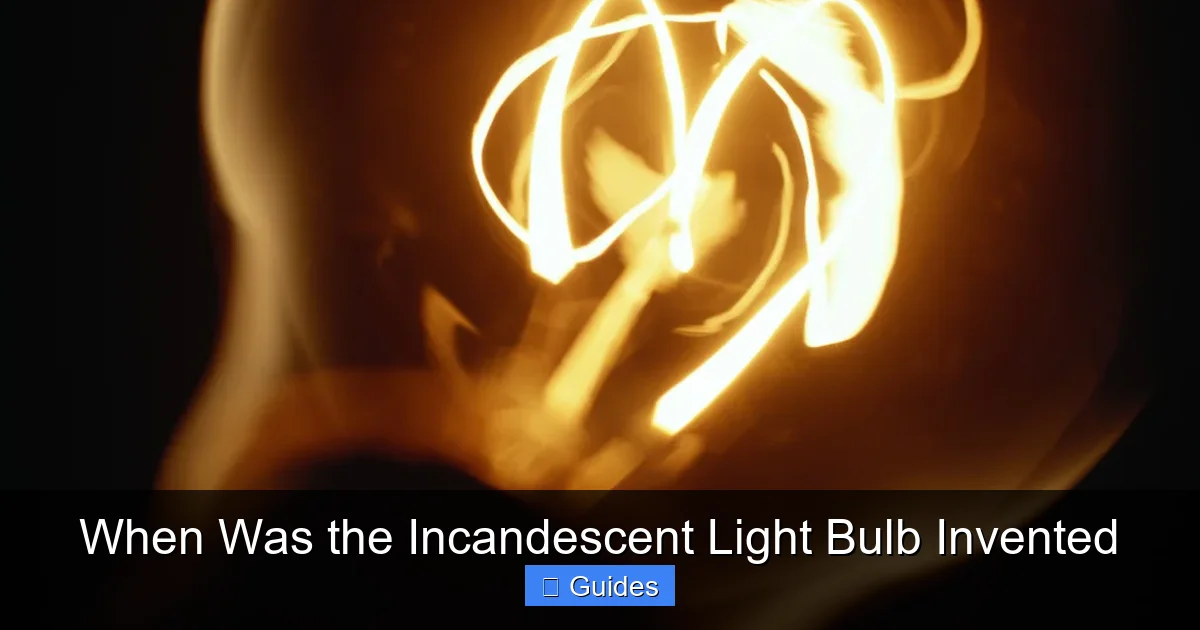
Visual guide about When Was the Incandescent Light Bulb Invented
Image source: photos.demandstudios.com
The concept of creating light by heating a filament to incandescence within a vacuum or inert gas was the true precursor to the modern bulb. Many inventors tinkered with this idea throughout the mid-19th century.
De la Rue’s Platinum Coil (1840)
In 1840, British scientist Warren De la Rue developed an early incandescent light bulb by enclosing a coiled platinum filament in a vacuum tube. Platinum was chosen because of its high melting point, allowing it to glow brightly without melting. While this worked, platinum was prohibitively expensive, making the bulb commercially impractical. This highlights a recurring theme: many inventors had technically working bulbs, but cost, durability, and efficiency were huge hurdles.
Joseph Swan’s Early Efforts (1860)
Another key figure in the incandescent light bulb’s history is British physicist and chemist Joseph Swan. As early as 1860, Swan demonstrated a working incandescent light bulb using carbonized paper filaments in an evacuated glass bulb. He even received a British patent for it. However, the vacuum technology of the time wasn’t sophisticated enough to create a strong enough vacuum, and the filaments degraded too quickly. The bulbs had very short lifespans, measured in minutes rather than hours. This prevented them from becoming a viable product. Swan continued his research, driven by the belief that a durable, long-lasting incandescent light bulb was possible.
Heinrich Goebel and the German Contribution (1850s)
It’s also worth noting Heinrich Goebel, a German clockmaker, who reportedly created his own incandescent light bulbs in the 1850s. Using carbonized bamboo filaments inside evacuated perfume bottles, he used them to light his New York City shop. While his claims were later brought up in patent disputes, and the extent of his practical influence is debated, his work further illustrates that the concept of an incandescent light bulb was being explored by many independent thinkers.
By the 1870s, technology had advanced. Better vacuum pumps were developed, capable of evacuating bulbs more effectively, and carbon filaments were becoming more refined. The stage was set for someone to combine these advancements into a truly practical device.
Edison Enters the Scene: Systemic Innovation and the Long-Lasting Filament
This brings us to the most famous name associated with the incandescent light bulb: Thomas Alva Edison. While he didn’t “invent” the light bulb from scratch, his genius lay in his systematic approach, his relentless experimentation, and his ability to turn a scientific curiosity into a practical, commercially viable product for the masses.
The Menlo Park “Invention Factory”
Edison’s laboratory in Menlo Park, New Jersey, was renowned as an “invention factory.” Unlike many lone inventors, Edison employed a team of skilled machinists, physicists, and chemists. When he turned his attention to electric lighting in 1878, he did so with the goal of creating not just a better incandescent light bulb, but an entire *system* of electric lighting that could compete with gaslight. This system would include generators, wiring, fuses, meters, and lamp sockets, all working seamlessly together.
The Vacuum and the Filament Challenge
Edison understood the critical importance of both a strong vacuum and a durable, high-resistance filament. Early bulbs suffered from short lifespans because the filament would either burn out quickly due to oxidation (if air was present) or simply degrade too fast. He experimented with countless materials for the filament – platinum, iridium, various metals, and different types of carbon. His team tested over 6,000 different plant materials from all over the world, even whiskers from red beards!
The Carbonized Cotton Thread Breakthrough (1879)
After numerous trials and errors, often to the point of exhaustion, Edison and his team made a crucial breakthrough in October 1879. They discovered that a carbonized cotton sewing thread, when heated in a vacuum, could glow for an unprecedented length of time. On October 22, 1879, a bulb with a carbonized cotton filament burned for 13.5 hours. Then, a few days later, they refined it further, and on November 4, 1879, Edison filed a U.S. patent application for an “improvement in electric lights” using a carbon filament.
This was the pivotal moment for the practical incandescent light bulb. This bulb, with its high electrical resistance, meant that less current was needed to make it glow brightly, allowing it to be used in parallel circuits suitable for domestic lighting. This was a massive leap from previous designs.
The Platinum Lead-in Wires
Another critical element of Edison’s design was the use of platinum lead-in wires. Platinum has a similar thermal expansion rate to glass, meaning it wouldn’t crack the glass bulb as it heated and cooled, maintaining the vital vacuum inside. This seemingly small detail was a significant engineering challenge that Edison and his team successfully tackled.
Establishing a Commercial System
Edison didn’t stop at the bulb. His vision was an entire ecosystem. He developed the first commercial power station (Pearl Street Station in New York City, 1882), designed the necessary wiring, switches, and even meters to measure electricity consumption. This holistic approach is what truly solidified his legacy as the father of modern electric lighting. Without the infrastructure, even the best incandescent light bulb would have remained a novelty.
The Swan-Edison Rivalry and Collaboration
While Edison was perfecting his incandescent light bulb in America, Joseph Swan was simultaneously making significant progress across the Atlantic in the United Kingdom.
Joseph Swan’s Concurrent Success
Swan had continued his research after his earlier attempts in 1860. By 1878, he produced a longer-lasting incandescent light bulb using a treated carbon filament made from cotton thread, just like Edison. He publicly demonstrated his working incandescent light bulb in Gateshead, England, in December 1878, even before Edison’s famous 1879 patent. His bulbs were also very successful and widely adopted in the UK.
Patent Wars and Amalgamation
Naturally, with two inventors independently arriving at very similar, successful solutions around the same time, patent disputes arose. Edison sued Swan for patent infringement in the UK. However, the legal battles were complex and often inconclusive, as both had valid claims to their respective developments.
Recognizing the futility and cost of constant litigation, and seeing the benefits of combining their strengths, Edison and Swan eventually merged their British companies in 1883, forming the Edison & Swan United Electric Light Company, commonly known as “Ediswan.” This collaboration ultimately led to the widespread adoption of the incandescent light bulb across the British Empire. This shared history underscores that invention is often a journey of parallel discovery rather than a solitary sprint.
Beyond Edison and Swan: Continuous Improvement and the Incandescent Light Bulb’s Evolution
Even after Edison and Swan made the incandescent light bulb a practical reality, the story of its development didn’t end. Innovation continued, leading to further improvements in efficiency and longevity.
From Carbon to Tungsten
The carbon filament, while a breakthrough, still had limitations. It wasn’t as efficient as it could be, meaning a significant amount of energy was lost as heat rather than light. The next major leap in incandescent light bulb technology came with the introduction of the tungsten filament.
In the early 20th century, inventors like Willis R. Whitney (General Electric) and William D. Coolidge (also GE) pioneered methods to create ductile tungsten filaments. Tungsten has an even higher melting point than carbon, allowing it to glow much brighter and more efficiently at higher temperatures without melting. This innovation, first commercialized around 1904, dramatically increased the lifespan and brightness of the incandescent light bulb while reducing its energy consumption compared to its carbon-filament predecessors. This tungsten-filament incandescent light bulb became the standard for over a century.
The Enduring Legacy
The incandescent light bulb, particularly the tungsten version, remained the dominant form of artificial lighting throughout the 20th century. It enabled longer working hours, safer homes, vibrant nightlife, and countless technological advancements. From illuminating factories and offices to bringing warmth and security to homes, its impact on human civilization is immeasurable.
While modern lighting technologies like LEDs have now largely surpassed the incandescent light bulb in terms of energy efficiency and lifespan, the historical significance of the incandescent light bulb, and the genius of the many minds who contributed to its invention and refinement, remains undiminished. It paved the way for the illuminated world we inhabit today.
Conclusion: A Symphony of Innovation
So, when was the incandescent light bulb invented? The answer, as you’ve seen, isn’t a simple date or a single name. It’s a testament to human ingenuity stretched over nearly a century. From Humphry Davy’s initial arc lamp in 1802, through the persistent efforts of early pioneers like Joseph Swan and Heinrich Goebel, to Thomas Edison’s masterful synthesis and commercialization in 1879, the incandescent light bulb was a collaborative achievement.
Edison’s genius wasn’t just in making a bulb that worked, but in making one that worked *well* and creating the entire system to support it. He transformed a laboratory curiosity into a practical, affordable, and widespread convenience, fundamentally changing how we live, work, and interact with the world after dark. The story of the incandescent light bulb reminds us that true innovation often builds on the foundations laid by many, with groundbreaking success coming to those who can refine, integrate, and apply existing knowledge in revolutionary ways. It truly was a collective journey to bring light to the world.
🎥 Related Video: Invention Of BULB | The Dr. Binocs Show | Best Learning Video for Kids | Preschool Learning
📺 Peekaboo Kidz
Here’s Presenting The Dr. Binocs Show SEASON 2 – Inventions Learn all about the Invention Of BULB from Dr. Binocs himself …
Frequently Asked Questions
Who invented the light bulb first, Edison or Swan?
Both Thomas Edison and Joseph Swan developed practical, long-lasting incandescent light bulbs around the same time, with Swan publicly demonstrating his version slightly earlier in 1878 and Edison filing his key patent in 1879. Their parallel innovations eventually led to a merger of their companies in the UK.
What was the key problem early incandescent bulbs faced?
Early incandescent light bulbs struggled primarily with two issues: finding a filament material that could glow brightly for extended periods without quickly burning out, and achieving a strong enough vacuum inside the glass bulb to prevent the filament from oxidizing.
Why is Edison credited so much if others worked on it too?
Edison is widely credited because he not only refined the incandescent light bulb into a practical, durable, and affordable product, but he also created the entire electrical system—including generators, wiring, and switches—necessary to deliver electricity to homes and businesses, making the bulb truly usable by the masses.
What material did Edison use for his famous 1879 incandescent light bulb filament?
For his breakthrough incandescent light bulb in 1879, Thomas Edison famously used a carbonized cotton sewing thread as the filament. This material proved to be high-resistance and long-lasting, burning for over 13 hours in initial tests.
How did the invention of the incandescent light bulb change the world?
The incandescent light bulb revolutionized daily life by extending the workday and evening hours, making homes and streets safer, and enabling the growth of industries, entertainment, and education. It ushered in an era of widespread artificial illumination, profoundly impacting society, culture, and economic development.
Are incandescent light bulbs still used today?
While still available in some places, incandescent light bulbs are being phased out in many regions due to their inefficiency compared to modern alternatives like LEDs. Many countries have implemented regulations to ban their sale or manufacture in favor of more energy-efficient lighting solutions.
