


As an Amazon Associate, We earn from qualifying purchases.
The question of “when was the light bulb invented” doesn’t have a single, simple answer, as it was the result of over 70 years of continuous innovation by many brilliant minds. While Thomas Edison is often credited with inventing the practical incandescent light bulb in 1879, his work built upon crucial advancements made by earlier pioneers like Humphry Davy, Joseph Swan, and many others. It was a collaborative evolution that brought efficient, long-lasting electric light into homes and businesses, fundamentally changing human civilization.
When Was the Light Bulb Invented? Unraveling the Brilliant History of Illumination
Have you ever stopped to think about what life was like before the light bulb? Imagine a world plunged into darkness after sunset, relying on flickering candles, sooty oil lamps, or roaring gaslights. It’s hard to picture, isn’t it? The simple act of flipping a switch and bathing a room in instant, clean light is something we often take for granted. This modern convenience feels so fundamental that we rarely ponder its origins.
And when we do, a single name usually springs to mind: Thomas Edison. We’re taught in school that he “invented the light bulb,” and while his contributions were undeniably monumental, the full story of when the light bulb was invented is far more complex, fascinating, and collaborative than a single person or a single date suggests. It’s a tale woven from the efforts of dozens of brilliant minds, stretching back decades before Edison even entered the scene. So, let’s peel back the layers of history and shed some light on the true story of how electric illumination came to be.
The Illusion of a Singular “Invention”
The idea of “invention” itself can be tricky. Does it mean the very first crude concept, or the first practical, widely usable version? When we ask “when was the light bulb invented,” are we looking for a spark of an idea or a fully-fledged commercial product? For the incandescent light bulb, it’s definitely the latter, built on a foundation of scientific discovery and incremental improvements by many different individuals. Edison’s genius lay in his ability to refine, combine, and commercialize previous ideas, creating a complete, viable system that brought electric light to the masses.
Key Takeaways
- No Single Inventor: The practical light bulb was not invented by one person in one moment, but rather evolved through the contributions of numerous scientists and inventors over several decades.
- Early Pioneers Paved the Way: Before Edison, figures like Humphry Davy demonstrated arc lamps in 1802, and others like Joseph Swan developed early incandescent bulbs with carbonized paper filaments in the 1860s and 70s.
- Edison’s Key Contribution (1879): Thomas Edison’s significant breakthrough in 1879 involved creating a highly effective, long-lasting, and commercially viable incandescent light bulb using a high-resistance carbonized cotton thread filament and an improved vacuum.
- Systematic Approach: Edison’s genius lay not just in the bulb itself, but in developing an entire electrical distribution system, including generators, wiring, and safety devices, making electric light practical for widespread use.
- Joseph Swan’s Parallel Development: British chemist Joseph Swan independently developed a long-lasting light bulb around the same time as Edison, leading to patent disputes that eventually resulted in a joint company.
- Continuous Improvement: The light bulb continued to evolve significantly after Edison and Swan, with later innovations like the tungsten filament (early 1900s) drastically improving efficiency and lifespan.
Quick Answers to Common Questions
Who invented the light bulb first?
No single person invented the light bulb first. Many individuals contributed to its development over decades. While Thomas Edison is often credited, British inventor Joseph Swan had developed a practical, long-lasting bulb around the same time.
When did Thomas Edison invent the light bulb?
Thomas Edison developed a practical, commercially viable incandescent light bulb with a long-lasting carbonized cotton thread filament in October 1879, giving a public demonstration in December 1879.
What was unique about Edison’s light bulb?
Edison’s light bulb was unique not just for its improved carbon filament and vacuum, but because he developed an entire electrical generation and distribution system around it, making electric lighting practical and scalable for homes and businesses.
Did Joseph Swan invent the light bulb independently?
Yes, Joseph Swan independently developed a practical incandescent light bulb in the UK, demonstrating it in 1878 and patenting it in 1880, using a carbonized cotton thread filament and improved vacuum.
What was the key material for early light bulb filaments?
The key material for early practical light bulb filaments, both for Joseph Swan and Thomas Edison, was carbon, often derived from carbonized cotton thread or bamboo fiber.
📑 Table of Contents
- The Dawn of Electric Light: Early Experimenters and Arc Lamps
- Joseph Swan: The British Pioneer of the Incandescent Bulb
- Thomas Edison’s Breakthrough: The “Invented” Moment (1879)
- The “War of the Currents” and Commercialization
- Beyond Incandescence: The Ongoing Evolution of Light Technology
- Understanding “Invention” in a Collaborative World
- Conclusion: A Legacy of Light
The Dawn of Electric Light: Early Experimenters and Arc Lamps
Long before Edison set up his famous laboratory, scientists were experimenting with electricity and its potential for illumination. The early 19th century saw significant strides in understanding electricity, laying the groundwork for future inventors.
Humphry Davy and the Arc Lamp (1802)
One of the earliest forms of electric light was the arc lamp. In 1802, British chemist Sir Humphry Davy demonstrated the world’s first electric lamp by connecting wires to a battery and a piece of charcoal. When the two pieces of charcoal touched, they produced a brilliant, intense arc of light – hence the name “arc lamp.” This was a powerful demonstration of electricity’s illuminating potential, but arc lamps were far too bright, hot, and short-lived for practical indoor use. They consumed a lot of power and required constant adjustment. Still, Davy’s work was a crucial first step, showing that electric current could indeed produce light.
Beyond Davy: Pushing the Boundaries of Illumination
Following Davy’s discovery, many other scientists and inventors toyed with different methods of producing light from electricity. They sought a more stable, less intense form of illumination than the arc lamp.
- Warren de la Rue (1820): British inventor Warren de la Rue enclosed a coiled platinum filament in a vacuum tube and passed an electric current through it. Platinum had a high melting point, but the cost made it impractical for commercial use.
- James Bowman Lindsay (1835): A Scottish inventor, Lindsay publicly demonstrated a constant electric light in Dundee, Scotland, illuminating a room with it. He never patented his invention, unfortunately.
- Frederick de Moleyns (1840): He received the first patent for an incandescent lamp in England. His design used platinum wires in a vacuum bulb.
- John Wellington Starr (1840s): An American, Starr designed an incandescent lamp using a carbon filament. His work was promising but tragically cut short by his early death.
- Joseph Swan’s Early Attempts (1860): Another crucial figure, British physicist and chemist Joseph Swan, began experimenting with carbonized paper filaments in evacuated glass bulbs. His early bulbs, though functional, suffered from short lifespans due to poor vacuum technology.
These early attempts highlight that the core concept of incandescence – heating a material until it glows – was well understood by the mid-19th century. The challenge was finding the right material, the right vacuum, and a practical design for mass production and widespread use. This period was essential in answering the fundamental question of *how* electric light could be created, even if it hadn’t yet solved *when* it would become practical.
Joseph Swan: The British Pioneer of the Incandescent Bulb
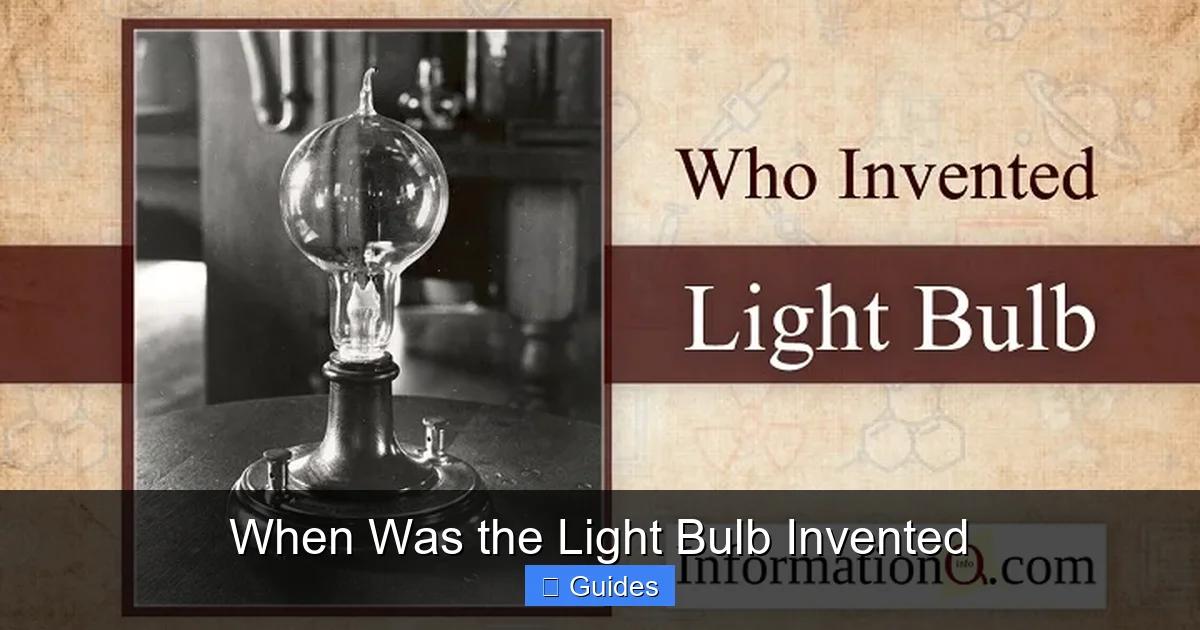
Visual guide about When Was the Light Bulb Invented
Image source: informationq.com
While Thomas Edison often takes center stage, it’s impossible to discuss when the light bulb was invented without giving significant credit to Joseph Swan. His independent research ran parallel to Edison’s, and in many ways, he was ahead of the curve.
Refining the Carbon Filament and Vacuum Technology
Swan’s persistent efforts throughout the 1860s and 1870s were vital. He focused on two key aspects:
- The Filament: Swan initially experimented with carbonized paper filaments. He found that by carbonizing cotton thread, he could create a durable filament that would glow when heated.
- The Vacuum: Early bulbs failed quickly because oxygen inside the bulb caused the filament to rapidly burn out. Swan significantly improved vacuum pump technology, which allowed him to create a much better vacuum inside his glass bulbs. This greatly extended the life of his carbon filaments.
By 1878, Swan developed a long-lasting light bulb using a thin, carbonized cotton filament inside a largely evacuated glass bulb. He demonstrated his invention extensively in England, notably lighting a public hall in Newcastle in 1879. He secured a British patent for his lamp in 1880. So, if you ask an Englishman “when was the light bulb invented,” they might very well point to Joseph Swan’s work in the late 1870s.
Swan’s bulbs were practical, and he began installing them in homes and landmarks in the UK, including the Savoy Theatre in London, which became the first public building in the world to be lit entirely by electricity in 1881.
Thomas Edison’s Breakthrough: The “Invented” Moment (1879)
This brings us to the most famous name associated with the light bulb: Thomas Alva Edison. While Swan was making progress in England, Edison and his team at Menlo Park, New Jersey, were relentless in their pursuit of a practical incandescent lamp.
The Quest for a Perfect Filament
Edison understood that the key to a commercially viable light bulb was a filament that possessed three critical qualities:
- High Resistance: This would allow the bulb to operate efficiently in a parallel circuit, meaning if one bulb burned out, the others would stay lit.
- Long Lifespan: Early filaments lasted only a few minutes or hours, making them impractical for everyday use.
- Affordability: The material had to be cheap and easily reproducible for mass production.
Edison and his researchers, particularly Francis Upton, tirelessly experimented with thousands of different materials. They tried platinum, iridium, various metal alloys, and countless organic substances. This period of intense trial and error is legendary.
The Carbonized Cotton Thread (October 1879)
The breakthrough came in October 1879. After experimenting with a variety of materials, Edison’s team tried a carbonized cotton sewing thread filament. On October 22, 1879, a bulb with this filament burned for an astonishing 13.5 hours. This was a monumental achievement, demonstrating a significant leap in longevity. Further refinement led to a carbonized bamboo fiber filament, which could last for over 1,200 hours. This was the moment that truly marked the invention of a *practical* incandescent light bulb by Edison’s team.
More Than Just a Bulb: Edison’s System
Edison’s genius wasn’t just in the bulb itself, but in his holistic approach. He didn’t just invent a better bulb; he invented the entire system needed to make electric light practical for homes and businesses:
- Generators: He developed improved dynamos to generate electricity.
- Wiring and Cables: He designed safe and efficient wiring systems.
- Switches and Sockets: He created the necessary components for controlling the light.
- Meters: For billing customers for electricity usage.
- Parallel Circuitry: Crucially, his high-resistance bulb design allowed bulbs to be connected in parallel, so if one bulb failed, the others in the circuit would continue to work. This was a major improvement over series circuits, where a single bulb failure would plunge an entire circuit into darkness.
On December 31, 1879, Edison gave a public demonstration of his incandescent lighting system in Menlo Park. Crowds flocked to witness the marvel of electric light, and the world understood that a new era of illumination had begun. His patent for the electric lamp was granted on January 27, 1880. This is often cited as the definitive answer to “when was the light bulb invented,” specifically referring to the commercially viable version.
The “War of the Currents” and Commercialization
With Swan and Edison both developing highly effective light bulbs around the same time, patent disputes were inevitable.
Edison vs. Swan: A Transatlantic Rivalry
Swan sued Edison for patent infringement in the UK. Recognizing the strength of Swan’s claims and his parallel development, a clever solution emerged: in 1883, the two companies merged to form the Edison & Swan United Electric Light Company, or “Ediswan.” This collaboration effectively ended the patent wars in Britain and allowed for the joint commercialization of their respective improvements. It’s a great example of how innovation often thrives through both competition and collaboration.
The Impact of Widespread Electric Light
The widespread adoption of electric light profoundly changed society.
- Extended Productivity: Factories could operate around the clock, increasing production.
- Enhanced Safety: Electric light was much safer than gaslight (reducing fires and explosions) and oil lamps.
- Social Transformation: It changed nightlife, allowed for later education, and generally made urban environments safer and more active after dark.
- Architectural Freedom: Buildings no longer needed complex gas piping or daylight-dependent designs.
This truly answers the question of *when* the light bulb invention impacted the world on a large scale – it was in the decades following Edison and Swan’s breakthroughs.
Beyond Incandescence: The Ongoing Evolution of Light Technology
Even after Edison’s practical bulb and Ediswan’s collaboration, the light bulb continued to evolve dramatically. The initial incandescent bulb was just the beginning.
The Tungsten Filament (Early 1900s)
While carbon filaments were a huge step forward, they weren’t the most efficient. In the early 20th century, scientists experimented with new materials. In 1904, Hungarian inventors Sándor Just and Franjo Hanaman patented a tungsten filament bulb. Tungsten has a much higher melting point than carbon, allowing it to glow brighter and more efficiently, and for a much longer time. General Electric bought the patent and introduced tungsten filaments to the market, quickly replacing carbon as the standard.
Gas-Filled Bulbs (1913)
Even with a better filament, some evaporation of the tungsten still occurred, eventually breaking the filament. In 1913, Irving Langmuir, an American chemist, discovered that filling the bulb with an inert gas like argon or nitrogen significantly reduced filament evaporation, further extending the bulb’s life and efficiency.
The Rise of New Lighting Technologies
The 20th and 21st centuries saw the development of entirely new lighting technologies, moving far beyond the incandescent bulb:
- Fluorescent Lamps: More efficient than incandescent bulbs, they became popular in commercial and industrial settings.
- Halogen Lamps: A type of incandescent bulb that uses halogen gas to improve efficiency and lifespan.
- LED (Light Emitting Diode) Lighting: The most significant revolution in recent decades, offering incredible energy efficiency, long lifespan, and versatility. LEDs have largely surpassed traditional incandescent and even fluorescent lighting in many applications.
Each of these innovations addresses the continuous quest for more efficient, durable, and versatile illumination. So, while “when was the light bulb invented” usually refers to the first practical incandescent bulb, the story of electric light is one of perpetual invention and refinement.
Understanding “Invention” in a Collaborative World
The story of the light bulb is a powerful reminder that significant inventions are rarely the work of a single “lone genius.” Instead, they often emerge from a collective effort, building upon generations of scientific inquiry, practical experimentation, and iterative improvements.
Thomas Edison’s genius was not in being the *first* to make a bulb glow, but in his relentless dedication to making it *work reliably, affordably, and as part of a complete system*. He was an exceptional entrepreneur and engineer who perfected the existing technology and, critically, made it accessible to the masses. Joseph Swan also played an indispensable role, demonstrating that viable electric light was possible concurrently.
So, when someone asks you “when was the light bulb invented,” you can now provide a much richer, more nuanced answer. You can explain that while electric light flickered into existence in rudimentary forms in the early 1800s, the practical, long-lasting incandescent light bulb, as we recognize it, truly took shape through the parallel and combined efforts of Joseph Swan and Thomas Edison in the late 1870s, culminating in Edison’s decisive demonstration in December 1879. It was a journey of over 70 years, a testament to human ingenuity and perseverance.
Conclusion: A Legacy of Light
The invention of the light bulb fundamentally reshaped human civilization, extending our active hours, increasing safety, and catalyzing countless other innovations. From Humphry Davy’s arc lamp to Edison’s refined carbon filament and Swan’s parallel breakthroughs, and on to modern LEDs, the path of illumination has been a testament to collaborative human endeavor.
The next time you effortlessly brighten a room, take a moment to appreciate the incredible journey of discovery and invention that made that simple act possible. It wasn’t just a bulb; it was a revolution, born from many minds, over many decades, finally reaching a practical zenith in the late 1870s, forever changing the way we live, work, and perceive the world after dark.
🎥 Related Video: Ask History: Who Really Invented the Light Bulb? | History
📺 HISTORY
Thomas Edison wasn’t the only inventor to lay claim to the light bulb, so whose bright idea was it? Ask History finds out.
Frequently Asked Questions
Who were some other inventors besides Edison and Swan who contributed to the light bulb?
Many others played a part, including Humphry Davy who demonstrated the arc lamp in 1802, Warren de la Rue who experimented with platinum filaments in the 1820s, and Frederick de Moleyns who received an early patent in 1840 for an incandescent lamp design.
What was the main problem with early light bulbs before Edison’s breakthrough?
The main problems with early light bulbs were their short lifespan, poor efficiency, and high cost. Filaments would burn out quickly due to incomplete vacuums, and the materials used were often too expensive or impractical for widespread adoption.
How did the invention of the light bulb change daily life?
The light bulb dramatically changed daily life by extending productive hours beyond sunset, making homes and workplaces safer, enabling new forms of entertainment and social activity, and reducing reliance on dangerous and inefficient forms of lighting like gas lamps and candles.
Why is Thomas Edison so widely credited with inventing the light bulb?
Edison is widely credited because he not only developed a highly effective, long-lasting bulb but also built the complete infrastructure—including generators, wiring, and distribution—that made electric light practical and commercially viable for mass adoption, essentially launching the modern electrical age.
What material replaced the carbon filament in light bulbs?
The carbon filament was eventually replaced by tungsten. Tungsten has a much higher melting point, allowing bulbs to glow brighter, more efficiently, and last significantly longer, becoming the standard for incandescent bulbs in the early 20th century.
Are incandescent light bulbs still used today?
While incandescent light bulbs are still technically used, their use has significantly declined due to their inefficiency. Many countries have phased them out in favor of more energy-efficient alternatives like compact fluorescent lamps (CFLs) and, predominantly, LED (Light Emitting Diode) lighting.
