


As an Amazon Associate, We earn from qualifying purchases.
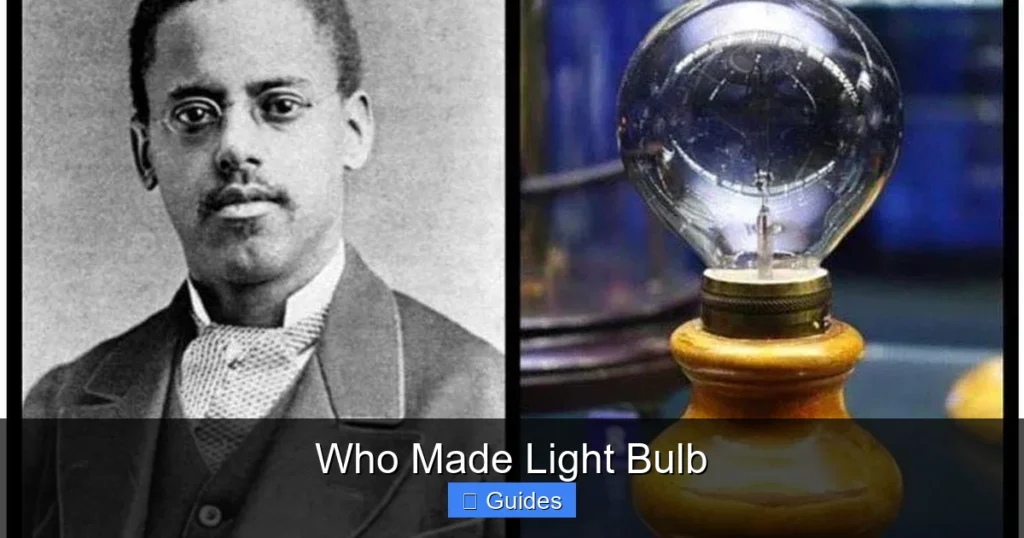
The invention of the light bulb was not the work of a single genius, but a culmination of centuries of scientific inquiry and iterative innovation. While Thomas Edison is famously credited, his significant contribution was perfecting a practical, long-lasting, and commercially viable incandescent light bulb, building upon the foundational work of many inventors before him, such as Humphry Davy and Joseph Swan. The journey to widespread electric light was a collaborative effort involving countless brilliant minds.
Have you ever stopped to wonder, really wonder, about the magic of flipping a switch and banishing darkness? It’s a moment we take for granted every single day. And when we think about who made light bulb, one name almost always springs to mind: Thomas Edison. He’s often hailed as the lone genius who illuminated the world, a brilliant inventor who single-handedly gave us the incandescent light bulb.
But here’s a little secret: the story of who made light bulb is far more complex, fascinating, and collaborative than the simplified version we often hear. It’s a tale woven from the threads of countless brilliant minds, each contributing a piece to the grand tapestry of electric illumination. Edison’s role was undoubtedly monumental, but he stood on the shoulders of giants, drawing from decades of scientific discovery and engineering attempts that paved the way for his ultimate success. Let’s peel back the layers and discover the true, intricate history behind the device that brightened our lives.
So, buckle up! We’re about to embark on a journey through time, exploring the unsung heroes, the scientific breakthroughs, and the relentless pursuit of a practical light source that culminated in the electric light bulb. You’ll soon realize that answering “who made light bulb” isn’t just about one person, but about a remarkable human endeavor.
Key Takeaways
- No Single Inventor: The light bulb, as we know it, was not invented by one person but evolved through the contributions of many scientists and inventors over several decades.
- Humphry Davy’s Early Work: In the early 1800s, Humphry Davy demonstrated the first electric arc lamp, laying the groundwork for electric illumination.
- Joseph Swan’s Practicality: British inventor Joseph Swan developed a functional incandescent light bulb with a carbonized paper filament years before Edison, receiving a British patent in 1878.
- Thomas Edison’s Breakthrough: Edison’s genius lay in his systematic approach, developing a commercially viable light bulb with a long-lasting carbonized cotton filament (1879) and, crucially, building an entire electrical distribution system around it.
- Collaboration and Competition: The path to the modern light bulb involved intense competition, patent battles, and eventually, collaboration, as seen in the Edison-Swan United company.
- Continuous Evolution: The light bulb continued to evolve significantly after Edison, with innovations like tungsten filaments and gas-filled bulbs further improving efficiency and lifespan.
- Systemic Innovation: Edison’s true legacy was not just the bulb itself, but his creation of a complete, practical, and affordable electrical lighting system, which truly brought electric light to the masses.
Quick Answers to Common Questions
Who is primarily credited with inventing the practical incandescent light bulb?
Thomas Edison is primarily credited with inventing the practical and commercially viable incandescent light bulb, though many others contributed significantly before him.
What was Humphry Davy’s contribution to electric light?
Humphry Davy demonstrated the first electric arc lamp in 1802, proving that electricity could produce light and laying early groundwork.
Who was Joseph Swan and what did he invent?
Joseph Swan was a British physicist and chemist who developed a functional incandescent light bulb with a carbonized paper filament and demonstrated it in 1878, receiving a British patent a year before Edison’s breakthrough.
What was unique about Edison’s approach to the light bulb?
Edison’s unique approach was his systemic innovation: he not only perfected a durable bulb but also created the entire electrical generation and distribution system (generators, wiring, sockets) needed to make electric light practical and widespread.
What type of filament did Edison use for his breakthrough light bulb in 1879?
For his breakthrough in 1879, Edison used a carbonized cotton sewing thread as the filament in his light bulb.
📑 Table of Contents
The First Sparks: Early Discoveries and Demonstrations
Long before Edison, the idea of using electricity to create light was a tantalizing dream for scientists. The early 19th century saw the very first glimmerings of what would become the light bulb. These initial experiments, while not yet practical for everyday use, laid crucial groundwork.
Humphry Davy’s Arc Lamp: A Dazzling Beginning
The year was 1802. A brilliant English chemist named Humphry Davy demonstrated something truly revolutionary. He used a large electric battery to send current through two charcoal rods, separated by a small gap. The result? A brilliant, sustained spark of light, which he aptly named the “electric arc lamp.” This was the very first demonstration of electric light, albeit one that was too bright, too hot, too quickly consumed, and far too dangerous for domestic use. It was, however, a profound proof of concept. Davy’s arc lamp showed the world that electricity could indeed produce light, sparking the imagination of future inventors.
The Challenge of Incandescence: A Flickering Dream
Following Davy’s breakthrough, many inventors across Europe and America tried to harness the principle of incandescence – making a material glow white-hot by passing an electric current through it. The challenge was immense. Early attempts faced several critical problems:
- Short Lifespan: Filaments (the glowing part) burned out almost instantly due to oxidation, reacting with oxygen in the air.
- High Cost: The materials used were often expensive, and the energy required was substantial.
- Inefficiency: Much of the energy was lost as heat, not light.
- Flicker and Dimness: Early bulbs were often unreliable and produced inconsistent light.
Despite these hurdles, the pursuit of a practical incandescent light bulb captivated minds, leading to a race that would span decades.
The Race for a Practical Incandescent Bulb: Many Hands in the Pot
Visual guide about Who Made Light Bulb
Image source: cf.shopee.ph
The mid-19th century saw an explosion of scientific and engineering efforts directed at solving the incandescent light puzzle. Many individuals came incredibly close, contributing vital pieces of the puzzle before Edison’s ultimate success.
Joseph Swan’s Early Triumphs
One of the most significant figures in the pre-Edison era was Joseph Swan, an English physicist and chemist. Swan had been working on incandescent lighting for decades, initially using platinum filaments, much like some of his contemporaries. However, his real breakthrough came in the 1860s and 1870s when he began experimenting with carbonized paper filaments in a vacuum. By placing the filament in a glass bulb from which most of the air had been removed, he significantly reduced oxidation, allowing the filament to glow for much longer.
In 1878, a full year before Edison’s celebrated success, Swan demonstrated a long-lasting electric light bulb in Newcastle, England, and received a British patent for it. His bulb used a thin carbon rod made from cotton treated with sulfuric acid. Swan’s bulbs were effective and demonstrated the viability of the incandescent principle, but still faced challenges with filament fragility and the quality of the vacuum.
Other Notable Contenders
Swan wasn’t alone in his pursuits. The story of who made light bulb is populated with many other names that deserve recognition:
- Warren de la Rue: In 1840, he created an efficient light bulb using a coiled platinum filament in a vacuum tube. While efficient, platinum was far too expensive for commercial use.
- Henry Woodward and Mathew Evans: These Canadian inventors patented an electric light bulb with a carbon rod in a nitrogen-filled glass bulb in 1874. They later sold their patent to Edison.
- Heinrich Göbel: A German clockmaker and inventor, Göbel claimed to have developed practical incandescent light bulbs as early as the 1850s, using bamboo filaments in fully evacuated bottles. While his claims were compelling, independent verification of his long-lasting bulbs at such an early date remains a subject of historical debate.
These efforts, though not leading to widespread commercialization, were crucial steps, showing iterative progress towards a truly practical electric light bulb.
Thomas Edison’s Role: Innovation, Not Sole Invention
Now, let’s talk about the man whose name is synonymous with the light bulb: Thomas Alva Edison. While he didn’t “invent” electric light from scratch, his contribution was transformative. Edison’s genius lay not just in developing a new light bulb, but in his systematic approach to invention and his relentless pursuit of a commercially viable product and the infrastructure to support it.
Edison’s Approach: Systemic Innovation
Edison was an industrialist inventor, a true visionary who understood that an invention needed to be practical, affordable, and scalable to change the world. He wasn’t just trying to make a filament glow; he was trying to build an entire system that could bring electric light into every home and business. This meant:
- A durable, efficient light bulb that wouldn’t burn out quickly.
- A reliable and affordable power generator.
- A stable electrical distribution grid.
- Wires, sockets, switches, and meters – everything needed to make the system work.
This comprehensive approach is what truly set Edison apart. He assembled a team of brilliant researchers and engineers at his Menlo Park laboratory, famously dubbed “The Invention Factory.”
The Quest for the Perfect Filament
Edison and his team embarked on a monumental task: testing thousands of different materials for the light bulb’s filament. They tried everything from platinum to various metals and carbonized plant fibers.
- Platinum Experiments: Early on, Edison focused on platinum filaments, similar to some of his predecessors, due to its high melting point. He even patented a platinum-iridium filament bulb. However, platinum was too expensive and still prone to breaking.
- The Carbonized Cotton Thread Breakthrough: After countless failures, in October 1879, Edison’s team made a pivotal discovery. They carbonized a common cotton sewing thread, creating a thin, resilient filament. When placed in a near-perfect vacuum and energized, this carbonized thread glowed for over 13.5 hours. This was a crucial milestone, demonstrating a light bulb that could actually be used for a practical period.
Improving Durability with a Vacuum
A key factor in the success of Edison’s light bulb, and indeed Swan’s, was the creation of a strong vacuum within the glass bulb. By removing nearly all the oxygen, the carbon filament could glow for extended periods without rapidly oxidizing and burning out. Edison significantly improved vacuum pump technology to achieve the necessary low-pressure environment, a seemingly small detail that made a huge difference in the longevity of the light bulb.
Building a Complete System
Edison didn’t stop at the bulb. His team designed and built the first central power station on Pearl Street in Manhattan, which began operating in 1882. They developed the necessary generators, wiring, protective devices, and even screw-in sockets (the Edison screw) that are still widely used today. This holistic approach, from the filament to the power plant, is what truly allowed the incandescent light bulb to revolutionize society. It wasn’t just about making *a* light bulb; it was about making electric light accessible and reliable for everyone.
The Edison-Swan Controversy and Collaboration
Given that both Swan and Edison had developed functional incandescent light bulbs around the same time, it was inevitable that their paths would cross, leading to both competition and eventual cooperation.
Patent Battles Across the Atlantic
In the late 1870s and early 1880s, intense patent disputes erupted. Swan held strong patents in the United Kingdom, while Edison secured his patents in the United States. Edison’s initial U.S. patents were challenged by inventors like William Sawyer and Albon Man, whose patents for carbon filaments preceded his. Ultimately, Edison’s patent was upheld, largely due to his specific method of creating a high vacuum and his robust manufacturing processes.
However, in the UK, Swan’s earlier work was undeniable. Edison tried to sell his light bulbs there, but Swan swiftly sued him for patent infringement. The legal battles were complex and costly for both sides.
The Amalgamation: Edison-Swan United
Recognizing the futility and expense of endless litigation, common sense prevailed. In 1883, Edison and Swan decided to merge their interests in the United Kingdom, forming the “Edison & Swan United Electric Light Company,” often shortened to “Ediswan.” This amalgamation allowed them to pool their patents, research, and manufacturing capabilities, effectively dominating the British market for incandescent light bulbs. It’s a testament to the idea that sometimes, collaboration can be more powerful than competition, especially when answering the question of who made light bulb truly practical.
Beyond Edison: The Evolution Continues
The story of who made light bulb didn’t end with Edison and Swan. Their work set the stage for continuous innovation, leading to even more efficient and longer-lasting light sources.
Tungsten Filaments: Brighter and Better
While carbon filaments were a monumental step forward, they had their limitations. They were relatively inefficient, converting a lot of energy into heat rather than light, and their lifespan, while practical, could still be improved. The next major leap came with the introduction of tungsten filaments.
In the early 20th century, scientists at General Electric, notably Irving Langmuir, perfected the use of tungsten as a filament material. Tungsten has an incredibly high melting point, allowing it to glow much brighter and more efficiently than carbon without melting. This innovation led to significantly brighter and more durable incandescent light bulbs. The tungsten filament, often coiled to further increase its surface area, became the standard for incandescent bulbs for the majority of the 20th century.
The Gas-Filled Bulb
Another significant improvement came with the introduction of inert gases, like argon or nitrogen, into the light bulb. Previously, bulbs were evacuated to a vacuum. While a vacuum prevented oxidation, over time, tungsten filaments would slowly evaporate, depositing a dark coating on the inside of the glass bulb and weakening the filament. Introducing an inert gas at a certain pressure helped to reduce this evaporation, allowing the filament to operate at higher temperatures and extending the light bulb’s lifespan and efficiency.
Modern Lighting: Fluorescent, LED, and Beyond
The incandescent light bulb reigned supreme for over a century, but the quest for even greater efficiency never stopped. The 20th century saw the rise of fluorescent lighting, which uses a completely different principle to produce light – exciting gases to emit UV light, which then makes a phosphor coating glow.
And now, in the 21st century, we are witnessing another revolution with Light Emitting Diodes (LEDs). LEDs are semiconductor devices that produce light when an electric current passes through them. They are incredibly energy-efficient, long-lasting, and versatile, quickly becoming the dominant lighting technology worldwide. Each of these advancements builds upon the fundamental understanding of electricity and light established by Davy, Swan, Edison, and countless others.
Conclusion: A Symphony of Innovation
So, who made light bulb? The definitive answer isn’t a single name whispered in reverence. It’s a chorus of brilliant minds, a symphony of scientific discovery, engineering ingenuity, and relentless persistence. Humphry Davy provided the initial spark. Joseph Swan and many others brought us to the cusp of practicality with carbon filaments in evacuated bulbs. Thomas Edison, with his unparalleled vision for a complete system, perfected a practical, long-lasting, and commercially viable incandescent light bulb and, crucially, built the entire infrastructure to bring it into our homes.
Edison’s true genius was not just in creating *a* light bulb, but in creating *the* light bulb that launched an industry and transformed society. He democratized electric light, making it safe, affordable, and accessible to the masses. The history of the light bulb is a powerful reminder that truly transformative inventions are rarely the work of one person. Instead, they are the culmination of collaborative effort, continuous improvement, and the relentless human desire to innovate and make the world a little brighter. The next time you flip that switch, take a moment to appreciate the vast, collective effort behind that simple, yet profound, act of illumination.
Frequently Asked Questions
Was Thomas Edison the first person to invent an electric light?
No, Thomas Edison was not the first person to invent an electric light. Humphry Davy demonstrated the first electric arc lamp in 1802, and numerous inventors, including Joseph Swan, had developed various forms of incandescent lights before Edison’s successful commercial bulb.
What made Edison’s light bulb different from those of other inventors?
Edison’s light bulb was distinguished by its long-lasting, cost-effective carbonized filament (initially cotton thread) combined with a highly evacuated glass bulb. Crucially, Edison also developed the complete system necessary for electric lighting, including generators, wiring, and sockets, making it practical and accessible for homes and businesses.
What role did Joseph Swan play in the invention of the light bulb?
Joseph Swan was a significant pioneer who developed and demonstrated a working incandescent light bulb with a carbonized paper filament in a vacuum in 1878, a year before Edison. His work was crucial and led to patent disputes that eventually resulted in the formation of the Edison & Swan United Electric Light Company.
Why is Edison so widely credited if others also contributed?
Edison is widely credited because he not only refined the light bulb to be practical and long-lasting but also engineered the entire infrastructure needed to deliver electricity and light to the masses. His systematic approach, robust manufacturing, and successful commercialization truly brought the light bulb revolution to fruition.
When was the first electric light bulb invented?
The very first demonstration of electric light, an arc lamp, was by Humphry Davy in 1802. For incandescent bulbs, various working prototypes emerged throughout the mid-19th century, with Joseph Swan demonstrating a practical version in 1878 and Thomas Edison perfecting his commercially viable bulb in 1879.
How did the light bulb evolve after Edison’s invention?
After Edison, the light bulb continued to evolve significantly. Key advancements included the introduction of more efficient and durable tungsten filaments in the early 20th century, and the use of inert gases within the bulb to extend lifespan. Later, entirely new technologies like fluorescent lighting and modern LEDs emerged, building on the foundational principles established by earlier inventors.
