


As an Amazon Associate, We earn from qualifying purchases.
The question of who created the light bulb first is far more complex than often believed, extending beyond Thomas Edison’s famous invention. While Edison successfully commercialized a practical, long-lasting incandescent bulb and its crucial power system, numerous brilliant inventors like Humphry Davy, Joseph Swan, and Heinrich Goebel made crucial foundational discoveries and developed early versions of electric lights years, even decades, before his renowned patent. This world-changing invention was truly a collective effort, building on incremental innovations from many minds across different countries.
Ask anyone, “who created the light bulb first?” and chances are you’ll hear “Thomas Edison!” It’s a name synonymous with innovation, and his role in bringing electric light to the masses is undeniable. But the true story of the light bulb’s invention is far more nuanced, fascinating, and, frankly, a lot more crowded than a single name suggests. It’s a tale of incremental progress, international competition, and the collective genius of many brilliant minds.
The incandescent light bulb, the one that lights our homes and offices, didn’t suddenly appear in a flash of inspiration in Edison’s laboratory. Instead, it was the culmination of decades of scientific research and technological experiments conducted by inventors across various countries. Many individuals made critical breakthroughs, each solving a piece of the complex puzzle before a practical, commercially viable bulb could light up the world.
So, let’s turn back the clock and explore the incredible journey of electric light, shedding light on the real heroes and crucial steps that ultimately answered the question: who created the light bulb first?
Key Takeaways
- No single inventor: The creation of the light bulb was a cumulative process involving many scientists and inventors over several decades, not a solitary act.
- Early electric light forms: Primitive forms of electric illumination, such as the arc lamp and early incandescent devices, existed long before Thomas Edison.
- Joseph Swan’s significant contributions: British inventor Joseph Swan developed highly effective and practical carbon filament incandescent bulbs, demonstrating them publicly in the UK before Edison’s 1879 patent.
- Thomas Edison’s genius was in systemization: Edison’s primary contribution was not inventing the *first* light bulb, but perfecting a long-lasting, affordable incandescent bulb and, crucially, developing the entire practical and scalable electrical generation and distribution *system* to power it.
- Key technical challenges: Inventors faced major hurdles in finding durable filament materials, creating a sufficient vacuum inside the bulb, and developing efficient power sources.
- Global collaboration: The journey to a practical light bulb involved inventors and scientists from various nations, each adding vital pieces to the puzzle.
- Innovation is iterative: The story of the light bulb perfectly illustrates how major inventions often evolve through continuous improvements and the combined efforts of many individuals.
Quick Answers to Common Questions
Was Thomas Edison the sole inventor of the light bulb?
No, Thomas Edison was not the sole inventor. The light bulb was the result of incremental discoveries and improvements by many scientists and inventors over several decades before Edison’s famous patent.
Who was Joseph Swan and what was his role?
Joseph Swan was a British physicist and chemist who, independently of Edison, developed and publicly demonstrated effective and long-lasting carbon filament incandescent bulbs in England during the late 1870s.
What key problems did inventors face when developing the light bulb?
Inventors faced three main challenges: finding a durable and efficient filament material, creating a strong enough vacuum inside the glass bulb to prevent oxidation, and developing an effective electrical power source.
How did Edison’s approach differ from earlier inventors?
Edison’s approach was unique because he focused on developing a complete, commercially viable electrical lighting *system* rather than just an individual bulb. His work included the generator, wiring, and distribution, alongside perfecting the bulb itself.
What was the significance of the Pearl Street Station?
The Pearl Street Station, launched by Edison in 1882, was the world’s first central power plant for electric light in New York City. Its significance was providing electricity to multiple customers on a large scale, making electric light accessible to the public for the first time.
📑 Table of Contents
The Dawn of Electric Light: Early Discoveries
The concept of electric light wasn’t born in the late 19th century. Its roots stretch back to the very beginning of electricity itself. Long before anyone dreamed of lighting a home with a small, glowing filament, scientists were experimenting with electricity’s illuminating properties.
Humphry Davy and the Arc Lamp
One of the earliest pioneers was the English chemist Humphry Davy. In 1802, using a powerful electric battery, he demonstrated that electricity could create light. He connected two charcoal electrodes to his battery, and as he brought them close together, a brilliant, intense arc of light appeared. This was the world’s first electric arc lamp. While incredibly bright, it was also dangerous, hot, and consumed electrodes quickly, making it utterly impractical for everyday use, especially in homes. But it was a monumental first step, showing that electricity could indeed be harnessed for illumination.
Early Incandescent Attempts
Davy’s work inspired others. The idea of using an electric current to heat a thin wire until it glowed (incandescence) began to take hold. Imagine trying to make something glow without burning up! It was a huge challenge. In 1820, British scientist Warren De la Rue enclosed a coiled platinum filament in a vacuum tube and passed an electric current through it. Platinum was chosen because of its high melting point. While his lamp worked, the cost of platinum made it completely unfeasible for widespread use.
Around 1835, James Bowman Lindsay, a Scottish inventor, publicly demonstrated a constant electric light, but he didn’t pursue commercialization. Later, in 1840, British scientist J.W. Starr patented an incandescent lamp using a platinum filament. These early attempts were crucial, proving the concept, even if they couldn’t overcome the practical hurdles of cost and durability.
The Race for a Practical Filament and Vacuum
The core problem for early incandescent lamp inventors was finding the right material for the filament and creating an environment where it wouldn’t quickly burn out. Oxygen, even a tiny bit, causes a hot filament to oxidize and break.
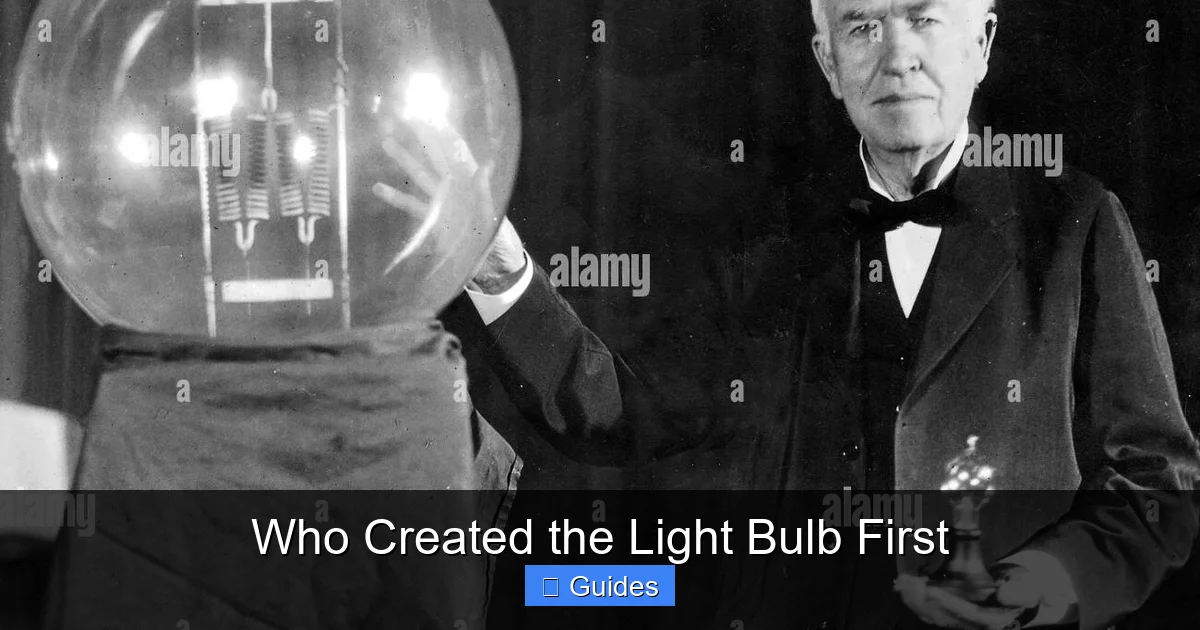
Visual guide about Who Created the Light Bulb First
Image source: c8.alamy.com
The Filament Challenge: Platinum vs. Carbon
Inventors struggled with two main filament types: platinum and carbon. Platinum was durable but expensive. Carbon, derived from materials like paper or bamboo, was cheaper but far more fragile and challenging to work with. The quest was for a material that was strong enough, glowed brightly, and lasted a reasonable amount of time without breaking or burning up.
One significant, though often overlooked, contributor was Heinrich Goebel, a German clockmaker who immigrated to the United States. In the 1850s, Goebel experimented extensively with incandescent lamps. He used thin, carbonized bamboo splints as filaments, enclosed in evacuated glass bottles (like cologne bottles!). He demonstrated his lights in New York, even using them to illuminate his store. While Goebel’s lamps were remarkably advanced for their time and very similar in concept to later successful bulbs, he lacked the means or perhaps the foresight to commercialize his invention effectively, and his contributions remained largely unrecognized until much later.
The Vacuum Problem
Even with the perfect filament, there was another massive hurdle: the vacuum. To prevent the filament from quickly oxidizing and burning out, it needed to be sealed in a vacuum – a space devoid of air. Creating a strong, reliable vacuum was technologically difficult in the mid-19th century. Early vacuum pumps were inefficient, leaving enough residual air inside the bulb to significantly shorten the filament’s life. This technical limitation held back many promising designs for years.
Joseph Swan’s Independent Breakthroughs
While Goebel was experimenting in the U.S., another brilliant mind across the Atlantic was making significant strides. Joseph Swan, an English physicist and chemist, had been working on incandescent lighting for decades, independently solving many of the same problems that others faced.
Early Efforts and Persistence
As early as 1860, Swan managed to develop a primitive incandescent lamp using carbonized paper filaments. However, like his predecessors, he was hampered by the inadequate vacuum pump technology of the time. His bulbs worked but had a frustratingly short lifespan due to residual oxygen inside the bulb. Swan, a persistent inventor, didn’t give up. He continued to refine his ideas, waiting for the technology to catch up.
Success in the 1870s
By the mid-1870s, improved vacuum pumps became available, allowing for much better vacuums inside the glass bulbs. With this technological advancement, Swan was able to make significant progress. In 1878, and more extensively in 1879, he demonstrated highly effective and long-lasting incandescent lamps. He used a carbonized cotton thread that was treated to make it denser and less porous, creating a much more durable filament. Swan’s bulbs were successful in public demonstrations across England, illuminating homes, art galleries, and even public streets. He patented his invention in Great Britain.
Swan’s work was incredibly important. He had developed a practical, long-lasting electric light bulb, addressing both the filament material and the vacuum challenges. His bulbs were, by all accounts, highly effective and viable. This places him firmly in the running for the title of “who created the light bulb first” in a truly practical sense.
Thomas Edison’s System-Oriented Approach
Now we arrive at the name most commonly associated with the light bulb: Thomas Edison. It’s important to understand that Edison’s genius wasn’t in discovering the principle of incandescence or even being the *first* to make a bulb that worked. His brilliance lay in his systematic approach to invention, his relentless pursuit of perfection, and his vision for a complete, commercially viable electrical lighting *system*.
More Than Just a Bulb: The Complete System
Edison didn’t just want a bulb; he wanted to replace gas lighting entirely. This meant his invention had to be affordable, safe, and capable of being powered on a large scale. He understood that a single bulb, no matter how good, was useless without an entire infrastructure to support it. This included:
- An efficient, long-lasting, and cheap filament.
- A much improved, high vacuum within the bulb.
- A powerful and reliable electrical generator (dynamo).
- A system of wiring and insulation to safely distribute electricity to many homes and businesses.
- Switches, fuses, and meters to control and measure electricity usage.
Edison’s laboratory in Menlo Park, New Jersey, became an “invention factory,” with a team of skilled engineers and scientists working tirelessly on every aspect of this ambitious project.
The “Long-Burning” Filament
After experimenting with thousands of materials – everything from human hair to plant fibers – Edison and his team made their famous breakthrough in October 1879. They successfully created a carbonized cotton thread filament that burned for over 13 hours. While this doesn’t sound like much by today’s standards, it was a massive leap forward at the time. Soon after, they discovered that carbonized bamboo fibers could last for more than 1,200 hours, making the bulb truly practical and affordable for widespread use.
Edison quickly filed a patent for his improved incandescent lamp in November 1879. His patent wasn’t for the *idea* of an incandescent bulb but for a specific design that combined a high resistance filament with a high vacuum, making it efficient and long-lasting. He didn’t invent the light bulb from scratch, but he perfected it and, crucially, made it part of a larger, functional system.
Commercialization and Pearl Street
Edison’s next monumental step was commercialization. On September 4, 1882, he launched the Pearl Street Station in New York City – the world’s first central power plant for electric light. This station supplied electricity to customers in lower Manhattan, making electric lighting available to the public on an unprecedented scale. This moment solidified Edison’s legacy and definitively brought electric light into the mainstream, changing urban life forever.
Other Illuminating Contributions and Patent Battles
The story wouldn’t be complete without acknowledging other key players and the inevitable legal battles that followed such a groundbreaking invention. When there’s a big discovery, there are often many people working on similar problems simultaneously, leading to overlapping claims.
The American Competitors
In the United States, inventors like William Sawyer and Albon Man also developed their own incandescent lamps, some of which predated or were contemporaneous with Edison’s early designs. They often used a nitrogen gas atmosphere inside their bulbs to prevent filament oxidation, rather than a full vacuum. Hiram Maxim, another prominent American inventor, also developed and patented incandescent light bulbs, becoming a direct competitor to Edison. These parallel developments highlight the intense scientific and commercial race to conquer electric illumination.
Lewis Howard Latimer: The Unsung Hero
One particularly important figure whose contributions are often overlooked is Lewis Howard Latimer, an African-American inventor and draftsman. Latimer worked for both Hiram Maxim and later for Thomas Edison. In 1881, he patented a new and improved method for manufacturing carbon filaments, which made the production process much more efficient and the filaments more durable. In 1882, he received another patent for an improved incandescent electric lamp with a threaded wooden base. Latimer’s innovations were critical in making light bulbs more commercially viable and accessible, playing a vital role in the widespread adoption of Edison’s system.
The Edison-Swan Merger
Given that Joseph Swan had developed and demonstrated practical light bulbs in England around the same time as Edison, it was inevitable that patent disputes would arise. Rather than engaging in lengthy and costly legal battles, the two inventors and their companies eventually merged their interests in the United Kingdom in 1883, forming the “Edison & Swan United Electric Light Company,” often simply known as “Ediswan.” This merger allowed them to combine their patents and expertise, dominating the British market for electric lighting.
Conclusion: A Symphony of Innovation
So, who created the light bulb first? The answer is not a single person, but a collective “we.” It’s a testament to the cumulative nature of human innovation. From Humphry Davy’s initial arc light to De la Rue’s platinum coil, from Heinrich Goebel’s bamboo filaments to Joseph Swan’s carbonized threads, each inventor added a crucial piece to the puzzle.
Thomas Edison’s genius was in synthesizing these ideas, tirelessly experimenting, perfecting the weakest links (especially the filament and vacuum), and, most importantly, envisioning and executing the entire system – from power generation to light bulb installation – that made electric light practical, affordable, and accessible for everyone. He wasn’t the first to create an electric light, but he was arguably the first to make it truly useful and widespread.
The story of the light bulb reminds us that great inventions are often built on the shoulders of giants, a collaborative symphony of brilliant minds working across time and geography. It’s a powerful lesson in how progress truly happens: through persistent effort, shared knowledge, and the relentless pursuit of solving complex problems, piece by painstaking piece.
🎥 Related Video: Ask History: Who Really Invented the Light Bulb? | History
📺 HISTORY
Thomas Edison wasn’t the only inventor to lay claim to the light bulb, so whose bright idea was it? Ask History finds out.
Frequently Asked Questions
Why is Edison often credited for inventing the light bulb if others came before him?
Edison is often credited because while others created working prototypes, he perfected a long-lasting, affordable, and practical incandescent bulb and, crucially, developed the entire electrical generation and distribution system needed to make electric light widely accessible and commercially viable.
Did any inventors successfully create a light bulb before Edison’s 1879 patent?
Yes, many inventors made successful light bulbs before Edison’s 1879 patent. Notable among them are Humphry Davy (arc lamp, 1802), Heinrich Goebel (carbonized bamboo filament, 1850s), and Joseph Swan (carbon filament bulb, public demonstrations 1878-1879).
What challenges did early light bulb inventors face regarding filament materials?
Early inventors struggled to find a filament material that was inexpensive, conducted electricity well, glowed brightly, and had a high melting point without quickly burning out. Platinum was too costly, while early carbon materials were fragile or short-lived.
How did the lack of a good vacuum pump affect early light bulb development?
The absence of efficient vacuum pumps was a major hurdle because even tiny amounts of oxygen inside the bulb would cause the hot filament to oxidize and burn out rapidly. Improved vacuum technology in the 1870s was a key factor in the development of practical bulbs.
What role did Lewis Latimer play in the development of the light bulb?
Lewis Latimer, an African-American inventor and draftsman, made crucial contributions by patenting an improved process for manufacturing carbon filaments in 1881, which significantly increased their durability and lowered production costs for light bulbs.
Were there patent disputes over the light bulb invention?
Yes, there were significant patent disputes, particularly between Thomas Edison and Joseph Swan, as both had developed practical incandescent lamps around the same time. These disputes eventually led to their companies merging in the United Kingdom to form the Edison & Swan United Electric Light Company.
