


As an Amazon Associate, We earn from qualifying purchases.
Light bulbs transform electrical energy into visible light through various mechanisms. Incandescent bulbs use a filament heated to incandescence by electrical resistance. Fluorescent bulbs pass electricity through a gas, creating ultraviolet light that a phosphor coating converts to visible light. LEDs (Light-Emitting Diodes) produce light through electroluminescence in semiconductor materials, making them the most energy-efficient option today. All types rely on fundamental electrical principles to illuminate our world.
Have you ever stopped to think about the incredible journey electricity takes to become the light that brightens your home? It’s something we often take for granted – flick a switch, and *poof*, there’s light! But behind that simple action lies a fascinating world of physics, engineering, and brilliant innovation. Understanding how a light bulb works isn’t just about knowing what’s inside; it’s about appreciating the clever ways we’ve learned to harness energy to banish the dark.
For centuries, humanity relied on fire for light, from candles to gas lamps. The invention of the practical electric light bulb by Thomas Edison and many others revolutionized our lives, ushering in an era of safe, accessible, and on-demand illumination. Today, our light bulbs are more diverse and sophisticated than ever, from the classic incandescent to the sleek, super-efficient LED. Each type has its own unique story of how it transforms invisible electrical energy into the visible light we depend on every day.
In this guide, we’re going to pull back the curtain and explore the magic behind the glow. We’ll delve into the science that makes each type of light bulb tick, from the fiery heart of an incandescent to the quantum dance within an LED. Get ready to understand not just what a light bulb does, but truly how a light bulb works, and why that knowledge can help you make brighter choices for your home and the planet.
Key Takeaways
- Fundamental Principle: All light bulbs convert electrical energy into light, but they employ different scientific principles to achieve this transformation.
- Incandescent Bulbs: These classics work by heating a thin tungsten filament to extreme temperatures (incandescence) until it glows, but they are highly inefficient as most energy is lost as heat.
- Fluorescent Bulbs (CFLs): They operate by sending electricity through a gas, exciting mercury vapor to produce UV light, which is then converted into visible light by a phosphor coating inside the bulb.
- LEDs (Light-Emitting Diodes): LEDs represent modern technology, using semiconductor materials that emit light (electroluminescence) when an electric current passes through them, offering superior efficiency and longevity.
- Energy Efficiency: There’s a clear progression in energy efficiency, with incandescents being the least efficient, fluorescents offering better performance, and LEDs being the most energy-saving and environmentally friendly choice.
- Key Components: Despite varied mechanisms, common components across different bulb types include an electrical connection (base), a protective enclosure (bulb), and a mechanism to generate light from electricity.
- Evolution of Lighting: The journey of the light bulb is a testament to continuous innovation, driven by the desire for brighter, more efficient, and longer-lasting illumination solutions, leading to advancements like smart lighting.
Quick Answers to Common Questions
How does an incandescent light bulb work?
An incandescent light bulb works by passing an electric current through a thin tungsten filament, heating it to such an extreme temperature that it glows, emitting visible light and a lot of heat.
What is the main difference between an incandescent bulb and an LED bulb?
The main difference is their light-producing mechanism: incandescents use a heated filament, while LEDs use semiconductor materials to directly emit light through electroluminescence, making LEDs far more efficient and durable.
Do fluorescent bulbs contain mercury?
Yes, fluorescent bulbs (including CFLs) contain a small amount of mercury vapor, which is essential for their operation. This is why they require proper disposal to prevent environmental contamination.
What makes LED bulbs so energy efficient?
LED bulbs are energy efficient because they convert most of the electrical energy directly into visible light (photons) with minimal loss as heat, unlike incandescent bulbs which waste most of their energy as heat.
Why do older incandescent bulbs burn out?
Incandescent bulbs burn out primarily because the intense heat causes the tungsten filament to slowly evaporate and thin over time. Eventually, a weak spot develops, the filament breaks, and the electrical circuit is interrupted.
📑 Table of Contents
The Incandescent Light Bulb: A Classic Innovation
When most people picture a light bulb, they probably imagine the classic incandescent model – a clear glass globe with a delicate wire coil inside. For over a century, this was the primary way we lit our homes, and its method for creating light is surprisingly straightforward, yet somewhat inefficient by today’s standards. Let’s break down how this iconic light bulb works.
The Simple Principle: Resistance and Heat
The core idea behind an incandescent bulb is incandescence, which literally means “emitting light as a result of being heated.” Think about a piece of metal getting red-hot in a blacksmith’s forge – that’s incandescence in action. In a light bulb, we want that glowing effect to be contained and controlled. The key component here is the filament.
Key Components: Filament, Bulb, Base
- Filament: This is the heart of the incandescent bulb. Typically made from a thin, coiled wire of tungsten, a metal chosen for its incredibly high melting point (over 6,000°F or 3,400°C). The coiling makes the filament longer, increasing its electrical resistance in a compact space.
- Glass Bulb (Envelope): This protective glass shell serves two main purposes. First, it isolates the filament from oxygen. If the hot tungsten filament were exposed to air, it would instantly burn up, much like a match. Second, it often contains an inert gas, like argon or nitrogen. This gas further slows down the evaporation of the tungsten filament, extending the bulb’s lifespan. Without the gas, the filament would wear out even faster.
- Electrical Contacts (Base): The metal screw base allows the bulb to be securely connected to a lamp socket. It has two separate electrical contacts: one on the very bottom tip and another on the side of the screw base. These connect to the two ends of the filament.
- Support Wires: Small wires hold the filament in place, preventing it from sagging or touching the glass bulb.
How It Works: Electron Flow to Light
When you flip the switch, electricity flows from the wall socket, through the lamp base, and into the filament. Here’s how a light bulb works to create light:
- Resistance: The tungsten filament is a conductor, but it has significant electrical resistance. As electrons (the tiny particles that carry electricity) try to push through this narrow, coiled wire, they encounter resistance.
- Heat Generation: This resistance causes the filament to heat up intensely, much like how rubbing your hands together creates heat. The filament can reach temperatures of 4,500°F (2,500°C) or even hotter.
- Incandescence: At these extreme temperatures, the tungsten atoms in the filament become so energized that they begin to emit energy in the form of electromagnetic radiation. A portion of this radiation falls within the visible light spectrum, causing the filament to glow brightly. The hotter the filament, the brighter and whiter the light.
- Continuous Cycle: As long as electricity flows, the filament remains superheated and continues to glow, providing constant illumination.
Practical Example: Think of a toaster. When you put bread in, the heating elements glow red-hot. That’s a similar principle to how a light bulb works, just at a much higher temperature to produce visible light.
Why They’re Less Common Now: Inefficiency
While effective, the incandescent bulb has a major drawback: efficiency. A huge percentage (around 90%) of the electrical energy put into an incandescent bulb is converted into heat, not light. This means only about 10% of the energy actually contributes to illumination. This inefficiency led to the development of more energy-saving alternatives.
Fluorescent Lights (CFLs): A Gaseous Glow
Moving beyond the incandescent bulb, the next significant leap in lighting technology came with fluorescent lights. These bulbs, often seen as long tubes in offices or twisted compact fluorescent lamps (CFLs) in homes, operate on a completely different principle that significantly boosts energy efficiency. Let’s explore how a light bulb of this type creates its glow.
Visual guide about How a Light Bulb Works
Image source: i.ytimg.com
Beyond the Filament: Gas and Mercury Vapor
Unlike incandescents, fluorescent bulbs don’t rely on a super-heated filament to directly produce visible light. Instead, they use a gas-filled tube. The main components include:
- Glass Tube: A sealed tube, often coated on the inside.
- Inert Gas: Usually argon, at low pressure.
- Mercury Vapor: A tiny amount of liquid mercury is present inside the tube, which vaporizes when the bulb is turned on.
- Electrodes: At each end of the tube are electrodes, often filaments, which initiate the process.
- Ballast: An external or integrated component that regulates the current flowing through the bulb. This is crucial for starting and maintaining the electrical discharge.
The Role of Phosphor Coating
This is arguably the most critical element in a fluorescent bulb. The inside surface of the glass tube is coated with a material called phosphor. Phosphors are substances that absorb ultraviolet (UV) light and then re-emit that energy as visible light. Different phosphor mixtures create different “colors” or temperatures of white light (e.g., warm white, cool white).
How CFLs Work: UV to Visible Light
The process of how a light bulb of the fluorescent type works is a multi-step transformation:
- Current Flow: When the switch is flipped, the ballast sends a high voltage burst to the electrodes, creating an electrical arc across the tube.
- Exciting the Gas: This arc causes electrons to flow rapidly through the low-pressure inert gas and mercury vapor inside the tube. As these electrons collide with mercury atoms, they excite the mercury atoms to a higher energy state.
- UV Light Emission: When the excited mercury atoms return to their normal energy state, they release energy primarily in the form of ultraviolet (UV) light. This UV light is invisible to the human eye.
- Phosphor Conversion: This is where the magic happens! The invisible UV light strikes the phosphor coating on the inside of the glass tube. The phosphor absorbs the UV energy and then glows, emitting visible light that we can see.
- Continuous Cycle: The ballast then maintains a steady current to keep the mercury atoms excited, ensuring a continuous flow of UV and thus visible light.
Practical Example: Think of a “black light” poster. The black light emits UV, and the special inks on the poster contain phosphors that glow when exposed to it. A fluorescent bulb works similarly, but it’s designed to contain that UV and convert it into visible light.
Pros and Cons: Energy Efficiency vs. Mercury
Fluorescent bulbs are significantly more energy-efficient than incandescents, typically using 75% less energy and lasting up to 10 times longer. However, a major concern is the small amount of mercury contained within the bulb, which requires proper disposal to prevent environmental contamination. This is why LEDs have largely overtaken CFLs in popularity.
LED Technology: The Future of Illumination
Light-Emitting Diodes, or LEDs, represent the pinnacle of modern lighting technology. They have rapidly become the standard for energy efficiency, longevity, and versatility, transforming how a light bulb works into a sophisticated electronic process. You’ll find LEDs everywhere now, from indicator lights on your electronics to the main lighting in your home and even traffic signals.
What is an LED? Diodes and Semiconductors
An LED is a semiconductor device that emits light when an electric current passes through it. The “diode” part means it allows current to flow in only one direction. Unlike incandescents or fluorescents, LEDs do not have a filament that burns out, nor do they rely on gas discharge or mercury.
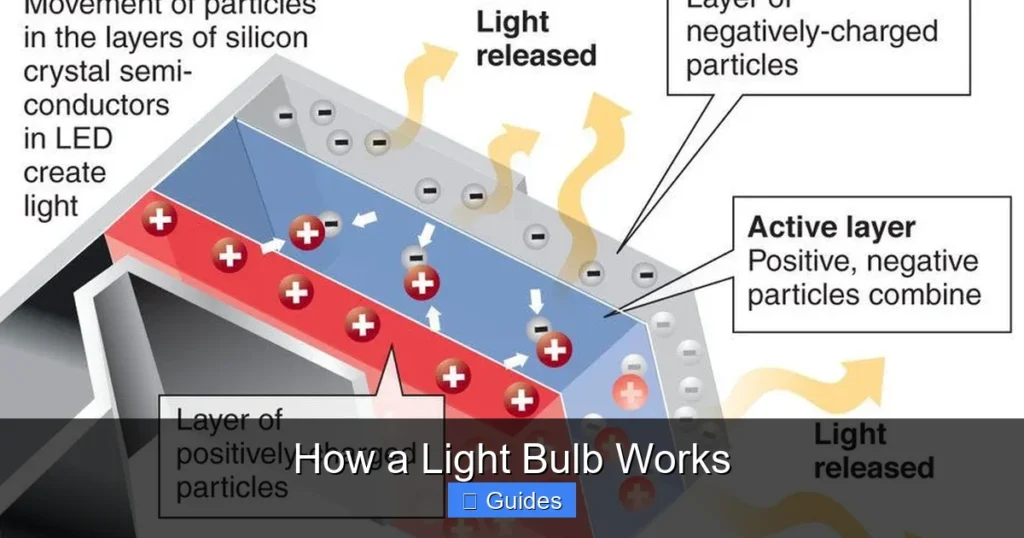
- Semiconductor Materials: LEDs are made from layers of semiconductor materials, such as gallium arsenide or gallium nitride. These materials are “doped” with impurities to create specific electrical properties, resulting in two distinct regions: an n-type (negative, excess electrons) and a p-type (positive, electron “holes”).
- PN Junction: The point where the n-type and p-type materials meet is called the PN junction. This is where the light emission occurs.
How LEDs Work: Electroluminescence
The process of how an LED light bulb works is called electroluminescence:
- Forward Bias: When electricity is applied to the LED in the correct direction (forward bias), electrons from the n-type material are pushed across the PN junction into the p-type material.
- Electron-Hole Recombination: In the p-type material, these electrons encounter “holes” (vacancies where electrons should be). When an electron “falls” into a hole, it recombines with it.
- Photon Emission: During this recombination, the electron releases energy in the form of a photon – a tiny packet of light. The specific semiconductor materials used determine the energy level of the photons, which in turn dictates the color of the emitted light (e.g., red, green, blue).
- White Light Generation: To create white light, there are two common methods:
- RGB Mixing: Combining red, green, and blue LEDs in close proximity.
- Phosphor Conversion: Most commonly, a blue LED chip is coated with a yellow phosphor. The blue light from the LED excites the phosphor, which then emits yellow light. The combination of the remaining blue light and the emitted yellow light creates white light that appears warm or cool depending on the phosphor blend.
- Heat Sink: While very efficient, LEDs do generate some heat. This heat needs to be dissipated, usually by a heat sink, to prevent damage to the delicate semiconductor materials and ensure longevity. This is why many LED bulbs have a substantial base.
Practical Tip: When buying LED bulbs, look for “lumens” (brightness) rather than “watts” (power consumption), as LEDs consume far fewer watts for the same brightness compared to older technologies. Also, check the “Kelvin” (color temperature) to ensure you get the desired warm (2700K-3000K) or cool (4000K-5000K+) light.
The Benefits of LEDs: Efficiency, Durability, Versatility
LEDs boast an impressive list of advantages:
- Exceptional Energy Efficiency: They use up to 80-90% less energy than incandescents for the same light output.
- Long Lifespan: LEDs can last for 25,000 to 50,000 hours or more, significantly outlasting other bulb types.
- Durability: Being solid-state devices (no filaments or glass tubes filled with gas), they are far more resistant to shock and vibration.
- Instant On: They reach full brightness immediately.
- Directional Light: LEDs naturally emit light in a specific direction, which can be advantageous for spotlighting or task lighting.
- Dimming Capabilities: Many LEDs are dimmable, though they may require specific LED-compatible dimmer switches.
- Color Options: LEDs can produce a wide spectrum of colors without filters, making them ideal for decorative and mood lighting.
The Core Science: Electricity and Light Production
No matter if it’s an incandescent, fluorescent, or LED, the fundamental principle behind how a light bulb works always traces back to electricity. It’s the controlled manipulation of electrical energy that ultimately gives us visible light. Let’s dive deeper into the core scientific concepts at play.
Understanding Current and Voltage
- Voltage (V): Think of voltage as the “pressure” or “force” that pushes electrons through a circuit. A higher voltage means a stronger push.
- Current (A): Current is the actual flow rate of electrons – how many electrons are passing a point in the circuit per second.
- Resistance (Ω): Resistance is the opposition to the flow of current. It’s like a narrow pipe reducing water flow. In a light bulb, the filament (in incandescents) or the semiconductor material (in LEDs) provides this resistance, converting electrical energy into other forms.
- Power (W): Power is the rate at which electrical energy is converted or used, measured in watts. It’s the product of voltage and current (P = V * I). A bulb’s wattage tells you how much energy it consumes, not necessarily how bright it is.
In all light bulbs, electrical current flows from a higher potential (voltage) to a lower potential, and as it navigates the bulb’s specific components, that energy conversion takes place.
The Electromagnetic Spectrum: Where Light Fits In
Light is just one small part of a much larger phenomenon called the electromagnetic (EM) spectrum. This spectrum includes everything from radio waves to X-rays and gamma rays, all of which are forms of energy that travel in waves. The only difference between them is their wavelength and frequency.
- Visible Light: The portion of the EM spectrum that human eyes can detect is called visible light. It spans a range of wavelengths, which we perceive as different colors (red has the longest wavelength, violet the shortest).
- Energy Conversion: A light bulb’s job is to convert electrical energy into EM radiation, specifically within the visible light range. Incandescents do this directly through heat (thermal radiation), while fluorescents use UV light (another part of the EM spectrum) which is then converted, and LEDs use electron recombination to emit photons in the visible range.
Practical Example: When you see a rainbow, you’re seeing different wavelengths of visible light separated. A light bulb is designed to create a broad mix of these wavelengths to appear as white light.
How Different Bulbs Harness Energy
The efficiency differences among bulb types largely come down to how effectively they convert electrical energy into visible light versus other forms of energy (primarily heat).
- Incandescent: Very poor at converting energy to visible light. Most is wasted as infrared radiation (heat).
- Fluorescent: More efficient. Converts electrical energy to UV, then UV to visible light. Less heat generated than incandescent.
- LED: Highly efficient. Direct conversion of electrical energy into visible light (photons) with minimal heat waste. This is why LEDs stay relatively cool to the touch even when lit.
Understanding these fundamental principles helps explain not just how a light bulb works, but also why some bulbs are so much better for our energy bills and the environment than others.
Evolution and Innovation: From Edison to Smart Lighting
The story of how a light bulb works is a dynamic narrative of continuous improvement and adaptation. From the early, crude incandescent lamps to today’s highly intelligent and connected lighting systems, the journey reflects humanity’s relentless quest for better, more efficient, and more versatile illumination.
A Brief History of Illumination
- Early Inventors: While Thomas Edison is often credited with the invention of the light bulb, many scientists and inventors contributed to its development. Joseph Swan, Humphry Davy, and Heinrich Goebel all made significant advancements in creating electric light sources. Edison’s genius lay in developing a practical, long-lasting, and commercially viable bulb.
- The Carbon Filament Era: Early bulbs often used carbonized bamboo or cotton filaments. Edison’s breakthrough was a high-resistance platinum filament, and later, a carbonized bamboo filament that lasted for hundreds of hours.
- Tungsten Filaments: The early 20th century saw the introduction of tungsten filaments, which could withstand much higher temperatures, leading to brighter, more efficient incandescents.
- Fluorescent Revolution: General Electric introduced commercial fluorescent lamps in the late 1930s, marking the first major shift towards gas-discharge lighting and higher efficiency. The compact fluorescent lamp (CFL) brought this technology to standard screw-in sockets.
- LED Emergence: The development of practical red LEDs in the 1960s, followed by blue LEDs in the 1990s (a key component for white light), truly paved the way for the LED lighting revolution we see today.
Smart Bulbs and Connectivity
The latest frontier in how a light bulb works extends beyond simply emitting light. Smart bulbs are integrating wireless communication technologies (like Wi-Fi, Bluetooth, or Zigbee) to offer unprecedented control and customization. These bulbs often contain small microcontrollers and memory, making them essentially tiny computers.
- Remote Control: Change brightness, color, or turn lights on/off from your smartphone, even when you’re away from home.
- Scheduling and Automation: Program lights to turn on/off at specific times, mimic occupancy, or integrate with smart home routines (e.g., lights dim when you start a movie).
- Color Tuning: Adjust the color temperature from warm to cool white, or choose from millions of colors to set the perfect mood.
- Voice Control: Integrate with virtual assistants like Amazon Alexa or Google Assistant for hands-free operation.
- Adaptive Lighting: Some smart systems can even adjust lighting based on natural daylight cycles, promoting better sleep and well-being.
These innovations fundamentally change not just how a light bulb works, but how we interact with and utilize light in our daily lives.
The Ongoing Quest for Efficiency
Every step in the light bulb’s evolution has been driven by the desire for more light for less energy. As environmental concerns grow and energy costs rise, the push for even greater efficiency continues. Researchers are exploring new materials and designs for LEDs, organic LEDs (OLEDs), and other emerging technologies that promise even more effective ways to convert electricity into light, ensuring our future will be even brighter and more sustainable.
Conclusion
From the incandescent bulb’s simple glowing filament to the complex semiconductor physics of modern LEDs, the journey of how a light bulb works is a testament to human ingenuity. What began as a revolutionary way to extend our days beyond sunset has evolved into a sophisticated science, delivering not just light, but efficiency, customization, and connectivity.
Understanding these different technologies helps us appreciate the engineering marvels that illuminate our world. Whether you’re captivated by the classic glow of a filament or impressed by the smart capabilities of an LED, the fundamental principle remains the same: transforming electricity into the visible light that guides our lives. So, the next time you flip a switch, take a moment to marvel at the invisible dance of electrons and photons that makes it all possible. The light bulb, in all its forms, continues to be a shining example of how science makes our lives brighter, one flicker (or steady glow) at a time.
Frequently Asked Questions
How long do different types of light bulbs typically last?
The lifespan varies significantly: incandescent bulbs typically last 750-2,000 hours, CFLs last 8,000-15,000 hours, and LED bulbs boast the longest lifespans, often ranging from 25,000 to over 50,000 hours, meaning they can last for many years of typical use.
Are all LED bulbs dimmable?
No, not all LED bulbs are dimmable. Dimmable LED bulbs contain specific circuitry to regulate current flow when connected to a dimmer switch. Using a non-dimmable LED with a dimmer can cause flickering, humming, or premature bulb failure.
What is “color temperature” when it comes to light bulbs?
Color temperature, measured in Kelvin (K), describes the apparent “warmth” or “coolness” of the light emitted by a bulb. Lower Kelvin values (e.g., 2700K-3000K) produce a warm, yellowish light similar to an incandescent, while higher values (e.g., 5000K-6500K) produce a cooler, bluish-white light similar to daylight.
Is it safe to touch an LED bulb when it’s on?
Generally, yes. While LEDs do produce some heat, they are much more efficient at dissipating it through their heat sink and therefore typically remain much cooler to the touch than an incandescent bulb, which can be very hot and cause burns.
What does “lumens” mean, and why is it important when choosing a bulb?
Lumens (lm) are a measure of the total amount of visible light emitted by a bulb, indicating its brightness. It’s important because, especially with energy-efficient bulbs like LEDs, wattage no longer accurately reflects brightness. When choosing a bulb, match the lumens to the brightness you need, rather than relying on watts.
Can smart bulbs work without an internet connection?
It depends on the specific smart bulb and ecosystem. Many smart bulbs rely on Wi-Fi or a hub connected to the internet for remote control and advanced features. However, some Bluetooth-enabled smart bulbs or systems with a local hub might offer basic control without an active internet connection, usually limited to proximity.
