


As an Amazon Associate, We earn from qualifying purchases.
Understanding how much watt does a light bulb use is key to energy savings and smart lighting choices. While older incandescent bulbs consumed significant watts for brightness, modern LEDs deliver the same or more light (lumens) using dramatically fewer watts. Focusing on lumens for brightness and watts for energy consumption helps you pick efficient bulbs and reduce your electricity bills.
How Much Watt Does a Light Bulb Use
Ever stood in the lighting aisle, staring at a dizzying array of bulbs, and felt a tiny spark of confusion? You’re not alone! For decades, picking a light bulb was simple: you just grabbed a 60-watt bulb for your lamp, and everyone knew what that meant. A 100-watt bulb was brighter, a 40-watt bulb dimmer. Easy, right?
But then came the revolution! Incandescent bulbs started fading away, replaced by fancy-sounding CFLs and ultra-efficient LEDs. Suddenly, that familiar “watt” number didn’t quite mean what it used to. Now you see bulbs that say “9W (60W equivalent)” or “800 Lumens.” It’s enough to make you miss the good old days of simple wattage. But don’t worry, friend! By the end of this guide, you’ll be a light bulb wizard, confidently understanding exactly how much watt does a light bulb use, what all those other numbers mean, and how to pick the perfect bulb for every corner of your home while saving energy and money.
Understanding light bulb wattage isn’t just about avoiding confusion; it’s about making smart choices for your wallet and the planet. Every watt a light bulb uses translates directly into electricity consumption, and that shows up on your monthly utility bill. In this comprehensive guide, we’ll demystify wattage, explore the different types of light bulbs, and equip you with the knowledge to make informed, energy-efficient lighting decisions. Let’s shine some light on the subject!
Key Takeaways
- Watts Measure Power Consumption: Watts tell you how much electricity a light bulb uses, not how bright it is. More watts generally mean higher energy usage and cost.
- Lumens Measure Brightness: For modern light bulbs, always check lumens to understand how bright a bulb will be. A higher lumen number means more light output.
- LEDs are King for Efficiency: Light Emitting Diodes (LEDs) are the most energy-efficient light bulbs available, using up to 90% less energy than old incandescents for the same brightness.
- “Watt Equivalent” Simplifies Choice: Bulb packaging often shows “watt equivalent” to help you compare modern efficient bulbs (like LEDs) to the brightness you’d expect from an older incandescent bulb.
- Saving Money is Easy: Switching from older, high-wattage bulbs to energy-efficient alternatives like LEDs significantly reduces your electricity bill and your carbon footprint.
- Consider More Than Just Watts: Beyond how much watt does a light bulb use, factors like lifespan, color temperature (Kelvin), color rendering index (CRI), and dimmability also influence your best choice.
Quick Answers to Common Questions
What’s the main difference between watts and lumens?
Watts measure the amount of electrical power a light bulb consumes, while lumens measure the actual brightness or light output produced by the bulb.
Are all LED bulbs energy efficient?
Yes, compared to older technologies like incandescents and CFLs, all LED bulbs are significantly more energy-efficient, using dramatically fewer watts to produce the same amount of light.
Can I put an LED bulb in any fixture?
Generally, yes, as long as the base type matches (e.g., E26 for standard screw-in). However, ensure the fixture is not fully enclosed unless the LED bulb is rated for enclosed fixtures, as heat buildup can reduce LED lifespan.
How much energy does a typical incandescent bulb use compared to an LED?
A typical incandescent bulb uses about 6-10 times more energy (watts) than an LED bulb to produce the same amount of light (lumens).
What does “watt equivalent” mean?
“Watt equivalent” on an LED bulb’s packaging indicates the approximate brightness (in lumens) of that LED bulb compared to a traditional incandescent bulb of a specific wattage.
📑 Table of Contents
- What Exactly is a Watt? (And How It Relates to Light Bulbs)
- The Evolution of Light Bulbs: How Wattage Changed
- Decoding Light Bulb Packaging: Lumens, Watts, and Equivalents
- Calculating Your Light Bulb’s Energy Usage (and Saving Money!)
- Beyond Just Watts: Other Factors Affecting Light Bulb Performance and Choice
- Conclusion
What Exactly is a Watt? (And How It Relates to Light Bulbs)
Before we dive into how much watt does a light bulb use, let’s get back to basics. What exactly is a watt? In the simplest terms, a watt (W) is a unit of power. It measures the rate at which electrical energy is consumed or produced. Think of it like this: if electricity were water flowing through a pipe, watts would be the rate of that flow. A higher wattage means more electricity is being used by the device at any given moment.
So, when you see a light bulb rated at, say, 10 watts, it means that bulb is drawing 10 watts of power when it’s on. This power consumption is what your electricity company charges you for. The more watts your light bulbs use, and the longer they are on, the higher your electricity bill will be. It’s that straightforward.
Power vs. Brightness: A Common Misconception
Here’s where the old thinking can trip us up. For a long time, watts were *also* an indirect measure of brightness. A 60-watt incandescent bulb was brighter than a 40-watt one because, with those older technologies, using more power directly resulted in more light. However, this isn’t true for modern, energy-efficient bulbs. Modern bulbs can produce the same amount of light (or even more!) using significantly fewer watts.
This is why understanding “how much watt does a light bulb use” needs to be separated from “how bright is this light bulb.” For brightness, you need to look for a different measurement: lumens. We’ll get to lumens in detail shortly, but for now, remember: watts = power consumption, lumens = brightness.
The Old vs. The New: Incandescent vs. Modern Bulbs
The shift from incandescent bulbs to more advanced technologies like CFLs (Compact Fluorescent Lamps) and especially LEDs (Light Emitting Diodes) is the main reason why our understanding of “how much watt does a light bulb use” has changed so dramatically. These newer technologies are designed to be much more efficient at converting electrical power into visible light, rather than wasting a lot of it as heat (which incandescents notoriously did).
The Evolution of Light Bulbs: How Wattage Changed
To truly appreciate the low wattage of today’s bulbs, it helps to take a quick trip down memory lane. Each generation of light bulb technology has approached the challenge of producing light with varying levels of efficiency, directly impacting how much watt does a light bulb use.
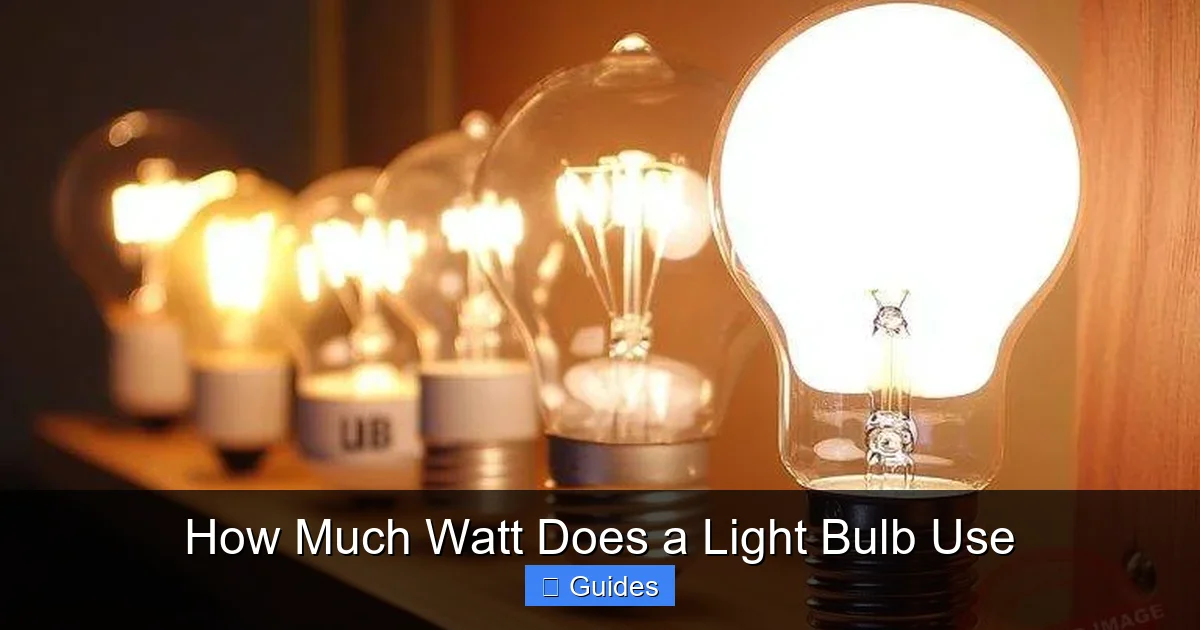
Visual guide about How Much Watt Does a Light Bulb Use
Image source: consumerenergycenter.org
Incandescent Bulbs: The Wattage Workhorses of the Past
For over a century, the incandescent light bulb was king. These bulbs work by heating a tiny wire filament until it glows brightly. It’s a simple, elegant design, but incredibly inefficient. A huge portion of the energy they consumed was released as heat, not light.
- Typical Wattage: 40W, 60W, 75W, 100W, 150W.
- Energy Use: High. To get a decent amount of light (e.g., 800 lumens), you’d need a 60-watt bulb.
- Efficiency: Very low, converting only about 10% of electricity into visible light.
Halogen Bulbs: A Step Towards Efficiency
Halogen bulbs are an improved version of incandescents. They still use a filament, but it’s encased in a capsule containing halogen gas, which allows the filament to burn hotter and more efficiently, extending its lifespan and producing brighter, whiter light for the same wattage.
- Typical Wattage: 29W, 43W, 72W (replacing 40W, 60W, 100W incandescents respectively).
- Energy Use: Moderate. They are about 25-30% more efficient than traditional incandescents.
- Efficiency: Better than incandescents, but still primarily heat-producing.
CFLs: The Compact Fluorescents
CFLs marked a significant departure in technology. They work by passing an electric current through a tube containing argon and a small amount of mercury vapor, which then emits ultraviolet (UV) light. A fluorescent coating on the inside of the tube converts the UV light into visible light. CFLs were the first widely adopted energy-efficient alternative to incandescents.
- Typical Wattage: 9W, 13W, 23W (replacing 40W, 60W, 100W incandescents).
- Energy Use: Low. A CFL uses about 75% less energy than an incandescent to produce the same amount of light.
- Efficiency: Good, but they have downsides like warm-up time, mercury content, and often less appealing light quality.
LEDs: The Current Champions of Efficiency
LEDs are the latest and greatest in lighting technology. They produce light through a process called electroluminescence, where a semiconductor material emits light when an electric current passes through it. LEDs are incredibly efficient, durable, and versatile.
- Typical Wattage: 6W, 9W, 12W, 15W (replacing 40W, 60W, 75W, 100W incandescents).
- Energy Use: Very low. An LED uses up to 90% less energy than an incandescent and significantly less than a CFL for the same light output.
- Efficiency: Excellent. LEDs convert most of their energy into light with minimal heat waste, making them cool to the touch.
Decoding Light Bulb Packaging: Lumens, Watts, and Equivalents
Now that we understand the evolution, let’s tackle what you actually see on the packaging. When asking “how much watt does a light bulb use,” you also need to understand lumens and “watt equivalent.”
What are Lumens? Your New Best Friend for Brightness
Forget watts for brightness; lumens are what you need to focus on! A lumen (lm) is the standard unit of measurement for the total amount of visible light produced by a light source. The higher the lumen number, the brighter the light output. It’s that simple.
- For a dim, accent light, you might look for 200-400 lumens.
- For general ambient lighting in a bedroom or living room, 450-800 lumens are common.
- For task lighting or brightly lit areas like kitchens, 800-1600+ lumens might be suitable.
Always compare lumens when trying to match the brightness of an old incandescent bulb with a new LED or CFL. For example, a traditional 60-watt incandescent bulb produced about 800 lumens. Today, an LED bulb can produce 800 lumens using only 9-10 watts!
“Watt Equivalent” Explained
Since people were so used to judging brightness by watts, manufacturers introduced the “watt equivalent” (often abbreviated as W equivalent or "replaces XW incandescent") on packaging. This is a helpful guideline to bridge the gap between old and new technology.
If a bulb says “9W LED (60W equivalent),” it means that this 9-watt LED bulb produces approximately the same amount of light (lumens) as an old 60-watt incandescent bulb. It’s a convenience factor, allowing you to instantly grasp the brightness without needing to memorize lumen ranges.
Other Important Labels (Color Temperature, CRI)
While how much watt does a light bulb use is about energy, and lumens are about brightness, other factors influence the quality of light. You’ll often see these on packaging:
- Color Temperature (Kelvin – K): This describes the “warmth” or “coolness” of the light. Lower Kelvin numbers (e.g., 2700K) produce a warm, yellowish light like traditional incandescents. Higher numbers (e.g., 5000K-6500K) produce a cool, bluish-white light similar to daylight.
- Color Rendering Index (CRI): This measures how accurately a light source reveals the true colors of objects compared to natural light. A CRI of 100 is perfect (like natural sunlight). Most good quality LEDs have a CRI of 80 or higher.
Calculating Your Light Bulb’s Energy Usage (and Saving Money!)
Now that you know how much watt does a light bulb use and what lumens mean, let’s talk about the practical impact on your electricity bill. Knowing the wattage of your bulbs allows you to calculate their energy consumption and, more importantly, figure out how much you can save by switching to more efficient options.
Simple Math: Watts to Kilowatt-Hours (kWh)
Your electricity bill measures consumption in kilowatt-hours (kWh). One kilowatt-hour means you’ve used 1,000 watts of power for one hour. Here’s how to calculate:
- Find the Wattage: Look at the bulb (or packaging) for its wattage (e.g., 60W incandescent or 9W LED).
- Multiply by Hours Used: Estimate how many hours per day (or month) the bulb is typically on.
- Calculate Watt-Hours: Wattage (W) x Hours Used (h) = Watt-hours (Wh).
- Convert to Kilowatt-Hours: Divide Watt-hours by 1,000 to get Kilowatt-hours (kWh).
- Multiply by Cost: Multiply the kWh by your electricity rate (e.g., $0.15 per kWh).
Real-World Examples of Energy Cost
Let’s use an example of a single light bulb that’s on for 4 hours a day, every day for a month (30 days). Your electricity rate is $0.15/kWh.
Example 1: Old 60-Watt Incandescent Bulb
- Wattage: 60W
- Hours per month: 4 hours/day * 30 days = 120 hours
- Watt-hours per month: 60W * 120h = 7,200 Wh
- Kilowatt-hours per month: 7,200 Wh / 1,000 = 7.2 kWh
- Monthly Cost: 7.2 kWh * $0.15/kWh = $1.08
Example 2: New 9-Watt LED Bulb (60W equivalent)
- Wattage: 9W
- Hours per month: 4 hours/day * 30 days = 120 hours
- Watt-hours per month: 9W * 120h = 1,080 Wh
- Kilowatt-hours per month: 1,080 Wh / 1,000 = 1.08 kWh
- Monthly Cost: 1.08 kWh * $0.15/kWh = $0.16
See the difference? For just one bulb, you’re saving almost a dollar a month. Multiply that by 10-20 bulbs in your home, and the annual savings quickly add up to significant figures. This vividly illustrates why understanding how much watt does a light bulb use is so crucial for your budget.
Practical Tips for Reducing Light Bulb Energy Consumption
- Switch to LEDs: This is the single most impactful step you can take. Replace all incandescent and even older CFLs with LEDs. They pay for themselves quickly through energy savings.
- Dim Lights When Possible: If your fixtures are dimmable and you have dimmable bulbs, use them! Dimming an LED bulb reduces its wattage consumption and extends its lifespan.
- Use Task Lighting: Instead of lighting an entire room brightly, use focused task lighting (like a desk lamp) where you need it, and lower ambient light elsewhere.
- Install Motion Sensors: For areas like hallways, closets, or outdoors, motion-sensing lights ensure they’re only on when needed.
- Maximize Natural Light: Open curtains and blinds during the day. Arrange furniture to take advantage of natural light, reducing the need for artificial lighting.
- Turn Lights Off: A classic, but still effective! Get into the habit of turning off lights when you leave a room.
Beyond Just Watts: Other Factors Affecting Light Bulb Performance and Choice
While understanding how much watt does a light bulb use is fundamental for energy efficiency, it’s just one piece of the puzzle. When selecting light bulbs, especially LEDs, there are other important considerations that impact performance, convenience, and overall satisfaction.
Lifespan and Durability
One of the biggest advantages of LEDs is their incredible lifespan. While an incandescent bulb might last 1,000-2,000 hours, a quality LED bulb can last 15,000 to 50,000 hours or even more. This means fewer bulb changes, less waste, and greater convenience, especially for hard-to-reach fixtures. This extended life often justifies the higher upfront cost of an LED, as you’re buying a bulb that will likely outlive several fixtures.
Dimming Capabilities
Not all LED bulbs are dimmable, and not all dimmers work well with LEDs. If you plan to use a dimmer switch, make sure both the bulb and the switch are compatible with LED dimming technology. Look for “Dimmable” clearly marked on the bulb packaging. Using a non-dimmable LED on a dimmer can cause flickering, buzzing, or even damage to the bulb.
Smart Home Integration
The world of lighting has gone smart! Many LED bulbs now offer smart capabilities, allowing you to control them via smartphone apps, voice assistants (like Alexa or Google Assistant), or integrate them into a larger smart home system. These bulbs can offer features like color changing, scheduling, and remote control, adding convenience and ambiance to your home. While the wattage itself might not change much, the intelligent control over when and how intensely they operate can contribute to further energy savings.
Environmental Impact
Beyond how much watt does a light bulb use, the environmental aspect is significant. LEDs consume far less energy, reducing the demand on power plants and decreasing greenhouse gas emissions. They also don’t contain mercury, unlike CFLs, making disposal safer. Their long lifespan means fewer bulbs end up in landfills. Choosing LEDs is a conscious step towards a more sustainable lifestyle.
Conclusion
So, you’ve made it! You now know that asking “how much watt does a light bulb use” is really asking about its energy consumption. You understand that for brightness, you look at lumens, and that “watt equivalent” helps you translate old incandescent brightness to new, efficient LED technology. You’re equipped to decode light bulb packaging, calculate potential savings, and choose bulbs that are right for your needs and your budget.
The transition in lighting technology has brought incredible opportunities for energy savings and improved light quality. By embracing LEDs and making informed choices, you’re not just buying a light bulb; you’re investing in lower utility bills, a more comfortable home, and a more sustainable future. Go forth and light your world wisely!
Frequently Asked Questions
Why should I care about how much watt does a light bulb use?
Caring about how much watt a light bulb uses directly impacts your electricity bill and environmental footprint. Lower wattage means less electricity consumed, leading to significant savings over time and reduced energy demand.
What are the average watts for common light bulbs today?
For common household lighting today, an LED bulb that provides brightness equivalent to a traditional 60-watt incandescent typically uses around 8-10 watts. Brighter LEDs might use 12-15 watts, while dim ones could be 4-6 watts.
Does dimming a light bulb save energy?
Yes, dimming a compatible LED light bulb significantly reduces its wattage consumption, thereby saving energy. It also helps extend the bulb’s lifespan.
How do smart light bulbs affect wattage?
Smart light bulbs are typically LEDs, so they inherently use low wattage. While their “smart” features (like Wi-Fi connectivity) consume a tiny amount of additional power, the overall wattage is still far lower than traditional bulbs, and their smart controls can help save energy by ensuring lights are only on when needed.
Is a higher wattage always brighter?
No, not anymore. With modern, energy-efficient bulbs like LEDs, a higher wattage no longer guarantees a brighter light. For brightness, you should always look at the lumen (lm) rating instead of the wattage (W).
How can I tell how much energy a light bulb uses before buying it?
You can find out how much energy a light bulb uses by checking its packaging. The wattage (W) is always listed, indicating its power consumption. You might also see an estimated annual energy cost based on typical usage, often found on the EnergyGuide label.
