


As an Amazon Associate, We earn from qualifying purchases.
A medium base light bulb, most commonly known by its E26 (North America) or E27 (Europe) designation, is the most prevalent screw-in bulb type used in homes globally. Its widespread popularity stems from its standardized size, ease of use, and compatibility with a vast array of fixtures, making it incredibly versatile for almost any lighting need. This guide will illuminate everything you need to know about this essential household item.
What Is Medium Base Light Bulb?
Have you ever found yourself in the lighting aisle, staring at a dizzying array of light bulbs, and just instinctively reaching for the “standard” one? Chances are, you were picking up a medium base light bulb. This unassuming hero of illumination is everywhere, powering the lamps in your living room, the ceiling fixtures in your kitchen, and even many outdoor lights. It’s so common, in fact, that most of us don’t even think about it – we just expect it to work.
But what exactly is a medium base light bulb? Why is it so popular? And what makes it the go-to choice for lighting designers and homeowners alike? This comprehensive guide is designed to shed light on all these questions and more. We’ll demystify the terms, explore the history, dive into the various types, and give you all the practical knowledge you need to confidently choose and use your medium base light bulbs. Get ready to illuminate your understanding!
So, whether you’re replacing a burnt-out bulb, upgrading your home’s lighting, or just curious about the everyday objects around you, understanding the medium base light bulb is a fantastic place to start. Let’s embark on this enlightening journey together and discover the simple brilliance behind this universal standard.
Key Takeaways
- Universal Standard: The medium base light bulb (E26 in North America, E27 internationally) is the most common screw-in bulb type, found in nearly all residential and many commercial light fixtures.
- Size and Fit: “Medium” refers to the diameter of the screw base, which is approximately 26mm or 27mm, ensuring a consistent fit across millions of sockets.
- Unmatched Versatility: Available in countless shapes, sizes (bulb envelopes), wattages, and technologies (LED, CFL, halogen), medium base bulbs serve every lighting purpose from ambient to task.
- Energy Efficiency Options: While historically incandescent, modern medium base bulbs are predominantly energy-efficient LEDs, offering significant savings and longer lifespans.
- Simple Replacement: Replacing a medium base bulb is a straightforward process, requiring no special tools or expertise, making it incredibly user-friendly.
- Smart Home Ready: Many smart bulbs with advanced features like color changing and app control are available with the standard medium base, integrating easily into modern smart home systems.
Quick Answers to Common Questions
What does E26 or E27 mean?
E26 and E27 refer to the size of the screw-in base of a light bulb. ‘E’ stands for Edison Screw, and the number (26 or 27) indicates the diameter of the base in millimeters. E26 is standard in North America, while E27 is common in Europe and other regions.
Are all medium base bulbs interchangeable?
Generally, yes, E26 and E27 medium base light bulbs are often interchangeable due to minor size differences and manufacturing tolerances. However, it’s always recommended to use the specific base type designated for your region or fixture for optimal fit and safety.
Can I use a smart bulb with a medium base?
Absolutely! Many smart light bulbs are designed with an E26 or E27 medium base, allowing them to screw directly into your existing light fixtures. This makes it easy to upgrade your home to smart lighting without changing hardware.
What’s the main difference between E26 and E27?
The main difference is the diameter of the screw base (26mm vs. 27mm) and their regional standards (E26 for North America, E27 for Europe). Functionally, they are very similar and often compatible, but electrical safety certifications may differ.
How do I know if my fixture takes a medium base bulb?
Most common household fixtures in North America are designed for E26 medium base light bulbs. You can often tell by looking at the existing bulb or the socket itself; it will be the familiar screw-in size. The fixture’s manual or a label inside the socket might also specify the required bulb base.
📑 Table of Contents
- Understanding the Basics: What is a Medium Base Light Bulb?
- The Anatomy of a Medium Base Bulb: More Than Just a Screw
- Why the Medium Base Reigns Supreme: Popularity and Versatility
- Beyond Incandescent: Medium Base Bulb Types and Technologies
- Choosing the Right Medium Base Bulb: A Buyer’s Guide
- Installation, Maintenance, and Troubleshooting Tips
- Conclusion
Understanding the Basics: What is a Medium Base Light Bulb?
At its heart, a medium base light bulb refers to the most common size of screw-in light bulb base. The “medium” part describes the diameter of the base itself, specifically the threaded metal part that screws into a socket. When we talk about medium base light bulbs, we’re almost always referring to what’s formally known as an “Edison Screw” base.
The Edison Screw Designation: E26 and E27
The “E” in E26 or E27 stands for “Edison,” honoring Thomas Edison, who pioneered this screw-thread design. The number that follows—26 or 27—represents the approximate diameter of the screw base in millimeters (mm). So, an E26 medium base light bulb has a base that’s roughly 26mm in diameter, and an E27 medium base light bulb has a base that’s about 27mm.
While E26 is the standard in North America (United States and Canada), E27 is the standard in Europe, Australia, and many other parts of the world. Despite the slight 1mm difference, these two base types are often interchangeable in practice due to manufacturing tolerances. Most sockets designed for E26 can typically accommodate an E27 bulb, and vice-versa, though it’s always best to use the type specified for your region for optimal fit and safety. This universal similarity is a huge part of why the medium base light bulb is so dominant globally.
A Legacy of Light
The medium base light bulb’s design dates back to the very early days of electric lighting. Its simplicity and effectiveness—allowing for easy installation and secure electrical contact—quickly made it the industry standard. For over a century, this basic design has remained largely unchanged, a testament to its enduring utility. From the incandescent bulbs of yesteryear to today’s advanced LEDs, the medium base light bulb has consistently served as the reliable connection between the power source and the light-emitting element, keeping our homes and businesses bright.
The Anatomy of a Medium Base Bulb: More Than Just a Screw
While the medium base light bulb is characterized by its screw base, there’s more to its design than meets the eye. Understanding its components helps appreciate its robust and functional nature.
The Screw Base Itself
The screw base, typically made of brass or aluminum, is the conductive part that twists into the socket. It has threads that match the internal threads of the lamp holder, ensuring a snug fit and electrical connection. The tip of the base, often called the “foot contact” or “center contact,” is a small metal button that makes contact with the live electrical terminal inside the socket. The threads themselves serve as the neutral electrical contact. This simple yet ingenious design provides both mechanical support and electrical conductivity.
The Insulator
Between the center contact and the threaded side wall of the base, there’s a vital insulating material, usually ceramic or a sturdy plastic. This insulator prevents a short circuit between the live and neutral parts of the base, ensuring safe operation. Without this small but crucial component, electricity would bypass the light-emitting element, leading to immediate failure and potential hazards.
Bulb Shape and Size (Envelope)
It’s important to distinguish between the “base” and the “bulb” itself. A medium base light bulb can come in a huge variety of shapes and sizes, referring to the glass or plastic enclosure that houses the light source. Common shapes include:
- A-Type: The classic, pear-shaped bulb we all recognize (e.g., A19, A21).
- G-Type: Globe-shaped bulbs, often used in vanity fixtures (e.g., G25).
- C-Type/B-Type: Candle-shaped bulbs, common in chandeliers (e.g., C7, B10).
- BR/PAR: Reflector bulbs, used for directional lighting (e.g., BR30, PAR38).
The numbers after these letters usually indicate the bulb’s diameter in eighths of an inch (e.g., A19 is 19/8ths of an inch, or 2.375 inches wide). So, while the base is medium, the actual light-emitting part can vary dramatically to suit different aesthetic and functional needs.
Why the Medium Base Reigns Supreme: Popularity and Versatility
The medium base light bulb isn’t just common by accident; its enduring popularity is a direct result of several key advantages that make it an unbeatable choice for general lighting.
Ubiquity in Residential Settings
Walk into almost any home in North America, and you’ll find E26 medium base light bulbs in nearly every light fixture. From table lamps and floor lamps to ceiling fans, recessed lighting, track lighting, and even many outdoor porch lights, the E26 socket is the default. This widespread adoption means that when you need a replacement bulb, you can almost always find one that fits, no matter where you shop. The same holds true for E27 in its respective regions. This consistency simplifies everything from home construction to everyday maintenance.
Effortless Compatibility
Imagine if every lamp required a different type of bulb base. It would be a nightmare! The medium base light bulb solves this by providing a standardized interface. This compatibility means that manufacturers can design countless fixture styles knowing that a standard, readily available bulb will fit. It also means consumers don’t have to worry about matching obscure bulb types to their existing lamps and fixtures. This ease of interchangeability drives down costs and increases convenience for everyone.
Adaptability to Evolving Technologies
One of the most remarkable aspects of the medium base light bulb is its ability to adapt to new lighting technologies. When incandescent bulbs were phased out or limited, CFLs (compact fluorescent lamps) stepped in, offering energy efficiency while still using the familiar medium base. Today, LED (light-emitting diode) technology dominates, providing unparalleled energy savings, longevity, and versatility—all wrapped up in the same E26 or E27 medium base. This backward compatibility ensures that you can upgrade your lighting to the latest technology without having to replace your fixtures.
Aesthetic and Functional Versatility
As mentioned earlier, the medium base light bulb can house nearly any bulb shape, size, and even special features. Do you need a decorative flame-tip bulb for your chandelier? A bright floodlight for your recessed can? A smart bulb that changes color with an app? All of these are available with a medium base. This enormous range of options allows homeowners and designers to achieve almost any desired lighting effect or aesthetic without sacrificing the convenience of a standard base.
Beyond Incandescent: Medium Base Bulb Types and Technologies
While the medium base light bulb initially became popular with incandescent technology, its true power lies in its capacity to accommodate a wide spectrum of modern lighting solutions.
LED (Light-Emitting Diode) Bulbs
LED medium base bulbs are the reigning champions of modern lighting. They offer:
- Energy Efficiency: Up to 90% more efficient than incandescent bulbs, saving significant money on electricity bills.
- Longevity: Last tens of thousands of hours, often 15-25 times longer than incandescents, drastically reducing replacement frequency.
- Durability: No fragile filament, making them more resistant to breakage.
- Cool Operation: Generate very little heat, which is safer and reduces cooling costs.
- Instant On: Provide full brightness immediately, with no warm-up time.
Today, nearly every type of incandescent medium base light bulb has an LED equivalent, offering various wattages (equivalent lumens), color temperatures, and dimming capabilities.
CFL (Compact Fluorescent Lamp) Bulbs
CFL medium base bulbs were the first widely available energy-efficient alternative to incandescents. They offered:
- Energy Efficiency: Significantly more efficient than incandescents, though less so than LEDs.
- Lifespan: Longer lifespan than incandescents.
However, CFLs have largely been supplanted by LEDs due to their slower warm-up time, mercury content (requiring special disposal), and limited dimming capabilities. You’ll still find them, but LEDs are generally the preferred upgrade for medium base applications.
Halogen Bulbs
Halogen medium base bulbs are a more efficient form of incandescent technology. They use a halogen gas within the bulb to regenerate the tungsten filament, leading to:
- Brighter, Whiter Light: Often preferred for their crisp light quality.
- Energy Efficiency: Slightly more efficient than traditional incandescents, but still far less efficient than LEDs.
- Dimmability: Excellent dimming performance.
While they provide good light quality, their high heat output and relatively short lifespan compared to LEDs make them less popular for general lighting, though they still have niche applications where specific light quality or full-range dimming is crucial.
Smart Medium Base Light Bulbs
The medium base light bulb has even stepped into the future with smart technology. Many smart bulbs are designed with an E26 or E27 base, allowing them to screw into existing fixtures. These bulbs connect to your home’s Wi-Fi or a hub and offer features like:
- Remote Control: Turn lights on/off or dim from anywhere via a smartphone app.
- Color Changing: Adjust to millions of colors and various shades of white.
- Scheduling: Set lights to turn on/off automatically.
- Voice Control: Integrate with smart assistants like Alexa or Google Assistant.
- Scenes and Automation: Create custom lighting scenarios for different moods or activities.
This integration of smart technology into the common medium base light bulb truly showcases its incredible adaptability and future-proofing.
Choosing the Right Medium Base Bulb: A Buyer’s Guide
With so many options available for medium base light bulbs, making the right choice can seem overwhelming. Here’s a simple guide to help you pick the perfect one for your needs.
Lumens, Not Watts: Understanding Brightness
Forget watts when buying modern medium base light bulbs, especially LEDs. Watts measure energy consumption, not brightness. Instead, look for lumens (lm). Lumens measure the total amount of visible light produced by a bulb.
- For a traditional 60-watt incandescent equivalent, look for around 800 lumens.
- A 40-watt equivalent is typically around 450 lumens.
- A 100-watt equivalent is around 1600 lumens.
Always check the lumen output to ensure you get the desired brightness.
Color Temperature: Setting the Mood with Kelvin (K)
Color temperature, measured in Kelvin (K), describes how “warm” or “cool” the light appears.
- Warm White (2700K – 3000K): A cozy, yellowish light, similar to traditional incandescents. Ideal for bedrooms, living rooms, and dining areas.
- Neutral/Cool White (3500K – 4100K): A balanced, whiter light. Good for kitchens, bathrooms, offices, and workshops where task lighting is needed.
- Daylight (5000K – 6500K): A very bright, bluish-white light, mimicking natural daylight. Best for highly functional areas, garages, or for stimulating alertness.
Choose the color temperature that best suits the mood and function of the space.
Dimmability: Does Your Bulb Dim?
Not all medium base LED bulbs are dimmable. If you plan to use a dimmer switch, always look for bulbs explicitly labeled “dimmable.” Using a non-dimmable LED on a dimmer switch can lead to flickering, buzzing, or premature bulb failure. For the best performance, pair dimmable LEDs with LED-compatible dimmer switches.
Energy Efficiency and Longevity
Prioritize LED medium base light bulbs for their superior energy efficiency and exceptionally long lifespan. While they might have a slightly higher upfront cost, the savings on electricity and replacement bulbs quickly make up for it. Look for bulbs with Energy Star certification for verified performance.
Specialty Applications and Features
Consider specific features if your medium base light bulb needs to do more than just illuminate:
- Outdoor Use: Look for bulbs rated for “damp” or “wet” locations if used outdoors in open fixtures.
- Enclosed Fixtures: Some LEDs may not be suitable for fully enclosed fixtures if they can’t dissipate heat properly. Check the packaging.
- Smart Features: If you’re building a smart home, opt for smart medium base bulbs for advanced control.
- Decorative Styles: Filament-style LEDs or unique shapes can add aesthetic appeal to visible fixtures.
Taking these factors into account will help you select the ideal medium base light bulb for every scenario.
Installation, Maintenance, and Troubleshooting Tips
Installing and maintaining your medium base light bulb is generally straightforward, but a few tips can ensure safety and longevity.
Safe Installation Practices
- Turn Off Power: Always, always turn off the power to the fixture at the wall switch before removing or installing a medium base light bulb. For added safety, consider flipping the circuit breaker.
- Let Cool Down: Incandescent and halogen bulbs get very hot. Allow a burnt-out bulb to cool completely before touching it to avoid burns. LEDs run cooler but it’s still good practice.
- Handle with Care: Hold the bulb by its base or the non-light-emitting portion. Avoid touching the glass or plastic envelope of a halogen or bare LED directly, as oils from your skin can create hot spots and shorten the bulb’s life.
- Screw In Gently: Twist the medium base light bulb into the socket clockwise until it’s finger-tight. Do not overtighten, as this can damage the socket or the bulb.
Proper Cleaning and Care
Dust can accumulate on light bulbs, reducing their brightness. Periodically, with the power off and the bulb cool, wipe down your medium base light bulbs with a soft, dry, or slightly damp cloth. Avoid harsh chemicals or abrasive cleaners. For intricate fixtures, a soft brush can help remove dust.
Common Troubleshooting for Medium Base Light Bulbs
If your medium base light bulb isn’t working, here are a few things to check:
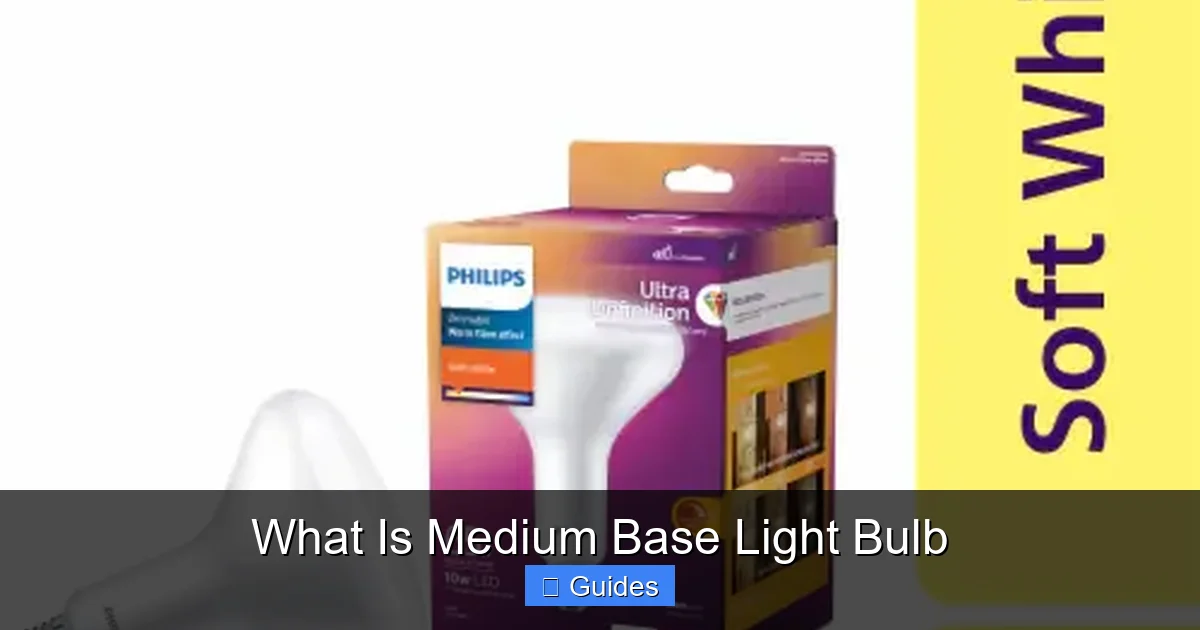
Visual guide about What Is Medium Base Light Bulb
Image source: kroger.com
- Is it Tight? Ensure the bulb is screwed in firmly. A loose connection is a common culprit.
- Is the Bulb Burned Out? While LEDs last a long time, all bulbs eventually fail. Try a known working bulb in the same socket.
- Is the Fixture Working? If a new bulb doesn’t work, the issue might be with the fixture or the switch. Check the switch, then examine the socket for damage or corrosion.
- Circuit Breaker: If multiple lights are out, check your home’s circuit breaker box to see if a breaker has tripped.
Most issues with medium base light bulbs are simple fixes, often just requiring a new bulb or a tighter twist.
Conclusion
The medium base light bulb is far more than just a simple component; it’s the unsung hero of home lighting, a testament to enduring design, and a marvel of adaptability. From its humble origins with Edison to its sophisticated manifestations as smart, energy-efficient LEDs, the E26/E27 medium base has consistently provided a reliable and versatile foundation for illuminating our lives.
Its ubiquity means convenience, its flexibility allows for endless design possibilities, and its compatibility with the latest technologies empowers us to light our homes efficiently and intelligently. Understanding what a medium base light bulb is and why it’s so important gives you the knowledge to make smart lighting choices, enhance your home’s ambiance, and save energy along the way. So next time you screw in that familiar bulb, you’ll know you’re connecting to over a century of innovation, all within that wonderfully standard medium base.
Frequently Asked Questions
What are the common shapes for medium base bulbs?
Medium base light bulbs come in numerous shapes to suit different aesthetics and functions. Common examples include the classic pear-shaped A-type (like A19), globe-shaped G-type (G25), candle-shaped C-type (C7), and various reflector shapes like BR (BR30) or PAR (PAR38) for directional lighting.
How do lumens relate to medium base bulbs?
Lumens measure a medium base light bulb’s brightness, unlike watts, which measure energy consumption. When buying modern LED medium base bulbs, always look for the lumen rating (e.g., 800 lumens for a 60W incandescent equivalent) to ensure you get the desired light output.
What is color temperature (Kelvin) in medium base bulbs?
Color temperature, measured in Kelvin (K), describes the hue of the light emitted by a medium base light bulb. Lower Kelvin numbers (e.g., 2700K-3000K) produce a warm, yellowish light, while higher numbers (e.g., 5000K-6500K) emit a cool, bluish-white light similar to daylight.
Can I use medium base bulbs outdoors?
Yes, many medium base light bulbs are suitable for outdoor use, but you must choose bulbs and fixtures specifically rated for “damp” or “wet” locations. This ensures they can withstand moisture and environmental exposure without posing a safety risk or failing prematurely.
How long do modern medium base LED bulbs typically last?
Modern medium base LED bulbs are incredibly durable and long-lasting, typically offering lifespans of 15,000 to 25,000 hours or even more. This translates to many years of use under normal household conditions, significantly outperforming traditional incandescent bulbs.
Are there specific safety tips for handling medium base bulbs?
When handling medium base light bulbs, always turn off the power at the switch or circuit breaker first, and allow hot bulbs to cool down. Avoid overtightening bulbs in the socket, and for delicate types like halogens, try not to touch the glass with bare hands as oils can create hot spots.
