


As an Amazon Associate, We earn from qualifying purchases.
Understanding how to measure the brightness of a light bulb goes beyond just Watts. The key metric for perceived brightness is the lumen (lm), which indicates the total visible light output. While watts measure energy consumption, lumens directly tell you how much light a bulb emits, making it easier to choose the right illumination for any space.
Have you ever stood in the lighting aisle, squinting at light bulb packages, utterly confused by numbers like “60W equivalent,” “800 lumens,” or “2700K”? You’re not alone! For decades, we’ve instinctively associated the “brightness” of a light bulb with its wattage. A 100-watt bulb was brighter than a 60-watt bulb, simple as that. But with the advent of energy-efficient lighting like LEDs and CFLs, that old rule of thumb has gone out the window.
Today, understanding how to truly measure the brightness of a light bulb is more crucial than ever. It’s not just about saving energy; it’s about creating the right ambiance, ensuring proper task lighting, and making informed choices for your home or office. Let’s demystify the science behind light, unravel the various units of measurement, and empower you to pick the perfect bulb every single time. Get ready to illuminate your understanding!
Key Takeaways
- Lumens are Key: Forget Watts when judging brightness; lumens (lm) are the primary unit for measuring the total visible light emitted by a light bulb. More lumens mean more light.
- Watts Measure Energy, Not Brightness: Watts indicate how much energy a bulb consumes, not how bright it is. Modern energy-efficient bulbs produce more lumens per watt.
- Understanding Other Metrics: While lumens measure total output, candelas (luminous intensity) are for directional light, and lux (illuminance) measure light falling on a surface. Color temperature (Kelvin) and CRI affect light quality, not just brightness.
- Lab vs. Home Measurement: Professional brightness measurement uses specialized equipment like integrating spheres and goniophotometers. For home use, a simple light meter can measure lux on a surface.
- Practical Application: To choose the right bulb, consider the room size, purpose, and desired ambiance. Use lumens as your guide, aiming for higher lumens in task areas and lower for mood lighting.
- Efficiency Matters: LED bulbs offer superior energy efficiency, producing comparable or greater lumens than older incandescent bulbs while using significantly less power.
Quick Answers to Common Questions
What is the primary unit for measuring light bulb brightness?
The primary unit for measuring a light bulb’s perceived brightness is the lumen (lm), which indicates the total amount of visible light emitted.
Do more watts mean a brighter light bulb?
No, not anymore. Watts measure energy consumption, not brightness. With modern energy-efficient bulbs, a lower wattage can produce the same or more lumens (brightness) than older, higher-wattage bulbs.
What’s the difference between lumens and lux?
Lumens measure the total light emitted by a source (luminous flux), while lux measures the amount of light falling on a specific surface area (illuminance). One lux is one lumen per square meter.
How does color temperature relate to brightness?
Color temperature (measured in Kelvin) describes the color appearance of light (e.g., warm white, cool white). While it doesn’t measure actual brightness (lumens), cooler light often *feels* brighter and more stimulating to the human eye than warmer light, even at the same lumen output.
Can I measure light brightness at home?
You can measure the illuminance (lux) on a surface using a light meter or a smartphone app. However, accurately measuring a bulb’s total lumen output requires specialized laboratory equipment like an integrating sphere.
📑 Table of Contents
The Old Way: Why Watts Don’t Measure Brightness
For a long time, comparing light bulbs was incredibly straightforward. If you wanted a brighter light, you simply bought a bulb with a higher wattage. A 60-watt incandescent bulb gave you a certain amount of light, and a 100-watt bulb gave you more. This was because, for incandescent bulbs, there was a fairly direct correlation between the energy consumed (watts) and the amount of light produced. More energy meant more heat *and* more light.
The Shift to Energy Efficiency
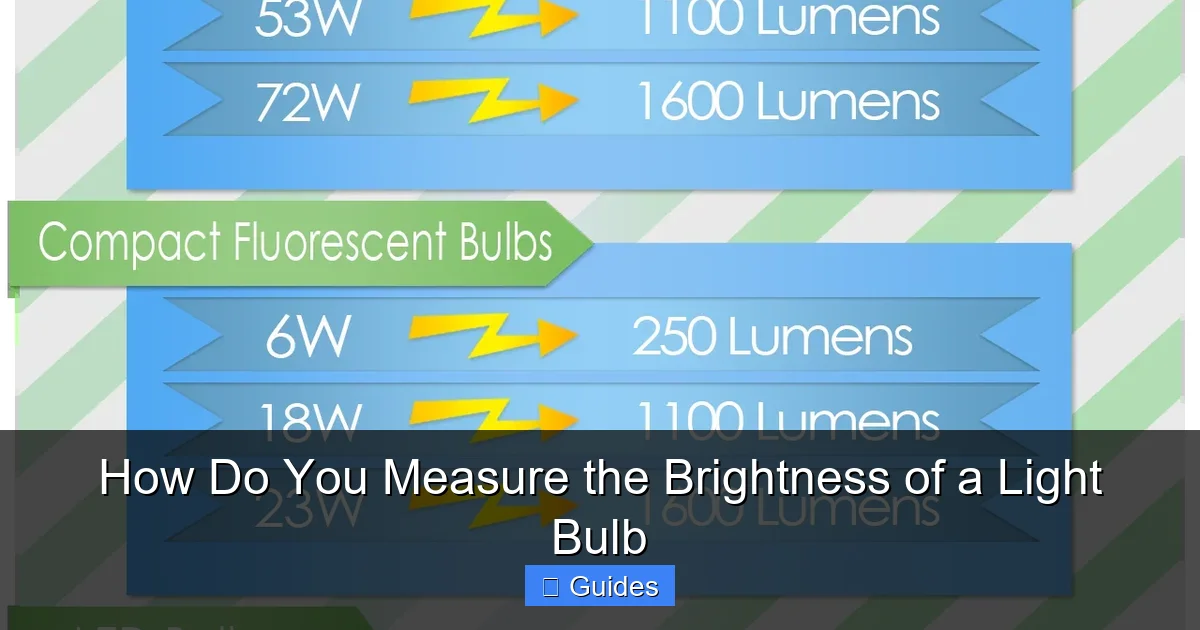
However, incandescent bulbs are incredibly inefficient. A significant portion of the energy they consume is wasted as heat, not light. Modern lighting technologies, particularly LEDs (Light Emitting Diodes) and CFLs (Compact Fluorescent Lamps), changed everything. These bulbs are designed to produce light much more efficiently, meaning they can create the same amount of light (or even more!) using a fraction of the wattage.
This shift meant that a “60-watt equivalent” LED bulb might only consume 9 or 10 watts, yet it produces the same visible light output as an old 60-watt incandescent. Suddenly, using watts to measure the brightness of a light bulb became meaningless. You can no longer rely on wattage to tell you how much light you’re actually going to get. This brings us to the real hero of brightness measurement: the lumen.
The New Standard: Lumens (lm) – The True Measure of Brightness
If you want to understand how to measure the brightness of a light bulb, you absolutely need to know about lumens. Lumens (symbolized as lm) are the international standard unit for measuring luminous flux, which essentially means the total amount of visible light emitted by a light source in all directions.
What Exactly are Lumens?
Think of it this way: if a light bulb is like a mini sun, lumens measure all the light rays pouring out of it. The higher the lumen rating, the more light the bulb emits, and thus, the brighter it will appear to your eyes. This is a direct measurement of light output, unlike watts which only measure energy input.
For example, an old 60-watt incandescent bulb typically produced around 800 lumens. A modern LED bulb that gives off the same amount of light will also be rated at approximately 800 lumens, but it might only use 9-10 watts of electricity. This is why packaging now often highlights the lumen rating much more prominently than the “equivalent” wattage.
How Many Lumens Do You Need?
The ideal number of lumens depends entirely on the specific application and the size of the room. There’s no one-size-fits-all answer, but here’s a general guide to help you measure the brightness of a light bulb effectively for different spaces:
- Ambient/General Lighting: For living rooms, bedrooms, or dining rooms, you might aim for a total of 10-20 lumens per square foot. So, a 10×12 foot room (120 sq ft) might need 1200-2400 lumens.
- Task Lighting: Areas where you read, cook, or work require brighter, more focused light. Think 30-50 lumens per square foot in kitchens, bathrooms, or home offices.
- Accent Lighting: For highlighting artwork or creating mood, fewer lumens are needed, often focused by a narrow beam.
Remember, these are general guidelines. Factors like wall color (darker walls absorb more light), ceiling height, and personal preference also play a role. It’s always a good idea to try out different lumen ratings or use dimmable bulbs to find your perfect brightness.
Beyond Lumens: Other Important Light Metrics
While lumens are king when you want to measure the brightness of a light bulb in terms of total output, light is a complex phenomenon, and other metrics help us understand its quality and distribution.
Candela (cd): Luminous Intensity
If lumens measure *all* the light emitted in *all* directions, candela (cd) measures *directional* brightness or intensity. Think of a spotlight. It might not have a huge total lumen output, but it directs all its light into a very narrow beam, making that beam intensely bright. Candela is useful for measuring the intensity of light in a specific direction, often for spotlights, flashlights, or automotive headlights.
One candela is roughly the luminous intensity of a single candle (hence the name!). So, while a room lamp might be high in lumens, a focused beam from a flashlight will have a higher candela rating in its beam direction.
Lux (lx): Illuminance (Light on a Surface)
Lux (lx) is another crucial unit when discussing how to measure the brightness of a light bulb, especially concerning what our eyes actually perceive on a surface. Lux measures illuminance – the amount of light falling on a given surface area. One lux is equal to one lumen per square meter (lm/m²).
This is very practical for designing lighting for specific tasks. For example:
- Office Work: Needs about 300-500 lux on the desk surface.
- General Home Lighting: Around 100-200 lux is common.
- Reading: Requires 300-500 lux directly on the page.
While lumens tell you how much light a bulb emits, lux tells you how much of that light *reaches* a specific spot. This is why a light meter (often found as an app on your smartphone, though professional ones are more accurate) measures lux, not lumens. It measures the light hitting its sensor.
Kelvin (K): Color Temperature
While not a direct measure of brightness, color temperature (measured in Kelvin, K) significantly impacts how we *perceive* brightness and the overall feel of a space.
- Warm Light (2700K – 3000K): Appears yellowish, similar to traditional incandescents. Creates a cozy, inviting atmosphere.
- Cool Light (3500K – 4500K): More neutral white, suitable for task lighting in kitchens or offices.
- Daylight (5000K – 6500K): Bluer, mimicking natural daylight. Can feel very bright and invigorating.
A higher Kelvin number doesn’t mean the bulb is brighter in terms of lumens, but a cooler, bluer light often *feels* brighter and more stimulating to our eyes.
Color Rendering Index (CRI)
CRI is a measure of how accurately a light source reveals the true colors of objects compared to natural light. A CRI of 100 is perfect (like natural sunlight). High CRI (80+) is desirable for areas where color accuracy is important, such as kitchens, bathrooms, or art studios. Again, CRI doesn’t measure brightness but rather the *quality* of the light.
How Brightness is Professionally Measured (and What You Can Do at Home)
Understanding how professionals measure the brightness of a light bulb gives insight into the precision required for accurate ratings.
Laboratory Measurement
In professional settings, specialized equipment is used to accurately measure lumens, candelas, and other light metrics.
Integrating Sphere
This is a hollow spherical cavity with a highly reflective, diffuse white inner coating. When a light bulb is placed inside and turned on, the sphere captures all the light emitted in every direction. Sensors then measure the total light, providing a precise lumen rating. This method is excellent for total luminous flux.
Goniophotometer
This more complex instrument measures light intensity (candela) at various angles around the light source. By rotating the bulb and taking measurements at hundreds of points, it can map out the light distribution pattern and calculate both candela values for specific directions and the total lumen output by integrating all these measurements. This is critical for understanding how a bulb projects light, especially for directional lamps.
Measuring Brightness at Home (Lux Meters)
While you can’t measure a bulb’s lumen output accurately at home without specialized equipment, you *can* measure the illuminance (lux) on a surface using a simple light meter.
Using a Light Meter
These devices, often handheld, have a sensor that measures the amount of light falling on it. Many smartphone apps also claim to be light meters, and while they can give you a rough idea, dedicated light meters are much more accurate.
To measure:
- Place the light meter (or your phone with a light meter app) on the surface where you want to measure the light (e.g., your desk, kitchen counter, or a book).
- Ensure no shadows are cast on the sensor.
- Read the lux value.
This gives you a practical understanding of how much light is *reaching* your workspace, which is often more useful for day-to-day use than knowing the bulb’s total lumen output.
Practical Tips for Choosing the Right Brightness
Now that you know how to measure the brightness of a light bulb using lumens and understand other critical metrics, let’s put it all into practice.
1. Focus on Lumens, Not Watts
This is the single most important takeaway. When shopping for bulbs, ignore the “equivalent wattage” and go straight for the lumen rating. A table lamp for reading might need a bulb around 800-1100 lumens, while a decorative fixture providing ambient light might be fine with 450-600 lumens.
2. Consider the Room Size and Purpose
- Small Rooms (e.g., half bath, small closet): 400-800 lumens total.
- Medium Rooms (e.g., bedroom, living room): 1500-3000 lumens total, often achieved with multiple light sources.
- Large Rooms/Task Areas (e.g., kitchen, workshop, garage): 3000-6000+ lumens total, ensuring adequate light for detailed work.
Visual guide about How Do You Measure the Brightness of a Light Bulb
Image source: warehouse-lighting.com
3. Layer Your Lighting
Don’t rely on a single overhead light. Combine ambient (general), task (focused), and accent (decorative) lighting to create a flexible and appealing space. Each layer will contribute to the overall perceived brightness. For example, in a living room, you might have an overhead fixture providing 1600 lumens of ambient light, two table lamps each providing 800 lumens for reading, and a picture light offering 200 lumens for accent.
4. Don’t Forget Color Temperature (Kelvin)
While not brightness itself, color temperature dramatically affects how bright a space *feels*. Cooler light (3500K-5000K) is perceived as brighter and more energetic, ideal for task-oriented areas. Warmer light (2700K-3000K) creates a cozier, more relaxed atmosphere, even with the same lumen output.
5. Dimmable Options are Your Friend
If you’re unsure about the exact lumen output you need, choose dimmable bulbs and compatible dimmer switches. This allows you to adjust the brightness to suit different activities or times of day, providing ultimate flexibility in how you measure the brightness of a light bulb in your daily life.
6. Check the CRI for Color Accuracy
For areas like kitchens, bathrooms, or art studios where true color representation is important, look for bulbs with a high CRI (80 or above). This ensures that your food looks appetizing, your makeup colors are accurate, and your artwork pops.
Conclusion
Gone are the days when a simple “60-watt” label told you everything you needed to know about a light bulb’s illumination. Today, to truly measure the brightness of a light bulb, you must embrace lumens as your primary guide. By understanding what lumens represent, how they differ from watts, and how other metrics like candelas, lux, Kelvin, and CRI contribute to the overall lighting experience, you’re now equipped to make smart, informed decisions.
Whether you’re lighting a cozy bedroom, a bustling kitchen, or a productive home office, knowing how to interpret these measurements will ensure you select the perfect bulbs, transforming your spaces with the right amount and quality of light. So next time you’re shopping, remember: look for the lumens, light up your life efficiently, and never be confused by a bulb package again!
🎥 Related Video: How to Measure a LED Headlight Bulb's Brightness Lumens or Lux Output?
📺 Alla Lighting Automotive LED Bulbs
This video shows how to measure a LED headlight bulb’s brightness lumens or lux output? If you want to know the LED headlight …
Frequently Asked Questions
What is a “60-watt equivalent” bulb?
A “60-watt equivalent” bulb indicates that it produces a similar amount of light (lumens) to an old 60-watt incandescent bulb, typically around 800 lumens. However, the “equivalent” bulb (usually LED or CFL) will consume significantly less energy (watts) to achieve that brightness.
Why are lumens a better measure than watts for brightness?
Lumens directly measure the total visible light output of a bulb, telling you how much light you’ll actually get. Watts, on the other hand, only measure the energy consumed by the bulb, which doesn’t directly correlate to brightness for modern, energy-efficient lighting technologies.
What’s the ideal lumen count for a kitchen?
For a kitchen, which requires good task lighting, a general guideline is to aim for a total of 30-50 lumens per square foot. So, a 10×10 foot kitchen (100 sq ft) might need 3000-5000 lumens in total, often achieved with multiple fixtures and bulbs.
Does a higher CRI mean a brighter bulb?
No, a higher Color Rendering Index (CRI) does not mean a brighter bulb. CRI measures how accurately a light source reveals the true colors of objects compared to natural light. It’s about the quality of color rendition, not the quantity of light (brightness).
How can I tell if an LED bulb will be bright enough?
To tell if an LED bulb will be bright enough, always check its lumen rating on the packaging. Ignore the “watts” or “watt equivalent” if you are concerned about brightness. Compare the lumen count to your lighting needs for the specific room or task.
Are more expensive bulbs always brighter?
Not necessarily. While more expensive bulbs might offer higher quality light (better CRI, more consistent color temperature, longer lifespan) or advanced features (smart dimming), their brightness is still primarily determined by their lumen output, which isn’t always directly proportional to price. Always compare lumens for brightness.
