



As an Amazon Associate, We earn from qualifying purchases.
Many wonder, how do you spell light bulb? The correct and most widely accepted spelling is “light bulb” as two separate words, without a hyphen. While sometimes seen as one word (“lightbulb”) or hyphenated (“light-bulb”), sticking to “light bulb” ensures clarity and adherence to standard English conventions. This article guides you through the nuances, history, and easy ways to remember this common term.
Ever paused mid-sentence, finger hovering over the keyboard, wondering if you’re about to commit a spelling faux pas? If the word “light bulb” was the culprit, you’re certainly not alone! It’s one of those everyday terms that seem simple enough, but its correct spelling can trip up even the most seasoned writers. Is it “lightbulb,” “light-bulb,” or “light bulb”? The answer, dear friend, might be simpler than you think, but it comes with a few interesting nuances.
From the moment Thomas Edison perfected his design, the incandescent light bulb became a symbol of innovation, clarity, and bright ideas. It literally lights up our world, yet its name can sometimes cast a shadow of doubt over our writing. Fear not! This comprehensive guide is designed to illuminate the correct spelling, explore why there’s confusion, and equip you with the knowledge to confidently spell “light bulb” every single time.
We’ll delve into the grammatical rules behind compound nouns, discuss common misspellings, and even touch upon those tricky situations where a hyphen might (or might not) be appropriate. By the end of this journey, you’ll not only know exactly how to spell “light bulb,” but you’ll also understand the ‘why’ behind it, boosting your overall spelling prowess and confidence in your writing.
Key Takeaways
- Two Separate Words: The standard and most common spelling for the device that emits light is “light bulb,” written as two distinct words.
- Avoid Hyphens (Mostly): Generally, you should not hyphenate “light bulb” when it’s used as a noun (e.g., “Change the light bulb.”).
- Adjectival Exception: A hyphen *can* be used when “light-bulb” acts as a compound adjective before a noun (e.g., “He had a light-bulb moment.”). However, even in this case, “light bulb moment” without a hyphen is increasingly common.
- Not One Word: Although “lightbulb” (one word) is sometimes encountered, it is less preferred than “light bulb” in most style guides and general writing.
- Understanding Compound Nouns: “Light bulb” is an “open compound noun,” meaning it’s formed by two words written separately but functioning as a single concept.
- Clarity is Key: Correct spelling ensures your writing is clear, professional, and easily understood by your audience.
- Simple Memory Aid: Think of it as “light” (what it produces) and “bulb” (its shape), two distinct components forming one essential item.
Quick Answers to Common Questions
Question 1: What is the correct spelling of “light bulb”?
The correct spelling is “light bulb,” written as two separate words.
Question 2: Should “light bulb” be hyphenated?
Generally, no. When referring to the device as a noun, it should not be hyphenated. A hyphen might sometimes appear when it’s used as a compound adjective before another noun (e.g., “light-bulb moment”), but even then, the hyphen is often optional in modern usage.
Question 3: Is “lightbulb” (one word) ever correct?
While “lightbulb” is sometimes seen, especially in informal contexts, “light bulb” (two words) is the more widely accepted and preferred spelling according to most major style guides.
Question 4: Why is “light bulb” spelled as two words?
“Light bulb” is an “open compound noun.” It consists of two distinct words (“light” and “bulb”) that combine to form a single concept without merging into one word or requiring a hyphen for clarity as a noun.
Question 5: What’s a simple trick to remember how to spell “light bulb”?
Think of it as two separate components: the “light” it produces and its “bulb” shape. This helps reinforce the idea of two distinct words.
📑 Table of Contents
The Simple Answer: How Do You Spell Light Bulb?
Let’s cut straight to the chase and clear the air. The most common, accepted, and grammatically standard way to spell the device we use to illuminate our homes and offices is: light bulb. That’s two distinct words, with a space in between, and no hyphen.
Breaking Down the Words: Light and Bulb
When you look at “light bulb,” it’s easy to see why it’s spelled the way it is. The word “light” refers to the illumination it provides, and “bulb” describes its often rounded, bulbous shape. Each word retains its individual meaning and function, even when they come together to form a single concept. Think of it like “apple tree” or “water cooler” – two words that combine to name one thing.
Why the Confusion? Compound Nouns and Their Quirks
So, if it’s just two simple words, why do so many people struggle with “how do you spell light bulb”? The confusion often stems from the tricky nature of English compound nouns. Compound nouns are words formed by combining two or more separate words to create a new word with a distinct meaning. They can appear in three forms:
- Closed compounds: One word (e.g., “sunflower,” “keyboard”).
- Hyphenated compounds: Connected by a hyphen (e.g., “well-being,” “mother-in-law”).
- Open compounds: Two separate words (e.g., “ice cream,” “real estate”).
“Light bulb” falls squarely into the “open compound” category. The challenge is that there aren’t always hard-and-fast rules for when a compound noun should be open, closed, or hyphenated. Often, it comes down to common usage and accepted conventions, which can evolve over time. This makes “light bulb” a prime candidate for spelling uncertainty.
Understanding “Light Bulb” as an Open Compound Noun
To truly grasp why “light bulb” is spelled as two words, it’s helpful to understand the concept of open compound nouns. These are fascinating linguistic creations that work together as a single unit, despite appearing as separate words. They are incredibly common in English, and once you recognize them, spelling “light bulb” correctly becomes much more intuitive.
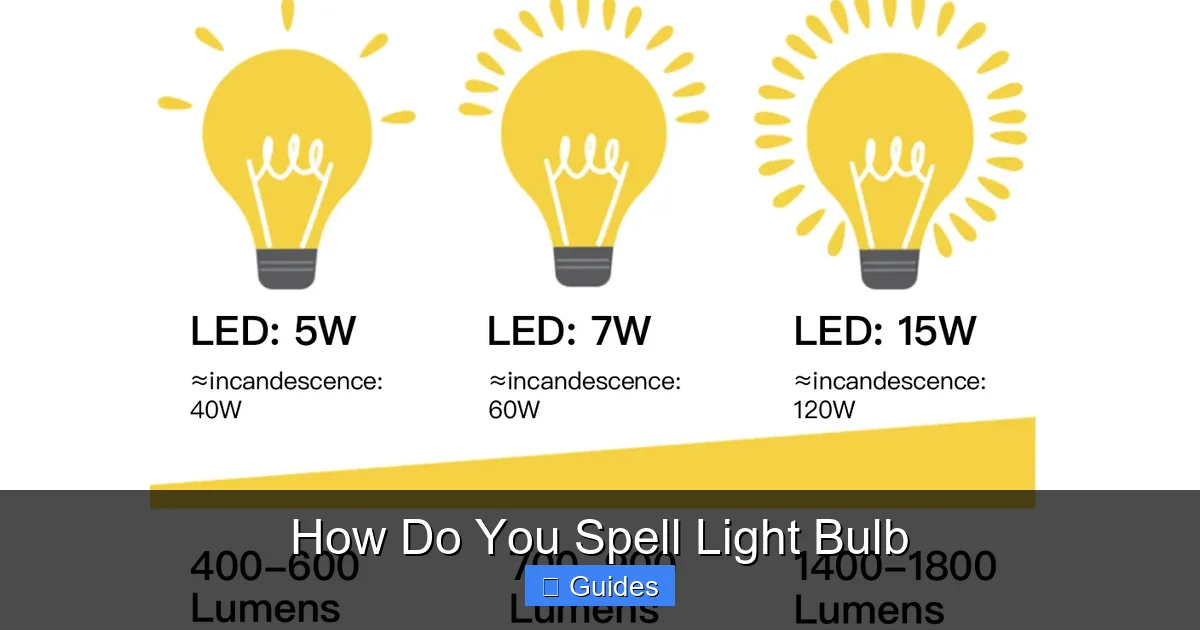
Visual guide about How Do You Spell Light Bulb
Image source: cdn.shopifycdn.net
Open Compound Nouns Explained
An open compound noun consists of two or more words that, when used together, represent a single concept or item. For example:
- “Bus stop” (not “busstop” or “bus-stop”)
- “Washing machine” (not “washingmachine” or “washing-machine”)
- “Science fiction” (not “sciencefiction” or “science-fiction”)
In each of these examples, the individual words contribute to the overall meaning, but they function as one noun. “Light bulb” fits this pattern perfectly. It’s the bulb *for* light, or the bulb *that provides* light.
Distinguishing from Hyphenated and Closed Compounds
It’s easy to see why people might think “lightbulb” (one word) or “light-bulb” (hyphenated) are correct. English has many examples of both:
- Closed compounds: “Bedroom,” “sunlight,” “bookmark.” These words have merged completely.
- Hyphenated compounds: “Self-esteem,” “check-in,” “sister-in-law.” Hyphens are often used for clarity, especially in complex or multi-word compounds.
The key difference is that “light bulb” hasn’t fully merged into a single word, nor does it typically require a hyphen for clarity when used as a noun. Its components are still distinct enough to warrant separate spelling. Think of how frequently you use “light bulb” in everyday conversation and writing; its open form feels natural and unstuffy.
The Evolution of Compound Nouns
Language is a living thing, and compound nouns are particularly prone to evolution. Often, a compound word starts as two separate words, then becomes hyphenated for a period, and eventually might merge into a single word. For example, “email” started as “electronic mail,” then became “e-mail,” and is now widely accepted as “email.”
While “lightbulb” (one word) *is* sometimes seen, especially in less formal contexts or newer publications, “light bulb” (two words) remains the dominant and preferred spelling according to most major style guides (like The Chicago Manual of Style and AP Stylebook). So, for formal and professional writing, sticking with “light bulb” is your safest bet.
Common Misspellings and How to Avoid Them
Knowing the correct spelling, “light bulb,” is half the battle. The other half is understanding the common errors and actively working to avoid them. Let’s look at the usual suspects when it comes to misspelling this illuminating term.
“Lightbulb” (One Word) vs. “Light Bulb” (Two Words)
This is arguably the most common alternative spelling you’ll encounter. While “lightbulb” is not inherently “wrong” in every context, especially as language evolves, it’s not the universally accepted standard. Many dictionaries list “light bulb” as the primary entry and “lightbulb” as a variant or less common form. The reason to prefer “light bulb” is consistency and adherence to established conventions. When in doubt, two words are always better for this specific compound.
“Light-bulb” (Hyphenated) – When It’s Usually Incorrect
Using a hyphen for “light-bulb” when it’s functioning as a noun is generally incorrect. For example, you would say, “I need to replace a light bulb,” not “I need to replace a light-bulb.” Hyphens serve specific purposes, often to clarify meaning or to link words acting as a single adjective before a noun. When “light bulb” is simply the name of the object, a hyphen isn’t necessary and can actually make your writing appear less polished.
Other Typographical Errors
Beyond the hyphenation and one-word debate, other common errors can creep in due to speed or simple typos:
- “Lite bulb”: “Lite” is an informal or marketing-driven alternative spelling of “light,” often used to denote something that is less heavy, less caloric, or watered down. It’s not correct for the light-emitting device.
- “Ligh bulb”: A simple missing ‘t’ that can happen with quick typing.
- Transpositions: Swapping letters, like “ligth bulb.”
Tip: Always proofread your work! Even the best writers make typos. Reading aloud can often help catch these small but significant errors, especially when you’re thinking about how do you spell light bulb.
When Might a Hyphen Be Used? The Grammatical Nuance
While “light bulb” as a noun is almost always two words, there’s a specific grammatical situation where a hyphen might make an appearance. This is where the intricacies of English grammar truly shine (pun intended!).
Adjectival Usage: The “Light-Bulb Moment”
A hyphen can be appropriate when “light bulb” acts as a compound adjective modifying another noun. This means the two words work together to describe something. The most famous example is “a light-bulb moment.” Here, “light-bulb” describes the “moment,” indicating a sudden realization or flash of insight, much like a light switching on.
Consider these examples:
- Noun usage: “The light bulb burned out.” (Two words)
- Adjectival usage: “It was a truly light-bulb idea.” (Hyphenated because “light-bulb” describes “idea.”)
However, even in this adjectival context, modern usage is often moving away from the hyphen, and you might see “light bulb moment” (two words, no hyphen) accepted in many informal or even semi-formal settings. When in doubt, ask yourself if “light” and “bulb” are separately describing the noun, or if they’ve truly joined forces to create a single descriptive term. If they are working as a unit to modify another noun, a hyphen *can* be used for clarity, but increasingly, it’s becoming optional.
Consistent Style Guides
Different style guides (like The Chicago Manual of Style, Associated Press (AP) Stylebook, or MLA Handbook) provide specific rules for hyphenation. While they generally agree on “light bulb” as an open compound noun, there might be slight variations for adjectival forms. For most general writing, sticking to the primary advice (two words as a noun, and often even as an adjective) is perfectly acceptable. If you’re writing for a specific publication, always check their style guide.
Clarity and Ambiguity
The primary purpose of hyphens is to prevent ambiguity. For instance, “a man eating shark” could mean a shark that eats men, or a man who is eating a shark. “A man-eating shark” clarifies it’s the former. In the case of “light bulb,” there’s rarely ambiguity when it’s used as a noun, which is another reason why the hyphen isn’t needed.
The History and Etymology of “Light Bulb”
Understanding where the term “light bulb” came from can also solidify its correct spelling in your mind. It’s a journey through innovation and linguistic evolution.
Origins of “Light” and “Bulb”
The word “light” comes from Old English “lēoht” and Proto-Germanic roots, referring to the natural agent that makes things visible. Its meaning has been consistent for centuries. “Bulb” has Latin roots, coming from “bulbus,” meaning “an onion, a bulb.” It was adopted into English to describe various round, swelling objects, like a flower bulb or the bulb of a thermometer, long before the electric version came along.
The Invention and Naming
While Thomas Edison is famously credited with inventing the practical incandescent lamp in 1879, many inventors contributed to the development of electric illumination. Early terms for these devices included “incandescent lamp,” “electric lamp,” or simply “lamp.”
The term “light bulb” naturally emerged to describe the specific component that housed the filament and emitted light. It was a descriptive and practical name: a “bulb” that gives “light.” It caught on because it was straightforward and easy for the public to understand, distinguishing it from other types of lamps (like oil lamps or gas lamps).
How the Term Stuck
The phrase “light bulb” gained widespread acceptance and solidified its two-word spelling because it was intuitive. It combined two simple, understandable words to describe a revolutionary device. There was no real need to hyphenate it for clarity, as “light” clearly described the function and “bulb” the form, and they didn’t create ambiguity when juxtaposed. Its simple, open compound form became the standard, a testament to its clarity and ease of use.
Practical Tips for Perfect Spelling Every Time
Now that we’ve thoroughly explored how to spell “light bulb,” let’s distill this knowledge into some actionable tips to ensure you get it right consistently.
1. Remember the “Two Words, No Hyphen” Rule for the Noun
This is the golden rule. When referring to the physical object that produces light, always think “light bulb” as two separate words. Imagine replacing a “light” and a “bulb” – they’re distinct parts that make a whole. “How do you spell light bulb?” The answer is simple: two words.
2. Be Mindful of Adjectival Usage (But Don’t Overthink It)
While a hyphen *can* be used when “light-bulb” modifies another noun (e.g., “light-bulb moment”), for most everyday writing, even “light bulb moment” without a hyphen is increasingly accepted. If you’re unsure, defaulting to two words is often the safest bet, even in these cases, unless a specific style guide dictates otherwise.
3. Visualize the Item
When you picture a light bulb, you see the light it emits and the bulbous glass shape. These are two distinct features, reinforcing the idea of two distinct words: “light” and “bulb.”
4. Read Aloud
Reading your text aloud can often help you catch awkward phrasing or incorrect spellings. If “lightbulb” or “light-bulb” sounds odd to your ear when referring to the object itself, it’s a good sign it should be “light bulb.”
5. Use Spell-Check (Wisely)
Your word processor’s spell-check will usually flag “lightbulb” or “light-bulb” as potential errors if your settings are geared towards standard English usage, nudging you towards “light bulb.” However, remember that spell-check isn’t infallible and might not catch every nuance, especially in adjectival contexts. Always use it as a tool, not a definitive authority.
6. Practice and Repetition
The more you write and correctly spell “light bulb,” the more ingrained it will become. Consciously correct yourself when you notice an error, and soon, it will feel natural to type it out as two words. It’s like building muscle memory for your fingers!
So, the next time you find yourself pondering, “how do you spell light bulb?” you can confidently type out “light bulb.” This seemingly small detail reflects a deeper understanding of English grammar and ensures your writing is always clear, precise, and professional. Shine on, confident writer!
Frequently Asked Questions
Is “lightbulb” a real word?
Yes, “lightbulb” is considered a real word and is listed in many dictionaries, often as a variant or secondary spelling of “light bulb.” However, “light bulb” (two words) remains the more traditional and widely accepted standard in formal writing.
When would you use a hyphen with “light bulb”?
A hyphen might be used when “light-bulb” functions as a compound adjective modifying another noun, such as in “a light-bulb moment” or “a light-bulb factory.” This helps clarify that “light” and “bulb” are working together to describe the following noun.
Why is “light bulb” not “lightbulb” like “sunlight”?
The evolution of compound nouns in English is often irregular. While “sunlight” merged into one word, “light bulb” has generally remained an open compound. The words “light” and “bulb” retain strong individual meanings that make the two-word form feel natural and clear.
Are there regional differences in spelling “light bulb”?
Not significantly. The “light bulb” (two words) spelling is consistently preferred across major English-speaking regions (e.g., American English, British English, Canadian English). Any variations like “lightbulb” tend to be a matter of style preference or informal usage rather than distinct regional conventions.
What is the etymology of “light bulb”?
“Light” comes from Old English for illumination, and “bulb” from Latin “bulbus” for a rounded object. The term “light bulb” emerged descriptively to name the new electric lighting device in the late 19th century, combining the function (“light”) with its common form (“bulb”).
Does using “lightbulb” (one word) make my writing incorrect?
While not strictly “incorrect” in all contexts, using “lightbulb” might be perceived as less formal or slightly less polished than “light bulb” by some readers and editors. For academic, professional, or journalistic writing, adhering to “light bulb” (two words) is generally recommended for consistency and adherence to established style guides.
