


As an Amazon Associate, We earn from qualifying purchases.
An incandescent light bulb illuminates by passing electricity through a thin tungsten filament, causing it to heat up to extreme temperatures. This intense heat makes the filament glow brightly, a process known as incandescence, where light is produced by heat. To prevent the filament from quickly burning out, it’s enclosed in a glass bulb filled with an inert gas or a vacuum, allowing us to enjoy its familiar warm light while keeping the filament protected.
How Does an Incandescent Light Bulb Work
There’s a special kind of comfort that comes from the warm, familiar glow of a traditional light bulb. For over a century, the incandescent light bulb was a staple in homes and businesses worldwide, providing illumination with a simple, elegant design. Even today, as more energy-efficient options like LEDs take center stage, the classic bulb holds a nostalgic charm and a fascinating story of scientific ingenuity. But have you ever stopped to wonder, “How does an incandescent light bulb actually work?”
It seems almost magical: flip a switch, and light appears. Yet, the process behind that light is a beautiful blend of physics, chemistry, and engineering, all working in harmony within a deceptively simple glass sphere. Understanding its mechanics not only demystifies an everyday object but also offers a peek into the foundational principles of electricity and light. Let’s peel back the layers and uncover the brilliant science that makes an incandescent bulb shine.
From the moment electricity flows into its base to the instant light radiates outwards, every component plays a crucial role. We’ll explore the tiny, yet mighty, filament, the protective glass envelope, and the invisible gases that keep it all going. Get ready to illuminate your understanding of this iconic invention!
Key Takeaways
- Basic Principle: An incandescent light bulb produces light through incandescence, a process where a material gets so hot it glows.
- Tungsten Filament: The heart of the bulb is a thin tungsten wire, chosen for its extremely high melting point (3,422 °C or 6,192 °F) and electrical resistance.
- Electrical Resistance: When electricity flows through the filament, its resistance converts electrical energy into heat, causing the tungsten to reach temperatures of 2,200–3,300 °C (4,000–6,000 °F) and emit light.
- Protective Environment: The filament is housed in a sealed glass bulb that contains either a vacuum or an inert gas (like argon or nitrogen) to prevent the tungsten from reacting with oxygen and quickly burning out.
- Energy Inefficiency: Incandescent bulbs are largely inefficient, converting only about 5-10% of their electrical energy into visible light; the vast majority is wasted as heat.
- Failure Mechanism: The primary cause of bulb failure is the evaporation of tungsten from the filament over time, which thins the wire until it eventually breaks.
- Historical Significance: Despite their inefficiency, incandescent bulbs revolutionized lighting and paved the way for modern, more efficient lighting technologies like LEDs and CFLs.
Quick Answers to Common Questions
What is incandescence?
Incandescence is the process by which an object emits light when it is heated to a very high temperature, like a hot piece of metal glowing red or white.
What material is the filament of an incandescent light bulb made of?
The filament is typically made from tungsten, a metal known for its extremely high melting point and electrical resistance, allowing it to get intensely hot without melting.
Why is there gas inside an incandescent light bulb?
The glass bulb is filled with an inert gas (like argon or nitrogen) or a vacuum to prevent the hot tungsten filament from reacting with oxygen and burning out quickly, extending its lifespan.
Why do incandescent bulbs get hot?
They get hot because most of the electrical energy passing through the filament is converted into heat due to its electrical resistance, with only a small percentage being converted into visible light.
What causes an incandescent light bulb to burn out?
An incandescent light bulb burns out when parts of its tungsten filament evaporate over time, making it thinner until it eventually breaks and opens the electrical circuit.
📑 Table of Contents
The Anatomy of an Incandescent Light Bulb: What’s Inside?
Before we dive into the “how,” let’s first get acquainted with the “what.” An incandescent light bulb might look like a single unit, but it’s a meticulously designed assembly of several key parts, each serving a vital function in producing light. Think of it like a small, self-contained factory for light.
The Filament: The Heart of the Glow
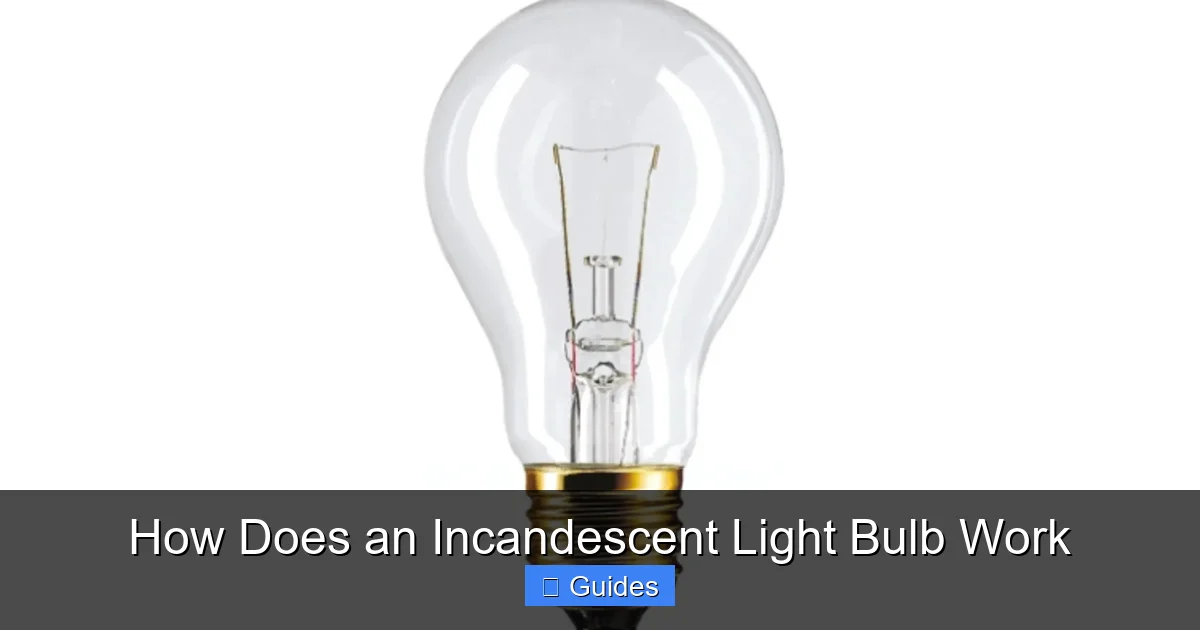
At the absolute core of the incandescent light bulb is its filament. This isn’t just any wire; it’s typically a very thin, tightly coiled wire made from tungsten. Why tungsten? This metal is a true superstar because it has an incredibly high melting point – higher than any other metal! We’re talking about a whopping 3,422 °C (6,192 °F). This extreme heat resistance is essential because, as we’ll soon see, the filament needs to get unbelievably hot to produce light.
The filament’s thinness and coiled design are also crucial. A thin wire provides high electrical resistance, which is key to generating heat. The coiling allows a much longer wire to fit into a small space, further increasing resistance and, therefore, the amount of light produced.
The Glass Bulb (Envelope): The Protective Shield
Surrounding the delicate filament is the familiar glass bulb, also known as the envelope. This isn’t just for aesthetics; it plays a critical protective role. The main purpose of the glass bulb is to create a sealed environment for the filament. This environment is either a vacuum (meaning no air at all) or, more commonly in modern bulbs, filled with an inert gas like argon or nitrogen.
Why is this protection so important? If the hot tungsten filament were exposed to oxygen in the air, it would instantly burn up, much like the glowing ember of a match. The vacuum or inert gas prevents this destructive reaction, allowing the filament to glow for hundreds or even thousands of hours instead of mere seconds.
The Base (Cap): Connecting to Power
At the bottom of the bulb is the base, which is usually made of aluminum or brass. This is how the bulb connects to your lamp or light fixture and, most importantly, to the electricity supply. Most incandescent light bulbs use a screw-in (Edison screw) base, but bayonet bases (where you push and twist) are also common, especially in some regions.
The base has two electrical contact points: the small metal tip at the very bottom and the threaded metal sleeve around the side. These contacts allow electricity to flow into and out of the bulb, completing the circuit.
Lead-in Wires and Support Wires: The Unseen Connections
Inside the bulb, small wires connect the filament to the electrical contacts in the base. These are called lead-in wires. They need to be good conductors of electricity but also strong enough to support the filament. Additionally, tiny support wires, often made of molybdenum, help to hold the fragile tungsten filament in place, preventing it from sagging or breaking due to gravity or vibrations, especially when it’s super-hot and delicate.
The Glass Stem and Mount: The Internal Structure
All these internal components – the filament, lead-in wires, and support wires – are carefully mounted on a central glass stem. This stem not only provides structural support but also acts as the seal point for the inert gas or vacuum inside the bulb, ensuring the protective environment remains intact.
The Science Behind the Glow: Incandescence Explained
Now that we know what’s inside, let’s explore the magical process that transforms invisible electricity into visible light. It all boils down to a phenomenon called incandescence.
Visual guide about How Does an Incandescent Light Bulb Work
Image source: storables.com
What is Incandescence?
Incandescence is simply the emission of light by a body when it’s heated to a high temperature. Think about a blacksmith heating a piece of metal: as the metal gets hotter, it first glows dull red, then bright red, then orange, yellow, and eventually white-hot. The incandescent light bulb works on precisely the same principle.
When electricity passes through the tungsten filament, its resistance to the flow of electrons causes it to heat up dramatically. This intense heat excites the atoms in the tungsten, causing them to vibrate rapidly and emit photons – tiny packets of light energy. The hotter the filament, the more energetic these photons, and the brighter and whiter the light becomes.
Ohm’s Law and Resistance: Heating It Up
To understand why the filament gets hot, we need to touch on a fundamental principle of electricity: Ohm’s Law and resistance. When an electrical current encounters resistance, some of the electrical energy is converted into heat. The tungsten filament is specifically designed to have high electrical resistance.
Imagine water flowing through a wide pipe versus a narrow, kinked hose. The narrow, kinked hose resists the flow of water, causing friction and potentially heating up the hose. Similarly, the thin, coiled tungsten filament acts like that narrow, kinked hose for electricity. As electrons struggle to push through its resistive pathway, they collide with tungsten atoms, generating a tremendous amount of heat. This is the same principle that makes your toaster glow red-hot, but a light bulb filament gets much, much hotter.
Blackbody Radiation: The Color of Light
The light emitted by an incandescent bulb is a form of blackbody radiation. A “blackbody” is an idealized object that absorbs all electromagnetic radiation that falls on it and, when heated, emits radiation at all wavelengths. While a tungsten filament isn’t a perfect blackbody, it behaves similarly.
The color of the light it emits depends entirely on its temperature. At typical operating temperatures (around 2,700-3,300 Kelvin or 2,427-3,027 °C), the filament emits a broad spectrum of light. However, it emits more light in the red and yellow parts of the spectrum and less in the blue and violet. This is why incandescent bulbs have that characteristic warm, yellowish glow that many people find appealing and soothing.
The Visible Spectrum: What We See
Human eyes are sensitive to only a small portion of the electromagnetic spectrum, which we call the visible light spectrum. While the incandescent filament emits a lot of visible light, it actually produces a far greater amount of invisible infrared radiation, which we perceive as heat. This is a crucial point regarding the efficiency of these bulbs, which we’ll discuss shortly.
The Operating Process: From Switch to Shine
Let’s put it all together and trace the journey of electricity as it transforms into light.
Completing the Circuit: The Flow Begins
When you flip the light switch, you complete an electrical circuit. Electricity flows from the power source (your wall outlet) through the lamp’s wiring, enters the bulb through one contact on its base (often the threaded sleeve), travels up a lead-in wire to the filament, passes through the filament, and then returns to the power source via another lead-in wire and the other contact on the base (the small tip at the bottom).
Filament Heating: Resistance at Work
As the electrical current encounters the high resistance of the thin tungsten filament, the filament quickly heats up. This heating is nearly instantaneous, going from room temperature to thousands of degrees Celsius in a fraction of a second. This rapid temperature increase is what causes the “inrush current” or “surge” you sometimes hear about, where the bulb briefly draws more power just as it turns on.
Light Emission: The Brilliant Glow
Once the filament reaches its operating temperature (typically between 2,200 °C and 3,300 °C, depending on the bulb’s design), it becomes incandescent. It glows brightly, emitting light across the visible spectrum, along with a significant amount of infrared radiation (heat).
Heat Emission: The Inefficiency Aspect
Here’s the trade-off: while incandescent bulbs produce beautiful light, they are incredibly inefficient at doing so. Roughly 90-95% of the electrical energy they consume is converted into heat, not light. This is why touching a traditional light bulb that has been on for a while is a bad idea – it’s extremely hot! This high heat output is a major reason why incandescent bulbs have been gradually phased out in favor of more energy-efficient alternatives.
Engineering for Longevity (and its Limits)
Despite their inefficiency, the design of incandescent bulbs is quite clever, particularly in how engineers tried to extend the life of that super-hot, delicate filament.
The Role of Inert Gas: Battling Evaporation
Earlier, we mentioned the inert gas inside the bulb. This is a critical component for extending the bulb’s lifespan. Even in a vacuum, the tungsten filament, at such high temperatures, will slowly evaporate. Tungsten atoms literally boil off the surface of the filament and deposit themselves on the cooler inner surface of the glass bulb, causing the bulb to darken over time (this is called “blackening”).
By filling the bulb with an inert gas like argon or nitrogen (or a mixture of both), the gas molecules act as a barrier. They collide with the evaporating tungsten atoms, knocking them back onto the filament or at least slowing their escape. This significantly reduces the rate of evaporation, allowing the filament to last much longer than it would in a vacuum. However, the gas does conduct a little heat away from the filament, slightly reducing efficiency.
Filament Evaporation: The Ultimate Cause of Failure
Despite the inert gas, tungsten evaporation is an inevitable process. Over time, parts of the filament will become thinner than others. These thinner spots have higher electrical resistance, causing them to get even hotter and evaporate even faster. Eventually, one of these thin spots will become so fragile that it can no longer withstand the electrical current, and it will break, causing the circuit to open and the light to go out – the dreaded “burnout.”
This is why incandescent bulbs have a finite lifespan, typically ranging from 750 to 1,000 hours. The moment you hear that little “pop” and the light goes dark, you’ve witnessed tungsten evaporation’s final act.
Cold Resistance vs. Hot Resistance: The Start-up Surge
An interesting characteristic of tungsten is that its electrical resistance increases with temperature. This means that when an incandescent light bulb is cold (turned off), its filament has much lower resistance than when it’s hot (glowing). When you first flip the switch, the cold filament draws a very high initial burst of current – this is the “inrush current” we mentioned. This sudden surge can stress the filament and is often the moment a bulb that’s already near its end of life will decide to give up and break.
Practical Tip: Frequent switching on and off can shorten the lifespan of an incandescent bulb due to these start-up surges. Dimming the bulb, however, reduces the filament temperature and current, actually extending its life.
Tungsten Halogen Bulbs: A Step Further
For a brief mention, tungsten halogen bulbs are a more advanced type of incandescent bulb. They use a special halogen gas (like iodine or bromine) inside the bulb. This gas creates a chemical reaction that “recycles” evaporated tungsten back onto the filament, greatly reducing blackening and extending bulb life while also allowing the filament to operate at higher temperatures for brighter, whiter light and slightly improved efficiency. They still operate on the principle of incandescence, just with a clever twist to combat evaporation.
The Incandescent Bulb in Context: Efficiency and Evolution
The incandescent light bulb was a monumental invention that literally lit up the world. However, its story isn’t just about its internal workings; it’s also about its place in history and its eventual evolution.
Why They’re Being Phased Out: The Energy Equation
As we’ve explored, the primary drawback of incandescent bulbs is their inefficiency. Turning 90-95% of electrical energy into heat instead of light is a significant waste. In an era of increasing environmental awareness and rising energy costs, this inefficiency became a major concern. Governments worldwide began implementing regulations to phase out traditional incandescent bulbs in favor of more energy-efficient alternatives like compact fluorescent lamps (CFLs) and light-emitting diodes (LEDs).
These newer technologies achieve much higher lumen-per-watt ratios, meaning they produce more light with less electricity, leading to substantial energy savings and a reduced carbon footprint.
The Beauty of Their Light: A Warm Legacy
Despite their inefficiency, many people still appreciate the quality of light produced by incandescent bulbs. Their warm, yellowish glow (low color temperature, typically around 2,700K) is often described as comforting and inviting, making spaces feel cozy. They also have excellent color rendering, meaning they make colors appear natural and vibrant, which is why they were often favored in art galleries and retail displays.
A Legacy of Innovation: Paving the Way
The incandescent light bulb, perfected by inventors like Thomas Edison and Joseph Swan, revolutionized society. It extended productive hours, made homes safer, and enabled countless advancements. It was the first truly practical electric light source, and its development spurred innovations in electricity generation, transmission, and household wiring that we still benefit from today. While its time as the dominant light source has passed, its impact is undeniable, and understanding how it works gives us a deeper appreciation for the foundation upon which modern lighting technology is built.
Conclusion
The incandescent light bulb, a seemingly simple device, is a testament to ingenious engineering and fundamental scientific principles. From the delicate tungsten filament to the protective inert gas, each component plays a vital role in transforming electricity into that familiar, comforting glow. We’ve journeyed through the science of incandescence, the function of resistance, and the delicate balance required to make a tiny wire glow for thousands of hours.
While the incandescent light bulb is gradually fading from common use due to its energy inefficiency, its legacy is anything but dim. It ignited a revolution in human living, lighting up the night and paving the way for the incredible array of lighting options we have today. Understanding how it works isn’t just a lesson in physics; it’s a look back at a cornerstone of modern civilization, a bright idea that truly changed the world.
🎥 Related Video: How Does a Light Bulb Work?
📺 ScienceABC II
Have you ever wondered what happens inside a light bulb when you flip the switch? The incandescent bulb, first patented by …
Frequently Asked Questions
When were incandescent bulbs invented?
While many inventors contributed to the development of electric lights, the first commercially practical incandescent light bulb, featuring a long-lasting filament, was famously perfected by Thomas Edison and Joseph Swan in the late 1870s.
Are incandescent bulbs efficient?
No, incandescent bulbs are generally quite inefficient. They convert only about 5-10% of the electrical energy they consume into visible light, with the vast majority (90-95%) being wasted as heat.
What is the average lifespan of an incandescent bulb?
The average lifespan of a standard incandescent light bulb is relatively short, typically ranging from 750 to 1,000 operating hours. This is significantly less than modern LED bulbs, which can last for tens of thousands of hours.
Can incandescent bulbs be recycled?
Traditional incandescent bulbs are generally not recyclable in standard municipal recycling programs because they contain small amounts of mixed materials (glass, metal filament, inert gas) that are difficult to separate. They are usually disposed of with regular household trash.
What are the alternatives to incandescent bulbs?
Common energy-efficient alternatives to incandescent bulbs include Compact Fluorescent Lamps (CFLs), which use less electricity and last longer, and Light-Emitting Diodes (LEDs), which are highly energy-efficient, offer long lifespans, and come in various color temperatures and styles.
Why do some incandescent bulbs get brighter when they are about to burn out?
When an incandescent filament is close to breaking, it often develops a very thin spot. This thin spot has higher resistance, causing it to heat up even more intensely than the rest of the filament, leading to a temporary surge in brightness just before it finally breaks and the bulb fails.
