


As an Amazon Associate, We earn from qualifying purchases.
The medium base light bulb, primarily known as E26 in North America and E27 internationally, is the most common and versatile bulb type found in homes worldwide. Its standardized screw-in base ensures broad compatibility with countless fixtures, making it the go-to choice for everything from lamps to overhead lighting. Understanding this ubiquitous base helps you confidently select the right bulb for any need.
Have you ever stood in the lighting aisle, perhaps a little overwhelmed, wondering which light bulb to pick? With so many shapes, sizes, wattages, and technologies, it can feel like you need a degree in lighting engineering just to change a bulb! But if there’s one thing that simplifies the process more than anything else, it’s understanding the light bulb base. And today, we’re diving deep into the most common player in the game: the medium base light bulb.
Chances are, almost every lamp or overhead fixture in your home uses a medium base light bulb. It’s the unsung hero of domestic illumination, reliably screwing into sockets and bringing light to our lives. But what exactly makes a medium base light bulb “medium”? And why is it so incredibly prevalent? Let’s shed some light on this essential piece of household technology, making your next bulb purchase not just easy, but truly informed.
Key Takeaways
- Universal Standard: The medium base light bulb (E26 in North America, E27 internationally) is the most common and widely used bulb base for residential and many commercial applications.
- Dimensions: The “E” stands for Edison screw, and “26” or “27” refers to the diameter of the base in millimeters, meaning it’s approximately 26 or 27mm wide.
- High Interchangeability: Despite the slight millimeter difference, E26 and E27 medium base light bulbs are generally interchangeable and compatible in most fixtures designed for either, thanks to manufacturing tolerances.
- Versatility in Fixtures: You’ll find medium base bulbs in everything from table lamps and floor lamps to ceiling fixtures, outdoor lighting, and recessed cans, making them incredibly versatile.
- Wide Range of Options: Medium base light bulbs are available in almost every lighting technology (incandescent, halogen, CFL, LED) and a vast array of shapes, sizes, lumens, and color temperatures.
- Easy Identification: If your bulb has a standard screw-in base that’s roughly an inch wide, it’s almost certainly a medium base light bulb.
- Safety and Compatibility: Always check your fixture’s wattage recommendations, but otherwise, choosing a medium base light bulb is usually a straightforward process due to its widespread standardization.
Quick Answers to Common Questions
What does the “E” in E26 or E27 stand for?
The “E” stands for Edison Screw, named after Thomas Edison, who developed the screw-in light bulb base.
Is an E26 medium base light bulb the same as an E27?
While E26 (26mm) and E27 (27mm) refer to slightly different diameters, they are generally interchangeable and compatible in most fixtures due to manufacturing tolerances and similar threading.
What is the most common light bulb base in North America?
The E26 medium base light bulb is the most common and standard light bulb base used in North America (USA, Canada, Mexico) for residential applications.
Can I use any wattage LED bulb in my medium base fixture?
Yes, as long as the LED bulb’s *lumen* output matches your desired brightness, its *wattage* will almost certainly be well below your fixture’s maximum wattage limit due to the high efficiency of LEDs.
Do smart bulbs come in a medium base?
Absolutely! Many smart bulbs are designed with a medium base (E26 or E27) to ensure compatibility with standard light fixtures, allowing for easy smart home integration.
📑 Table of Contents
Understanding Light Bulb Bases: A Quick Primer
Before we zero in on the medium base light bulb, it’s helpful to understand what a light bulb base is and why it matters. Think of the base as the bulb’s “foot” – it’s the part that physically connects the bulb to the electrical socket in your light fixture. This connection not only holds the bulb securely in place but, more importantly, facilitates the flow of electricity, allowing the bulb to illuminate.
The Importance of the Base
The base of a light bulb is crucial for two main reasons:
- Electrical Connection: It’s the point of contact where power from your home’s electrical system reaches the bulb’s filament or LED array. Without a proper fit, there’s no circuit, and no light.
- Physical Fit: Just like a key fits into a lock, a bulb’s base must fit snugly and correctly into the fixture’s socket. This ensures stability and prevents damage or hazards.
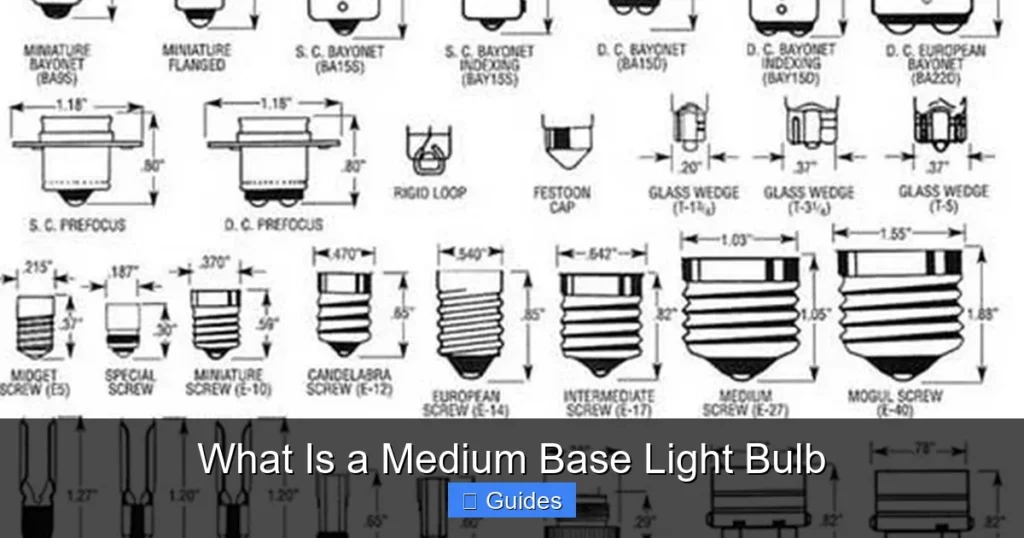
There are many types of light bulb bases out there, from tiny candelabra bases (E12) to large mogul bases (E39/E40), and even various pin-based and bayonet styles. Each is designed for specific applications, sizes, and power requirements. But for everyday home use, one base reigns supreme: the medium base.
Common Base Types (Beyond Medium)
While this article focuses on the medium base light bulb, it’s useful to briefly touch upon other common types to provide context. You might encounter:
- Candelabra Base (E12): Much smaller than the medium base, often found in decorative fixtures, chandeliers, night lights, and some ceiling fans.
- Intermediate Base (E17): A size between candelabra and medium, less common but sometimes seen in microwave ovens or older appliances.
- Mogul Base (E39/E40): Significantly larger, used for high-wattage bulbs in industrial settings, street lights, or very large commercial fixtures.
- Bi-Pin Bases (GU10, G9, G4, etc.): These don’t screw in but have two pins that push into the socket, common in track lighting, display lighting, and smaller halogen or LED lamps.
However, when someone talks about “the standard light bulb” for home use, they are almost certainly referring to the medium base light bulb.
The “Medium Base” Unpacked: E26 vs. E27
Now, let’s get to the heart of the matter: what defines a medium base light bulb? The key identifiers are “E” and a number. The “E” stands for Edison Screw, named after Thomas Edison, who invented the screw-in base. The number refers to the diameter of the screw base in millimeters (mm). So, a medium base light bulb is primarily known as E26 or E27.
E26: The North American Standard
In North America (the United States, Canada, and Mexico), the standard medium base light bulb is the E26. This means the screw-in base has a diameter of 26 millimeters. It’s the most common household bulb base you’ll find in these regions, fitting into nearly all standard lamps, overhead lights, and many appliances.
E27: The European Equivalent
Across Europe, Asia, and many other parts of the world, the equivalent standard for a medium base light bulb is the E27. As the name suggests, this base has a diameter of 27 millimeters. Functionally, it serves the exact same purpose as the E26: to provide a standardized, reliable electrical connection for household lighting.
Are E26 and E27 Interchangeable?
This is one of the most frequently asked questions about medium base light bulbs, and it’s a good one! The short answer is: mostly yes.
Despite the 1mm difference in diameter, E26 and E27 bases are designed to be largely interchangeable. The threading pitch and other key dimensions are nearly identical. Most E26 bulbs will screw perfectly into E27 sockets, and vice-versa, without issues. This is due to manufacturing tolerances and the slightly flexible nature of the materials used in sockets and bases.
However, there’s a crucial caveat: voltage. While the physical bases are interchangeable, the electrical systems they are designed for are different. North America primarily uses 120V AC electricity, while Europe and many other regions use 220-240V AC.
Important Tip: Always ensure the voltage rating of your bulb matches the voltage of your electrical supply, regardless of the base type. Putting a 120V bulb into a 240V socket will likely cause it to burn out instantly or even shatter. Conversely, a 240V bulb in a 120V socket will glow very dimly, if at all.
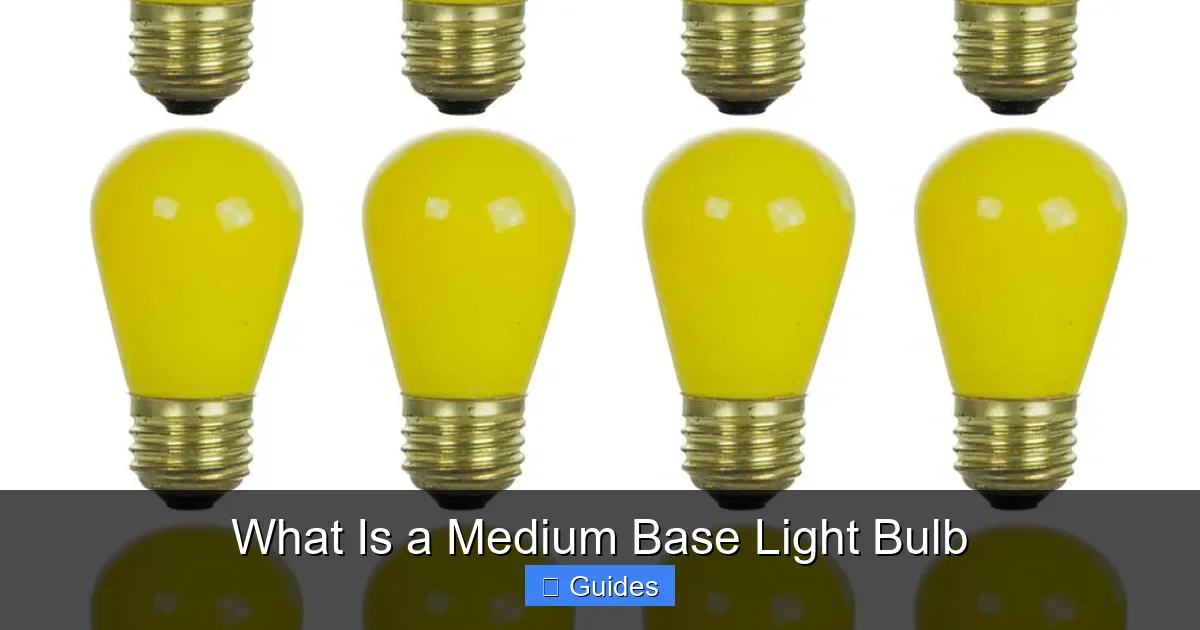
Visual guide about What Is a Medium Base Light Bulb
Image source: bulbamerica.com
So, if you’re traveling or importing fixtures, check the voltage first. For domestic use within your own country, you typically won’t encounter voltage issues with your medium base light bulb, as both bulbs and fixtures will be designed for the local standard.
Why the Medium Base is So Popular
The sheer ubiquity of the medium base light bulb isn’t just a happy accident; it’s the result of decades of standardization, practical design, and consumer convenience.
Ubiquity and Accessibility
Walk into any hardware store, supermarket, or even convenience store, and you’re guaranteed to find a wide selection of medium base light bulbs. This universal availability means you rarely have to search far and wide for a replacement. This accessibility makes it incredibly consumer-friendly and eliminates the frustration of needing a specialized part for everyday lighting.
Versatility Across Fixtures
The medium base’s dimensions strike a perfect balance: it’s large enough to be robust and easy to handle, yet compact enough to fit into a vast range of fixture sizes and designs. You’ll find a medium base light bulb illuminating:
- Table and floor lamps
- Ceiling fan lights
- Recessed lighting cans
- Pendant lights
- Outdoor porch lights and security lights
- Many bathroom vanity fixtures
- Garage and utility room lights
This versatility significantly reduces manufacturing complexity for fixture makers and simplifies inventory for retailers, further cementing its status as the default choice.
A Legacy of Illumination
The Edison screw base, including its medium variant, has been around for over a century. This long history has allowed it to become deeply ingrained in electrical infrastructure and consumer habits. As lighting technology evolved from incandescent to halogen, then to CFLs, and now predominantly to LEDs, manufacturers wisely maintained the medium base standard. This backwards compatibility meant that consumers didn’t have to replace all their light fixtures every time a new, more efficient bulb technology emerged – they could simply swap out the bulb. This continuity is a massive part of why the medium base light bulb remains so popular today.
Choosing the Right Medium Base Bulb for Your Needs
Just because you know you need a medium base light bulb doesn’t mean your decision-making stops there. Within this category, a world of options awaits! Here’s what else to consider when picking the perfect bulb.
Bulb Shape and Size
The “base” is the connection point, but the “bulb” part comes in many shapes and sizes, each serving a different aesthetic or functional purpose. For your medium base light bulb, you’ll encounter common shapes like:
- A19/A21: The classic “pear” or “A-shape” bulb, used in most general-purpose lamps and open fixtures. A19 is the most common size.
- BR (Bulged Reflector) series (e.g., BR30, BR40): These have a wider, bulged shape and an internal reflective coating to direct light forward. Ideal for recessed cans and floodlights.
- PAR (Parabolic Aluminized Reflector) series (e.g., PAR20, PAR30, PAR38): Similar to BR bulbs but often narrower with a more intense, focused beam. Great for track lighting, outdoor spotlights, and some recessed fixtures.
- G (Globe) series (e.g., G25, G30): Spherical bulbs, often used in vanity strips or decorative fixtures where the bulb is visible.
- Candelabra/Flame Tip (B, F, CA shapes): While typically associated with E12 bases, some decorative medium base bulbs can mimic these shapes for larger chandeliers or wall sconces.
Always ensure the bulb’s physical shape and size will fit within your fixture’s housing or shade without touching it, especially if it’s an enclosed fixture, as heat buildup can be an issue.
Light Technology: Incandescent, Halogen, CFL, LED
The medium base light bulb can house various lighting technologies:
- Incandescent: The original, warm glow. Inefficient and mostly phased out due to energy regulations, but still available for niche uses.
- Halogen: A more efficient version of incandescent, providing bright, crisp white light. Still inefficient compared to LEDs.
- CFL (Compact Fluorescent Lamp): The spiral-shaped energy saver that became popular before LEDs. More efficient than incandescents but contains mercury and has a slower warm-up time.
- LED (Light Emitting Diode): The current gold standard. Highly energy-efficient, long-lasting, durable, and available in a vast array of light outputs and colors. LED medium base light bulbs are the recommended choice for almost all applications.
Lumens, Watts, and Color Temperature
Forget watts when buying a medium base light bulb for brightness; focus on lumens!
- Lumens: This is the true measure of a bulb’s brightness. The higher the lumen count, the brighter the light. (e.g., a 60W incandescent typically produced ~800 lumens, so look for an 800-lumen LED for similar brightness).
- Watts: This measures energy consumption. For LEDs, lower wattage means less energy used for the same lumen output.
- Color Temperature (Kelvin – K): This describes the “warmth” or “coolness” of the light.
- 2700K – 3000K: Warm White (like traditional incandescents, yellowish, cozy)
- 3500K – 4000K: Neutral White / Cool White (more balanced, good for kitchens, offices)
- 5000K – 6500K: Daylight (bluish-white, energizing, good for task lighting, garages)
Choose a color temperature that suits the mood and function of the room.
- CRI (Color Rendering Index): Measures how accurately a light source renders colors compared to natural light. A CRI of 80+ is generally good for homes; 90+ is excellent for spaces where color accuracy is important.
- Dimmability: If your fixture is on a dimmer switch, ensure your medium base light bulb is explicitly labeled as “dimmable.” Not all LEDs are dimmable, and some may require specific LED-compatible dimmer switches.
Smart Bulb Options
The medium base light bulb has also embraced smart home technology. You can now get E26/E27 smart bulbs that connect to Wi-Fi or Bluetooth, allowing you to control them via apps, voice assistants (Alexa, Google Assistant, Siri), or smart home hubs. These bulbs often offer tunable white light (changing color temperature), full-color RGB options, and scheduling features, adding another layer of convenience and customization to your lighting.
Installation and Maintenance Tips
Installing a medium base light bulb is generally straightforward, but a few tips can ensure safety and longevity.
Safety First
Always turn off the power to the fixture at the wall switch before replacing a bulb. For added safety, you can also flip the circuit breaker. This prevents accidental shocks or short circuits. Allow hot bulbs to cool completely before touching them.
Proper Installation Techniques
- Remove the Old Bulb: Gently twist the old bulb counter-clockwise until it loosens and can be removed. If it’s broken, use pliers to carefully extract the base while the power is off.
- Inspect the Socket: Check the socket for any signs of damage, corrosion, or debris. Make sure the small metal tab at the bottom of the socket is slightly raised to ensure proper contact with the new bulb’s base.
- Insert the New Bulb: Screw in your new medium base light bulb clockwise until it’s finger-tight. Do not overtighten, as this can damage the socket or the bulb’s base. It just needs to be snug enough for the electrical contacts to connect.
- Restore Power: Turn the wall switch back on (and the circuit breaker if you flipped it).
When to Replace Your Bulb
For incandescent or halogen bulbs, replacement is obvious – they burn out. For CFLs, they might start flickering or take longer to warm up. For LED medium base light bulbs, replacement is far less frequent due to their long lifespans (often 15,000 to 50,000 hours!). You’ll typically only replace an LED if it starts to dim significantly, flickers, or if you want to change its color temperature or add smart features. Always refer to the manufacturer’s estimated lifespan.
Also, pay attention to your fixture’s maximum wattage rating. While LEDs use far fewer watts, it’s a good habit to ensure your chosen bulb (especially older tech like incandescent) doesn’t exceed this limit, as it could pose a fire hazard or damage the fixture. For LEDs, matching the lumen output to your old incandescent is usually the safest bet for brightness, while their low wattage keeps you well within fixture limits.
Conclusion
The medium base light bulb might seem like a small, insignificant component, but it’s truly the backbone of modern residential lighting. Its widespread adoption, interchangeable E26 and E27 standards, and adaptability to evolving technologies have made it an indispensable part of our daily lives.
By understanding what a medium base light bulb is, why it’s so popular, and the various options available, you’re now equipped to make informed choices. No more guessing in the lighting aisle! Whether you’re upgrading to energy-efficient LEDs, setting a specific mood with color temperature, or just replacing a burnt-out bulb, you can confidently choose the right medium base light bulb to illuminate your home brightly and beautifully.
🎥 Related Video: Standard Light Bulb – Size & Codes | Spec. Sense
📺 AMRE Supply
What does the A19 code describe? What is an E26 base? In this episode of Spec. Sense, Vance shows how to measure and how …
Frequently Asked Questions
What is the “medium” in medium base referring to?
The “medium” refers to the size of the screw-in base, distinguishing it from smaller bases like candelabra (E12) or larger ones like mogul (E39). It’s the most common general-purpose size for household lighting.
Why are there two numbers, E26 and E27, for the same base type?
E26 is the standard medium base diameter (26mm) used primarily in North America, while E27 (27mm) is the international standard used in Europe and other regions. They are nearly identical and generally interchangeable, with the main difference being the electrical voltage they are typically found in.
Can I use an E27 bulb in an E26 socket?
Yes, in most cases, an E27 medium base light bulb will fit and function perfectly in an E26 socket, and vice versa. However, always ensure the bulb’s voltage rating matches your local electrical supply (e.g., 120V in North America, 220-240V elsewhere).
How do I know if my lamp uses a medium base light bulb?
If your lamp uses a standard screw-in bulb that’s about an inch (26-27mm) in diameter at the base, it’s almost certainly a medium base light bulb. This is the typical bulb found in most table lamps, floor lamps, and ceiling fixtures.
Are medium base light bulbs always A-shaped?
No, while the classic A-shape (like A19) is very common for medium base light bulbs, they come in a vast variety of shapes. These include reflector bulbs (BR, PAR), globe bulbs (G), candelabra-style bulbs, and more, each designed for different lighting aesthetics and functionalities.
What should I look for when buying a new medium base light bulb?
Beyond confirming it’s a medium base, consider the light technology (LED is recommended), brightness (lumens), color temperature (Kelvin), dimmability, and the bulb’s shape to ensure it fits your fixture and provides the desired light quality for your space.
