



As an Amazon Associate, We earn from qualifying purchases.
Creating the practical incandescent light bulb was not a single “eureka” moment, but the result of relentless experimentation. Thomas Edison and his team at Menlo Park conducted thousands of trials, testing countless materials for the filament, vacuum, and overall design. It wasn’t just about one successful attempt, but a systematic process of learning from failures that ultimately illuminated the world.
Picture this: a dark room, a flash of inspiration, and *poof* – a light bulb appears, fully formed and glowing. That’s often how we imagine great inventions, right? A lone genius, a single moment of brilliance, and history is made. But when it comes to one of the most transformative inventions in human history, the practical incandescent light bulb, the reality is far more complex, far more gritty, and frankly, far more inspiring.
You might be asking yourself, “How many tries did it take to make the light bulb?” It’s a great question, and one that cuts right to the heart of what true innovation looks like. The answer isn’t a neat number like “three” or “thirty.” Instead, it’s a testament to incredible perseverance, systematic experimentation, and the sheer will to keep trying, even when failure seemed to be the only outcome. Thomas Edison, the name synonymous with the light bulb, wasn’t just a smart guy; he was a relentless experimenter, a visionary entrepreneur, and a master of iteration.
So, let’s peel back the layers of myth and legend to uncover the true story of how many tries did it take to make the light bulb. It’s a journey filled with countless experiments, numerous setbacks, and ultimately, a triumph that literally lit up the world.
Key Takeaways
- No Single “Aha!” Moment: The light bulb’s invention was not a sudden discovery but a prolonged process of iterative design and rigorous testing by Thomas Edison and his team.
- Thousands of Experiments: Edison famously tried hundreds, and by some accounts, thousands of different materials and configurations before finding a practical, long-lasting filament.
- Carbonized Cotton Thread Breakthrough: A major turning point was the discovery that a carbonized cotton thread could last for many hours, proving the concept of a viable incandescent bulb.
- Beyond the Filament: The invention involved perfecting not just the filament, but also the vacuum inside the bulb, the electrical contacts, and the overall system for generating and distributing light.
- Team Effort: While Edison is often credited, the light bulb was a collaborative achievement involving numerous engineers, scientists, and skilled workers in his “invention factory.”
- Perseverance is Key: The story highlights the critical role of persistence, learning from failure, and a systematic approach in achieving groundbreaking innovations.
- Building on Predecessors: Edison’s work advanced existing ideas and prototypes; he didn’t invent light itself, but rather the first commercially practical and widely adopted incandescent light bulb.
Quick Answers to Common Questions
How many different materials did Edison try for the light bulb filament?
Thomas Edison and his team tested hundreds, and by some accounts, over a thousand, different materials for the light bulb’s filament before finding a practical solution.
Was Edison the very first person to invent an electric light?
No, Edison was not the first to create an electric light. Many inventors before him, like Humphry Davy and Joseph Swan, had demonstrated various forms of electric arc lamps and incandescent lights. Edison’s contribution was developing the first commercially practical, long-lasting, and affordable incandescent light bulb.
What was the key breakthrough in Edison’s light bulb invention?
The key breakthrough was discovering that a carbonized cotton thread, placed in a nearly perfect vacuum, could last for many hours. This eventually led to the use of carbonized bamboo fibers, which significantly extended the bulb’s lifespan.
How long did Edison’s first successful light bulb filament last?
The carbonized cotton thread filament, considered one of his first significant successes in October 1879, lasted for about 13.5 hours.
Did Edison work alone on the light bulb?
No, Thomas Edison worked with a dedicated team of scientists, engineers, and machinists at his Menlo Park laboratory, often referred to as an “invention factory.” Their collaborative efforts were crucial to the light bulb’s development.
📑 Table of Contents
The Myth vs. The Reality of Invention
Before we dive into the specifics of Edison’s quest, let’s address a common misconception. Great inventions, especially those as complex as a practical electric light, rarely spring fully formed from a single person’s mind in an instant. The idea of a “lone genius” having a sudden “eureka!” moment is largely a romanticized notion.
The “Lone Genius” Fallacy
The “lone genius” narrative is appealing. It gives us heroes to look up to and simplifies complex historical events. However, most significant inventions are the culmination of years, often decades, of work by many individuals. Scientists and inventors build upon the knowledge and failures of those who came before them. Edison himself famously said, “Genius is one percent inspiration and ninety-nine percent perspiration.” This quote perfectly encapsulates the reality of his work on the light bulb.
Incremental Innovation and Continuous Improvement
The development of the light bulb is a classic example of incremental innovation. Early forms of electric light existed long before Edison. Humphry Davy demonstrated an electric arc lamp in 1802. Many others experimented with incandescent bulbs using various materials like platinum filaments, but none were practical for widespread home use. They either burned out too quickly, were too expensive, or consumed too much power. Edison’s genius wasn’t in inventing “light,” but in making it practical, affordable, and durable. This required thousands of small improvements, not one big one. Understanding this continuous process helps answer how many tries did it take to make the light bulb.
Edison’s Grand Pursuit: An Obsession with Light
Thomas Edison wasn’t just dabbling in electricity; he was obsessed. By the late 1870s, he had a clear vision: to create a safe, inexpensive, and long-lasting electric light system that could compete with gas lighting, which was then common in cities. This wasn’t just about a bulb; it was about an entire system of generation, distribution, and control.
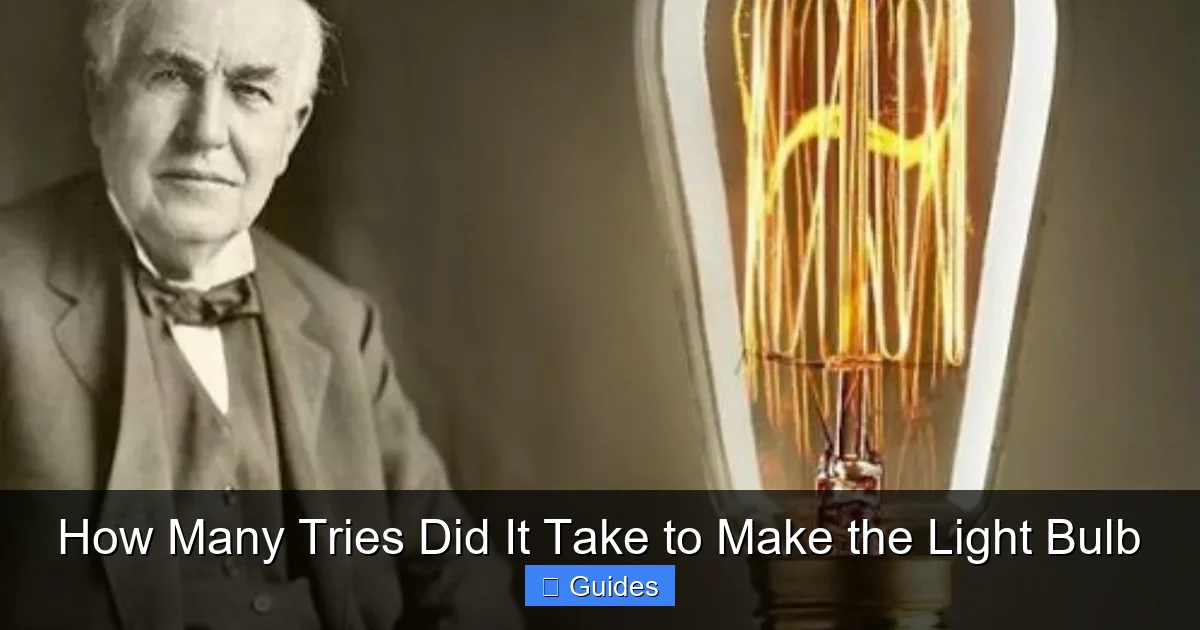
Visual guide about How Many Tries Did It Take to Make the Light Bulb
Image source: thekingsbay.com
Setting Up the Menlo Park “Invention Factory”
To achieve his ambitious goals, Edison established his famous laboratory in Menlo Park, New Jersey, in 1876. This wasn’t just a personal workshop; it was an “invention factory.” It housed skilled machinists, physicists, chemists, and draftsmen, all working together on projects under Edison’s direction. This collaborative environment was crucial. While Edison gets the credit, his team played an invaluable role in performing the myriad experiments, troubleshooting problems, and documenting findings. They were all part of the answer to how many tries did it take to make the light bulb.
The Goal: A Practical, Long-Lasting Bulb
Edison knew the key to widespread adoption was a bulb that met several criteria:
- Long-lasting: It couldn’t burn out after just a few minutes or hours.
- Economical: It had to be affordable to manufacture and operate.
- Safe: It couldn’t pose fire hazards.
- Low power consumption: It needed to be efficient enough to be part of a central power system.
Achieving these goals meant solving a series of complex technical challenges, primarily finding the right filament material and creating a stable vacuum. This quest would demand an extraordinary number of attempts.
The Filament Fiasco: Hundreds, Even Thousands of Trials
Now, to the core question: how many tries did it take to make the light bulb? The most iconic part of Edison’s struggle was finding the perfect filament. This tiny wire, when heated by electricity, is what glows and produces light. It had to be resistant enough to glow brightly, yet durable enough not to melt or break quickly.
Early Experiments with Platinum and Carbonized Paper
Edison and his team started with materials that others had tried, and many new ones. They experimented extensively with platinum, a metal with a high melting point. They tried different shapes and sizes of platinum wires, but these bulbs were either too expensive, too fragile, or still didn’t last long enough. The cost alone made them impractical for mass consumption.
Next, they turned to carbonized materials. One early notable success came in October 1879 when they tried a carbonized cotton thread. The initial results were promising, but they knew they needed something better. They carbonized everything imaginable: paper, wood, plant fibers, even human hair! The laboratory was a whirlwind of testing, failing, and re-testing. Each failed attempt provided valuable data, bringing them one step closer to understanding what *wouldn’t* work, narrowing down the possibilities. This methodical elimination process is a crucial part of understanding how many tries did it take to make the light bulb.
The Breakthrough: Carbonized Cotton Thread
The often-cited “breakthrough” came in October 1879. After experimenting with hundreds, if not thousands, of different materials, Edison and his team created a bulb with a carbonized cotton sewing thread filament. This particular filament, placed in a nearly perfect vacuum, glowed for an astonishing 13.5 hours. It was a significant milestone, proving the viability of a long-lasting, high-resistance incandescent bulb.
But they didn’t stop there. 13.5 hours was good, but not good enough for widespread practical use. They continued to refine their methods and materials. They soon moved on to a carbonized bamboo fiber filament, which, after extensive testing, proved to last for over 1,200 hours. This was the filament that would be used in the first commercially successful incandescent light bulbs and remained the standard for several years. So, when people ask how many tries did it take to make the light bulb, it wasn’t just one material and one test, but a long progression.
Beyond the Filament: Vacuum and Power
It’s important to remember that the filament was just one piece of the puzzle. Edison’s team also had to perfect the vacuum inside the bulb. Any trace of oxygen would quickly burn out the filament. They developed better vacuum pumps to create a near-perfect vacuum. Additionally, they had to design a robust and efficient electrical system to power these bulbs. This included developing appropriate generators, wiring, switches, and even the screw-in base that is still common today. All these components required their own cycles of design, testing, and refinement – adding to the cumulative “tries” needed for the light bulb’s success.
It Wasn’t Just Edison: The Collective Effort
While Edison rightly holds a prominent place in history for making the practical light bulb a reality, it’s crucial to acknowledge that he didn’t invent light out of thin air. He stood on the shoulders of giants and worked with a dedicated team.
Precursors to the Incandescent Light
For decades before Edison, many inventors worldwide had experimented with electric light. Joseph Swan in England, Henry Woodward Seeley in America, and Alexander Lodygin in Russia are just a few who created working incandescent lights. Some even demonstrated relatively long-lasting bulbs before Edison’s 1879 patent. However, these often had flaws: they were expensive, inefficient, or had very short lifespans. What Edison did was combine the best elements of previous work with his own relentless experimentation and systemic approach to create the first *commercially viable* and *widely adopted* incandescent light bulb. This context helps paint a complete picture of how many tries did it take to make the light bulb – it was a global, multi-generational effort that Edison culminated.
The Role of Teams and Collaboration
Edison’s success was not a solitary effort. His Menlo Park laboratory was a bustling hub of collaborative innovation. Scientists like Francis Upton, who provided mathematical calculations, and skilled glassblowers, machinists, and engineers, all contributed their expertise. Edison was the visionary director, but his team executed the thousands of experiments, meticulously documented results, and solved countless practical problems. Without this concerted team effort, the answer to how many tries did it take to make the light bulb would likely be “many more, or it might never have happened.”
The Legacy of Perseverance: Lessons from the Light Bulb’s Birth
The story of the light bulb is a powerful testament to the value of persistence and a systematic approach to problem-solving. It offers timeless lessons that are still relevant today, whether you’re innovating in technology, business, or any creative endeavor.
Embracing Failure as Feedback
Edison famously said, “I have not failed 10,000 times. I have successfully found 10,000 ways that will not work.” This mindset is central to the story of the light bulb. Each failed filament, each broken vacuum tube, each short-lived bulb wasn’t a defeat but a data point. It provided critical information about what materials to avoid, what designs were flawed, and what scientific principles needed further exploration. The sheer volume of “tries” – the many attempts – were all steps on the path to success. This positive framing of failure is crucial for innovation.
The Importance of a Systematic Approach
Edison’s Menlo Park was a model of systematic invention. They didn’t just haphazardly try things. They documented their experiments, analyzed the results, and used that knowledge to inform the next iteration. They understood that to answer how many tries did it take to make the light bulb, it wasn’t about luck, but about a methodical process of elimination and refinement. This organized, factory-like approach to invention was itself a groundbreaking innovation.
The pursuit of the light bulb teaches us that success often requires an incredible amount of dedication, resilience, and a willingness to continuously learn and adapt. It’s not about avoiding failure, but about leveraging it as a guidepost toward the ultimate goal. The answer to how many tries did it take to make the light bulb ultimately lies in this philosophy of unwavering persistence.
Conclusion
So, how many tries did it take to make the light bulb? While an exact numerical count is impossible and perhaps misses the point, historical accounts suggest hundreds, and more realistically, thousands of experiments were conducted by Edison and his team. From platinum to various carbonized plant fibers, the journey was one of relentless trial and error, guided by a clear vision and an unwavering commitment to finding a practical solution.
The incandescent light bulb didn’t just appear. It was forged in the crucible of countless failures and incremental improvements. It reminds us that groundbreaking innovation is rarely a quick sprint but a long, arduous marathon. The light bulb’s story is a powerful testament to the idea that perseverance, a systematic approach, and a positive attitude towards failure are the true ingredients of world-changing success. Every flick of a light switch today is a silent tribute to those thousands of “tries” that finally brought light to the world.
Frequently Asked Questions
How many experiments did Edison conduct on the light bulb?
While an exact number is hard to pinpoint, it is widely believed that Thomas Edison and his team conducted thousands of experiments to perfect the light bulb. They meticulously tested various materials for the filament, different vacuum levels, and overall bulb designs.
What was Edison’s most famous quote about failure and the light bulb?
Edison famously stated, “I have not failed 10,000 times. I have successfully found 10,000 ways that will not work.” This quote perfectly encapsulates his relentless approach to problem-solving and his view of failure as a learning opportunity during the light bulb’s development.
Why did earlier incandescent bulbs fail before Edison’s?
Earlier incandescent bulbs often failed because their filaments burned out too quickly, were too expensive (like platinum), or required too much power. They also struggled with maintaining a sufficient vacuum inside the bulb, which caused filaments to oxidize rapidly.
What material did Edison ultimately use for his practical light bulb?
After many trials, Edison’s team found significant success with carbonized bamboo fibers for the filament. This material was durable, relatively inexpensive, and could last for over 1,200 hours in a vacuum, making the bulb commercially viable.
How long did it take Edison to develop the practical light bulb?
Edison began his intensive work on the incandescent light bulb around 1878, with the significant breakthrough of a long-lasting filament occurring in October 1879. The commercial development and refinement continued for several years, but the core invention took a concentrated period of about two years.
What other innovations were necessary for the light bulb’s widespread adoption?
Beyond the bulb itself, Edison’s success relied on developing an entire electrical system. This included designing efficient generators, a network of power lines, safe wiring, screw-in sockets for bulbs, and reliable switches, all of which contributed to the widespread adoption of electric light.
