


As an Amazon Associate, We earn from qualifying purchases.
Once, understanding how many watts in a light bulb directly told you its brightness. However, with the rise of energy-efficient LED and CFL bulbs, watts now primarily indicate energy consumption, not light output. The modern standard for brightness is lumens, which helps you choose the right light level while saving on electricity bills and reducing your environmental footprint.
How Many Watts in a Light Bulb
Have you ever stood in the lighting aisle, scratching your head, wondering exactly how many watts in a light bulb you really need? For decades, it was simple: more watts meant more light. A 100-watt bulb was brighter than a 60-watt bulb, plain and simple. We grew up with this understanding, and it became ingrained in how we thought about lighting our homes.
But times have changed, and so has light bulb technology. With the rise of energy-efficient bulbs like LEDs and CFLs, the old rule of “watts equal brightness” no longer applies directly. Today, a bulb with far fewer watts can produce the same — or even more — light than its old-school incandescent counterpart. This shift can be a bit confusing, but understanding it is key to making smart choices for your home, your wallet, and even the planet. Let’s demystify the wattage of a light bulb together!
Key Takeaways
- Watts Primarily Indicate Energy Use: For modern LED and CFL bulbs, “watts” tell you how much electricity the bulb consumes, not how bright it is.
- Lumens Are the New Brightness Standard: To know how bright a light bulb will be, always check its lumen rating. Higher lumens mean brighter light.
- “Equivalent Wattage” Helps Transition: Bulb packaging often shows “60W equivalent” to help you compare modern bulbs to the old incandescent standards you’re familiar with.
- Lower Watts, Same Brightness Means Savings: An LED bulb that uses 9-12 watts but produces 800 lumens (a 60W equivalent) is far more energy-efficient and cost-effective than an old 60W incandescent bulb.
- Consider More Than Just Brightness: Look for color temperature (Kelvin), which describes the light’s warmth or coolness, and CRI (Color Rendering Index) for how accurately colors appear under the light.
- Energy Efficiency Benefits Your Wallet and the Planet: Choosing lower wattage, high-lumen bulbs significantly reduces your electricity bill and lowers your carbon footprint.
- Not All Bulbs Are Dimmable: If you plan to use a dimmer, ensure the bulb is specifically labeled as “dimmable,” especially for LED bulbs, and check for dimmer compatibility.
Quick Answers to Common Questions
How many watts in a light bulb means it’s bright?
For modern LED and CFL bulbs, “watts” indicate energy consumption, not brightness. To know how bright a bulb is, you should look for its lumen rating; higher lumens mean brighter light.
What is a good number of lumens for a standard room?
For a general room, a single bulb providing 800 lumens (equivalent to an old 60-watt incandescent) is a good starting point. However, larger rooms or task-specific areas might require multiple bulbs or higher total lumens, often ranging from 1500 to 3000 lumens in total.
Can I replace any old bulb with an LED?
Yes, in most cases, you can replace old incandescent bulbs with equivalent LED bulbs, as long as the base type (e.g., screw-in, bayonet) matches your fixture. Just ensure you check the lumens for brightness and consider if you need a “dimmable” LED if your fixture uses a dimmer switch.
Do lower wattage bulbs last longer?
Generally, yes, especially when comparing LEDs to incandescents. LED bulbs inherently consume less power (lower wattage) to produce the same light and are designed to last significantly longer (tens of thousands of hours) than higher wattage incandescent bulbs, regardless of their specific wattage.
Why are LED bulbs more expensive than traditional bulbs?
LED bulbs use more complex technology and manufacturing processes than simple incandescent bulbs, which contributes to their higher initial cost. However, their superior energy efficiency and extremely long lifespan lead to significant cost savings over time, quickly offsetting the initial expense.
📑 Table of Contents
- What Exactly Are Watts? Understanding Power Consumption
- The Incandescent Era: Where Watts Meant Brightness
- The Revolution: LEDs, CFLs, and the Shift from Watts to Lumens
- Decoding Bulb Labels: Watts, Lumens, and Equivalent Wattage
- Beyond Brightness: Energy Efficiency and Your Wallet
- Dimming, Smart Bulbs, and Future Trends
- Conclusion
What Exactly Are Watts? Understanding Power Consumption
Before we dive into the specifics of light bulbs, let’s get a clear picture of what a “watt” actually is. In the simplest terms, a watt (W) is a unit of power. It measures the rate at which electrical energy is consumed or produced. Think of it like this: if you have an electrical device, its wattage tells you how much electricity it uses per second when it’s operating.
For generations, the watt rating on a light bulb was a pretty straightforward indicator of how bright the bulb would be. An old 40W incandescent bulb would emit a certain amount of light, and a 100W bulb would emit significantly more. This was because incandescent bulbs operated on a relatively simple principle: electricity flowed through a filament, heating it up until it glowed. The more watts you put into it, the hotter and brighter the filament would get. So, for these traditional bulbs, asking how many watts in a light bulb directly answered the question of its light output.
However, it’s crucial to understand that watts are fundamentally a measure of *energy consumption*, not brightness. This distinction is vital in our modern world of lighting. Your electricity bill charges you based on kilowatt-hours (kWh), which is essentially how many kilowatts (1,000 watts) you use over an hour. So, a higher wattage bulb, regardless of its brightness, will consume more electricity and cost you more to run.
The Historical Role of Watts in Lighting
For nearly a century, the question of “how many watts in a light bulb” was the only question people needed to ask when buying a new bulb. The technology was standardized, and the relationship between wattage and perceived brightness was consistent. This made purchasing easy, but it also masked a significant inefficiency: a large portion of the energy consumed by incandescent bulbs was wasted as heat, not converted into visible light. They were more like tiny space heaters that happened to glow! This historical context is important because it explains why so many of us still instinctively look for the watt number when shopping for lights.
The Incandescent Era: Where Watts Meant Brightness
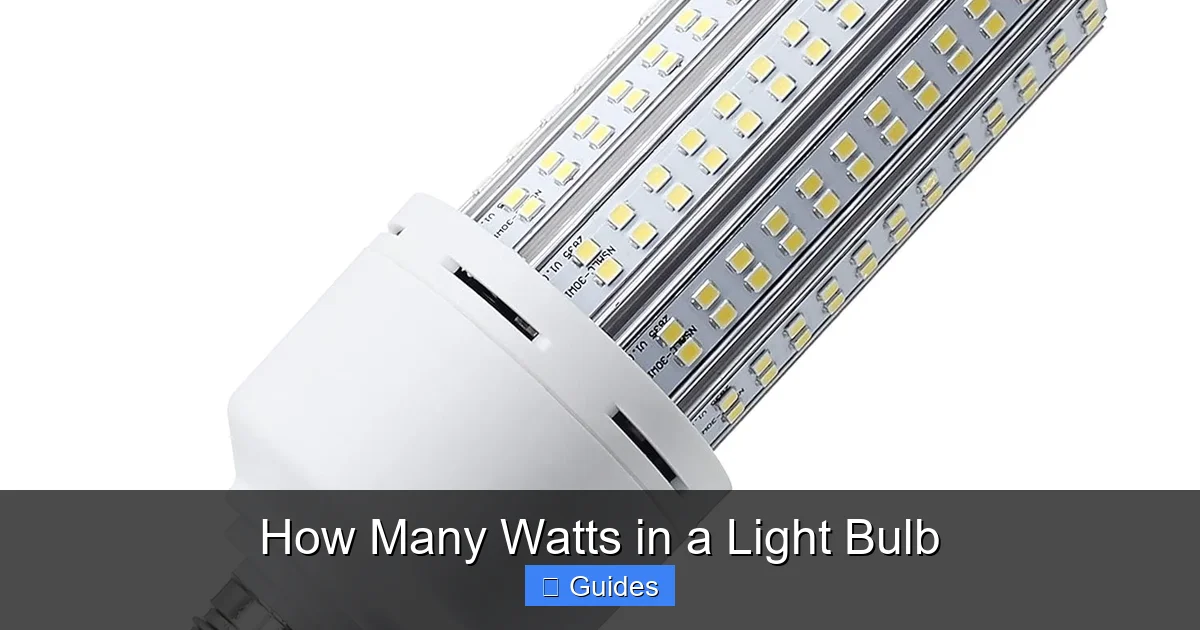
Visual guide about How Many Watts in a Light Bulb
Image source: storables.com
Let’s take a quick trip down memory lane to the incandescent era. This is the world many of us grew up in, where choosing the right light bulb was as simple as picking a number. If you wanted a dim, cozy glow, you might grab a 40W bulb. For general room lighting, a 60W or 75W bulb was common. And if you needed serious illumination for reading or a workspace, a 100W or even 150W bulb was the go-to.
In this world, the answer to how many watts in a light bulb equaled its brightness was very direct. A 60W bulb, for example, would provide a consistent level of light output that everyone recognized. We developed an intuitive sense of what a “60-watt light” looked like. This familiarity made bulb shopping straightforward but also anchored our perception of light output to energy consumption.
The Inefficiency of Old-School Bulbs
While simple, the incandescent system had a major flaw: inefficiency. As mentioned, a huge chunk of the electrical energy they consumed was converted into heat, not light. In fact, only about 10-15% of the electricity used by an incandescent bulb actually produces light; the rest becomes heat. This is why you could easily burn yourself touching a hot incandescent bulb. This inefficiency meant higher electricity bills and a larger carbon footprint, something we started to understand more clearly as environmental awareness grew. The need for a better way to light our homes became obvious, pushing engineers to invent more energy-efficient alternatives that would change how many watts in a light bulb we needed.
The Revolution: LEDs, CFLs, and the Shift from Watts to Lumens
Enter the lighting revolution! With the widespread adoption of compact fluorescent lamps (CFLs) and, more recently, light-emitting diodes (LEDs), the way we measure and understand light has fundamentally changed. These new technologies are vastly more efficient at converting electricity into light. This means they can produce the same amount of light as an old incandescent bulb using significantly fewer watts.
This is why simply asking “how many watts in a light bulb” isn’t enough anymore. A modern LED bulb might only consume 9 watts, but it could produce the same amount of light as an old 60-watt incandescent bulb. If you just looked for a 60-watt LED, you’d end up with something blindingly bright, and that’s not what you want!
Introducing Lumens: The True Measure of Brightness
So, if watts no longer reliably tell us how bright a bulb is, what does? The answer is *lumens*.
A lumen (lm) is the international standard unit for measuring the total amount of visible light emitted by a source. Think of lumens as the “brightness rating” of a light bulb. The higher the lumen count, the brighter the light source. This is the crucial number you should look for when buying a new light bulb, especially if you’re trying to replicate the light output of an older incandescent.
Comparing Watts to Lumens: A Quick Guide
To help make the transition easier, here’s a rough guide comparing the typical lumen output of common incandescent bulbs to the wattage of modern LEDs that produce a similar amount of light:
* Old 40W Incandescent: ~450 lumens. Equivalent LED: 4-6 watts.
* Old 60W Incandescent: ~800 lumens. Equivalent LED: 9-12 watts.
* Old 75W Incandescent: ~1100 lumens. Equivalent LED: 12-15 watts.
* Old 100W Incandescent: ~1600 lumens. Equivalent LED: 15-20 watts.
As you can see, a modern LED can produce the same brightness as a 60W incandescent while consuming a fifth or even a sixth of the power! This huge jump in efficiency is the main reason why knowing how many watts in a light bulb has become less about brightness and more about energy consumption. It’s a game-changer for your energy bill.
Decoding Bulb Labels: Watts, Lumens, and Equivalent Wattage
Navigating the light bulb aisle can still feel like a puzzle if you don’t know what to look for. Thankfully, light bulb manufacturers have adapted their packaging to help consumers understand the new metrics. When you pick up a new bulb, you’ll see a lot more information than just how many watts in a light bulb it uses.
The “Lighting Facts” Label
Many bulbs, especially in regions with energy efficiency standards, come with a “Lighting Facts” label, similar to the nutrition labels on food. This label is your best friend for understanding what you’re buying. Here’s what to look for:
1. Brightness (Lumens): This is usually the largest and most prominent number on the label. It tells you exactly how much light the bulb will produce. If you want a “60-watt equivalent,” look for around 800 lumens.
2. Energy Used (Watts): This number tells you how many watts the bulb actually consumes. This is important for calculating your electricity costs. You’ll notice this number is much lower for LEDs and CFLs than for the incandescent equivalent.
3. Equivalent Wattage: This is a helpful cross-reference. It will often say something like “Replaces 60W Incandescent” or “60W Equivalent.” This helps you mentally translate the lumen output into the old wattage system you’re familiar with. This is still a common way to answer the “how many watts in a light bulb” question, even if it’s an equivalence.
4. Life (Years/Hours): This indicates the estimated lifespan of the bulb, which is significantly longer for LEDs than for traditional bulbs. This is another area where modern bulbs offer huge savings and convenience.
5. Light Appearance (Kelvin): This number refers to the “color temperature” of the light.
* Lower Kelvin numbers (e.g., 2700K-3000K) produce a “warm white” or yellowish light, similar to traditional incandescents. This is great for cozy living spaces.
* Mid-range numbers (e.g., 3500K-4100K) are “cool white” or “neutral white,” often used in kitchens, offices, or bathrooms.
* Higher numbers (e.g., 5000K-6500K) produce a “daylight” or bluish-white light, ideal for task lighting, workshops, or areas where you need high contrast.
6. CRI (Color Rendering Index): This measures how accurately the light renders colors compared to natural sunlight. A CRI of 80 or higher is generally good, while 90+ is excellent for tasks requiring accurate color perception (like art studios or makeup areas).
Practical Tips for Choosing the Right Bulb
* Match Lumens to Your Needs: Don’t just pick a low-wattage bulb. Decide on the brightness first (lumens), then look at the watts to understand its efficiency. For instance, if you need ambient light for a bedroom, 450-800 lumens might be perfect. For a bright kitchen, you might combine several bulbs to achieve 2000-4000 total lumens.
* Consider Color Temperature: Think about the mood and function of the room. Warm white for relaxation, cool white for alertness and productivity.
* Check Dimmability: If you have a dimmer switch, make sure the LED or CFL bulb you choose is specifically labeled “dimmable.” Not all are, and using a non-dimmable bulb on a dimmer can cause flickering or damage the bulb.
* Look at the Base: Ensure the bulb’s base (e.g., E26 standard screw base, GU10, candelabra) matches your fixture.
By understanding these labels, you can confidently answer not only how many watts in a light bulb, but also how bright it will be, its color, and how long it will last.
Beyond Brightness: Energy Efficiency and Your Wallet
The shift from incandescent bulbs to LEDs and CFLs isn’t just about different numbers on a package; it has profound impacts on your energy consumption, your utility bills, and the environment. Choosing modern, energy-efficient light bulbs is one of the easiest ways to make a significant difference in your home’s energy footprint.
Connecting Lower Wattage to Lower Energy Bills
This is where understanding how many watts in a light bulb directly affects your wallet. Remember, your electricity company charges you for kilowatt-hours (kWh). Since an LED bulb uses significantly fewer watts to produce the same amount of light, it dramatically reduces the amount of electricity it consumes.
Let’s do a quick comparison:
* An old 60W incandescent bulb operating for 4 hours a day consumes 0.06 kWh * 4 hours = 0.24 kWh per day.
* A 9W LED “60W equivalent” bulb operating for 4 hours a day consumes 0.009 kWh * 4 hours = 0.036 kWh per day.
That’s a massive reduction! Over a year, this difference adds up. If you replace all the incandescent bulbs in your home with LEDs, you’re looking at substantial savings on your annual electricity bill. Even if the initial cost of an LED bulb is higher, its energy savings and longer lifespan mean it pays for itself many times over.
Environmental Benefits
Beyond your wallet, there’s a significant environmental upside. Lower energy consumption means power plants burn less fossil fuel, leading to:
* Reduced greenhouse gas emissions (less carbon dioxide).
* Less air pollution.
* Reduced demand on natural resources.
LEDs also contain no mercury, unlike CFLs, making their disposal simpler and safer for the environment. Their extended lifespan also means fewer bulbs end up in landfills, further reducing waste.
Tips for Maximizing Energy Savings
* Replace All Incandescents: Start by swapping out your most-used incandescent bulbs for LEDs. This will give you the quickest return on investment.
* Dim When Possible: If you have dimmable LED bulbs and compatible dimmer switches, dimming your lights not only sets a mood but also further reduces energy consumption.
* Use Motion Sensors/Timers: For outdoor lighting, closets, or rarely used spaces, consider bulbs or fixtures with motion sensors or timers to ensure lights are only on when needed.
* Take Advantage of Natural Light: Maximize natural daylight in your home by keeping windows clean and drapes open. This reduces the need for artificial lighting during the day.
By making smart choices about how many watts in a light bulb you choose, and opting for energy-efficient solutions, you’re investing in both your financial future and the health of the planet.
Dimming, Smart Bulbs, and Future Trends
The evolution of light bulbs isn’t stopping with basic energy efficiency. Modern lighting offers a wealth of features that enhance convenience, ambiance, and even connectivity in your home.
The Nuance of Dimmable LEDs
When incandescents were king, dimming was simple: reduce the voltage, and the light got dimmer. For LEDs, it’s a bit more complex. Not all LED bulbs are designed to be dimmable, and those that are often require specific types of dimmer switches. If you try to dim a non-dimmable LED, you might experience flickering, buzzing, or even premature bulb failure.
Always check the packaging for a “dimmable” label. If you’re upgrading to LEDs in a fixture connected to an old dimmer, you might also need to upgrade your dimmer switch to an “LED-compatible” or “universal” dimmer. This ensures smooth, flicker-free dimming across the entire range.
The Rise of Smart Bulbs
Smart bulbs take convenience to a whole new level. These bulbs connect to your home’s Wi-Fi network or a smart home hub, allowing you to control them from your smartphone, tablet, or even with voice commands via smart assistants like Alexa or Google Assistant.
With smart bulbs, you can:
* Adjust brightness: Fine-tune the lumen output to your exact preference without a physical dimmer switch.
* Change color temperature: Shift from a warm, cozy glow in the evening to a bright, cool light for morning tasks.
* Change colors: Many smart bulbs can produce millions of different colors, perfect for mood lighting, parties, or holiday decorations.
* Set schedules and timers: Have your lights turn on automatically before you wake up or dim gradually as you drift off to sleep.
* Group lights: Control multiple bulbs in a room or your entire home with a single command.
While smart bulbs often have a higher upfront cost, their versatility and energy efficiency (they are almost always LEDs) make them an exciting option for tech-savvy homeowners. The flexibility they offer goes far beyond simply knowing how many watts in a light bulb; it’s about total lighting control.
What’s Next for Lighting?
The future of lighting continues to evolve rapidly. We’re seeing advancements in:
* Human-centric lighting: Systems that automatically adjust color temperature and brightness throughout the day to mimic natural light cycles, supporting our circadian rhythms and well-being.
* Li-Fi: Technology that uses light to transmit data, potentially offering incredibly fast and secure wireless internet.
* Integration with smart home ecosystems: Deeper connectivity and automation, where your lights work seamlessly with other smart devices in your home, from thermostats to security cameras.
The humble light bulb has come a long way, and its journey is far from over.
Conclusion
The question of “how many watts in a light bulb” has a much more nuanced answer today than it did even a couple of decades ago. While watts still tell you about a bulb’s energy consumption, lumens are the true indicator of its brightness. Understanding this fundamental shift is the key to making informed lighting decisions for your home.
By choosing energy-efficient LED or CFL bulbs and paying attention to lumens, color temperature, and dimmability, you can achieve the perfect lighting ambiance for every space. You’ll not only enjoy superior light quality but also reap the benefits of lower electricity bills and a reduced environmental impact. So, next time you’re in the lighting aisle, armed with this knowledge, you can confidently choose the right light bulb for your needs, knowing you’re making a smart and sustainable choice. Light up your world intelligently!
Frequently Asked Questions
What is the difference between watts and lumens for a light bulb?
Watts measure the amount of electrical power a light bulb consumes, indicating its energy usage. Lumens, on the other hand, measure the total amount of visible light produced by the bulb, which directly tells you how bright it will be. For modern, energy-efficient bulbs, lumens are the primary indicator of brightness.
How do I know what LED wattage equals an old incandescent bulb?
Light bulb packaging often provides “equivalent wattage” information (e.g., “Replaces 60W Incandescent”). You can also look for the lumen rating; an old 60W incandescent typically produced around 800 lumens, so an LED bulb with 800 lumens, regardless of its low wattage (e.g., 9-12 watts), will provide similar brightness.
Is a higher wattage bulb always brighter?
Not anymore, especially with modern light bulbs. While a higher wattage incandescent bulb was always brighter, an LED bulb with fewer watts can be significantly brighter than an older, higher wattage incandescent because LEDs are much more efficient at converting electricity into light. Always check the lumens for brightness.
What does “color temperature” mean on a light bulb?
Color temperature, measured in Kelvins (K), describes the perceived warmth or coolness of the light emitted by a bulb. Lower Kelvin numbers (e.g., 2700K-3000K) produce a warm, yellowish light, while higher numbers (e.g., 5000K-6500K) create a cool, bluish “daylight” effect. This affects the ambiance of a room.
Are LED bulbs truly energy efficient?
Yes, LED bulbs are incredibly energy efficient. They use a fraction of the electricity compared to incandescent bulbs to produce the same amount of light, meaning lower wattage for the same lumen output. This efficiency translates directly into significant savings on your electricity bill and a reduced environmental footprint.
Do I need a special dimmer switch for LED bulbs?
Often, yes. Many older dimmer switches designed for incandescent bulbs are not compatible with LED bulbs and can cause flickering, buzzing, or prevent proper dimming. If you plan to use dimmable LED bulbs, it’s recommended to install an LED-compatible or universal dimmer switch for optimal performance.
