


As an Amazon Associate, We earn from qualifying purchases.
When a light bulb has burned out it will cease to emit light, often accompanied by a visible filament break or an internal electronics failure in modern bulbs. Recognizing the signs and understanding the underlying causes helps in safe replacement and future prevention. This guide explores the specifics of various bulb types, practical tips for troubleshooting, and how to make your bulbs last longer, ensuring you’re never left in the dark wondering why.
Imagine the scene: you walk into a room, flip the switch, and nothing happens. Or perhaps, after a long, steady glow, your trusty light source suddenly flickers, dims, and then… darkness. It’s a common household occurrence, often met with a sigh and the familiar thought: “Well, there goes another one.” But what exactly happens when a light bulb has burned out it will go dark? What are the mechanics behind this ubiquitous phenomenon, and what steps should you take when it inevitably happens in your home?
This guide dives deep into the world of burnt-out light bulbs, demystifying the process and equipping you with the knowledge to handle these situations like a pro. From the intricate science of how different bulb types fail to practical advice on safe replacement and even preventative measures, we’ll illuminate every corner of this topic. So, next time when a light bulb has burned out it will, you’ll be prepared, understanding not just the symptom, but the cause and the solution.
Key Takeaways
- Filament vs. Modern Bulb Failure: Traditional incandescent bulbs fail when their filament breaks. Modern LEDs and CFLs fail due to internal electronic component degradation or power driver issues, not typically a “burn out” in the traditional sense.
- Common Signs of Burnout: Obvious signs include no light, a dark spot on the bulb, a rattling sound from a broken filament, or flickering before complete failure, especially with CFLs and LEDs.
- Safety First During Replacement: Always turn off the power at the switch and, if possible, the circuit breaker before handling a burnt-out bulb. Allow the bulb to cool completely to prevent burns.
- Troubleshooting Beyond the Bulb: If a new bulb doesn’t work, the issue might be with the fixture, socket, switch, or even the circuit breaker. Systematically check each component.
- Extend Bulb Lifespan: Factors like using the correct wattage, avoiding frequent switching, ensuring proper ventilation, and choosing quality bulbs significantly contribute to extending a light bulb’s life.
- Proper Disposal is Crucial: Incandescent bulbs can go in regular trash (if allowed locally). CFLs contain mercury and require special hazardous waste disposal. LEDs are electronic waste and should be recycled at designated facilities.
Quick Answers to Common Questions
What is the most common reason for an incandescent bulb to burn out?
The most common reason for an incandescent bulb to burn out is a break in its tungsten filament due to evaporation and thinning over time, creating an open circuit.
Can a burnt-out LED bulb be fixed?
No, a burnt-out LED bulb generally cannot be fixed by a consumer. Its failure is typically due to degradation of internal electronic components or the driver, which are not user-serviceable.
Is it safe to touch a light bulb immediately after it burns out?
No, it is generally not safe to touch an incandescent or halogen bulb immediately after it burns out as it can be extremely hot and cause severe burns. Always allow it to cool completely first.
What should I do if a new bulb doesn’t work in a fixture?
If a new bulb doesn’t work, first ensure the switch is on. Then, check the circuit breaker, inspect the fixture’s socket for issues like a bent contact tab, and try the new bulb in a different fixture to rule out a faulty bulb.
Why do CFLs sometimes flicker before dying?
CFLs often flicker or take longer to start before dying because their internal electronic ballast or electrodes are degrading, making it harder to initiate and maintain the gas discharge necessary for light production.
📑 Table of Contents
The Anatomy of a Burnout: What Actually Happens?
When we talk about a light bulb “burning out,” we’re often thinking of the classic incandescent bulb. However, with the advent of CFLs and LEDs, the mechanism of failure has become a bit more complex. Understanding these differences is key to knowing what happens when a light bulb has burned out it will.
Incandescent Bulbs: The Classic Filament Break
For incandescent bulbs, the process is straightforward. Inside the glass bulb is a thin tungsten filament. When electricity flows through this filament, it heats up to extreme temperatures (thousands of degrees Fahrenheit), causing it to glow brightly—a phenomenon known as incandescence.
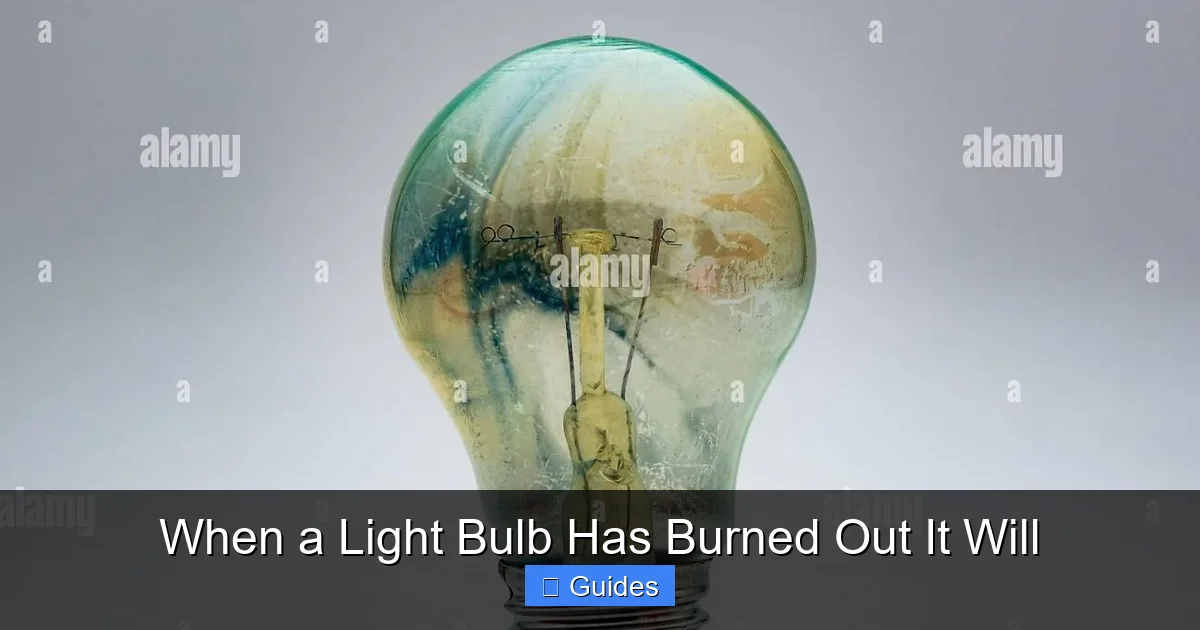
Over time, as the filament heats and cools repeatedly, tungsten atoms evaporate from its surface. This evaporation thins the filament in certain spots. Eventually, one of these thin spots becomes too weak to carry the electrical current and breaks. This open circuit stops the flow of electricity, and the bulb goes dark. This is precisely when a light bulb has burned out it will cease to produce light. You might sometimes see a dark, smoky deposit on the inside of the glass bulb, which is tungsten vapor that has condensed on the cooler glass. If you shake the bulb, you might hear the broken filament rattling inside.
CFLs (Compact Fluorescent Lamps): Electronic Components and Gas
CFLs operate differently. They contain a gas (usually argon and a small amount of mercury vapor) and are coated with a phosphor. When electricity flows through the tube, it excites the mercury vapor, which emits ultraviolet (UV) light. This UV light then hits the phosphor coating, causing it to glow, producing visible light.
CFLs don’t “burn out” in the same way as incandescents. Instead, when a light bulb has burned out it will, it’s typically due to the degradation of internal electronic components (like the ballast or starter) or the electrodes at either end of the tube. The electrodes can wear out, making it harder to initiate the arc. You might notice flickering, dimming, a slow start-up, or even a noticeable hum before a CFL completely fails. Sometimes, a CFL will simply refuse to light up at all, indicating an internal component failure.
LEDs (Light-Emitting Diodes): Driver Failure and Diode Degradation
LEDs are semiconductors that emit light when electricity passes through them. Unlike incandescents, they don’t have a filament that burns out. When an LED light bulb has burned out it will, it’s usually not because the LED itself has failed instantly, but because of the electronics that power it.
LED bulbs contain a “driver,” which is a circuit that converts the alternating current (AC) from your home’s wiring into the direct current (DC) that LEDs need. This driver is often the weakest link. Overheating, power surges, or general component degradation can cause the driver to fail, cutting off power to the LEDs. Sometimes, individual LED diodes within the bulb can also degrade over time, leading to dimming or a change in color before complete failure. An LED bulb is often said to “fail slowly” rather than “burning out” suddenly, though a driver failure can be instant.
Telltale Signs: How to Know Your Bulb is Done
Knowing the specific indicators helps you quickly identify when a light bulb has burned out it will need replacing. While the ultimate sign is a lack of light, there are often precursors or accompanying visual cues.
No Light at All
This is the most obvious sign. You flip the switch, and the room remains dark. For an incandescent bulb, this is a clear indication that the filament has broken. For a CFL or LED, it means an internal failure has occurred.
Visible Filament Break
For incandescent bulbs, if you look closely, you might see a clear break in the thin wire inside the bulb. Sometimes, the filament is completely disintegrated, leaving only tiny fragments. This is a definitive sign when a light bulb has burned out it will require replacement.
Dark Spot or Blackening on the Bulb
Incandescent bulbs often show a dark, silvery, or black spot on the inside of the glass, usually near the base. This is evaporated tungsten that has condensed on the glass. It indicates the bulb is nearing the end of its life or has already failed. CFLs might show blackening at the ends of the tube, indicating electrode wear.
Rattling Sound
If you gently shake a non-working incandescent bulb and hear a rattling sound, it’s likely the broken filament pieces moving around inside. This is a strong clue that when a light bulb has burned out it will be due to this classic failure.
Flickering or Dimming (CFLs and LEDs)
Before a CFL completely dies, it might start flickering erratically or taking longer to reach full brightness. Similarly, LEDs can start to dim over time or flicker if their driver is failing or individual diodes are degrading. These are warning signs that when a light bulb has burned out it will soon be dark for good.
Humming or Buzzing Sound (CFLs)
A noticeable hum or buzz from a CFL can indicate a failing ballast or an issue with the internal electronics. This is often a precursor to complete failure.
Taking Action: Safe Replacement and Disposal
Once you’ve confirmed that a light bulb has burned out it will need replacing, safety should be your top priority.
Safety First: Power Off and Cool Down
Before touching any bulb, *always* turn off the light switch. For extra safety, especially if you’re unsure or the fixture is exposed to moisture, switch off the power to that circuit at your home’s electrical panel (breaker box).
Visual guide about When a Light Bulb Has Burned Out It Will
Image source: c8.alamy.com
Allow the bulb to cool completely. Incandescent and halogen bulbs can get incredibly hot, causing severe burns. Even CFLs and LEDs can be warm to the touch. Give it a few minutes before attempting to unscrew it.
Removing the Old Bulb
For standard screw-in bulbs, firmly grip the bulb (wearing gloves is a good idea, especially for smooth glass or if it’s hot) and turn it counter-clockwise until it’s loose and can be removed.
If the bulb breaks while unscrewing, *do not use your bare hands*. Turn off the power at the circuit breaker immediately. Use pliers to grip the metal base of the bulb and carefully twist it out. If glass shards remain, use a potato or piece of cork pressed into the base to help twist it out, ensuring all power is off first.
Choosing and Installing a New Bulb
Always replace a bulb with one of the correct wattage or equivalent lumen output for the fixture. Exceeding the recommended wattage can lead to overheating, fixture damage, and fire hazards. Check the fixture for a maximum wattage sticker.
Screw the new bulb in clockwise until it’s snug, but don’t overtighten it. Overtightening can damage the socket or the bulb’s base. Once installed, restore power and test the light. When a light bulb has burned out it will usually be a simple swap, but sometimes more troubleshooting is needed.
Proper Disposal
- Incandescent and Halogen: In most areas, these can be disposed of with regular household trash, as they don’t contain hazardous materials.
- CFLs: These contain a small amount of mercury and should *not* be thrown in the regular trash. Many hardware stores, home improvement centers, and local waste management facilities offer recycling programs for CFLs. Check your local regulations for proper disposal. If a CFL breaks, carefully ventilate the room and clean up the shards without using a vacuum cleaner, then dispose of them as hazardous waste.
- LEDs: While not containing mercury, LEDs are electronic waste (e-waste) and contain various components that can be recycled. Look for e-waste recycling centers or special collection events in your community.
Prolonging Life: Tips to Prevent Early Burnout
While nothing lasts forever, you can take steps to ensure that when a light bulb has burned out it will be after a reasonably long life.
Use the Correct Wattage/Lumen Output
As mentioned, using a bulb with too high a wattage can overheat the fixture and shorten the bulb’s life. Always match the fixture’s rating.
Avoid Frequent Switching
For incandescent and CFL bulbs, the most wear and tear often occurs during startup. Frequent on/off cycles can reduce their lifespan. LEDs are less affected by this, making them ideal for high-traffic areas.
Ensure Proper Ventilation
Heat is the enemy of all electronics, including LED drivers and CFL ballasts. Ensure that bulbs are not enclosed in fixtures that trap heat, unless they are specifically designed for enclosed fixtures. Overheating can significantly shorten a bulb’s life.
Choose Quality Bulbs
While cheaper bulbs might seem appealing, investing in reputable brands often pays off in terms of lifespan and consistent performance. Read reviews and look for energy efficiency ratings.
Clean Fixtures and Sockets
Dust and debris can accumulate in light fixtures and sockets, sometimes interfering with electrical contact or causing overheating. Occasionally clean fixtures with power off.
Address Voltage Issues
If bulbs in a particular area are consistently burning out quickly, it might indicate a voltage issue in your home’s wiring. An electrician can test your home’s voltage to ensure it’s within safe limits. Power surges can also shorten bulb life; surge protectors for lamps can help.
Troubleshooting: When It’s Not Just the Bulb
Sometimes, when a light bulb has burned out it will, you replace it, and the new one still doesn’t work. This suggests the problem lies elsewhere.
Check the Switch
Ensure the light switch is fully in the “on” position. Sometimes switches can become loose or faulty. If it’s an older switch, it might be time for a replacement.
Inspect the Fixture and Socket
With the power off, carefully examine the bulb socket. Look for any corrosion, bent metal tabs (which make contact with the bulb’s base), or signs of burning. The small metal tab at the bottom of the socket can sometimes get pushed down, preventing proper contact. Gently (and *only* with power off) pry it up slightly with a wooden stick or needle-nose pliers.
Test with Another Bulb/Fixture
Try the new bulb in a different, known-working fixture to confirm the bulb itself isn’t faulty. Alternatively, try a known-working bulb in the problematic fixture to pinpoint if the fixture is the issue.
Check the Circuit Breaker
A tripped circuit breaker can cut power to an entire circuit, affecting multiple outlets or lights. Go to your electrical panel and look for any breakers that are in the “off” or middle (tripped) position. Flip them fully to “off” and then back to “on.” If the breaker immediately trips again, there’s a more serious electrical issue that needs professional attention.
Loose Wiring
If all else fails, the issue could be loose wiring within the fixture itself, at the switch, or in the wall. This is typically a job for a qualified electrician, as working with live wires can be dangerous.
Conclusion
The moment when a light bulb has burned out it will often be a minor inconvenience, but understanding the underlying mechanisms and knowing how to respond safely and effectively turns a simple household task into an informed process. Whether it’s the classic filament snap of an incandescent, the electronic fatigue of a CFL, or the driver failure of an LED, each type of bulb has its unique way of reaching its end.
By being aware of the signs, following safe replacement procedures, disposing of bulbs responsibly, and adopting practices that extend their life, you’re not just changing a bulb; you’re maintaining your home’s electrical system and contributing to a safer environment. And if the problem persists even after a bulb swap, remember the troubleshooting steps to diagnose deeper issues. So, the next time when a light bulb has burned out it will happen, you’ll be well-prepared to bring the light back!
Frequently Asked Questions
What does it mean when a light bulb has burned out it will make a rattling sound?
When an incandescent light bulb has burned out it will sometimes make a rattling sound if you shake it gently. This sound comes from the broken pieces of the tungsten filament, which have detached from their supports and are loose inside the glass bulb.
When a light bulb has burned out it will sometimes have a dark spot inside. What is that?
A dark spot, often black or silvery, inside an incandescent bulb indicates evaporated tungsten. As the filament heats, tungsten atoms vaporize and deposit on the cooler inner surface of the glass, leading to the filament’s thinning and eventual break, which is when a light bulb has burned out it will stop working.
Can I put a higher wattage bulb in a fixture after a light bulb has burned out it will?
No, you should always replace a bulb with one that matches or is lower than the fixture’s maximum wattage rating. Exceeding the recommended wattage can lead to overheating, potential fire hazards, and damage to the fixture’s wiring, even after a light bulb has burned out it will no longer produce light.
How do I dispose of different types of bulbs when a light bulb has burned out it will?
When a light bulb has burned out it will, disposal depends on its type. Incandescent and halogen bulbs can typically go in regular trash. CFLs contain mercury and require special hazardous waste recycling (check local centers). LEDs are e-waste and should be recycled at designated electronics recycling facilities.
Why do LED bulbs seem to “die” slower than incandescent ones?
LED bulbs don’t “burn out” like incandescents. When an LED light bulb has burned out it will, it’s usually due to degradation of its electronic driver or individual diodes over time, causing dimming or color shifts before complete failure. This slow degradation leads to a gradual decline in light output rather than an abrupt stop.
Is it possible for a circuit breaker to trip when a light bulb has burned out it will?
While rare, a severe short circuit within a failing bulb, especially an incandescent, could potentially cause a circuit breaker to trip. More commonly, if you replace a burnt-out bulb and the new one doesn’t work, then a tripped breaker (or other electrical issue) might be the actual problem for that circuit.
