


As an Amazon Associate, We earn from qualifying purchases.
Navigating the world of light bulbs can be tricky, but understanding how to identify light bulb size is crucial for compatibility and proper illumination. This guide simplifies the process by breaking down the common naming conventions, focusing on two key aspects: the bulb’s shape and its base type. By learning to decode the alphanumeric codes found on most bulbs and packaging, you’ll confidently select the perfect replacement every time.
Ever stood in the lighting aisle, completely overwhelmed by the sheer number of light bulbs, trying desperately to remember what kind you need? You’re not alone. Replacing a light bulb often feels like a guessing game, especially when you’re faced with cryptic codes like “A19,” “E26,” or “GU10.” It’s frustrating to bring home the wrong bulb only to find it doesn’t fit, doesn’t provide the right light, or simply looks out of place.
But what if I told you there’s a straightforward way to decode these mysterious labels and confidently identify light bulb size every single time? Understanding the naming conventions of light bulbs is like learning a secret language that opens up a world of perfect illumination. It’s not just about getting the bulb to screw in; it’s about ensuring it fits properly in your fixture, delivers the intended brightness and beam spread, and ultimately, enhances your space.
This comprehensive guide is designed to demystify the process of identifying light bulb size. We’ll walk you through everything you need to know, from understanding the different shapes and base types to making precise measurements. By the end of this article, you’ll be a pro at decoding light bulb labels, making your next trip to the store a breeze and ensuring you always pick the right light for your home.
Key Takeaways
- Bulb Size Codes are Universal: Most light bulbs follow a standardized naming convention (e.g., A19, BR30, E26) where the letters indicate the shape and the numbers represent the diameter of the bulb in eighths of an inch.
- Prioritize Shape and Base: When trying to identify light bulb size, the two most critical pieces of information are the bulb’s shape (e.g., ‘A’ for traditional, ‘BR’ for bulged reflector) and its base type (e.g., ‘E’ for Edison screw, ‘GU’ for bi-pin).
- Decoding the Base: Base codes like E26, E12, GU10, or G9 are vital. ‘E’ refers to an Edison screw base, with the number indicating its diameter in millimeters. ‘GU’ and ‘G’ bases are typically bi-pin, with the number showing the distance between the pins in millimeters.
- Measurement is Key for Diameter: If no markings are visible, you can measure the bulb’s widest point in inches. Multiply this measurement by 8 to get the number that follows the shape code (e.g., 2.375 inches x 8 = 19, for an A19 bulb).
- Check for Markings: Always start by looking for markings directly on the bulb’s base, glass, or original packaging. This is the easiest and most accurate way to identify light bulb size.
- Consider the Fixture: The physical constraints of your light fixture (e.g., shade size, socket depth) will also dictate what bulb shapes and sizes can fit, even if the base is compatible.
Quick Answers to Common Questions
What do the numbers in bulb sizes like A19 or BR30 mean?
The numbers in bulb sizes like A19 or BR30 indicate the maximum diameter of the bulb across its widest point, measured in eighths of an inch. So, an A19 bulb is 19/8 (2.375) inches in diameter, and a BR30 bulb is 30/8 (3.75) inches in diameter.
What’s the difference between E26 and E12 bases?
Both E26 and E12 are Edison screw bases, but their numbers refer to their diameter in millimeters. E26 is the standard “medium” base (26mm) common in North America, while E12 is the smaller “candelabra” base (12mm) often found on decorative or chandelier bulbs.
How can I identify a light bulb size if there are no markings?
If there are no markings, you can identify the light bulb size by visually determining its shape and then carefully measuring its widest diameter in inches (multiplying by 8 for the shape code number) and the base diameter or pin spacing in millimeters for the base code.
Can I use an LED bulb in any fixture?
Generally, if the LED bulb has the correct base type and voltage for your fixture, it should work. However, always ensure the physical size and shape of the LED bulb fit within the fixture, especially if there’s a shade or enclosed space, as some LEDs can be slightly larger and require ventilation.
What does “GU10” mean for a bulb base?
GU10 refers to a specific bi-pin base type, commonly found on MR16-style bulbs for track or recessed lighting. The “G” indicates a bi-pin base, and “10” signifies that the distance between the centers of the two pins is 10 millimeters. It typically uses a twist-and-lock mechanism.
📑 Table of Contents
Understanding the Basics: What Do Bulb Sizes Mean?
Before we dive into the specifics, let’s establish what “light bulb size” actually refers to. It’s not just the physical dimensions you see; it’s a combination of two critical elements: the bulb’s shape and its base type. These two pieces of information, often combined into an alphanumeric code, are essential for finding the right replacement.
The Two Key Components: Shape and Base
- Bulb Shape: This refers to the overall design of the glass envelope, which dictates how the light is distributed and how the bulb looks. Common shapes include traditional “A” types, decorative “B” or “C” types, floodlights, and globes.
- Base Type: This is the part of the bulb that connects to the light fixture’s socket. It determines whether the bulb will physically fit into the socket and make electrical contact. The base type is identified by a letter (or letters) followed by a number.
When you see a light bulb labeled “A19 E26,” for example, “A19” describes the shape and approximate diameter, while “E26” describes the base type. Understanding this fundamental structure is the first step in learning how to identify light bulb size effectively.
Decoding the Bulb Shape Code
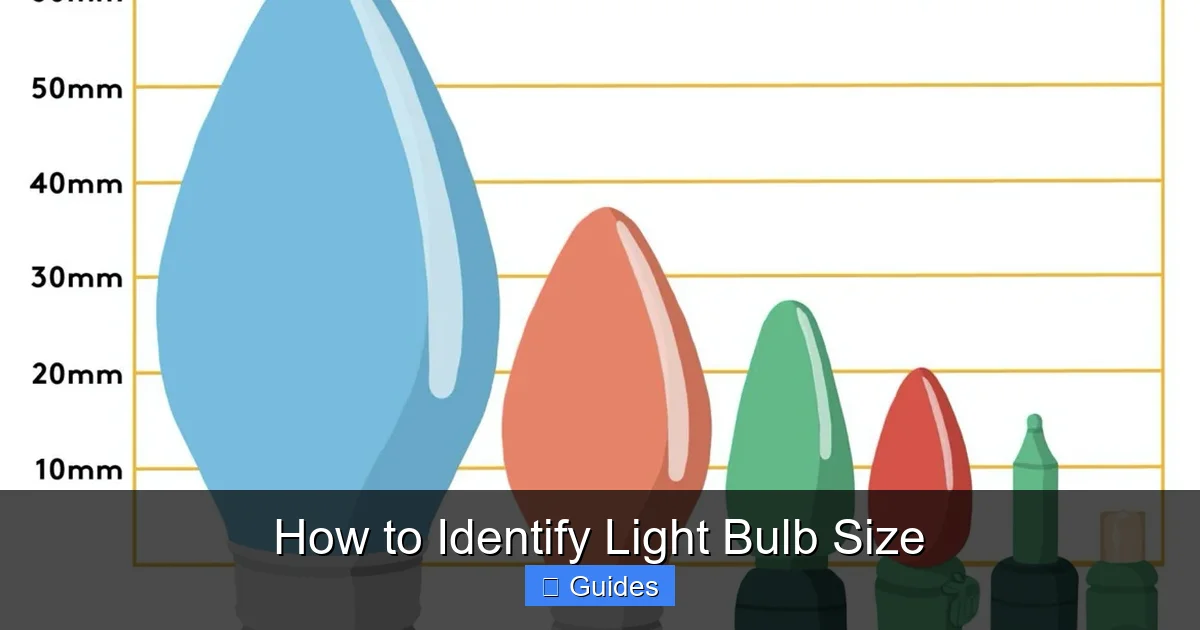
The first part of a light bulb’s identification code usually describes its shape. This is typically a letter or a combination of letters, followed by a number. The letter indicates the general form, and the number tells you the maximum diameter of the bulb across its widest point, measured in eighths of an inch.
Visual guide about How to Identify Light Bulb Size
Image source: lh5.googleusercontent.com
Common Bulb Shapes and Their Meanings
- A (Arbitrary/Standard): This is the classic, pear-shaped bulb we all recognize. The “A” stands for “Arbitrary” or “Standard.”
- Example: A19 is the most common household bulb. The “19” means it’s 19 eighths of an inch in diameter, or 19/8 = 2.375 inches (about 60mm) at its widest point. A21 is slightly larger (21 eighths or 2.625 inches).
- B (B-shape/Bullet): These are often decorative bulbs, slimmer than A-types, sometimes with a blunt or rounded tip.
- Example: B10 for chandeliers or decorative fixtures.
- C (Candle/Conical): Similar to B-shape but often with a more pointed tip, designed to mimic a candle flame.
- Example: C7 or C9 are common for nightlights or holiday lights. C35 is a popular size for decorative and chandelier bulbs.
- G (Globe): Round, spherical bulbs, often used in vanity lighting or exposed fixtures where aesthetics are important.
- Example: G25 (25 eighths or 3.125 inches) is common for bathroom vanity strips. G30 or G40 are larger globes.
- T (Tubular): Long, slender bulbs, often used in signs, appliances, or decorative fixtures.
- Example: T8 or T10 are often found in appliances or certain decorative light strips. Fluorescent tubes also use ‘T’ (e.g., T8, T12), but their sizing is slightly different, referring to diameter in eighths of an inch (T8 is 1 inch diameter).
- R (Reflector): These bulbs have an internal reflective coating to direct light forward. They create a focused beam.
- Example: R20 (20 eighths or 2.5 inches) is often used in track lighting.
- BR (Bulged Reflector): Similar to R-types but with a wider, bulged shape that disperses light more broadly, often for floodlighting.
- Example: BR30 (30 eighths or 3.75 inches) and BR40 are popular for recessed lighting in homes.
- PAR (Parabolic Aluminized Reflector): These are powerful reflector bulbs with a very precise beam control, often used outdoors or in commercial settings. They are designed for maximum light output and control.
- Example: PAR20, PAR30, PAR38. The number again indicates diameter in eighths of an inch.
- MR (Multifaceted Reflector): Small, often low-voltage bulbs with a pressed glass reflector and multiple facets for precise beam control. Commonly used in track lighting, display lighting, or landscape lighting.
- Example: MR16 (16 eighths or 2 inches) is very common.
- S (Straight-sided): Often used for decorative purposes or in some appliances.
- Example: S11.
- F (Flame): Designed to resemble a flickering candle flame, often with a bent tip.
- Example: F15.
How to Measure Bulb Diameter
If the shape code isn’t immediately obvious, you can measure the bulb’s widest point. Use a ruler or tape measure to find the diameter in inches. Then, multiply this measurement by 8. The closest whole number will be the number in your bulb’s shape code.
- Example: If your bulb measures 3.75 inches at its widest point, then 3.75 x 8 = 30. This would correspond to a BR30 or PAR30 bulb.
Identifying the Base Type: The Critical Connection
The base type is arguably the most critical piece of information because it dictates whether the bulb will physically connect to your fixture’s socket. A bulb with the wrong base simply won’t fit. Base types are identified by a letter (or letters) followed by a number, which usually refers to the diameter of the base or the pin spacing in millimeters.
Common Base Types and Their Codes
- Edison Screw Bases (E-type): These are the most common screw-in bases. The ‘E’ stands for Edison, and the number indicates the diameter of the screw base in millimeters.
- E26: Also known as “Medium” or “Standard” base. This is the most common screw-in base in North America. (26mm diameter)
- E27: The European equivalent of E26, slightly different thread but often interchangeable in practice, though not always. (27mm diameter)
- E12: “Candelabra” base. Smaller than E26, often found on decorative bulbs like C-shapes, B-shapes, or F-shapes. (12mm diameter)
- E17: “Intermediate” base. Less common than E26 or E12, but found in some applications. (17mm diameter)
- E39: “Mogul” base. Much larger than E26, used for high-wattage industrial or commercial applications. (39mm diameter)
- E14: European “Small Edison Screw” (SES), similar to E12 but with metric threads.
- Bi-Pin Bases (G-type and GU-type): These bases feature two pins that insert into the fixture’s socket. The number typically indicates the distance between the center of the pins in millimeters.
- GU10: A common base for MR16-type halogen or LED bulbs, often found in track lighting or recessed fixtures. It has two short, thick pins with a twist-and-lock mechanism. (10mm pin spacing)
- GU24: A unique twist-and-lock base designed for energy-efficient bulbs, specifically to prevent incandescent bulbs from being used. It has two prongs. (24mm diameter mounting ring)
- G4: A very small bi-pin base, often used for low-voltage puck lights, desk lamps, or landscape lighting. (4mm pin spacing)
- G9: A common bi-pin base with looped pins, often used in decorative fixtures and typically line voltage. (9mm pin spacing)
- G6.35, G8, GY6.35: Other variations of bi-pin bases with different pin spacing, often found in specialty or low-voltage applications.
- Bayonet Bases (B-type): Instead of screwing in, these bases have two pins that protrude from the sides, which slide into slots in the fixture and then twist to lock. Common in older fixtures, certain appliances, or internationally.
- BA15s (15mm Single Contact Bayonet): Standard bayonet base.
- BA15d (15mm Double Contact Bayonet): Similar to BA15s but with two contacts for dual-filament bulbs (e.g., in automotive).
- B22d: The standard bayonet base in the UK, often referred to as “BC” (Bayonet Cap). (22mm diameter)
- Fluorescent Pin Bases: Fluorescent tubes have specific bi-pin or quad-pin bases.
- G13: Standard bi-pin base for T8 and T12 fluorescent tubes. (13mm pin spacing)
- G5: Standard bi-pin base for T5 fluorescent tubes. (5mm pin spacing)
How to Measure Base Diameter or Pin Spacing
If you can’t find the base code, a ruler or caliper can help. For screw-in bases, measure the diameter of the threaded part in millimeters. For bi-pin bases, measure the distance between the centers of the two pins in millimeters. This measurement will directly correspond to the number in the base code.
Putting It All Together: A Step-by-Step Guide to Identification
Now that you understand the different codes, let’s walk through the practical steps to identify light bulb size effectively.
Step 1: Check the Old Bulb for Markings
This is always the easiest and most reliable method. Most bulbs have their size, wattage, and voltage printed directly on the glass, the base, or the metal collar. Look for codes like “A19 E26” or “BR30 GU10.” Sometimes, the fixture itself might have a sticker indicating the maximum bulb size or type.
- Tip: Take a photo of the markings with your phone. This is incredibly helpful when you’re at the store.
Step 2: Identify the Bulb Shape
Visually determine the general shape of your bulb. Is it pear-shaped (A), spherical (G), tubular (T), or a reflector type (R, BR, PAR, MR)? Once you have the general shape, you can move to measuring its diameter if the code isn’t immediately visible.
- Example: If it’s a traditional pear shape, you’re likely looking for an ‘A’ type. If it’s a floodlight in a recessed can, it’s probably ‘BR’ or ‘PAR’.
Step 3: Measure the Bulb Diameter (If Needed)
If the number part of the shape code isn’t clear, use a ruler or tape measure to find the maximum diameter of the bulb in inches. Multiply this by 8 to get the corresponding number for the code.
- Example: A bulb measuring 4.75 inches at its widest point would be 4.75 x 8 = 38. If it’s a reflector, this would suggest a PAR38.
Step 4: Identify the Base Type
Examine the base of the bulb. Is it a screw-in type or does it have pins?
- For Screw-in Bases: Measure the diameter of the threaded base in millimeters. This will tell you if it’s E12, E17, E26, E27, etc.
- For Pin Bases: Count the number of pins and measure the distance between their centers in millimeters. This will help you determine if it’s G4, G9, GU10, etc.
- For Bayonet Bases: Note the diameter of the base and the presence of side pins.
Step 5: Combine the Information
Once you have the shape code (e.g., A19, BR30) and the base code (e.g., E26, GU10), you have the complete light bulb size identification! Write it down or keep your photo handy.
When in Doubt: Other Identification Methods & Tips
Sometimes, the markings are worn off, or you’re dealing with a very old or unusual fixture. Here are some additional tips:
Consult the Fixture Manual or Manufacturer
If you still have the instruction manual for the light fixture, it often specifies the recommended bulb type and maximum wattage. If not, look for a model number on the fixture itself and search online for its specifications.
Bring the Old Bulb to the Store
This is a foolproof method if all else fails. Many hardware or lighting stores have staff who can help you identify light bulb size by comparing your old bulb to their stock.
Use Online Resources and Apps
Several online guides and mobile apps are available that can help you identify bulb types by showing pictures or guiding you through measurements. Some even allow you to scan the bulb packaging.
Consider LED Equivalents
When replacing old incandescent or CFL bulbs, you’ll often want an LED equivalent. LED bulbs usually list the incandescent bulb type they are designed to replace (e.g., “Replaces 60W Incandescent A19 E26”). Make sure the LED’s shape and base type match your old bulb, and also consider the lumens (brightness) and color temperature (warm white, cool white) for optimal results.
- Tip: Even if an LED bulb has the correct base, ensure its physical dimensions (length and width) will fit inside your fixture or under any shades. Some LED bulbs can be slightly larger than their incandescent counterparts.
Don’t Forget the Voltage
While usually standard (120V in North America, 230V in Europe), some specialty bulbs (like MR16s or certain landscape lights) are low-voltage (e.g., 12V). Using a 120V bulb in a 12V fixture (or vice versa) will either not work or cause damage. Always check the voltage requirement.
Identifying light bulb size doesn’t have to be a bewildering experience. By understanding the common naming conventions, knowing how to interpret shape and base codes, and being comfortable with basic measurements, you can confidently navigate the world of light bulbs. Remember, the key is to look for the markings first, then measure if necessary, and always ensure both the shape fits the fixture and the base fits the socket. With this guide, you’re now equipped to make informed choices, ensuring your home is perfectly lit, one correct bulb at a time.
Frequently Asked Questions
What is the most common light bulb size for homes?
The most common light bulb size for general household use in North America is the A19 shape with an E26 (medium) screw base. This combination is found in a vast majority of lamps, ceiling fixtures, and general lighting applications.
How do I measure a bulb’s diameter correctly?
To measure a bulb’s diameter correctly, use a ruler or tape measure to find the widest point across the glass envelope in inches. Once you have this measurement, multiply it by 8 to get the number that accompanies the bulb’s shape code (e.g., 2.375 inches x 8 = 19 for an A19 bulb).
Can I mix different bulb shapes in the same fixture if the base is the same?
Technically, yes, if the base is compatible, you can mix different bulb shapes. However, it’s generally not recommended for aesthetic reasons and because different shapes distribute light differently, which can lead to uneven illumination or an inconsistent look in your fixture.
What if my light bulb has a “GU24” base?
A GU24 base is a unique twist-and-lock bi-pin base designed specifically for energy-efficient bulbs, like CFLs or LEDs, and typically found in California and other regions with strict energy codes. It’s meant to prevent the use of standard incandescent bulbs, so you must replace it with another GU24 base bulb.
Are international bulb sizes different from those in the US?
Yes, international bulb sizes often differ. While the shape codes are largely consistent, base types vary significantly. For example, Europe commonly uses E27 (medium screw) and E14 (small screw) Edison bases, and the B22d (bayonet cap) base, which are less common as primary standards in the US.
Why is it important to know the bulb’s voltage when identifying its size?
Knowing the bulb’s voltage is crucial because using a bulb with the wrong voltage can damage the bulb, the fixture, or even pose a safety hazard. While most household bulbs are 120V (or 230V internationally), some specialty bulbs (like certain track lights or landscape lighting) are low-voltage (e.g., 12V) and require a transformer.
